
Market Report · July 15, 2026

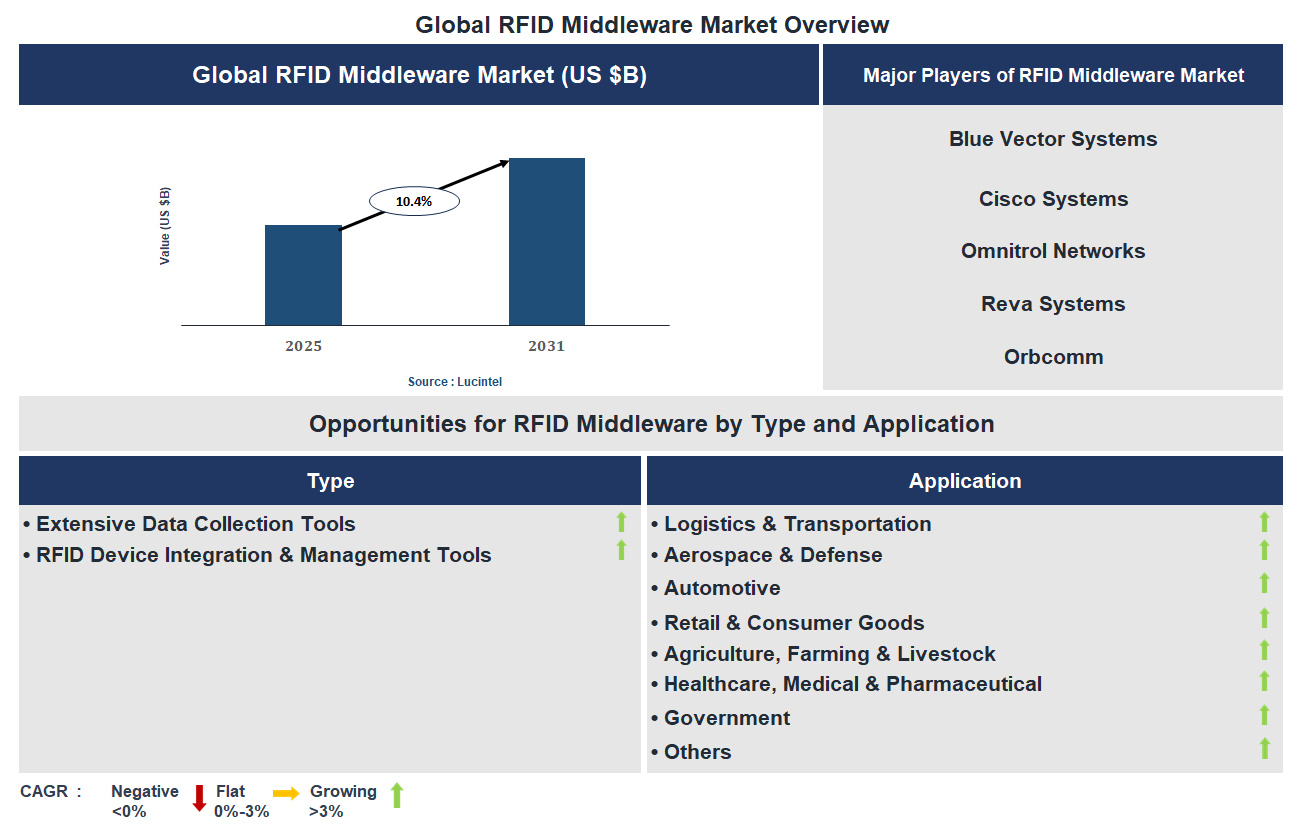
Key data points: The growth forecast = 10.4% annually for the next 7 years. Scroll below to get more insights. This market report covers trends, opportunities and forecasts in RFID middleware market to 2031 by type (extensive data collection tools and RFID device integration & management tools), application (logistics & transportation, aerospace & defense, automotive, retail & consumer goods, agriculture, farming & livestock, healthcare, medical & pharmaceutical, government, and others), and region (North America, Europe, Asia Pacific, and the Rest of the World)
We'll send your sample report shortly.
• Lucintel forecasts that, within the type category, RFID device integration & management tool is expected to witness higher growth over the forecast period.
• Within the application category, retail & consumer good is expected to witness the highest growth.
• In terms of region, APAC is expected to witness the highest growth over the forecast period. Gain valuable insights for your business decisions with our comprehensive 150+ page report. Sample figures with some insights are shown below.
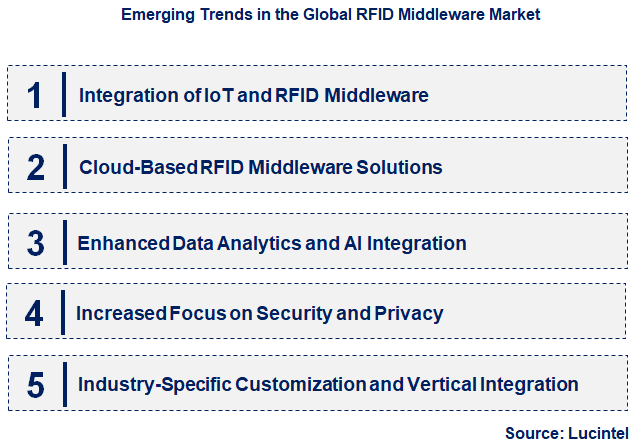
• Integration of IoT and RFID Middleware: The convergence of IoT and RFID middleware is enabling real-time data sharing and automation. This integration allows for seamless communication between RFID devices and other IoT-enabled systems, enhancing asset tracking, inventory management, and security protocols. As IoT adoption accelerates, RFID middleware becomes a critical component in creating interconnected ecosystems, leading to smarter, more responsive operations across industries such as retail, manufacturing, and logistics.
• Cloud-Based RFID Middleware Solutions: Cloud technology is transforming RFID middleware by offering scalable, flexible, and cost-effective solutions. Cloud-based platforms facilitate remote management, real-time data analytics, and easier integration with enterprise systems. This trend reduces the need for extensive on-premises infrastructure, making RFID solutions more accessible to small and medium-sized enterprises. The shift to cloud also enhances data security, disaster recovery, and collaboration, thereby broadening the market reach and accelerating deployment speeds.
• Enhanced Data Analytics and AI Integration: Advanced data analytics and artificial intelligence are being integrated into RFID middleware to derive actionable insights from collected data. These capabilities enable predictive maintenance, demand forecasting, and improved decision-making processes. AI-driven analytics help organizations optimize supply chains, reduce losses, and enhance customer experiences. As these technologies become more sophisticated, RFID middleware is evolving into a vital tool for data-driven strategies, significantly impacting operational efficiency and competitive advantage.
• Increased Focus on Security and Privacy: With the proliferation of RFID devices and data exchange, security and privacy concerns are gaining prominence. Emerging trends include the implementation of encryption protocols, secure authentication methods, and compliance with data protection regulations. Strengthening security measures is essential to prevent unauthorized access, data breaches, and counterfeiting. This focus on security not only safeguards sensitive information but also builds trust among users and stakeholders, fostering wider adoption of RFID solutions in sensitive sectors like healthcare and government.
• Industry-Specific Customization and Vertical Integration: RFID middleware solutions are increasingly tailored to meet the specific needs of different industries. Customization includes specialized features for retail, healthcare, manufacturing, and logistics, among others. Vertical integration ensures that RFID systems align with industry standards and workflows, improving efficiency and compliance. This trend allows vendors to offer more targeted solutions, enhancing user experience and operational outcomes. As industry-specific requirements grow more complex, customized RFID middleware will play a crucial role in delivering precise, effective asset and data management. In summary, these emerging trends are significantly reshaping the RFID middleware market by enhancing connectivity, scalability, intelligence, security, and industry-specific solutions. They are driving innovation, expanding market opportunities, and enabling organizations to leverage RFID technology more effectively within their digital transformation strategies.
• Integration with IoT Platforms: Enhanced connectivity and data sharing capabilities have been achieved by integrating RFID middleware with Internet of Things (IoT) platforms, enabling real-time data collection and analysis. This development improves operational efficiency, asset tracking accuracy, and decision-making processes across sectors such as manufacturing, retail, and logistics.
• AI and Machine Learning Integration: Incorporating artificial intelligence and machine learning algorithms into RFID middleware has improved data processing, anomaly detection, and predictive analytics. This advancement allows businesses to optimize inventory management, reduce theft, and streamline supply chain operations, leading to cost savings and increased productivity.
• Cloud-Based Solutions: The shift towards cloud-based RFID middleware solutions offers scalability, flexibility, and remote access. Cloud integration facilitates easier deployment, maintenance, and updates, making RFID systems more accessible to small and medium-sized enterprises, thereby broadening market reach.
• Enhanced Security Features: Recent developments include the integration of advanced security protocols within RFID middleware to prevent data breaches and unauthorized access. These security enhancements are critical for sensitive applications in healthcare, government, and financial sectors, boosting user confidence and compliance with regulations.
• Industry-Specific Customization: Vendors are now offering tailored RFID middleware solutions designed for specific industries such as healthcare, retail, and manufacturing. Customization improves system compatibility, user experience, and operational effectiveness, fostering wider adoption in niche markets. In summary, these developments are significantly transforming the RFID middleware market by making solutions more integrated, intelligent, secure, and adaptable. The adoption of IoT, AI, cloud technology, and industry-specific features is driving growth, expanding application areas, and increasing market competitiveness. As a result, the market is poised for continued expansion, with enhanced capabilities meeting the evolving needs of diverse industries.
• Enhanced Inventory Management : RFID middleware enables real-time tracking of stock levels, reducing out-of-stock situations and overstocking, leading to improved customer satisfaction and optimized supply chain operations.
• Asset and Patient Tracking : Middleware solutions facilitate accurate tracking of medical equipment and patient data, improving safety, reducing loss, and streamlining hospital workflows.
• Real-Time Shipment Visibility : RFID middleware provides end-to-end tracking of shipments, enhancing transparency, reducing delays, and enabling proactive decision-making in complex supply networks.
• Automated Production Monitoring : Middleware supports seamless data collection from RFID tags on components, enabling real-time monitoring of production lines, reducing errors, and increasing efficiency.
• Asset Security and Identification : RFID middleware enhances security protocols by enabling reliable identification and tracking of government assets, improving accountability and reducing theft or loss. In summary, these growth opportunities are significantly impacting the RFID middleware market by driving technological innovation and expanding its application scope. They are enabling industries to achieve higher operational efficiency, better asset management, and improved security, thereby fueling market growth and competitiveness.
• Technological Advancements: Rapid innovations in RFID hardware and software enable more efficient and scalable middleware solutions, supporting diverse industry applications. These advancements improve data accuracy, processing speed, and integration capabilities, making RFID middleware more adaptable to complex environments. As technology evolves, the market benefits from increased reliability and functionality, encouraging broader adoption across sectors such as retail, healthcare, and logistics.
• Growing Adoption in Industries: Industries like retail, healthcare, manufacturing, and logistics are increasingly integrating RFID middleware to streamline operations, improve inventory management, and enhance supply chain visibility. This widespread adoption is driven by the need for real-time data and automation, which RFID middleware facilitates effectively. As organizations recognize the benefits of improved operational efficiency, demand for sophisticated middleware solutions continues to rise, fueling market growth.
• Cost Reduction and ROI: The decreasing costs of RFID tags and hardware, coupled with the potential for significant return on investment, motivate organizations to implement RFID systems. Middleware acts as a critical component in maximizing these benefits by enabling seamless data integration and management. As the total cost of ownership declines, more enterprises are willing to invest in RFID middleware, expanding the market scope.
• Regulatory and Standardization Initiatives: Governments and industry bodies are establishing standards and regulations to ensure data security, privacy, and interoperability of RFID systems. These standards promote confidence among users and facilitate cross-industry integration. Compliance with such regulations encourages vendors to develop compliant middleware solutions, thereby expanding market opportunities and ensuring sustainable growth.
• Increasing Investment in IoT Ecosystems: The rise of the Internet of Things (IoT) has amplified the need for middleware that can connect and manage diverse devices and sensors. RFID middleware plays a vital role in IoT ecosystems by providing data integration and device management capabilities. Growing investments in IoT infrastructure across various sectors drive demand for robust RFID middleware solutions, supporting smarter, connected environments. The challenges facing RFID middleware market include:
• Data Security and Privacy Concerns: As RFID middleware handles vast amounts of sensitive data, ensuring security and privacy becomes critical. Threats such as data breaches and unauthorized access can undermine trust and hinder adoption. Vendors must invest in advanced security protocols, which can increase costs and complexity. Regulatory compliance adds further pressure, requiring continuous updates and monitoring to prevent vulnerabilities, thereby posing significant challenges to market players.
• Interoperability and Standardization Issues: Despite efforts to establish standards, variations in RFID tags, readers, and middleware solutions can lead to compatibility issues. Lack of universal standards hampers seamless integration across different systems and devices, limiting scalability. Vendors face the challenge of developing flexible middleware that can operate across diverse hardware and software environments, which can slow down market growth and increase development costs.
• High Implementation Costs: Although RFID middleware offers long-term benefits, initial setup costs, including hardware, software, and integration expenses, can be substantial. Small and medium-sized enterprises may find these costs prohibitive, restricting market penetration. Additionally, ongoing maintenance and upgrades add to the total cost of ownership, creating financial barriers that can slow adoption and impact overall market expansion. In summary, the RFID middleware market is driven by technological innovations, industry adoption, cost efficiencies, regulatory standards, and IoT integration. However, challenges such as data security, interoperability issues, and high implementation costs pose significant hurdles. These factors collectively influence the market’s trajectory, requiring stakeholders to balance innovation with risk management. Overall, the market is poised for growth, provided that solutions to these challenges are effectively addressed, enabling broader adoption and enhanced operational efficiencies across industries.
• Blue Vector Systems
• Cisco Systems
• Omnitrol Networks
• Reva Systems
• Orbcomm
• Tyco Retail Solutions
• SML
• Acsis
• Globeranger
• NCR
• Extensive Data Collection Tools
• RFID Device Integration & Management Tools
• Logistics & Transportation
• Aerospace & Defense
• Automotive
• Retail & Consumer Goods
• Agriculture, Farming & Livestock
• Healthcare, Medical & Pharmaceutical
• Government
• Others
• North America
• Europe
• Asia Pacific
• The Rest of the World
• United States: The US market has seen rapid adoption of RFID middleware solutions in retail and logistics sectors, driven by e-commerce growth and supply chain digitization. Major players are investing in cloud-based RFID platforms to enhance scalability and data analytics capabilities. Regulatory support and industry standards are fostering innovation, with increased integration of RFID with IoT and AI for smarter inventory management and asset tracking. The US also witnesses a surge in startups developing advanced middleware solutions tailored for specific industry needs, boosting overall market competitiveness.
• China: China is experiencing robust growth in RFID middleware adoption, primarily fueled by government initiatives to modernize manufacturing and retail sectors. The country is focusing on developing indigenous RFID technologies to reduce reliance on foreign suppliers. Smart manufacturing and logistics are key areas where RFID middleware is being integrated to improve automation and real-time tracking. Additionally, China’s emphasis on smart city projects is driving demand for RFID solutions in public transportation, healthcare, and security applications, fostering a vibrant ecosystem of innovation and deployment.
• Germany: The German market emphasizes industrial automation and manufacturing efficiency, with RFID middleware playing a crucial role in Industry 4.0 initiatives. Companies are adopting middleware solutions that support seamless integration with existing ERP and manufacturing execution systems (MES). Germany’s focus on quality and precision is reflected in the deployment of RFID for asset management, traceability, and compliance. The market also benefits from strong collaborations between technology providers and industrial giants, promoting the development of customized middleware solutions that cater to complex industrial environments.
• India: India’s RFID middleware market is expanding rapidly, driven by government programs like Digital India and Make in India, which promote digital transformation across sectors. Retail, logistics, and healthcare are key sectors adopting RFID for inventory management, asset tracking, and patient identification. The country is witnessing increased investments in infrastructure and technology startups offering innovative middleware solutions. The focus is on affordable, scalable, and easy-to-deploy RFID systems to support the growing demand for automation and supply chain transparency in a developing economy.
• Japan: Japan’s market is characterized by advanced technological integration and a focus on quality control. RFID middleware solutions are widely used in manufacturing, automotive, and healthcare sectors to improve traceability and operational efficiency. The country is investing in integrating RFID with IoT and AI to develop smart factories and automated logistics systems. Japanese companies are also exploring RFID applications in retail and consumer electronics, emphasizing high precision and reliability. The market benefits from strong R&D activities and collaborations with global technology firms, fostering innovation in RFID middleware solutions.


• Blue Vector Systems
• Cisco Systems
• Omnitrol Networks
• Reva Systems
• Orbcomm
• Tyco Retail Solutions
• SML
• Acsis
• Globeranger
• NCR Q5. Which RFID middleware market segment will be the largest in future? Answer: Lucintel forecasts that, within the type category, RFID device integration & management tool is expected to witness higher growth over the forecast period. Q6. In RFID middleware market, which region is expected to be the largest in next 5 years? Answer: In terms of region, APAC is expected to witness the highest growth over the forecast period. Q7. Do we receive customization in this report? Answer: Yes, Lucintel provides 10% customization without any additional cost.


Choose a license that fits your team. Instant PDF delivery.
Prices exclude taxes. Instant delivery. Custom licensing available on request.
Market Report · July 15, 2026
Market Report · June 26, 2026
Market Report · June 24, 2026
Trusted partner for strategic intelligence and business growth


Receive a complimentary market analysis tailored to your industry. Our analysts will identify key growth opportunities and competitive dynamics specific to your business.

Market size, growth rate, and key trend analysis for your specific sector.

Top competitor positioning and market share analysis.

Strategic recommendations backed by data-driven insights.
Get curated market intelligence and competitive moves straight to your inbox.
By subscribing, you agree to receive our monthly insights. Unsubscribe anytime.
Receive a complimentary market analysis tailored to your industry. Our analysts will identify key growth opportunities and competitive dynamics specific to your business.
Market size, growth rate, and key trend analysis for your specific sector.
Top competitor positioning and market share analysis.
Strategic recommendations backed by data-driven insights.
Get curated market intelligence, emerging trends, and competitive moves straight to your inbox each month.
By subscribing, you agree to receive our monthly insights. Unsubscribe anytime.
We'll send your sample report shortly.