
Market Report · July 15, 2026

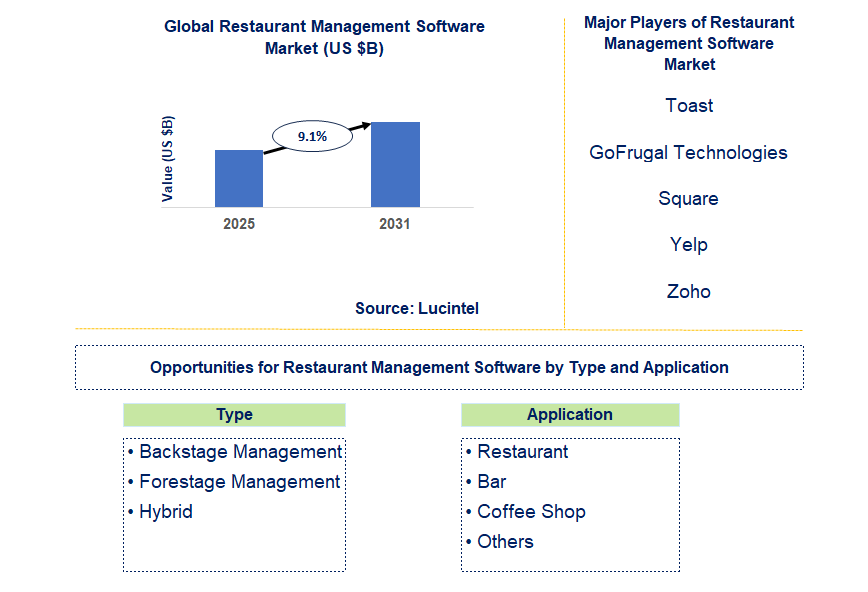
Key data points: The growth forecast = 9.1% annually for the next 7 years. Scroll below to get more insights. This market report covers trends, opportunities and forecasts in restaurant management software market to 2031 by type (backstage management, forestage management, and hybrid), application (restaurant, bar, coffee shop, and others), and region (North America, Europe, Asia Pacific, and the Rest of the World)
We'll send your sample report shortly.
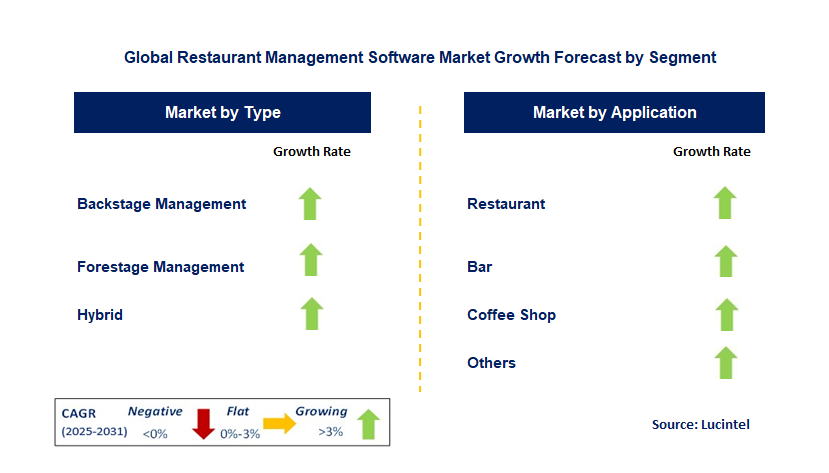
• Lucintel forecasts that, within the type category, hybrid is expected to witness the highest growth over the forecast period.
• Within the application category, restaurant is expected to witness the highest growth.
• In terms of region, APAC is expected to witness the highest growth over the forecast period. Gain valuable insights for your business decisions with our comprehensive 150+ page report. Sample figures with some insights are shown below.
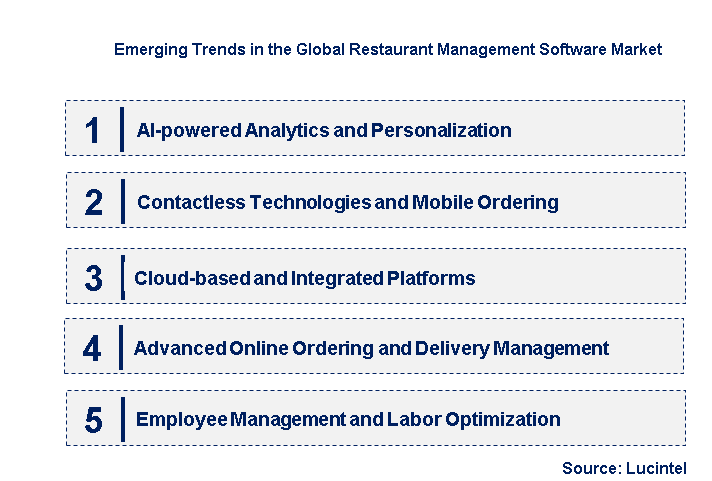
• AI-powered Analytics and Personalization: AI is increasingly integrated to offer predictive analytics for sales forecasting, inventory optimization, and personalized customer recommendations. This enables restaurants to make data-driven decisions, reduce food waste, and deliver highly customized dining experiences, boosting customer loyalty and profitability.
• Contactless Technologies and Mobile Ordering: The demand for contactless solutions, including QR code menus, mobile ordering apps, and tap-to-pay options, is surging. This trend, accelerated by hygiene concerns, enhances customer convenience, reduces waiting times, and streamlines order processing, contributing to a more efficient and safer dining environment.
• Cloud-based and Integrated Platforms: The widespread adoption of cloud-based solutions is a major trend, offering scalability, remote accessibility, and real-time data synchronization. Integrated platforms that combine POS, inventory, labor, and CRM functionalities into a single system are preferred, providing a holistic view of operations and improving data flow.
• Advanced Online Ordering and Delivery Management: With the continued growth of food delivery, software is evolving to offer more sophisticated online ordering platforms and delivery management tools. Features include dynamic delivery routing, seamless integration with third-party aggregators, and real-time order tracking, optimizing off-premise operations and customer satisfaction.
• Employee Management and Labor Optimization: Software is increasingly incorporating advanced features for employee scheduling, payroll management, and labor cost optimization. These tools leverage data to forecast staffing needs, manage shifts, and ensure compliance with labor laws, directly addressing labor shortages and improving operational efficiency for restaurants. These emerging trends are fundamentally reshaping the restaurant management software market by driving the development of more intelligent, integrated, and customer-centric solutions. They are enabling restaurants to navigate complex operational challenges, enhance efficiency, and adapt to the evolving demands of the modern dining landscape.
• Development of unified omni-channel platforms: A key development is the creation of unified platforms that integrate all customer touchpoints, from in-house dining and online ordering to delivery and loyalty programs. This ensures a consistent customer experience and provides restaurants with a holistic view of operations, optimizing sales channels.
• Enhanced inventory and supply chain automation: Recent advancements focus on automating inventory management, including real-time stock tracking, predictive ordering based on sales data, and integration with suppliers. This reduces waste, optimizes food costs, and ensures ingredient availability, improving overall financial performance for restaurants.
• Introduction of AI-powered virtual assistants and chatbots: The integration of AI-powered virtual assistants and chatbots for customer service and internal operations is a growing trend. These tools can handle reservations, answer FAQs, and even assist with order placement, enhancing customer experience and freeing up staff for more complex tasks.
• Increased adoption of self-service kiosks and digital menus: Restaurants are increasingly deploying self-service kiosks and digital menu boards, often integrated with the core management software. This allows customers to place orders and pay independently, reducing wait times, improving order accuracy, and freeing up staff, particularly beneficial for quick-service restaurants.
• Focus on robust data security and compliance: With the increasing volume of sensitive customer and financial data, recent developments prioritize enhanced data security features and compliance with industry regulations (e.g., PCI DSS). This builds trust, protects against cyber threats, and ensures legal adherence, which is crucial for restaurant operators. These recent developments are significantly impacting the restaurant management software market by delivering more integrated, automated, and secure solutions. They are empowering restaurants to optimize their operations, enhance customer engagement, and adapt to the evolving demands of a highly competitive industry.
• Quick Service Restaurants: QSRs offer significant growth potential due to their high transaction volumes and focus on speed and efficiency. Opportunities lie in developing software that streamlines order processing, integrates with delivery platforms, facilitates self-service kiosks, and optimizes drive-thru operations, enhancing customer throughput and speed of service.
• Full-Service Restaurants: FSRs require comprehensive solutions for reservations, table management, sophisticated POS, and personalized customer experiences. Growth opportunities exist in software that offers advanced reservation systems, detailed table management, integrated loyalty programs, and data analytics for menu optimization, enhancing customer satisfaction and operational flow.
• Cloud Kitchens/Virtual Restaurants: The rapid proliferation of cloud kitchens, which operate solely for delivery, presents a major growth area. Software tailored for these operations focuses on seamless integration with multiple delivery platforms, efficient order routing, inventory management for ghost kitchens, and virtual brand management, optimizing their unique business model.
• Cafes and Coffee Shops: Cafes and coffee shops benefit from simplified POS systems, inventory tracking for fresh ingredients, and loyalty programs for repeat customers. Opportunities are found in developing user-friendly software that supports quick transactions, manages loyalty points, and integrates with mobile ordering apps, enhancing customer convenience and speed.
• Hotel and Institutional Foodservice: Large-scale hotel and institutional foodservice operations require robust software for complex inventory, catering management, event planning, and multi-outlet integration. Growth opportunities lie in providing scalable solutions that manage diverse food service operations, integrate with hotel management systems, and ensure consistent quality and cost control. These strategic growth opportunities are significantly impacting the restaurant management software market by driving specialized product development and market penetration across various restaurant models. They underscore the software’s indispensable role in optimizing industry-specific workflows, enhancing customer engagement, and ensuring operational profitability.
• Toast
• GoFrugal Technologies
• Square
• Yelp
• Zoho
• eZee Technosys
• Flipdish
• Schedulefly
• Evergreen
• BIM POS
• Backstage Management
• Forestage Management
• Hybrid
• Restaurant
• Bar
• Coffee Shop
• Others
• North America
• Europe
• Asia Pacific
• The Rest of the World
• United States: The U.S. market sees robust adoption of comprehensive cloud-based platforms, with a strong emphasis on integrating online ordering, delivery, and loyalty programs. There’s a notable trend towards AI-powered analytics for personalized customer experiences and predictive inventory management, driven by a highly competitive and tech-savvy restaurant landscape.
• China: China’s restaurant management software market is experiencing rapid growth, propelled by the booming food delivery sector and a strong consumer preference for digital payments. Local developers are innovating with mobile-first solutions, integrated payment gateways, and sophisticated table and delivery management systems to cater to a fast-paced, digitally native clientele.
• Germany: Germany’s market prioritizes reliable and secure restaurant management software, with a focus on efficient POS systems, inventory control, and employee management. There’s a growing inclination towards solutions that ensure compliance with data privacy regulations while supporting seamless integration within established hospitality operations, including self-service kiosks.
• India: India’s restaurant management software market is expanding rapidly, fueled by increasing urbanization, rising disposable incomes, and the proliferation of online food aggregators. Demand is high for affordable, cloud-based solutions that streamline online ordering, digital payments (especially UPI), and inventory management for a diverse range of restaurants and cloud kitchens.
• Japan: Japan’s market emphasizes high efficiency, precision, and customer experience in its restaurant management software. Recent developments focus on advanced reservation systems, seamless integration with various payment methods, and tools to optimize table turnover and delivery management, supporting the country’s high standards of service and operational excellence.


• Toast
• GoFrugal Technologies
• Square
• Yelp
• Zoho
• eZee Technosys
• Flipdish
• Schedulefly
• Evergreen
• BIM POS Q5. Which restaurant management software market segment will be the largest in future? Answer: Lucintel forecasts that, within the type category, hybrid is expected to witness the highest growth over the forecast period. Q6. In restaurant management software market, which region is expected to be the largest in next 5 years? Answer: In terms of region, APAC is expected to witness the highest growth over the forecast period. Q7. Do we receive customization in this report? Answer: Yes, Lucintel provides 10% customization without any additional cost.


Choose a license that fits your team. Instant PDF delivery.
Prices exclude taxes. Instant delivery. Custom licensing available on request.
Market Report · July 15, 2026
Market Report · June 26, 2026
Market Report · June 24, 2026
Trusted partner for strategic intelligence and business growth


Receive a complimentary market analysis tailored to your industry. Our analysts will identify key growth opportunities and competitive dynamics specific to your business.

Market size, growth rate, and key trend analysis for your specific sector.

Top competitor positioning and market share analysis.

Strategic recommendations backed by data-driven insights.
Get curated market intelligence and competitive moves straight to your inbox.
By subscribing, you agree to receive our monthly insights. Unsubscribe anytime.
Receive a complimentary market analysis tailored to your industry. Our analysts will identify key growth opportunities and competitive dynamics specific to your business.
Market size, growth rate, and key trend analysis for your specific sector.
Top competitor positioning and market share analysis.
Strategic recommendations backed by data-driven insights.
Get curated market intelligence, emerging trends, and competitive moves straight to your inbox each month.
By subscribing, you agree to receive our monthly insights. Unsubscribe anytime.
We'll send your sample report shortly.