
Market Report · July 15, 2026

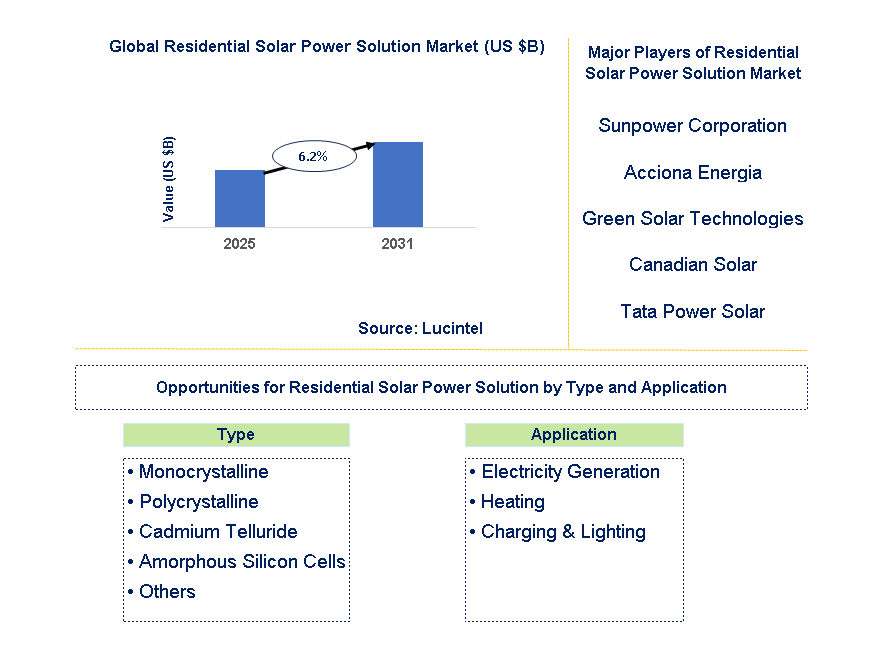
Key data points: The growth forecast = 6.2% annually for the next 7 years. Scroll below to get more insights. This market report covers Trends, opportunities and forecasts in residential solar power solution market to 2031 by type (monocrystalline, polycrystalline, cadmium telluride, amorphous silicon cells, and others), application (electricity generation, heating, and charging & lighting), and region (North America, Europe, Asia Pacific, and the Rest of the World)
We'll send your sample report shortly.
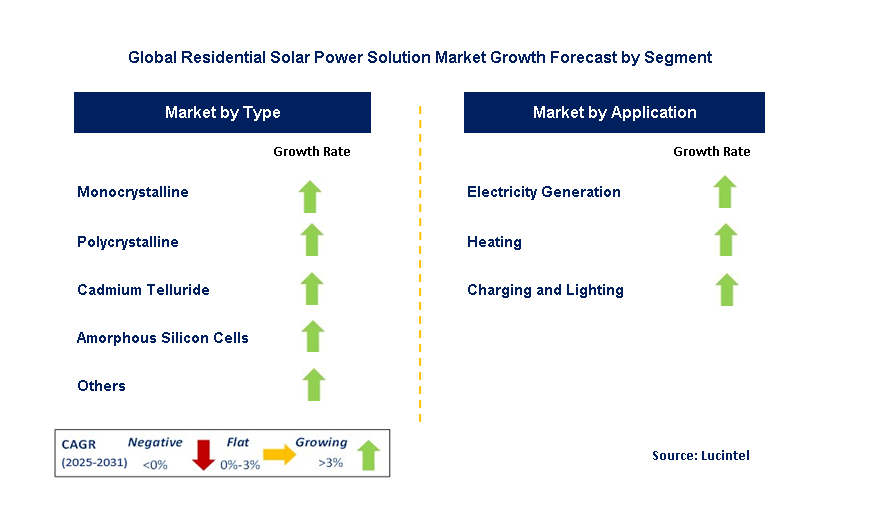
• Lucintel forecasts that, within the type category, monocrystalline is expected to witness the highest growth over the forecast period due to its better performance in limited space.
• Within the application category, electricity generation is expected to witness the highest growth.
• In terms of region, APAC is expected to witness the highest growth over the forecast period.
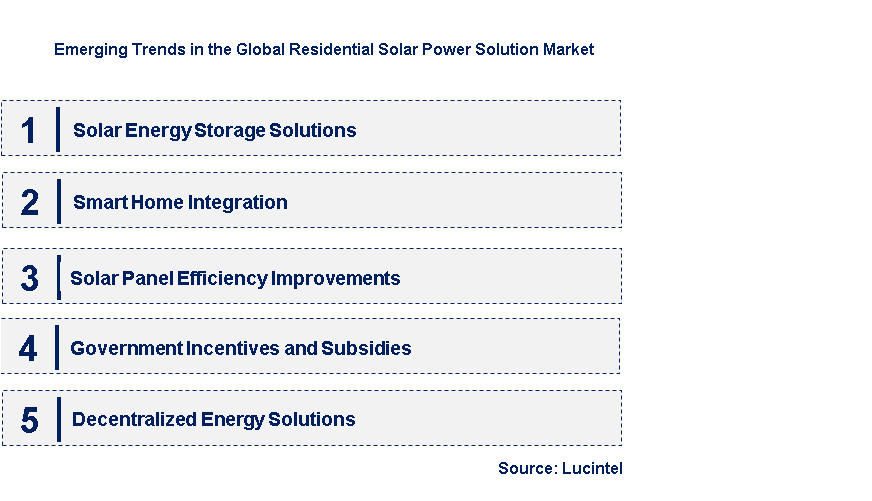
• Solar Energy Storage Solutions: The integration of battery storage with residential solar systems is gaining momentum. Homeowners are increasingly investing in energy storage solutions to store excess energy generated by solar panels for use during periods of low sunlight. This trend is driven by the desire for energy independence and cost savings. As battery technology improves and prices decrease, energy storage systems are becoming more affordable and accessible to the average homeowner, making solar energy a viable alternative to traditional energy sources.
• Smart Home Integration: The rise of smart home technology is transforming the residential solar sector. Solar power systems are increasingly being integrated with home automation systems, allowing homeowners to manage energy consumption efficiently. Smart meters, energy management systems, and real-time data analytics are becoming more common in solar installations. These innovations enable consumers to monitor their solar energy production and consumption, optimizing energy usage and minimizing costs. As smart home adoption grows, the integration of solar systems with IoT devices is expected to increase.
• Solar Panel Efficiency Improvements: Advancements in solar panel technology are driving improvements in efficiency and energy generation. New materials and manufacturing techniques, such as bifacial and perovskite solar cells, are enhancing solar panel performance. These innovations enable higher energy yields and more efficient use of available space. As the efficiency of solar panels continues to improve, homeowners can generate more power from smaller installations, making solar energy even more attractive for residential applications.
• Government Incentives and Subsidies: Governments around the world continue to support residential solar adoption through a variety of incentives, subsidies, and tax credits. In the United States, the federal solar tax credit (ITC) has played a significant role in encouraging homeowners to invest in solar energy. Similarly, countries like Germany, India, and China are offering financial incentives to promote solar installations. These programs help reduce the upfront cost of solar systems, making them more accessible to a wider range of consumers.
• Decentralized Energy Solutions: There is an increasing focus on decentralized energy solutions, such as rooftop solar panels, that allow homeowners to produce their own electricity and reduce reliance on the grid. This trend is driven by the need for greater energy independence and resilience in the face of grid failures. The growing popularity of microgrids and community solar systems also supports this trend, enabling neighborhoods to share solar energy and reduce overall costs. Decentralized energy solutions are becoming a key component of the global push for cleaner, more sustainable energy. To sum up, the emerging trends in the residential solar power solution market show that there is a moving focus towards better, environmentally-friendly and more efficient solar energy solutions that are tailored to the needs of consumers. Innovation in technology like advanced storage systems, sophisticated home energy management systems, and improved solar panels have greatly simplified and lowered the costs associated with solar energy. At the same time government funding is helping foster growth in the market as demand for off grid renewable energy sources continues to increase. These shifts are changing the face of residential solar power systems making them one of the core components of the world’s shift towards renewable energy and self-sufficiency.
• Reduction in Solar Panel Costs: One of the most impactful developments in the residential solar market is the significant reduction in the cost of solar panels. The prices of solar panels have decreased dramatically over the past decade, making solar energy more affordable for homeowners. This cost reduction has been driven by advances in manufacturing processes, economies of scale, and increased competition. As the price of solar systems continues to fall, more homeowners are opting to install solar panels, driving further market growth.
• Advancements in Energy Storage Technologies: Energy storage technologies, such as lithium-ion batteries, are becoming more efficient and cost-effective, making it easier for homeowners to store excess energy generated by their solar systems. These advancements allow homeowners to use solar power during non-sunny hours, improving energy independence and reducing reliance on the grid. As battery technology continues to evolve, the performance and affordability of energy storage systems will further enhance the appeal of residential solar power.
• Smart Solar Technologies: Smart solar technologies are increasingly being integrated into residential solar systems, providing homeowners with real-time monitoring and control over their energy usage. Smart inverters, energy management systems, and IoT-enabled devices are enabling homeowners to optimize energy production and consumption. These systems can automatically adjust energy use based on weather conditions and time-of-day pricing, further enhancing energy efficiency and reducing costs.
• Growth of Solar Leasing and Financing Options: The availability of solar leasing and financing options has made solar power more accessible to homeowners who may not have the upfront capital to invest in solar installations. Solar leases allow homeowners to install solar systems with little to no initial investment, while financing options, such as solar loans, enable them to pay for the system over time. These options have opened the door to a larger segment of the market, helping more households transition to solar energy.
• Regulatory Support and Incentives: Governments worldwide continue to introduce policies and incentives that support the adoption of residential solar power. The extension of the federal solar tax credit in the United States, the introduction of subsidies in India, and favorable feed-in tariffs in Germany have all contributed to market growth. These policies reduce the financial burden of installing solar systems and encourage homeowners to make the transition to renewable energy. To sum up “Insights In The Market For Residential Solar Power Solutions” the answer to the problem posed for investigation has been set forth. The analyzed data reveals the decline in costs of solar technology adoption as a primary factor supporting the expansion of solar systems for use in homes. Innovative business strategies, along with government policies provide capital and tax incentives which also assist in rapid adoption of residential solar systems. Continuous changes will not only increase accessibility to solar energy for homeowners, but will also help shape a sustainable energy future which places solar power tops on a modern energy system.
• Energy Storage Integration: The integration of energy storage systems with residential solar solutions presents a significant growth opportunity. Energy storage allows homeowners to store excess energy generated during the day and use it during the night or during grid outages. As battery technology improves and costs decrease, the market for energy storage in residential solar systems is expected to grow substantially. Companies that focus on offering efficient, affordable storage solutions can tap into this expanding market.
• Smart Home Integration with Solar Systems: The rise of smart homes is creating opportunities for integrating solar systems with home automation technologies. Smart inverters, energy management systems, and home automation platforms that optimize energy use are becoming increasingly popular. This trend presents growth opportunities for solar companies that develop products that can be easily integrated into smart home ecosystems, offering consumers more control and efficiency in managing their energy use.
• Solar Leasing and Financing Options: Solar leasing and financing options are creating growth opportunities in the residential solar market by removing the high upfront costs associated with solar installations. Solar leasing programs, power purchase agreements (PPAs), and solar loans make it easier for homeowners to adopt solar power without a large initial investment. As financing options continue to evolve and become more accessible, more consumers will have the opportunity to transition to solar energy, fueling market growth.
• Emerging Markets in Developing Regions: The growing adoption of solar energy in developing regions, such as parts of Africa, Southeast Asia, and Latin America, presents significant growth opportunities. In these regions, rising electricity costs, unreliable grids, and increasing environmental awareness are driving the demand for residential solar power solutions. Companies that focus on these emerging markets can benefit from untapped potential, especially as government incentives and subsidies support solar adoption in these regions.
• Solar Power System Upgrades and Maintenance Services: As residential solar installations increase, there is growing demand for upgrades and maintenance services to optimize the performance and longevity of solar systems. Companies that provide monitoring, repair, and maintenance services can leverage this demand to grow their businesses. Additionally, offering system upgrades such as more efficient panels or energy storage solutions provides opportunities for companies to generate recurring revenue. At last, the market of Residential Solar Power Solutions possesses ample scope of strategic and planned expansion throughout important applications. The market is fueled by the existing possibilities like energy storage integration, solar leasing, and various financing opportunities. Moreover, the rise in smart home technology and emerging centralized energy solutions increase the scope for new inventions and expansion. By pursuing these opportunities, businesses of all sizes have the chance to enter and fill the overflowing demand from consumers seeking cheap, renewable energy. Moving forward in time, it is definitely unquestionable that these growth opportunities will determine the future of residential solar power as the industry matures.
• Sunpower Corporation
• Acciona Energia
• Green Solar Technologies
• Canadian Solar
• Tata Power Solar
• Wuxi Suntech Power
• Sungevity
• Monocrystalline
• Polycrystalline
• Cadmium Telluride
• Amorphous Silicon Cells
• Others
• Electricity Generation
• Heating
• Charging & Lighting
• North America
• Europe
• Asia Pacific
• The Rest of the World
• United States: The U.S. residential solar market continues to expand due to falling prices of solar technology, federal tax incentives, and state-level support. The market has seen increased adoption of solar-plus-storage solutions, where homeowners are investing in battery storage to maximize energy independence. Additionally, utilities are increasingly supporting net metering policies that make solar more attractive. The implementation of solar energy in new homes is growing rapidly, further bolstering the market’s potential.
• China: China is the world’s largest producer and consumer of solar panels, and the residential solar market is rapidly expanding. The Chinese government has been offering substantial subsidies and incentives for solar energy adoption, further accelerating growth in the sector. Rising environmental awareness and government goals to reduce carbon emissions have driven the increased adoption of residential solar systems. Furthermore, China has been leading innovation in high-efficiency solar panels and energy storage solutions.
• Germany: Germany remains a global leader in residential solar power, with a large portion of its population adopting solar systems for homes. The government has introduced policies like the EEG (Renewable Energy Sources Act) to promote the transition to renewable energy. Residential solar systems in Germany have benefitted from increased energy independence, tax incentives, and efficiency improvements in solar technologies. As energy prices rise, the demand for energy storage systems is also growing in Germany.
• India: India’s residential solar market is rapidly growing, driven by both government policies and increasing electricity prices. The government has rolled out the Pradhan Mantri Kisan Urja Suraksha evam Utthaan Mahabhiyan (PM KUSUM) scheme, which provides incentives for solar installation in rural areas. Rising electricity demand and a push for cleaner energy solutions are fueling the market growth. As a result, solar energy is becoming increasingly affordable for Indian households, with greater opportunities for decentralized solar solutions.
• Japan: Japan’s residential solar market has seen steady growth, primarily driven by incentives for renewable energy use. The government offers subsidies for home solar installations and focuses on grid integration and energy storage to enhance the efficiency of solar power systems. After the Fukushima disaster, Japan’s push toward renewable energy sources, particularly solar, has been strengthened. The adoption of residential solar power systems is also benefiting from technological advancements such as more efficient panels and increased energy storage capabilities.


• Sunpower Corporation
• Acciona Energia
• Green Solar Technologies
• Canadian Solar
• Tata Power Solar
• Wuxi Suntech Power
• Sungevity Q5. Which residential solar power solution market segment will be the largest in future? Answer: Lucintel forecasts that, within the type category, monocrystalline is expected to witness the highest growth over the forecast period due to its better performance in limited space. Q6. In residential solar power solution market, which region is expected to be the largest in next 5 years? Answer: In terms of region, APAC is expected to witness the highest growth over the forecast period. Q7. Do we receive customization in this report? Answer: Yes, Lucintel provides 10% customization without any additional cost.


Choose a license that fits your team. Instant PDF delivery.
Prices exclude taxes. Instant delivery. Custom licensing available on request.
Market Report · July 15, 2026
Market Report · May 18, 2026
Market Report · May 18, 2026
Trusted partner for strategic intelligence and business growth


Receive a complimentary market analysis tailored to your industry. Our analysts will identify key growth opportunities and competitive dynamics specific to your business.

Market size, growth rate, and key trend analysis for your specific sector.

Top competitor positioning and market share analysis.

Strategic recommendations backed by data-driven insights.
Get curated market intelligence and competitive moves straight to your inbox.
By subscribing, you agree to receive our monthly insights. Unsubscribe anytime.
Receive a complimentary market analysis tailored to your industry. Our analysts will identify key growth opportunities and competitive dynamics specific to your business.
Market size, growth rate, and key trend analysis for your specific sector.
Top competitor positioning and market share analysis.
Strategic recommendations backed by data-driven insights.
Get curated market intelligence, emerging trends, and competitive moves straight to your inbox each month.
By subscribing, you agree to receive our monthly insights. Unsubscribe anytime.
We'll send your sample report shortly.