
Market Report · May 16, 2026

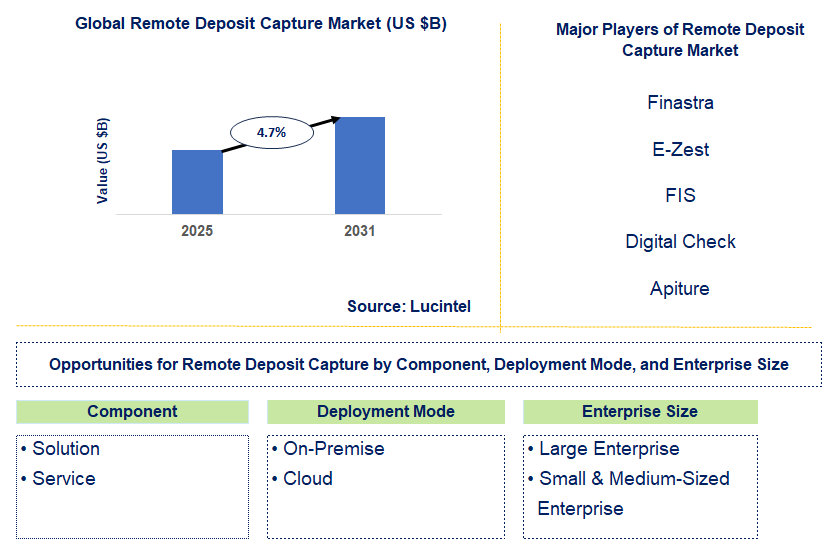
Key data points: The growth forecast = 4.7% annually for the next 7 years. Scroll below to get more insights. This market report covers trends, opportunities and forecasts in remote deposit capture market to 2031 by component (solution and service), deployment mode (on-premise and cloud), enterprise size (large enterprise and small & medium-sized enterprise), and region (North America, Europe, Asia Pacific, and the Rest of the World)
We'll send your sample report shortly.
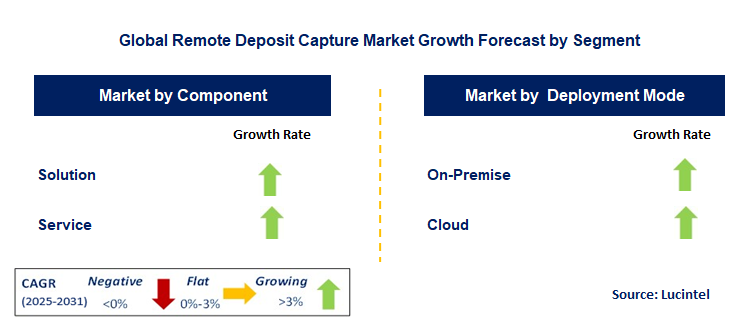
• Lucintel forecasts that, within the component category, solution is expected to witness higher growth over the forecast period.
• Within the deployment mode category, cloud is expected to witness the highest growth.
• In terms of region, APAC is expected to witness the highest growth over the forecast period. Gain valuable insights for your business decisions with our comprehensive 150+ page report. Sample figures with some insights are shown below.
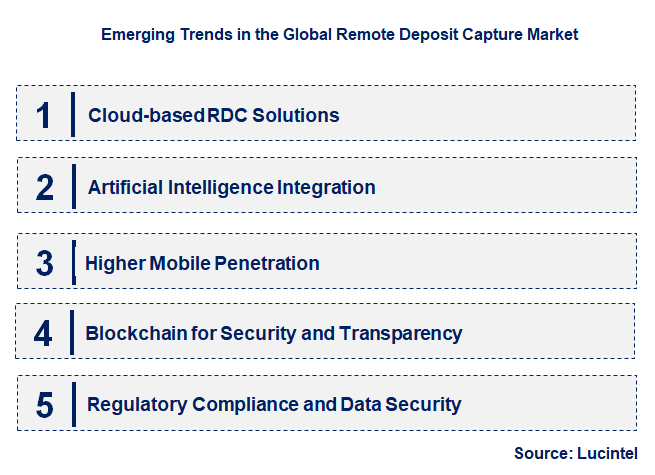
• Cloud-based RDC Solutions: Cloud-based RDC solutions are gaining prominence because they promise scalability, affordability, and instant accessibility from anywhere. Through the usage of cloud infrastructure, banks and companies are able to enhance data management, save on hardware costs, and enhance delivery of services. Cloud solutions are convenient and scalable, which makes them an ideal choice for small and medium businesses that might lack the expertise and budget to deal with on-premise systems.
• Artificial Intelligence Integration: AI is increasingly contributing to augmenting RDC systems by facilitating better fraud detection, automating processes, and offering predictive analysis. With the help of AI algorithms, RDC platforms are able to analyze patterns and alert suspicious behavior, minimizing the threat of fraud. AI-based automation also assists in streamlining the process, decreasing the time and resources needed for manual intervention. This trend is enhancing operational efficiency and customer satisfaction.
• Higher Mobile Penetration: With the increased use of smartphones, mobile-based RDC applications are being adopted quickly. Customers are now able to deposit checks using their phones directly, a functionality that is convenient, particularly for those residing in remote or underbanked areas. The flexibility and ease of use of mobile RDC solutions are revolutionizing the way individuals and companies deal with their banks.
• Blockchain for Security and Transparency: Blockchain technology is becoming an important tool for increasing the security and transparency of RDC transactions. Through a decentralized, immutable ledger, blockchain can minimize the threat of fraud, guarantee data integrity, and enable real-time processing. The transparency provided by blockchain also enables increased trust in remote deposit systems, which is important for mass adoption.
• Regulatory Compliance and Data Security: While RDC scales up, banks are focusing more on compliance with data security norms like GDPR in Europe and CCPA in America. Tighter regulations are driving banks to make greater investments in stronger security frameworks. Making the RDC platforms compliant with rules is not only necessary but is also a means of staying competitive, as users are increasingly requiring greater security in their financial dealings. These upcoming trends are remodeling the RDC market, as they make it more secure, accessible, and efficient. Through adopting technologies such as AI, blockchain, and cloud solutions, financial institutions will be able to provide more convenient and secure services to their consumers. As trends develop, the RDC market is likely to become more interconnected with the consumer and business communities‘ daily activities.
• AI and Automation Integration: AI and automation are becoming more integrated into RDC solutions by banks and financial institutions. AI is more effective at detecting fraud, while automation minimizes manual processes, leading to increased operational efficiency. These technologies‘ integration has also supported better accuracy in processing transactions, such as quicker deposit times and reduced errors.
• Advanced Mobile RDC Solutions: Mobile RDC solutions have evolved considerably with easy-to-use interfaces, advanced security capabilities, and higher processing speeds. Through the use of biometric authentication and artificial intelligence, mobile RDC apps are becoming more secure and trustworthy. These improvements are leading to the attractiveness of mobile RDC to both individual consumers and merchants, especially in areas with high smartphone penetration.
• Scalability via Cloud Adoption: Cloud-based RDC solutions are increasingly being adopted, giving businesses the ability to scale their operations without an initial investment in hardware. Cloud-based solutions are easier to integrate into current financial systems and decrease the operational cost, which is making them increasingly popular among companies of all sizes.
• Cybersecurity Emphasis: With remote banking on the rise, the importance of effective cybersecurity has gained greater prominence. RDC providers are pouring in investment in strong encryption, multi-factor authentication, and real-time fraud detection technologies. These efforts ensure that financial information is secure, thus inspiring user confidence and wider use of RDC solutions.
• Regulatory Push for Standardization: Governments and financial regulators are increasingly pushing for the standardization of RDC processes to ensure security and compliance. New regulations that enhance data protection and facilitate cross-border RDC transactions are triggering innovation and compelling financial institutions to tailor their offerings to satisfy these regulatory needs. These new developments indicate a move towards more efficient, secure, and scalable RDC solutions. With banks and fintech companies investing in AI, mobile, and cloud technologies, the RDC market is set to continue growing. The growing emphasis on cybersecurity and regulatory compliance will facilitate trust building and further adoption.
• Small Business Integration: Small firms are increasingly embracing RDC solutions to streamline their cash management and automate accounting processes. Through the utilization of RDC, these firms can minimize the manual processing of checks and enhance their cash flow. Affordable pricing structures and user-friendly interfaces are making RDC solutions more approachable for small firms.
• Retail and E-commerce Growth: With the growth of the retail and e-commerce industries, RDC provides a solution for businesses to process payments and deposits remotely. E-commerce businesses, in fact, are using RDC to deposit customer checks quickly without having to go to a bank branch. This trend is likely to grow as the digital payments landscape continues to develop.
• Fintech Startups Banking Partnerships: Fintech startups are partnering with traditional banks to launch innovative RDC solutions. With the use of sophisticated technologies such as AI, blockchain, and mobile payments, fintech firms are improving the RDC process both for consumers and companies. Such collaborations are assisting financial institutions in bolstering their online offerings and remaining competitive.
• Public Sector and Government Adoption: Governments and public sector organizations are also embracing RDC systems to enhance efficiency and decrease the workload on physical branches. Governments can automate administrative procedures and provide more convenient services to the public by allowing employees and citizens to remotely deposit checks.
• Cross-border RDC Solutions: As globalization increases, businesses are in search of RDC solutions that can efficiently manage cross-border transactions. Emerging technologies are facilitating safe, quick, and inexpensive cross-border check deposits, and it is becoming simpler for global businesses to cope with their finances. This opportunity will expand as international trade continues to grow. These opportunities for growth emphasize the ways in which RDC is moving beyond banking applications into a broad array of industries. As emerging technologies make integrations increasingly seamless, the RDC market will expand, offering advantages to businesses, consumers, and financial institutions.
• Finastra
• E-Zest
• FIS
• Digital Check
• Apiture
• Bank of America
• Jack Henry & Associates
• Alogent
• Mitek Systems
• Avivatech
• Solution
• Service
• On-Premise
• Cloud
• North America
• Europe
• Asia Pacific
• The Rest of the World
• United States: The US RDC market continues to develop with growing usage of mobile apps and banking channels. Banks are placing emphasis on improving the user experience with easier-to-use interfaces and in-line security options. Large banks and fintech firms have adopted artificial intelligence (AI) to automate fraud detection, enhance transactional accuracy, and streamline operations. Moreover, the use of cloud computing is enhancing scalability for corporations, with quicker deposit processing. Notwithstanding these developments, regulatory issues and data security fears are still central considerations in the American market.
• China: China‘s RDC market has witnessed tremendous uptake, which has been fueled by the speedy expansion of mobile banking and digital payments. With huge mobile ecosystems such as Alipay and WeChat, users now enjoy easy access to RDC services. The government of China has further encouraged the development of financial technologies, which have created a positive regulatory environment for digital banking. In addition, developments in blockchain and AI technologies are being incorporated into RDC systems to improve transaction efficiency and security. Nonetheless, privacy concerns, data leakages, and regulatory compliance continue to raise obstacles towards increased adoption.
• Germany: In Germany, RDC is increasingly being adopted with emphasis on both operational efficiency and customer experience improvement. With more and more German banks embracing digitalization strategies, RDC is being incorporated into mobile banking applications, enabling users to deposit checks remotely. Stringent data protection regulations like GDPR have impacted how RDC solutions are designed and deployed. Moreover, fintech startups are making inroads into the market, offering innovative and secure solutions. Although adoption is steady, concerns regarding cybersecurity and the necessity to have high levels of data protection are paramount issues.
• India: India‘s RDC market is growing very fast as mobile and internet banking continues to develop. With a sizeable unbanked population, remote deposit capture is assisting in bridging the gap by allowing customers in remote locations to deposit checks without having to physically go to a bank branch. The government‘s initiatives to promote financial inclusion via campaigns such as Digital India have been key drivers of growth in the country. Yet, issues such as poor internet connectivity and the acceptance of new technologies by rural inhabitants are still major roadblocks to increased growth.
• Japan: Japan‘s RDC market is picking up steadily, pushed by the country‘s high level of technology adoption and the transition towards digital financial services. The financial institutions of the country are combining RDC solutions with automated teller machines (ATMs) and mobile apps in order to bring more convenience to consumers. The regulatory environment in Japan is conducive to the adoption of RDC, but banks are adopting a cautious stance with regard to data security. The main issues in Japan are obtaining user confidence in new technologies and making the population aware of the benefits and security of RDC.


• Finastra
• E-Zest
• FIS
• Digital Check
• Apiture
• Bank of America
• Jack Henry & Associates
• Alogent
• Mitek Systems
• Avivatech Q5. Which remote deposit capture market segment will be the largest in future? Answer: Lucintel forecasts that, within the component category, solution is expected to witness higher growth over the forecast period. Q6. In remote deposit capture market, which region is expected to be the largest in next 5 years? Answer: In terms of region, APAC is expected to witness the highest growth over the forecast period. Q7. Do we receive customization in this report? Answer: Yes, Lucintel provides 10% customization without any additional cost.


Choose a license that fits your team. Instant PDF delivery.
Prices exclude taxes. Instant delivery. Custom licensing available on request.
Market Report · May 16, 2026
Market Report · September 4, 2025
Market Report · June 11, 2025
Trusted partner for strategic intelligence and business growth


Receive a complimentary market analysis tailored to your industry. Our analysts will identify key growth opportunities and competitive dynamics specific to your business.

Market size, growth rate, and key trend analysis for your specific sector.

Top competitor positioning and market share analysis.

Strategic recommendations backed by data-driven insights.
Get curated market intelligence and competitive moves straight to your inbox.
By subscribing, you agree to receive our monthly insights. Unsubscribe anytime.
Receive a complimentary market analysis tailored to your industry. Our analysts will identify key growth opportunities and competitive dynamics specific to your business.
Market size, growth rate, and key trend analysis for your specific sector.
Top competitor positioning and market share analysis.
Strategic recommendations backed by data-driven insights.
Get curated market intelligence, emerging trends, and competitive moves straight to your inbox each month.
By subscribing, you agree to receive our monthly insights. Unsubscribe anytime.
We'll send your sample report shortly.