
Market Report · July 16, 2026

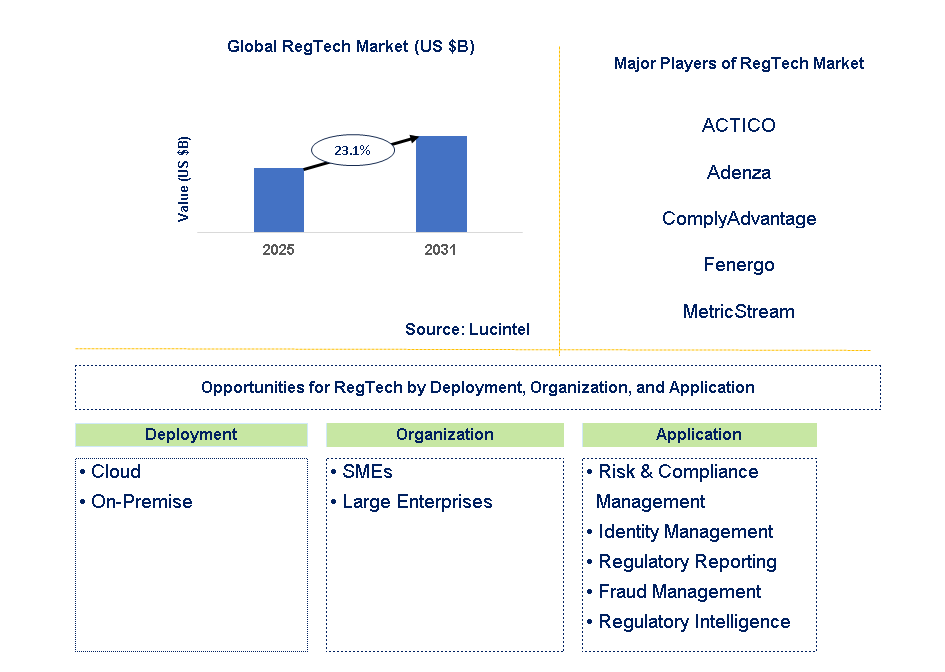
Key data points: The growth forecast = 23.1% annually for the next 7 years. Scroll below to get more insights. This market report covers trends, opportunities and forecasts in RegTech market to 2031 by deployment (cloud and on-premise), organization (smes and large enterprises), application (risk & compliance management, identity management, regulatory reporting, fraud management, and regulatory intelligence), and region (North America, Europe, Asia Pacific, and the Rest of the World)
We'll send your sample report shortly.
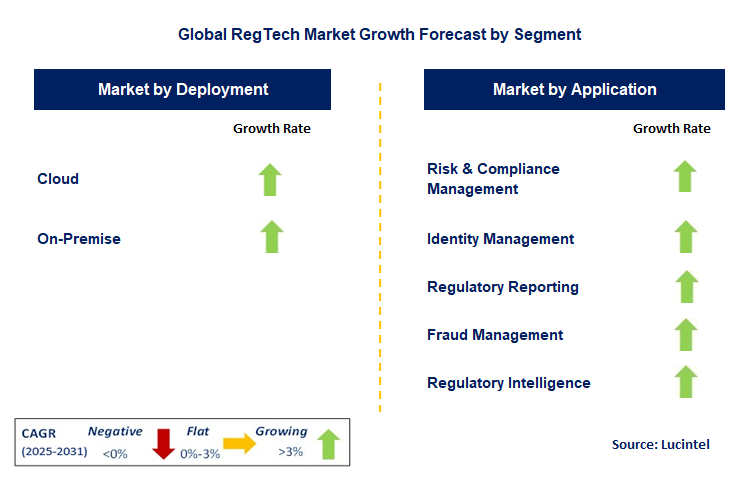
• Lucintel forecasts that, within the deployment category, cloud is expected to witness higher growth over the forecast period.
• Within the application category, regulatory reporting is expected to witness the highest growth.
• In terms of region, APAC is expected to witness the highest growth over the forecast period. Gain valuable insights for your business decisions with our comprehensive 150+ page report. Sample figures with some insights are shown below.
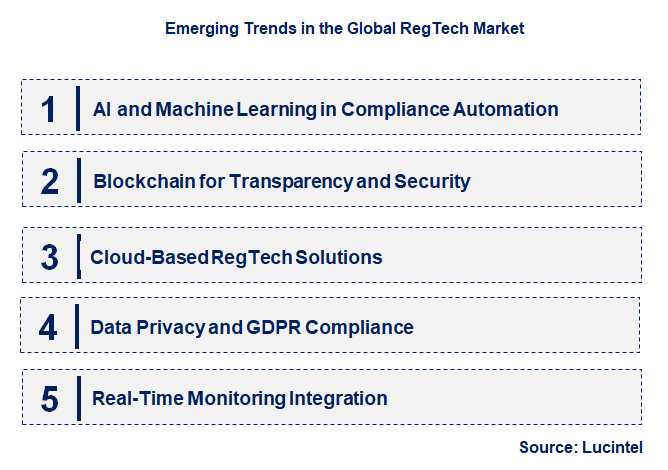
• AI and Machine Learning in Compliance Automation: Artificial intelligence and machine learning are increasingly becoming essential technologies for automating regulatory compliance functions. RegTech firms are leveraging these technologies to enhance risk assessment, fraud detection, and regulatory reporting. AI is able to process large volumes of data to identify anomalies and possible compliance violations in real-time. Machine learning algorithms learn continuously from historical data, enhancing their predictive power and minimizing the need for human intervention. This trend is leading to massive cost savings, enhanced efficiency, and accelerated compliance across sectors, especially financial services.
• Blockchain for Transparency and Security: Blockchain technology is increasingly being used in RegTech solutions to provide transparency, security, and traceability in regulatory processes. By offering a decentralized, tamper-proof ledger, blockchain increases the integrity of data utilized for compliance, particularly in financial transactions. It enables businesses to keep an open record of their activities, which can facilitate compliance with regulatory requirements like anti-money laundering (AML) and know-your-customer (KYC) regulations. This is a trend that is changing the way organizations address compliance by providing secure, tamper-evident solutions that enhance trust and minimize fraud risk.
• Cloud-Based RegTech Solutions: Cloud computing is revolutionizing the RegTech space by allowing businesses to roll out compliance tools quickly and easily. Cloud-based solutions offer scalable and economical means of managing regulatory compliance without having to make costly infrastructure investments. These platforms are also extremely versatile and enable organizations to respond quickly to shifting regulation, as well as seamlessly incorporating fresh compliance technologies. Cloud technologies are also transforming international collaboration by optimizing real-time reporting and compliance tracking. With businesses increasingly taking to cloud-based solutions, the sector is growing based on this trend.
• Data Privacy and GDPR Compliance: With the adoption of the General Data Protection Regulation (GDPR) and other data privacy regulations across the globe, companies are turning to solutions that enable them to comply with rigorous data protection obligations. RegTech firms are creating tools to make data protection procedures automatic, ensuring that businesses remain in charge of personal data and stay away from heavy fines. This is a tendency that is very prominent in the EU and is spreading worldwide, as more countries implement data protection legislation. The increasing need to protect data is forcing firms to spend money on RegTech products to manage risks of non-compliance.
• Real-Time Monitoring Integration: Real-time monitoring is the key feature of RegTech products, especially for sectors like finance and healthcare. Through the use of AI, big data, and advanced analytics, companies can now track their compliance status in real-time, enabling them to implement corrective measures instantly if needed. This trend is fueled by the demand for more accuracy and efficiency in regulatory management, especially in high-risk, fast-paced environments. Real-time monitoring enables companies to immediately spot and fix compliance gaps, minimizing exposure to penalties and legal risks. These new trends are transforming the RegTech market by improving efficiency, security, and transparency in compliance procedures. AI, blockchain, and cloud technologies are making it easier for companies to operate with complex regulatory environments. With the ongoing development of these trends, the RegTech market will see increased expansion, providing groundbreaking solutions that simplify regulatory compliance and enhance risk management.
• Expansion of AI-Powered Regulatory Reporting Tools: AI-based tools are gaining widespread acceptance in the RegTech industry for the automation of regulatory reporting. These reporting tools use natural language processing (NLP) and machine learning to process big data, pull out key data, and provide real-time reports. This technology has the capability to cut the time and cost of regulatory reporting drastically, which helps companies remain compliant with ever-evolving rules and regulations. The development of AI-based reporting tools is making it possible for organizations to keep their regulatory burdens under control in a more effective way, lowering errors and increasing the accuracy of submissions.
• Blockchain-Powered KYC Solutions: Blockchain is revolutionizing Know Your Customer (KYC) procedures by allowing secure, decentralized record-keeping. Through blockchain, RegTech firms are streamlining the efficiency and security of KYC procedures, facilitating customer identity verification with ease while decreasing the likelihood of fraud. Blockchain also enables more transparent and auditable KYC procedures, which is essential to comply with anti-money laundering (AML) requirements. This evolution is particularly critical for financial institutions, as it simplifies the KYC process, lowers costs, and boosts customer confidence.
• Rise of Regulatory Sandboxes: Regulatory sandboxes are becoming a critical instrument in the RegTech sector, enabling firms to pilot test their compliance products in a safe environment before unleashing them onto the broader market. These sandboxes are mostly supplied by governments or regulatory authorities and provide a secure platform for companies to test new processes and technologies without going beyond regulatory constraints. Regulatory sandboxes are assisting organizations in innovation while keeping them compliant with the current regulations. This is especially common in those markets with fast-evolving regulation environments.
• Integration of Big Data Analytics for Risk Assessment: Big data analytics is increasingly being applied in RegTech solutions to enhance risk assessment abilities. By processing large amounts of data from different sources, businesses are able to get a better understanding of their regulatory risks and compliance positions. Big data technologies assist businesses in identifying patterns, forecasting potential compliance problems, and creating plans to address risks before they become major issues. Embedding big data analytics in RegTech solutions is revolutionizing the way companies respond to risk management, allowing them to make better decisions and stay ahead of regulatory hurdles.
• Cross-Border Compliance Solutions Focus: With increasing globalization, companies are experiencing increasingly complex cross-border regulatory issues. RegTech firms are countering this by creating solutions that enable companies to regulate compliance across borders. These solutions automate the process of moving through various regulatory landscapes, making sure that companies are compliant with local regulations and global standards. This innovation is especially significant for multinational companies that must deal with compliance across regions. Cross-border compliance solutions are assisting companies in minimizing the risk of non-compliance and evading penalties across jurisdictions. The RegTech industry is changing very fast, with innovation in AI, blockchain, big data analytics, and regulatory sandboxes driving the business ahead. These technologies are enabling companies to enhance their compliance mechanisms, lower expenses, and remain one step ahead of compliance hurdles. As pressure builds on regulatory efficiency and security, the RegTech industry will keep growing and innovating.
• Cloud-Based Compliance Solutions: Cloud computing is providing companies with the ability to expand their compliance operations rapidly and economically. With cloud-based solutions, companies can automate their compliance processes without having to make costly infrastructure investments. This opportunity for growth is especially attractive to small and medium-sized businesses (SMEs) that need flexible, scalable solutions to address regulatory risks. Cloud-based compliance platforms are allowing companies to access real-time monitoring, reporting, and automated compliance tools, which facilitate compliance with regulatory requirements.
• AI-Powered Risk Management Tools: AI-powered risk management tools represent a strong growth area in the RegTech industry. Such tools employ machine learning algorithms to scan large amounts of data, detect patterns, and forecast potential compliance risks. By automating risk analysis and fraud detection, companies can minimize the time and effort required for manual compliance efforts. AI-based tools are also making compliance monitoring more accurate, allowing companies to detect potential problems before they turn critical. This is especially useful in industries like finance, healthcare, and insurance.
• Blockchain for Secure Data Sharing: Blockchain technology provides companies with the ability to share data securely with multiple stakeholders while maintaining transparency and minimizing the risk of fraud. In the RegTech industry, blockchain is being increasingly used to build secure, decentralized systems for handling sensitive regulatory information. This technology has the potential to enhance data protection legislation compliance and make the process of verification and information sharing between organizations and regulators easier. As more businesses adopt blockchain, this growth prospect is likely to redefine how organizations deal with their regulatory responsibilities.
• Cross-Jurisdictional Compliance Management Solutions: With the growth of businesses going global, managing compliance in different jurisdictions is getting more complicated. Cross-jurisdictional compliance RegTech solutions are creating large growth prospects. These compliance solutions enable companies to deal with different regulatory standards in different nations so that they are in line with international norms and local legislations. With the automation of cross-border compliance management, RegTech firms can enable companies to lower the risk of non-compliance and the cost of penalties.
• Regulatory Analytics for Predictive Compliance: Predictive analytics is becoming a major growth prospect in the RegTech space. Through the use of data analytics and AI, companies can anticipate future regulatory risks and proactively take steps to address them. Predictive analytics software is assisting companies in keeping ahead of compliance issues by giving them real-time insights into regulatory trends and prospective risks. This prospect is especially useful for companies operating in sectors like banking, insurance, and healthcare, where regulatory compliance is essential to operations. The RegTech industry offers many growth opportunities that are fueled by developments in AI, blockchain, cloud computing, and data analytics. With attention to important applications such as cloud-based solutions, predictive compliance, and cross-jurisdictional compliance management, companies can leverage the increasing demand for effective, secure regulatory solutions.
• ACTICO
• Adenza
• ComplyAdvantage
• Fenergo
• MetricStream
• NICE Actimize
• OneTrust
• LSEG Data & Analytics
• CUBE Content Governance Global
• Trulioo
• Cloud
• On-Premise
• SMEs
• Large Enterprises
• North America
• Europe
• Asia Pacific
• The Rest of the World
• United States: The United States is at the forefront of RegTech adoption, with businesses from all sectors looking to automate compliance procedures through technology. The market is witnessing substantial growth as banks and other financial institutions adopt AI-based technologies to anti-money laundering (AML) and fraud detection. Regulatory agencies such as the SEC and the CFTC are urging more usage of RegTech in order to enhance efficiency in compliance. U.S. companies are also spending money on blockchain and data analytics to comply with strict compliance norms, particularly within the financial services industry. With increasing regulatory complexity, the U.S. is witnessing an increasing need for innovative RegTech solutions to handle risk and ensure compliance.
• China: In China, the RegTech market is developing at a fast pace, particularly in the financial sector, as the government is encouraging more robust regulatory frameworks. China is emphasizing digital currency, data privacy legislation, and anti-money laundering (AML) regulations, which are propelling the demand for RegTech solutions. Chinese regulators are increasingly relying on technologies like AI and blockchain to track financial transactions and gauge regulatory compliance. China is also using cloud computing and big data analytics to monitor compliance in real-time, assisting businesses in lowering regulatory risks. China's RegTech sector is expanding, heavily influenced by the growing emphasis on fintech regulation.
• Germany: Germany's RegTech landscape is defined by strong regulatory environments, particularly in banking and insurance. The German government is focusing on adherence to EU regulations like GDPR and MiFID II. RegTech vendors in Germany are leveraging AI and machine learning capabilities to automate regulatory checks and enhance operational efficiencies. Additionally, German financial institutions are using RegTech to enhance risk management and verify anti-money laundering (AML) compliance. Blockchain is also increasingly becoming an important tool to achieve transparency and security in regulatory compliance procedures. The market in Germany is experiencing robust growth due to strict EU regulations and the importance of data privacy
• India: India's RegTech market is expanding as the regulatory environment in the country becomes more sophisticated. The drive by the government for digital financial services, coupled with a greater emphasis on anti-money laundering (AML) rules, is one of the strong drivers for the adoption of RegTech. Indian fintech companies and banks are increasingly using cloud-based RegTech solutions to comply with regulations and handle risks. India is also prioritizing enacting data protection legislation, leading businesses to rely on RegTech solutions for compliance management. As the regulatory landscape becomes more complex, the need for AI-based tools and machine learning models is growing to automate compliance activities and enhance accuracy.
• Japan: Japan's RegTech industry is transforming with a high emphasis on the financial services sector and cybersecurity regulations. The government of Japan has been advocating more robust compliance solutions following financial scandals and increased cyber threats. RegTech in Japan is increasingly using AI, big data, and blockchain technologies to improve the security and efficiency of financial transactions. As digital transformation sets in within Japanese financial institutions, RegTech is at the center of facilitating compliance with global and domestic regulation. The Japanese marketplace is noted to have a very high innovation level and adoption of sophisticated regulatory technology.


• ACTICO
• Adenza
• ComplyAdvantage
• Fenergo
• MetricStream
• NICE Actimize
• OneTrust
• LSEG Data & Analytics
• CUBE Content Governance Global
• Trulioo Q5. Which RegTech market segment will be the largest in future? Answer: Lucintel forecasts that, within the deployment category, cloud is expected to witness higher growth over the forecast period. Q6. In RegTech market, which region is expected to be the largest in next 5 years? Answer: In terms of region, APAC is expected to witness the highest growth over the forecast period. Q7. Do we receive customization in this report? Answer: Yes, Lucintel provides 10% customization without any additional cost.


Choose a license that fits your team. Instant PDF delivery.
Prices exclude taxes. Instant delivery. Custom licensing available on request.
Market Report · July 16, 2026
Market Report · May 18, 2026
Market Report · May 18, 2026
Trusted partner for strategic intelligence and business growth


Receive a complimentary market analysis tailored to your industry. Our analysts will identify key growth opportunities and competitive dynamics specific to your business.

Market size, growth rate, and key trend analysis for your specific sector.

Top competitor positioning and market share analysis.

Strategic recommendations backed by data-driven insights.
Get curated market intelligence and competitive moves straight to your inbox.
By subscribing, you agree to receive our monthly insights. Unsubscribe anytime.
Receive a complimentary market analysis tailored to your industry. Our analysts will identify key growth opportunities and competitive dynamics specific to your business.
Market size, growth rate, and key trend analysis for your specific sector.
Top competitor positioning and market share analysis.
Strategic recommendations backed by data-driven insights.
Get curated market intelligence, emerging trends, and competitive moves straight to your inbox each month.
By subscribing, you agree to receive our monthly insights. Unsubscribe anytime.
We'll send your sample report shortly.