
Market Report · July 20, 2026

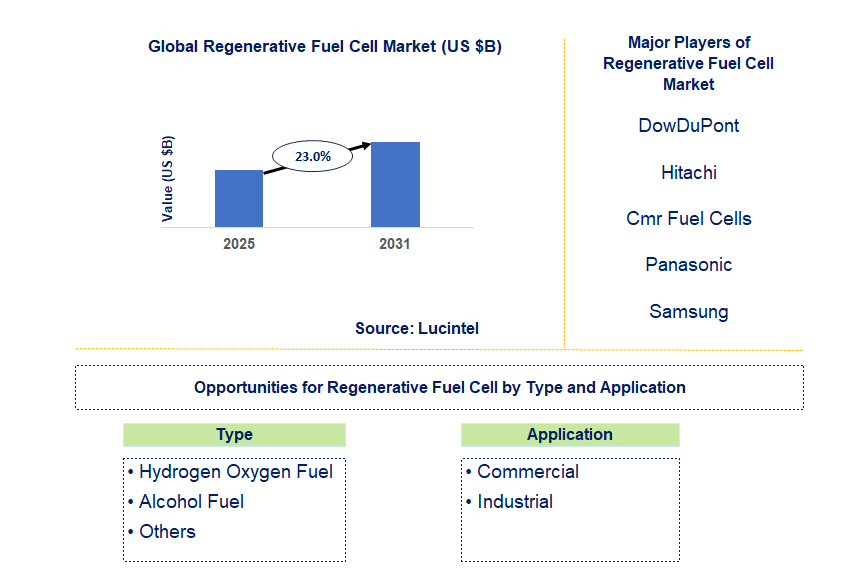
Key data points: The growth forecast = 23% annually for the next 7 years. Scroll below to get more insights. This market report covers Trends, opportunities and forecasts in regenerative fuel cell market to 2031 by type (hydrogen oxygen fuel, alcohol fuel, and others), application (commercial and industrial), and region (North America, Europe, Asia Pacific, and the Rest of the World)
We'll send your sample report shortly.
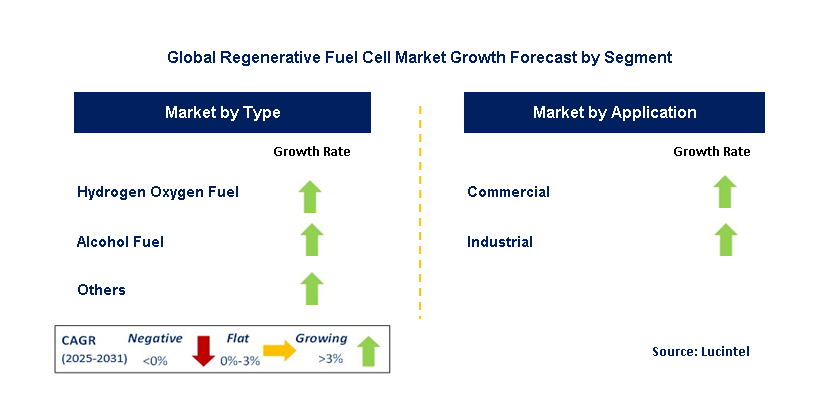
• Lucintel forecasts that, within the type category, hydrogen oxygen fuel is expected to witness higher growth over the forecast period.
• Within the application category, industrial is expected to witness higher growth.
• In terms of region, North America is expected to witness the highest growth over the forecast period due to the increasing adoption of clean energy technology.
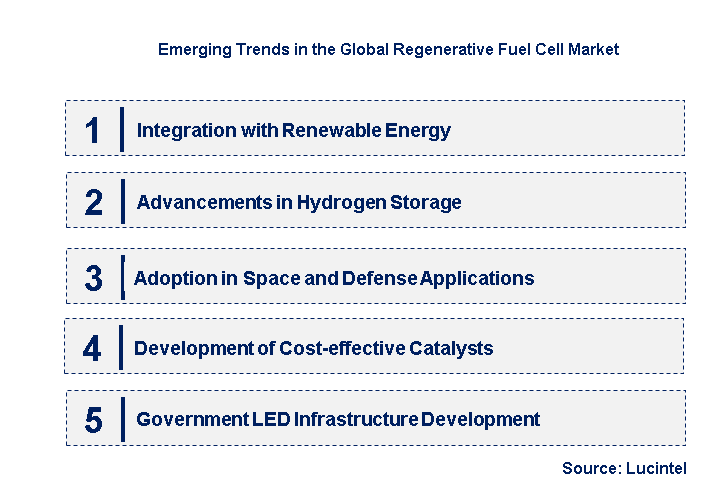
• Integration with Renewable Energy: Enhancements to existing systems with additional renewable energy sources RFC are being integrated with solar and wind power systems to provide reliable energy storage. This trend is driven by the need for stable energy supply in off-grid and remote areas, as well as the growing acceptance of decentralized energy systems.
• Advancements in Hydrogen Storage: Innovations in Hydrogen Storage Advanced developments in hydrogen storage are one of the two areas crucial for improving the RFC technology. Solid-state hydrogen storage, along with new solutions for liquid hydrogen storage, are among the key areas of development.
• Adoption in Space and Defense Applications: RFCs are adopted in space missions and defense applications because of their high energy density and long-duration power supply capabilities. NASA and other space agencies are developing RFCs to be used for spacecraft energy systems and deep-space exploration.
• Development of Cost-effective Catalysts: Advancements in non-precious metal catalysts and nanostructured materials are making RFCs more cost-effective and scalable for commercial applications. Researchers are working on alternative catalyst materials such as non-precious metals and nanostructured materials which can replace the expensive platinum-based catalysts.
• Government LED Infrastructure Development: The commercialization of RFC technology and their subsequent application in hydrogen infrastructure is being aided by the creation of new hydrogen refueling stations, production facilities, and distribution networks. These initiatives are government led and are fostered around the globe, creating opportunity for industry players. These trends are expected to drive innovation, reduce costs, and expand the range of applications which will impact the regenerative fuel cell market’s recovery significantly. As these trends continue to occur, they are likely to change the industry for the better making it easier and more practical for people to use RFC technology.
• Advances in Electrolyzer Technology: RFCs have become more efficient due to improvements in electrolyzer technology because of optimization of hydrogen production. Decreasing energy losses and increasing system longevity is the goal of current research efforts. These advancements are enabling RFCs to store energy effectively, which can significantly improve long-term energy storage. The integration of advanced electrolyzers is also reducing costs, making RFCs more competitive with traditional energy storage solutions.
• Spending more on hydrogen infrastructure: To enable RFC systems, both the public and private sectors are putting money towards infrastructures that aid in the production, storage, and distribution of hydrogen. New storage facilities and refueling stations are being constructed to ensure support of RFC uses in industrial, transportation, and backup power sectors. This expansion of infrastructure is important for the widespread use of RFC technologies.
• Integration with Renewable Energy Sources: Support from other renewable energy sources RFC technology combines with solar and wind power to allow better storage of energy. This helps manage fuel use more efficiently and increases energy independence. Numerous pilot programs throughout the world have already begun to show how RFC technologies can store abundant renewable energy for future use and provide energy constantly and reliably.
• Creating cheaper catalyst materials: Platinum based catalyst materials are too costly, so research is being done to find cheaper options to replace them. Advances in material science and nanotechnology are yielding novel, affordable catalysts that enhance system performance and lower cost. Economically, this is essential because it allows the use of RFC technology in many different industries and applications.
• Increasing Use of RFC Technology in Aerospace and Defense: The use of Radio Frequency Cells (RFCs) in aerospace and defense applications has increased due to their capacity to deliver sustained power with high energy density. Space agencies and military organizations are developing RFC technology for spacecraft, satellites, and military operations that require dependable and efficient energy storage. Such applications are further enhancing RFC development in regards to quality and stability. With investment and research efforts, RFCs should be expected to evolve into a prominent energy storage solution while undergoing drastic changes. These major shifts in the market will be essential for the transition to green energy.
• Aerospace and Exploration of Space: RFC offer prolonged power for aid in space missions and high-altitude flying craft. Private companies and space agencies are using RFC technology to foster energy storage for satellites and deep-space exploration. These developments are positioning RFCs as a backbone energy source for future space missions RFCs support the aerospace industry RFCs are being heavily adopted by private companies and space agencies because of the profound power management capabilities these RFCs possess. RFCs are being recognized as elite energy storage devices.
• Backup Energy for Use in Critical Infrastructure: RFCs are being adopted to aid in providing hospitals, data centers, and telecommunication facilities with reliable energy storage systems. Unlike the traditional backup systems, RFCs do not emit harmful gasses during long-term energy storage. Growing ERCOT and global power outages, hitting Texas severely within the past few years, point towards the dysfunctionality present in the current state of power infrastructure. Power grid and backbone systems face rising concerns about their stability and outages, resulting in rapid growth of this sector.
• Grid Energy Storage for Renewable Integration: Integration of renewables into the grid RFCs are being installed to facilitate the reliable infrastructure's functionality. RFCs guarantee uninterrupted energy supply by storing useable solar and wind energy. The enhanced energy security and reliability of the power grid attributed to RFCs has the governments and utility investors to support the improvement of RFC technologies.
• Industrial Applications for Decarbonization: Both traditional factories, as well as the steel, automotive and chemicals sectors are emphasizing the adoption of RFCs in the quest to meet sustainability targets alongside decarbonization. This trend should induce substantial growth in industrial applications.
• Sustainable Solutions for Transportation: RFCs are being pioneered for use in electric vehicles, marine transport, and rail systems as clean substitutes for fossil fuels. These technologies are gaining traction with policies favoring hydrogen as a fuel for transportation. This emerging market is propelling the use of RFC technology in the transportation sector. The future of the regenerative fuel cell market is enhanced through these emerging opportunities by expanding the application scope and fueling innovative developments. RFCs are poised to play a central role in fulfilling global energy targets sustainably as adoption ramps up.
• DowDuPont
• Hitachi
• Cmr Fuel Cells
• Panasonic
• Samsung
• SFC Power
• Polyfuel
• Sharp
• Toshiba
• Ultracell
• Hydrogen Oxygen Fuel
• Alcohol Fuel
• Others
• Commercial
• Industrial
• North America
• Europe
• Asia Pacific
• The Rest of the World
• United States: The US has historically been a leader in RFC technology, with government agencies like NASA and DOE spending significant resources on the hydrogen fuel cell innovation. Increased funding for RFC projects has been driven by the decarbonization and energy independence efforts. Military, aerospace, and other industries are also working on improving the efficiency of RFCs. Recently developed pilot projects that combine renewable energy plants with RFCs to deliver off-grid and backup power continue to expand. Hydrogen infrastructure development is also supported in the country's regulatory policies, meaning market adoption will only increase.
• China: With strong government support fueling the development of RFCs, China is rapidly working on growing their hydrogen economy. Companies and research institutions in China are working on making RFCs more efficient and cost-effective. Major hydrogen production and storage technologies have been developed, alongside more international partnerships seeking to expedite commercialization. In addition, China is funding large-scale pilot programs for RFCs for the purposes of grid energy storage, as they seek to shift focus to clean energy. The market is aided by positive legislation, subsidies, and government investment building the hydrogen infrastructure.
• Germany: Germany aggressively pursues new hydrogen technologies and innovations as part of their energy transition policies which enable the widespread adoption of RFCs. The nation is also working to develop long-term energy storage options to supplement their renewable energy sources. Collaboration between German companies and research institutes aims to improve RFCs’ performance and scalability with notable projects like RFCs being integrated with wind and solar farms to construct energy positive storage facilities. The German government also supports projects that seek to make RFC technology commercially available for industrial, backup, and transportation power applications which strengthens the position of the Germany as a preeminent nation in fuel cell technology.
• India: Because of its commitment to hydrogen energy and the growing renewable energy sector, India is poised to become a major player in the regenerative fuel cell market. The Indian government has been enacting policies and providing financial support to foster RFC research and implementation. Indian research institutions are developing low-cost locally produced RFCs that can assist with rural electrification and use as backup power sources. The country’s emphasis on producing green hydrogen is expected to increase the use of RFCs in industry and transportation. The pace of commercialization of RFC technology is improving in India due to partnerships with foreign firms.
• Japan: Japan took the lead on hydrogen fuel cell technology development, and has invested a lot of resources into RFCs from both the public and private sectors. The nation is working on the integration of RFCs into its hydrogen economy, allowing for seamless integration of energy storage. These include improving catalyst technology used in RFCs with the aim of enhancing efficiency and reducing costs. In addition, Japan is using RFCs for backup power in essential services and areas vulnerable to disasters. Japan already invests heavily into RFC research as part of its roadmap for a hydrogen society, giving it a head start in commercializing the technology for residential, industrial, and transportation use.


• DowDuPont
• Hitachi
• Cmr Fuel Cells
• Panasonic
• Samsung
• SFC Power
• Polyfuel
• Sharp
• Toshiba
• Ultracell Q5. Which regenerative fuel cell market segment will be the largest in future? Answer: Lucintel forecasts that, within the type category, hydrogen oxygen fuel is expected to witness higher growth over the forecast period. Q6. In regenerative fuel cell market, which region is expected to be the largest in next 5 years? Answer: In terms of region, North America is expected to witness the highest growth over the forecast period due to the increasing adoption of clean energy technology. Q7. Do we receive customization in this report? Answer: Yes, Lucintel provides 10% customization without any additional cost.


Choose a license that fits your team. Instant PDF delivery.
Prices exclude taxes. Instant delivery. Custom licensing available on request.
Market Report · July 20, 2026
Market Report · July 20, 2026
Market Report · July 20, 2026
Trusted partner for strategic intelligence and business growth


Receive a complimentary market analysis tailored to your industry. Our analysts will identify key growth opportunities and competitive dynamics specific to your business.

Market size, growth rate, and key trend analysis for your specific sector.

Top competitor positioning and market share analysis.

Strategic recommendations backed by data-driven insights.
Get curated market intelligence and competitive moves straight to your inbox.
By subscribing, you agree to receive our monthly insights. Unsubscribe anytime.
Receive a complimentary market analysis tailored to your industry. Our analysts will identify key growth opportunities and competitive dynamics specific to your business.
Market size, growth rate, and key trend analysis for your specific sector.
Top competitor positioning and market share analysis.
Strategic recommendations backed by data-driven insights.
Get curated market intelligence, emerging trends, and competitive moves straight to your inbox each month.
By subscribing, you agree to receive our monthly insights. Unsubscribe anytime.
We'll send your sample report shortly.