
Market Report · July 15, 2026

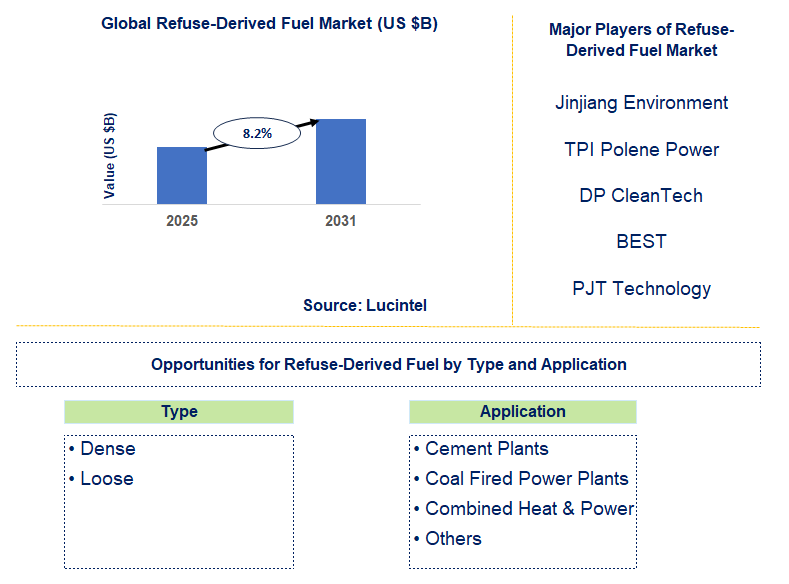
Key data points: The growth forecast = 8.2% annually for the next 7 years. Scroll below to get more insights. This market report covers trends, opportunities and forecasts in refuse-derived fuel market to 2031 by type (dense and loose), application (cement plants, coal fired power plants, combined heat & power, and others), and region (North America, Europe, Asia Pacific, and the Rest of the World)
We'll send your sample report shortly.
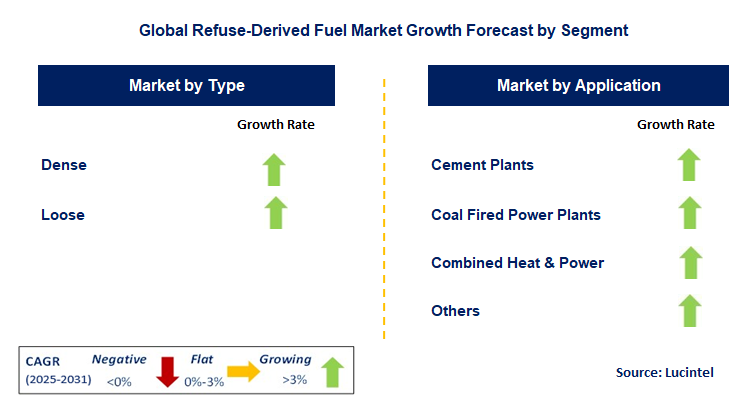
• Lucintel forecasts that, within the type category, dense is expected to witness higher growth over the forecast period.
• Within the application category, combined heat & power is expected to witness the highest growth.
• In terms of region, APAC is expected to witness the highest growth over the forecast period. Gain valuable insights for your business decisions with our comprehensive 150+ page report. Sample figures with some insights are shown below.
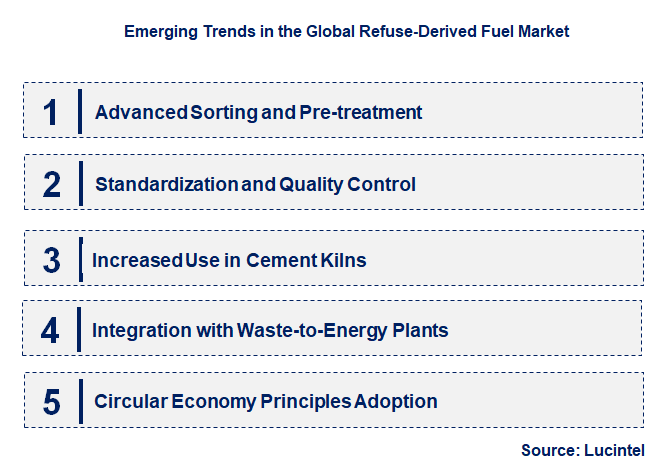
• Advanced Sorting and Pre-treatment: The adoption of advanced sorting technologies, including optical sorters, AI-driven systems, and mechanical biological treatment (MBT), is a key trend. These technologies enhance the separation of non-combustible materials and improve the homogeneity and calorific value of refuse-derived fuel, leading to a higher quality fuel and better combustion efficiency.
• Standardization and Quality Control: There's a growing emphasis on developing and implementing standardized quality norms for refuse-derived fuel, such as those for moisture content, calorific value, and contaminant levels. Standardization is crucial for ensuring consistent fuel quality, building trust among end-users, and facilitating broader market acceptance and international trade of refuse-derived fuel.
• Increased Use in Cement Kilns: Cement kilns are increasingly becoming major consumers of refuse-derived fuel due to their high energy demands and ability to safely co-process waste at high temperatures. This trend is driven by the cement industry's efforts to reduce reliance on fossil fuels, lower carbon emissions, and leverage refuse-derived fuel as a cost-effective and sustainable energy alternative.
• Integration with Waste-to-Energy Plants: The development of integrated waste-to-energy (WtE) facilities that specifically process refuse-derived fuel for power generation is a growing trend. These plants efficiently convert non-recyclable waste into electricity or heat, playing a crucial role in landfill diversion and contributing to national energy security and renewable energy targets.
• Circular Economy Principles Adoption: The refuse-derived fuel market is increasingly aligning with broader circular economy principles, focusing on resource recovery and waste valorization. This trend views waste not as a disposal problem but as a resource for energy production, promoting sustainable waste management practices and reducing the environmental footprint of waste. These trends are profoundly reshaping the refuse-derived fuel market by making refuse-derived fuel a more reliable, high-quality, and widely accepted alternative fuel. The focus on advanced processing, standardization, and integration into key industries is driving market expansion and positioning refuse-derived fuel as a vital component in achieving global sustainable waste management and energy goals.
• Technological Improvements in refuse-derived fuel Production: Recent advancements include the deployment of sophisticated mechanical biological treatment (MBT) plants and advanced sorting technologies (e.g., optical sorters, AI-driven systems). These innovations enhance the purity, homogeneity, and calorific value of refuse-derived fuel, making it a more consistent and efficient fuel source for various industries.
• Increased Utilization in Cement Industry: The cement industry has significantly increased its adoption of refuse-derived fuel as a substitute for fossil fuels. High-temperature kilns are ideal for burning refuse-derived fuel, reducing greenhouse gas emissions and operational costs. This trend is driven by environmental regulations and the economic benefits of waste valorization.
• Growing Investment in Waste-to-Energy Projects: There's a notable increase in investments in new and upgraded waste-to-energy facilities that utilize refuse-derived fuel. These projects, often public-private partnerships, aim to convert non-recyclable waste into electricity or heat, addressing waste management challenges while contributing to renewable energy targets.
• Emphasis on Quality Standardization: Recent efforts have focused on establishing and enforcing stricter quality standards for refuse-derived fuel. This includes parameters like moisture content, chlorine levels, and calorific value. Standardization ensures consistent fuel performance, builds industry confidence, and facilitates the broader commercialization and trading of refuse-derived fuel.
• Policy Support and Incentives: Governments globally are introducing and strengthening policies that encourage refuse-derived fuel production and utilization. This includes landfill diversion targets, carbon pricing mechanisms, and financial incentives for waste-to-energy projects. Such regulatory support provides a stable framework for market growth and attracts further investment. These recent developments are significantly impacting the refuse-derived fuel market by improving the quality and consistency of refuse-derived fuel, expanding its applications, and creating a more favorable regulatory and economic environment. This collective progress is accelerating the shift from waste disposal to resource recovery, making refuse-derived fuel a cornerstone of sustainable energy and waste management.
• Cement Manufacturing Sector: The cement industry represents a significant growth opportunity for refuse-derived fuel. Cement kilns require high temperatures, making them ideal for refuse-derived fuel co-incineration. Utilizing refuse-derived fuel reduces reliance on fossil fuels, lowers production costs, and decreases carbon emissions, aligning with the industry's sustainability goals.
• Power Generation and Combined Heat and Power (CHP) Plants: refuse-derived fuel offers a vital alternative fuel for dedicated waste-to-energy power plants and combined heat and power (CHP) facilities. As countries seek to diversify their energy mix and reduce landfill waste, developing new and upgrading existing WtE/CHP plants using refuse-derived fuel provides substantial growth avenues.
• Industrial Boilers and Furnaces: Various industries, beyond cement, that operate large boilers and furnaces (e.g., steel, paper, and lime industries) present a growth opportunity. refuse-derived fuel can partially or fully replace conventional fossil fuels, leading to cost savings and reduced environmental impact, especially for companies committed to decarbonization.
• Emerging Economies' Waste Management: Rapid urbanization and increasing waste generation in emerging economies create immense potential. Establishing modern refuse-derived fuel production facilities and WtE plants can address critical waste management challenges while simultaneously providing much-needed energy infrastructure, making these regions key growth targets.
• Development of Specialized refuse-derived fuel Products: Opportunities exist in developing customized refuse-derived fuel products tailored for specific industrial needs, such as high-calorific value pellets or briquettes with standardized specifications. This specialization can open new markets and increase the value proposition of refuse-derived fuel by optimizing its use in diverse applications. These strategic growth opportunities are profoundly impacting the refuse-derived fuel market by driving innovation in production and expanding its application across critical industries. By positioning refuse-derived fuel as a sustainable and economically viable energy alternative, these opportunities are accelerating the transition towards a circular economy and enhancing global waste management practices.
• Jinjiang Environment
• TPI Polene Power
• DP CleanTech
• BEST
• PJT Technology
• Republic Cement & Building Materials
• Dai Dong Environment Solutions
• Dense
• Loose
• Cement Plants
• Coal Fired Power Plants
• Combined Heat & Power
• Others
• North America
• Europe
• Asia Pacific
• The Rest of the World
• United States: The U.S. refuse-derived fuel market is witnessing steady growth, fueled by increasing waste-to-energy solutions and strict landfill regulations. Over 33% of refuse-derived fuel producers are incorporating AI and sensor-based waste sorting systems to optimize fuel quality. Public-private partnerships and environmental subsidies are further boosting market sentiment, seeing refuse-derived fuel as integral to waste valorization strategies.
• China: China's refuse-derived fuel market is experiencing significant growth, driven by stringent environmental regulations and the urgent need for sustainable waste management. The government's focus on carbon emission reduction has led to increased investments in waste-to-energy projects, with several new refuse-derived fuel production facilities planned, particularly for the cement industry and power generation.
• Germany: The European refuse-derived fuel market, including Germany, is projected for substantial growth, driven by renewable energy targets and stringent waste management policies. Germany is focused on maximizing energy recovery from waste and reducing landfill dependence, with a strong emphasis on meeting high quality standards for refuse-derived fuel used in industrial applications like cement kilns and power plants.
• India: India faces challenges in managing increasing waste and energy demand. Recent developments include setting up waste-to-energy plants that process refuse-derived fuel from non-recyclable plastics, paper, and cardboard to generate power. Projects like the one in Lucknow aim to cut high logistic costs by processing refuse-derived fuel locally and contributing to a circular economy.
• Japan: Japan has a well-established system for waste management, including advanced incineration facilities that achieve high-efficiency power generation. Recent developments focus on optimizing these systems to handle diverse types of waste, from low-calorie to high-calorie, and exploring technologies for efficient waste collection and transport to support energy recovery from waste.


• Jinjiang Environment
• TPI Polene Power
• DP CleanTech
• BEST
• PJT Technology
• Republic Cement & Building Materials
• Dai Dong Environment Solutions Q5. Which refuse-derived fuel market segment will be the largest in future? Answer: Lucintel forecasts that, within the type category, dense is expected to witness higher growth over the forecast period. Q6. In refuse-derived fuel market, which region is expected to be the largest in next 5 years? Answer: In terms of region, APAC is expected to witness the highest growth over the forecast period. Q7. Do we receive customization in this report? Answer: Yes, Lucintel provides 10% customization without any additional cost.


Choose a license that fits your team. Instant PDF delivery.
Prices exclude taxes. Instant delivery. Custom licensing available on request.
Market Report · July 15, 2026
Market Report · May 18, 2026
Market Report · May 18, 2026
Trusted partner for strategic intelligence and business growth


Receive a complimentary market analysis tailored to your industry. Our analysts will identify key growth opportunities and competitive dynamics specific to your business.

Market size, growth rate, and key trend analysis for your specific sector.

Top competitor positioning and market share analysis.

Strategic recommendations backed by data-driven insights.
Get curated market intelligence and competitive moves straight to your inbox.
By subscribing, you agree to receive our monthly insights. Unsubscribe anytime.
Receive a complimentary market analysis tailored to your industry. Our analysts will identify key growth opportunities and competitive dynamics specific to your business.
Market size, growth rate, and key trend analysis for your specific sector.
Top competitor positioning and market share analysis.
Strategic recommendations backed by data-driven insights.
Get curated market intelligence, emerging trends, and competitive moves straight to your inbox each month.
By subscribing, you agree to receive our monthly insights. Unsubscribe anytime.
We'll send your sample report shortly.