
Market Report · July 29, 2026

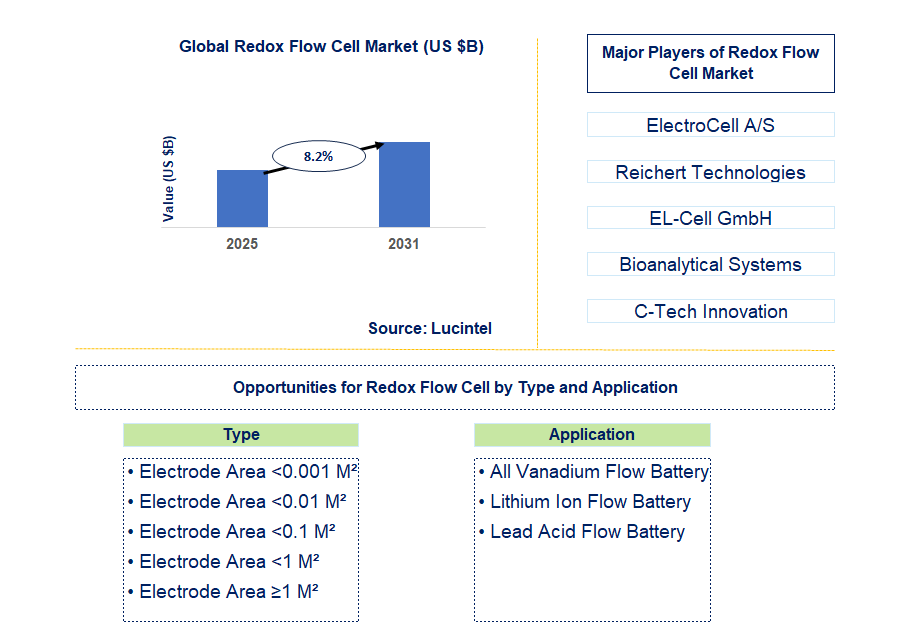
Key data points: The growth forecast = 8.2% annually for the next 7 years. Scroll below to get more insights. This market report covers Trends, opportunity and forecast in redox flow cell market to 2031 by type (electrode area <0.001 m², electrode area <0.01 m², electrode area <0.1 m², electrode area <1 m², and electrode area ≥1 m²), application (all vanadium flow battery, lithium ion flow battery, and lead acid flow battery), and region (North America, Europe, Asia Pacific, and the Rest of the World)
We'll send your sample report shortly.
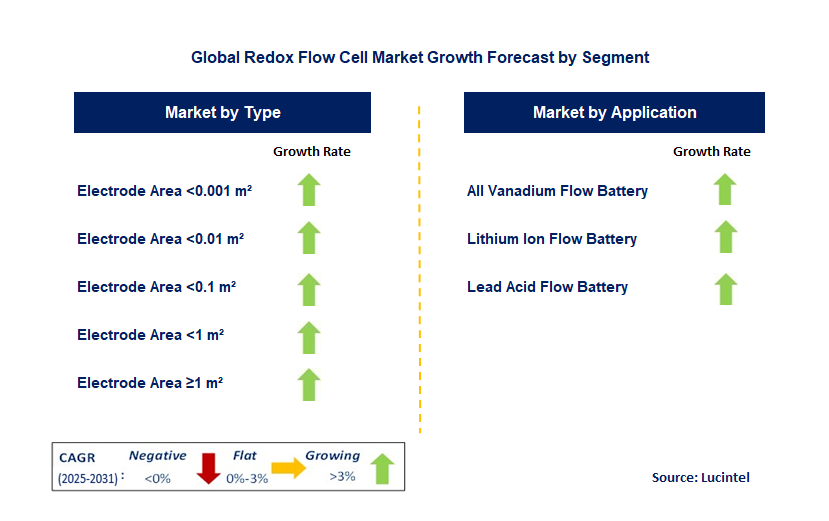
• Lucintel forecasts that, within the type category, electrode area ≥1 m² is expected to witness higher growth over the forecast period due to larger surface area, greater size..
• Within the application category, all vanadium flow battery is expected to witness the higher growth due to vanadium batteries have larger energy density..
• In terms of region, APAC is expected to witness the highest growth over the forecast period due to asia-pacific leads in renewable energy, manufacturing, and market adoption.. Gain valuable insights for your business decisions with our comprehensive 150+ page report. Sample figures with some insights are shown below.
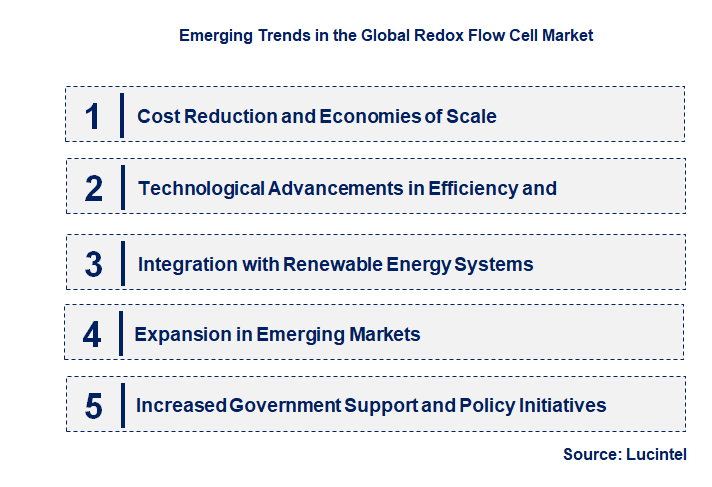
• Cost Reduction and Economies of Scale: As the production of redox flow cells scales up, manufacturers are able to reduce the cost of materials and production. Innovations in manufacturing processes and economies of scale are driving down costs, making redox flow batteries more competitive compared to traditional lithium-ion batteries. This trend is opening new opportunities for large-scale energy storage applications, especially in the grid and renewable energy sectors. With reduced costs, redox flow cells are expected to become more widely adopted in various industries, accelerating their deployment globally.
• Technological Advancements in Efficiency and Performance: Ongoing technological advancements are enhancing the efficiency and performance of redox flow batteries. Innovations in electrolyte chemistry, membrane development, and system integration are increasing the energy density and longevity of redox flow cells. These improvements are addressing some of the initial limitations of redox flow batteries, such as lower energy density and slow charge-discharge cycles, making them more attractive for commercial and industrial applications. This trend is expected to boost the adoption of redox flow cells in sectors such as energy storage for renewables, automotive, and even backup power systems.
• Integration with Renewable Energy Systems: Redox flow cells are increasingly being integrated with renewable energy systems, such as solar and wind farms, to provide reliable and efficient energy storage. As renewable energy generation is intermittent, redox flow batteries offer a solution to store excess energy for later use. This integration allows for better grid stability and reduces dependency on fossil-fuel-based backup systems. This trend is especially strong in regions with high renewable energy penetration, such as Europe and parts of Asia, and is expected to expand as renewable energy projects grow worldwide.
• Expansion in Emerging Markets: The Redox Flow Cell market is witnessing rapid growth in emerging markets, particularly in regions like India, Africa, and Southeast Asia, where the demand for clean energy solutions is on the rise. As these regions focus on expanding their renewable energy capacity, redox flow batteries provide an effective solution for large-scale energy storage. Governments in these regions are increasingly investing in energy storage solutions to stabilize power grids and support renewable energy integration. The growing demand for energy storage technologies is creating new opportunities for redox flow cells in these emerging markets.
• Increased Government Support and Policy Initiatives: Government policies and incentives are playing a significant role in driving the adoption of redox flow cells. Many countries have introduced subsidies, tax incentives, and funding opportunities to support energy storage technologies. In particular, nations focused on renewable energy goals are encouraging the development and deployment of redox flow batteries to improve grid resilience and integrate solar and wind energy. These government initiatives are fostering a favorable market environment for redox flow cell manufacturers, further accelerating their adoption and contributing to the market’s growth. These emerging trends are reshaping the Redox Flow Cell market by increasing their competitiveness, enhancing efficiency, and expanding their applications. Cost reduction, technological improvements, and increased adoption in emerging markets are accelerating the deployment of redox flow batteries. As governments continue to support renewable energy integration, the demand for reliable energy storage solutions like redox flow cells is expected to rise, driving market expansion across various industries.
• Breakthroughs in Electrolyte Chemistry: Significant progress has been made in the development of new electrolytes for redox flow cells, improving their efficiency and energy density. Researchers are exploring organic and hybrid electrolytes to enhance the performance of redox flow batteries, leading to longer cycle life, faster charge-discharge cycles, and better overall efficiency. These breakthroughs are addressing some of the key limitations of traditional electrolytes, making redox flow batteries more competitive for grid-scale energy storage and other industrial applications.
• Large-scale Deployments of Redox Flow Batteries: Several large-scale deployment projects have demonstrated the feasibility and reliability of redox flow batteries. In countries like the United States, China, and Germany, redox flow cells have been integrated into grid-scale energy storage systems, stabilizing renewable energy output and improving grid reliability. These projects have proven the effectiveness of redox flow batteries in addressing intermittency issues with renewable energy and are serving as models for future deployments worldwide.
• New Partnerships and Collaborations: Strategic partnerships between energy companies, research institutions, and technology providers are accelerating the development and commercialization of redox flow cells. Collaborations between leading players in the energy and technology sectors are driving innovation in battery chemistry, manufacturing processes, and system integration. These partnerships are helping to overcome the challenges of scale, cost, and performance, enabling the widespread adoption of redox flow batteries in commercial and industrial applications
• Expansion of Manufacturing Capabilities: In response to growing demand, several manufacturers are expanding their production capabilities for redox flow cells. Companies are investing in new production facilities and streamlining their manufacturing processes to reduce costs and increase supply. These efforts are making redox flow batteries more affordable and accessible, particularly for large-scale energy storage projects. As production volumes increase, economies of scale are expected to further drive down costs, contributing to the broader adoption of redox flow technology.
• Government Funding and Policy Support: Governments around the world have increasingly recognized the potential of redox flow cells for energy storage and have introduced funding programs and policy support to promote their development and adoption. In the U.S., China, and Europe, subsidies, grants, and tax incentives are being offered to companies involved in energy storage solutions, including redox flow battery technologies. This financial support is helping to offset the initial high costs of redox flow batteries and accelerate their commercialization. These key developments are driving the Redox Flow Cell market toward broader adoption. Breakthroughs in electrolyte chemistry, large-scale deployments, new partnerships, and increased manufacturing capabilities are making redox flow batteries more viable for a wide range of applications. Government funding and policy support are further facilitating market growth, solidifying the role of redox flow cells in the transition to cleaner, more reliable energy systems.
• Renewable Energy Integration: Redox flow cells are well-suited for integrating with renewable energy systems, especially solar and wind farms. Their ability to store excess energy generated during peak periods and release it when demand is high makes them ideal for renewable energy applications. As countries worldwide expand their renewable energy capacity, redox flow batteries will play a crucial role in ensuring grid stability and supporting energy transition efforts.
• Grid Stabilization and Backup Power: Redox flow cells offer a cost-effective solution for grid stabilization and backup power. With their ability to provide long-duration energy storage, they are particularly valuable for maintaining a stable supply during periods of high demand or power outages. Utilities and energy companies are increasingly adopting redox flow batteries for this purpose, creating a significant market opportunity for large-scale installations
• Electric Vehicle Charging Infrastructure: The growing electric vehicle (EV) market presents a new growth opportunity for redox flow batteries. Redox flow cells can be integrated into EV charging stations to provide energy storage that reduces grid stress during peak charging hours. This application is expected to grow as EV adoption increases and charging infrastructure expands worldwide, offering new market prospects for redox flow technologies.
• Industrial Energy Storage: Manufacturers and industrial facilities are looking for reliable, long-duration energy storage solutions to optimize their energy usage. Redox flow cells provide a flexible and scalable solution for these applications, offering benefits such as long cycle life and low maintenance costs. As industries seek ways to reduce energy costs and improve efficiency, redox flow batteries will gain traction in industrial energy storage systems.
• Remote and Off-grid Applications: Redox flow batteries are also well-suited for remote and off-grid applications, where reliable energy storage is critical. In areas without stable grid access, redox flow cells can store renewable energy and provide power during periods of low generation. This makes them an ideal solution for remote communities, military installations, and research stations, offering significant market opportunities in off-grid energy storage. The Redox Flow Cell market presents strategic growth opportunities in various sectors, including renewable energy integration, grid stabilization, electric vehicle infrastructure, industrial storage, and off-grid applications. As the demand for efficient, long-duration energy storage solutions continues to rise, redox flow cells are poised to play a central role in meeting global energy storage needs.
• ElectroCell A/S
• Reichert Technologies
• KNAUER Wissenschaftliche Gerate GmbH
• Bioanalytical Systems
• C-Tech Innovation
• Antec Scientific
• EL-Cell GmbH
• Thermo Fisher
• Electrode Area <0.001 M²
• Electrode Area <0.01 M²
• Electrode Area <0.1 M²
• Electrode Area <1 M²
• Electrode Area ≥1 M²
• All Vanadium Flow Battery
• Lithium Ion Flow Battery
• Lead Acid Flow Battery
• North America
• Europe
• Asia Pacific
• The Rest of the World
• United States: The United States has been at the forefront of research and development in the Redox Flow Cell market, particularly for grid-scale energy storage applications. Major players like ESS Inc. and ViZn Energy Systems are leading the charge in commercializing these batteries for renewable energy storage solutions. The U.S. government has also been increasing funding for energy storage projects under its push for clean energy, and several states have introduced policies to encourage energy storage solutions. The market is benefitting from incentives for renewable energy and energy storage technologies, with several pilot projects underway in various parts of the country.
• China: China is accelerating its adoption of redox flow batteries as part of its push for energy independence and a cleaner energy future. The country is a significant player in the global redox flow cell market, with government initiatives promoting energy storage systems to stabilize renewable energy supply. China has begun large-scale deployments of redox flow batteries in its renewable energy projects, particularly in solar and wind power farms. Domestic manufacturers, such as Rongke Power, are scaling up their production and driving down costs, while the government offers subsidies and incentives to promote the development of energy storage technologies.
• Germany: Germany is one of the leading European nations advancing redox flow cell technology. The country’s strong commitment to renewable energy and its Energiewende (energy transition) policy is fueling demand for reliable energy storage solutions. Germany’s government has been supporting the development of redox flow cells through funding initiatives and partnerships with research institutions. Companies like Bosch and Gildemeister are exploring redox flow battery technology for grid integration and renewable energy storage. The emphasis on renewable energy sources and the ongoing transition to a sustainable energy system is creating a strong demand for redox flow batteries in Germany.
• India: In India, the Redox Flow Cell market is gaining traction as the country looks for solutions to address its energy storage challenges, particularly in the renewable energy sector. With increasing reliance on solar and wind power, energy storage technologies like redox flow batteries are becoming essential for stabilizing the grid. The government’s ambitious renewable energy targets are driving investments in energy storage systems, including redox flow batteries, with both domestic and international companies entering the market. This growth is also supported by India’s push towards clean energy and smart grid integration, creating a favorable environment for the expansion of redox flow cell technologies.
• Japan: Japan is another key player in the Redox Flow Cell market, with a growing focus on renewable energy storage solutions. Japan’s energy policy is shifting towards a larger share of renewable energy, which increases the need for reliable energy storage systems to manage intermittency. The Japanese government has been supporting the development of energy storage technologies, including redox flow cells, to aid in this transition. Companies like Sumitomo Electric and Mitsubishi are leading efforts to commercialize flow battery technologies, and Japan’s expertise in electronics and engineering positions it as a potential leader in energy storage innovation.


• ElectroCell A/S
• Reichert Technologies
• KNAUER Wissenschaftliche Gerate GmbH
• Bioanalytical Systems
• C-Tech Innovation
• Antec Scientific
• EL-Cell GmbH
• Thermo Fisher Q5. Which redox flow cell market segment will be the largest in future? Answer: Lucintel forecasts that electrode area ≥1 m² is expected to witness higher growth over the forecast period due to larger surface area, greater size.. Q6. In redox flow cell market, which region is expected to be the largest in next 5 years? Answer: APAC is expected to witness the highest growth over the forecast period due to asia-pacific leads in renewable energy, manufacturing, and market adoption.. Q7. Do we receive customization in this report? Answer: Yes, Lucintel provides 10% customization without any additional cost.


Choose a license that fits your team. Instant PDF delivery.
Prices exclude taxes. Instant delivery. Custom licensing available on request.
Market Report · July 29, 2026
Market Report · July 20, 2026
Market Report · July 20, 2026
Trusted partner for strategic intelligence and business growth


Receive a complimentary market analysis tailored to your industry. Our analysts will identify key growth opportunities and competitive dynamics specific to your business.

Market size, growth rate, and key trend analysis for your specific sector.

Top competitor positioning and market share analysis.

Strategic recommendations backed by data-driven insights.
Get curated market intelligence and competitive moves straight to your inbox.
By subscribing, you agree to receive our monthly insights. Unsubscribe anytime.
Receive a complimentary market analysis tailored to your industry. Our analysts will identify key growth opportunities and competitive dynamics specific to your business.
Market size, growth rate, and key trend analysis for your specific sector.
Top competitor positioning and market share analysis.
Strategic recommendations backed by data-driven insights.
Get curated market intelligence, emerging trends, and competitive moves straight to your inbox each month.
By subscribing, you agree to receive our monthly insights. Unsubscribe anytime.
We'll send your sample report shortly.