
Market Report · July 16, 2026

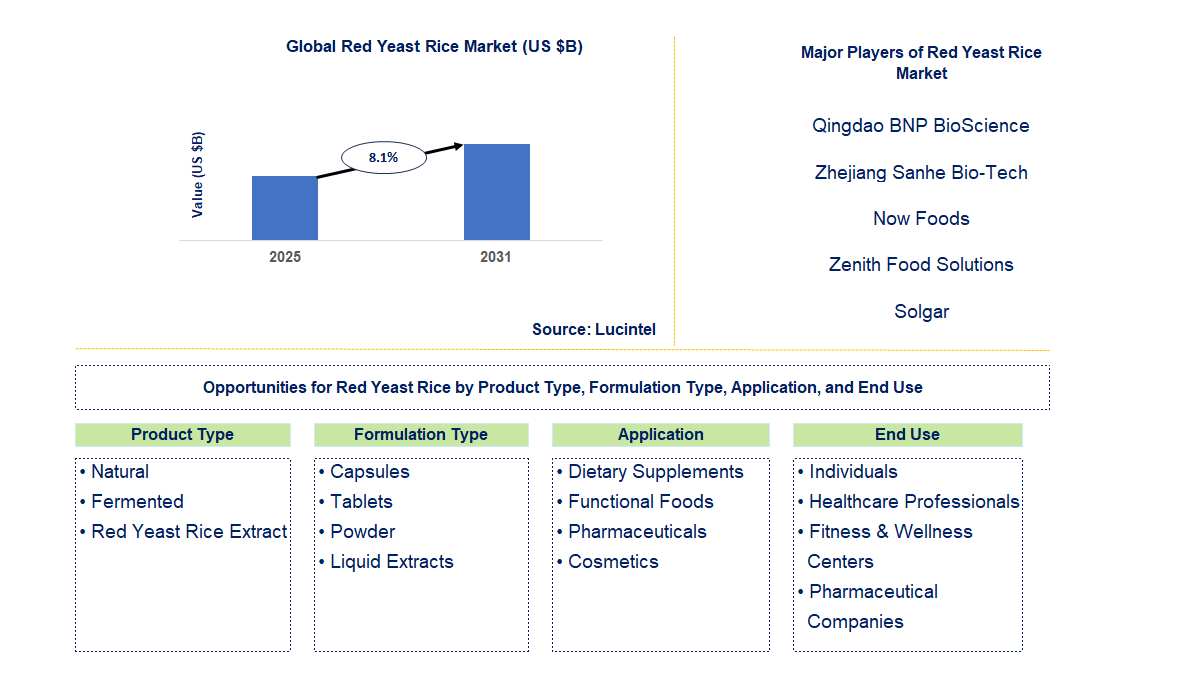
Key data points: The growth forecast = 8.1% annually for the next 7 years. Scroll below to get more insights. This market report covers trends, opportunities and forecasts in red yeast rice market to 2031 by product type (natural, fermented, and red yeast rice extract), formulation type (capsules, tablets, powder, and liquid extracts), application (dietary supplements, functional foods, pharmaceuticals, and cosmetics), end use (individuals, healthcare professionals, fitness & wellness centers, and pharmaceutical companies), and region (North America, Europe, Asia Pacific, and the Rest of the World)
We'll send your sample report shortly.
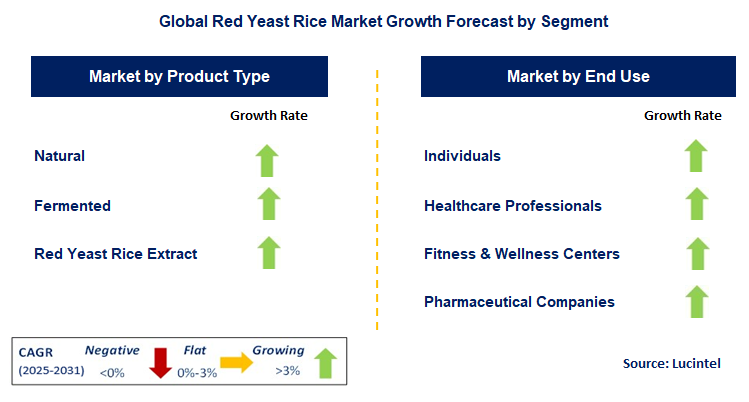
• Lucintel forecasts that, within the product type category, natural is expected to witness the highest growth over the forecast period.
• Within the end use category, healthcare professional is expected to witness the highest growth.
• In terms of region, APAC is expected to witness the highest growth over the forecast period. Gain valuable insights for your business decisions with our comprehensive 150+ page report. Sample figures with some insights are shown below.
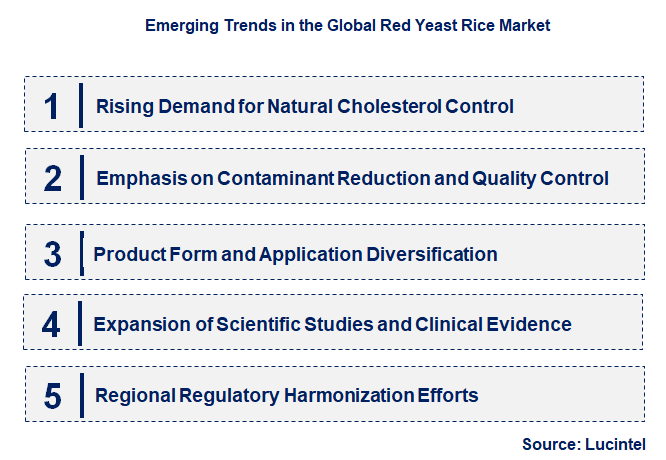
• Rising Demand for Natural Cholesterol Control: This trend is one of a rising worldwide consumer preference for natural products as an alternative to standard pharmaceutical medications for controlling cholesterol. Most people try to escape the side effects of statins by using supplements such as red yeast rice because of its natural monacolin K, which is structurally identical to lovastatin. The effect is a continued rise in demand for red yeast rice supplements, pushing research into its efficacy and safety profile and pushing manufacturers to create standardized, high-quality products to fill this market demand.
• Emphasis on Contaminant Reduction and Quality Control: The industry is placing greater emphasis on strict quality control processes to guarantee the safety and purity of red yeast rice supplements. This is primarily due to previous issues of possible contamination with citrinin, a cytotoxic fermentation byproduct, as well as variability in monacolin K levels. The effect is increased focus on sophisticated fermentation methods, stringent testing procedures, and transparent labeling, which promotes consumer confidence and complies with regulations, especially in markets with strict health supplement regulations.
• Product Form and Application Diversification: In addition to the conventional capsules and powders, red yeast rice is now being added to broader ranges of product forms and applications. Functional foods, drinks, and even certain cosmetic products now make use of their health-promoting effects and coloring properties. The result is an expanded market penetration and appeal as companies develop more convenient and integrated means for consumers to make red yeast rice part of their daily lives, pushing its application beyond specialty health supplements.
• Expansion of Scientific Studies and Clinical Evidence: There is a continuing pattern of more scientific studies and clinical trials to verify the safety and effectiveness of red yeast rice for medical conditions, specifically cardiovascular health. These studies aim to standardize doses, recognize potential interactions, and resolve issues regarding safety. The effect is increased credibility of red yeast rice as a nutritional supplement, delivering evidence-based substantiation for health claims and possibly affecting the future regulatory regimes, thus developing more welcoming acceptance by healthcare professionals and consumers.
• Regional Regulatory Harmonization Efforts: With the varied and sometimes opposing regulatory environments for red yeast rice around the world, a trend is being seen toward attempts to standardize regulations. This includes debate about acceptable levels of monacolin K and what labeling must be done so that consumers are safe yet international trade can be made easier. The effect is a more stable and efficient market for manufacturers, a lower barrier to entry, and broader distribution possibilities yet safer consumers through more transparent, consistent red yeast rice product guidelines. These new trends are actually transforming the red yeast rice market at a fundamental level by pushing it towards increasing standardization, enhanced safety, and varied applications. The interaction between increasing consumer demand for natural products and the need for sound scientific substantiation and regulatory clarity is driving innovation and determining market dynamics. Ultimately, these trends are creating a more mature and reliable marketplace for red yeast rice, thereby guaranteeing its continued growth and further inclusion in mainstream health and wellness routines.
• Heightened Regulatory Enforcement and Scrutiny: One of the most significant developments is the increased regulatory scrutiny and enforcement of red yeast rice products, especially with respect to the level of monacolin K and contamination with substances such as citrinin. Regulatory agencies in areas such as the European Union and the United States have either prohibited or strictly regulated products with high amounts of monacolin K. The consequence is a market in which producers are driven to spend lavishly on quality testing, assurance, and more transparent labeling, resulting in reformulations and even recalls, for consumer safety and conformity.
• Emphasis on Red Yeast Rice Production that is Citrinin-Free: There has been a high level of industry development towards producing "citrinin-free" red yeast rice. Citrinin is a nephrotoxic mycotoxin that may be produced during the fermentation phase. Producers are implementing sophisticated fermentation processes and quality control methods to guarantee that their product is free from this toxic contaminant. The effect is greater product safety and consumer trust, distinguishing responsible producers in the market and making red yeast rice a more acceptable choice for health-conscious consumers.
• Expansion in Organic and Clean Label Products: The industry is seeing a significant development with the explosion of organic and "clean label" red yeast rice products. More and more consumers are looking for supplements that contain no artificial additives, GMOs, or pesticides, keeping in line with overall health and wellness trends. The effect is a migration of production practices toward sustainable and organic farming and open sourcing. This appeals to a niche but increasing consumer base that is ready to pay more for products viewed as more natural and pure.
• Scientific Research and Public Awareness Campaigns: Recent trends involve a rise in scientific studies on the effectiveness and safety of red yeast rice, as well as public campaigns. Although some studies affirm its ability to lower cholesterol, other studies identify safety issues with monacolin K and citrinin. The effect is a wiser consumer base but also greater caution among health professionals, requiring manufacturers to give proper information and participate in ethical marketing to control public perception and achieve credibility.
• Foray into Functional Food and Beverage Segments: Another significant trend is the growth of red yeast rice from conventional supplements to functional food and beverage markets. It is being integrated into fortified cereals, health beverages, and specialty snacks, tapping into its health and coloring properties. The effect is diversification of consumption patterns, making red yeast rice a universal product and incorporating it into regular diets, bringing new opportunities for market expansion and product development. These advancements are collectively shaping the red yeast rice market by inducing a dual emphasis on scientific proof and rigorous safety protocols while also broadening its uses. The sector is weathering the nuances of regulatory environments and consumer distrust by emphasizing purity, encouraging open labeling, and expanding product variety. This tripartite strategy is revolutionizing the market toward a more responsible, innovative, and consumer-driven future.
• Dietary Supplements for Cardiovascular Health: The largest opportunity for growth is in dietary supplements tailored for cardiovascular wellness. With increasing global concern over cholesterol, red yeast rice presents a natural solution to chemical statins, appealing to active consumers wanting control over health issues. The potential is in creating high-quality, standardized formulas with validated monacolin K levels, and possibly blended with other heart-support ingredients, and positioning them with transparent scientific support to secure consumer and healthcare professional confidence.
• Functional Foods and Beverages: Incorporating red yeast rice in functional foods and beverages is a massive opportunity for growth. This would involve fortified yogurts, health beverages, cereals, and snack bars that are formulated to provide cholesterol-reducing benefits as part of a normal diet consumption. The opportunity is to service consumers who would like to get health benefits in their day-to-day food consumption as opposed to using pills alone, producing products that are not only healthy but also tasty, hence driving red yeast rice consumption beyond the supplement shelf.
• Traditional and Herbal Medicine Formulations: Growth potential lies in the traditional and herbal medicine channels, especially for Asian markets where red yeast rice has traditional associations. Introducing or repackaging red yeast rice as an Ayurvedic, Traditional Chinese Medicine (TCM), or other traditional formulation, frequently with synergistic herbs, can attract a broad base of consumers who believe in traditional remedies. The opportunity lies in using cultural heritage and traditional therapeutic practice to establish authentic and effective natural health products.
• Natural Food Colorings and Flavorings: Red yeast rice presents a unique growth opportunity as a natural food colorant and flavoring ingredient. With growing consumer demand for "clean label" foods without artificial flavors and colors, its reddish color and milder flavor can be leveraged in different types of food such as fermented bean curd, processed foods, and confectionery. The opportunity is in offering a safe, natural, and multi-purpose ingredient that addresses both the aesthetic and health-conscious needs of consumers in the food industry.
• Cosmetics and Personal Care Products: One of the promising but niche areas of growth for red yeast rice is in cosmetics and personal care. Its potential antioxidant activity and historical usage for healthy skin may give rise to use in skincare, anti-aging creams, and hair products. The opportunity is to investigate its bioactive ingredients for topical purposes, capturing the increasing trend toward natural and botanical ingredients in personal care products, and appealing to consumers looking for holistic wellness carried over to their personal care regimen. These growth strategies are essentially transforming the red yeast rice industry by driving it towards diversified product lines and broadening market opportunities. With its established health value and natural characteristics, producers can access increasing consumer bases in pharmaceuticals, food, and personal care. This multi-dimensional strategy induces innovation, adds market value, and keeps red yeast rice a relevant and desirable product in the changing scenario of health and wellness.
• Qingdao BNP BioScience
• Zhejiang Sanhe Bio-Tech
• Now Foods
• Zenith Food Solutions
• Solgar
• Weider Global Nutrition
• BioScience Nutrition
• Natural
• Fermented
• Red Yeast Rice Extract
• Capsules
• Tablets
• Powder
• Liquid Extracts
• North America
• Europe
• Asia Pacific
• The Rest of the World
• United States: In the United States, the red yeast rice market is largely motivated by growing consumer demand for natural supplements for cholesterol control. It is, however, subject to strict regulatory controls from the Food and Drug Administration (FDA), treating products containing high monacolin K content as unapproved drugs. Recent trends involve producers emphasizing formulations with standardized levels of monacolin K and intense third-party verification to guarantee purity and prevent contamination, such as citrinin, hoping for clearer labeling and consumer confidence.
• China: China is still a dominant force in the red yeast rice market, both as a historical user and a large-scale producer. Although widely utilized as a food coloring and flavoring agent, some functional red yeast rice products have also been developed with explicit health claims, mainly for lipid reduction. New advances involve greater study of classical uses and fermentation processes to maximize desirable compounds without producing unwanted ones. The market also maintains a difference between general food-grade red yeast rice and functional types with differing regulations.
• Germany: The German red yeast rice market is dominated by a risk-averse attitude owing to stringent European Union regulations related to food supplements with monacolins. The German Federal Institute for Risk Assessment recommends against its consumption under medical supervision owing to the fear of side effects from statin-like effects as well as citrinin content. Advances emphasize transparent labeling standards, consumer warnings, and restricted distribution, with most products being open to recall when monacolin K content rises above trace levels or when contamination is found.
• India: In India, the red yeast rice market is picking up momentum in the larger natural health and Ayurvedic medicine markets. Its historical applications for cardiovascular health and digestion are being rediscovered and incorporated into contemporary dietary supplements. Recent trends reflect a growing consciousness among consumers of its cholesterol-reducing attributes and antioxidant value. Local producers are surfacing, marketing red yeast rice in multiple forms, frequently in combination with other herbal substances to meet the expanding popularity of integrated health products.
• Japan: The Japanese market for red yeast rice recently experienced a major setback from a highly publicized contamination crisis with a leading pharmaceutical firm’s red yeast rice supplements. This event caused all kinds of health complications and product recalls, critically affecting consumer confidence and regulatory oversight. Consequently, current developments are strongly centered on strengthening safety measures, quality control, and more stringent regulations for red yeast rice dietary supplements, highlighting the importance of purity and avoiding future recurrence of contamination.


• Qingdao BNP BioScience
• Zhejiang Sanhe Bio-Tech
• Now Foods
• Zenith Food Solutions
• Solgar
• Weider Global Nutrition
• BioScience Nutrition Q5. Which red yeast rice market segment will be the largest in future? Answer: Lucintel forecasts that, within the product type category, natural is expected to witness the highest growth over the forecast period. Q6. In red yeast rice market, which region is expected to be the largest in next 5 years? Answer: In terms of region, APAC is expected to witness the highest growth over the forecast period. Q7. Do we receive customization in this report? Answer: Yes, Lucintel provides 10% customization without any additional cost.


Choose a license that fits your team. Instant PDF delivery.
Prices exclude taxes. Instant delivery. Custom licensing available on request.
Market Report · July 16, 2026
Market Report · July 15, 2026
Market Report · July 15, 2026
Trusted partner for strategic intelligence and business growth


Receive a complimentary market analysis tailored to your industry. Our analysts will identify key growth opportunities and competitive dynamics specific to your business.

Market size, growth rate, and key trend analysis for your specific sector.

Top competitor positioning and market share analysis.

Strategic recommendations backed by data-driven insights.
Get curated market intelligence and competitive moves straight to your inbox.
By subscribing, you agree to receive our monthly insights. Unsubscribe anytime.
Receive a complimentary market analysis tailored to your industry. Our analysts will identify key growth opportunities and competitive dynamics specific to your business.
Market size, growth rate, and key trend analysis for your specific sector.
Top competitor positioning and market share analysis.
Strategic recommendations backed by data-driven insights.
Get curated market intelligence, emerging trends, and competitive moves straight to your inbox each month.
By subscribing, you agree to receive our monthly insights. Unsubscribe anytime.
We'll send your sample report shortly.