
Market Report · July 29, 2026

Key data points: The growth forecast = 33.2% annually for the next 7 years. Scroll below to get more insights. This market report covers Trends, opportunity and forecast in reconfigurable intelligent surfaces (RIS) hardware market to 2031 by antenna type (phased array antenna, reflect array antenna, and metasurface antenna), application (spectrum enhancement, coverage extension, and beamforming), and region (North America, Europe, Asia Pacific, and the Rest of the World)
We'll send your sample report shortly.
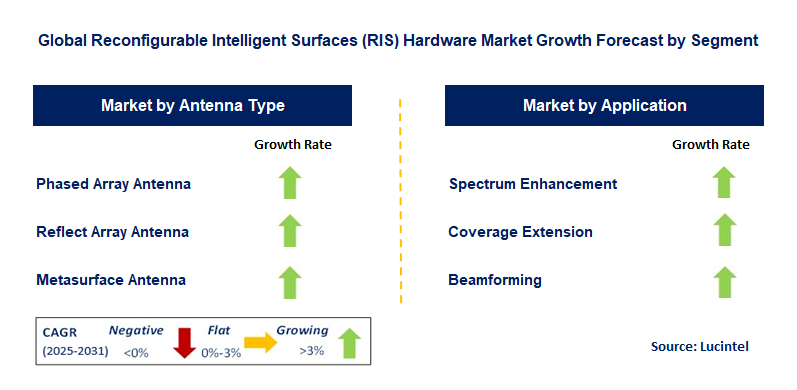
• Lucintel forecasts that, within the antenna type category, the phased array antenna is expected to witness the highest growth over the forecast period.
• Within the application category, spectrum enhancement is expected to witness the highest growth.
• In terms of region, North America will remain the largest region over the forecast period due to growing R&D investment in wireless communication technologies.
Gain valuable insights for your business decisions with our comprehensive 150+ page report. Sample figures with some insights are shown below.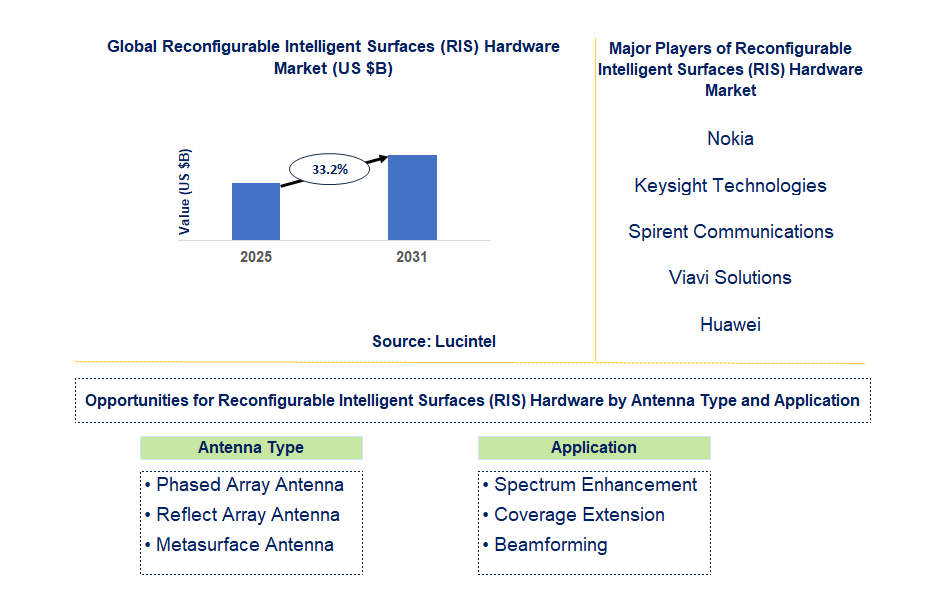
• Integration with 6G Networks: RIS hardware is emerging as a foundational technology for 6G networks, addressing challenges in spectrum efficiency, energy optimization, and latency reduction. As 6G promises terahertz communication and ultra-reliable connectivity, RIS facilitates dynamic wavefront shaping and real-time adaptability, ensuring optimal performance. Research and development in this area focus on creating lightweight, cost-effective RIS panels suitable for dense urban and remote environments. This integration not only enhances connectivity but also reduces the environmental footprint of communication systems, aligning with global sustainability goals.
• AI-Driven Optimization: Artificial Intelligence (AI) is increasingly being leveraged to optimize RIS hardware functionality. Machine learning algorithms enable adaptive control of surface elements to improve network performance under varying conditions. This trend supports intelligent decision-making in real-time, such as beam steering and interference cancellation. By integrating AI, RIS systems can self-learn and evolve, leading to more robust and efficient communication networks. This development enhances user experiences while enabling telecom operators to deploy smarter, more cost-effective solutions.
• Collaborative R&D Ecosystems: Global collaborations between academia, industry, and government bodies are driving innovation in RIS hardware. Joint research projects and open innovation platforms are fostering the development of advanced prototypes and accelerating commercialization. Such ecosystems enable stakeholders to share expertise, pool resources, and address technical challenges collectively. As a result, RIS technology is rapidly transitioning from theoretical models to practical applications, boosting its adoption across diverse sectors, including healthcare, transportation, and smart cities.
• Miniaturization and Portability: Miniaturization of RIS hardware is a growing trend, making the technology more portable and versatile. Advances in materials science and manufacturing techniques have enabled the production of compact RIS units that can be seamlessly integrated into various devices and environments. Portable RIS panels are particularly beneficial for temporary installations and mobile applications, such as disaster recovery and event coverage. This trend broadens the scope of RIS deployments, making the technology accessible to a wider range of use cases.
• Focus on Sustainability: Environmental sustainability is a key driver in RIS hardware innovation. By enabling energy-efficient communication and reducing reliance on power-intensive infrastructure, RIS technology supports green network initiatives. Researchers are also exploring eco-friendly materials for RIS manufacturing and developing designs that minimize electronic waste. This trend reflects a growing commitment to sustainable practices in the telecommunications industry, addressing both consumer expectations and regulatory requirements for environmentally responsible technologies.
The RIS hardware market is undergoing a transformative phase driven by advancements in 6G integration, AI, collaborative innovation, miniaturization, and sustainability. These trends are not only enhancing the functionality and applicability of RIS technology but also positioning it as a critical enabler for next-generation communication networks. As RIS solutions continue to evolve, they are poised to redefine the future of wireless connectivity, offering smarter, greener, and more adaptive communication systems.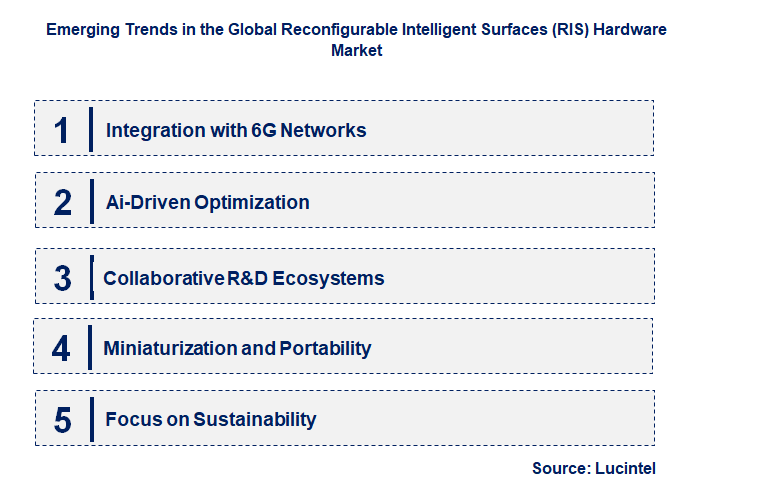
• Advanced Material Innovation: Recent advancements in metamaterials and tunable surfaces are significantly enhancing the performance of RIS hardware. These materials allow precise manipulation of electromagnetic waves, improving signal reflection, absorption, and transmission. Innovations in low-loss, energy-efficient materials are enabling the production of more compact and versatile RIS panels. Such developments are vital for integrating RIS into urban environments and smart infrastructures, where space constraints and efficiency demands are critical. This progress enhances the reliability and scalability of RIS solutions, making them more practical for diverse applications.
• Integration with Artificial Intelligence (AI): AI is increasingly integrated into RIS hardware to optimize performance dynamically. Machine learning algorithms are being employed to adjust surface configurations in real-time, ensuring efficient signal propagation under varying conditions. This development allows for smarter networks capable of handling complex environments, such as dense urban areas and industrial zones. The synergy between RIS and AI is driving the creation of autonomous, self-optimizing communication systems, reducing operational costs while boosting network reliability and user experiences.
• Prototyping for 6G Networks: The development of RIS prototypes tailored for 6G networks represents a major leap forward. These prototypes focus on supporting terahertz frequencies and ultra-low latency communication. Researchers and industry players are collaborating to test RIS systems in real-world scenarios, validating their effectiveness for massive device connectivity and enhanced data rates. Such advancements underline RIS hardware's role as a cornerstone for 6G, setting the stage for its commercialization and widespread implementation in future networks.
• Multi-Functional Surface Design: Innovations in multi-functional RIS hardware enable simultaneous control over multiple communication parameters, such as phase, amplitude, and polarization. These designs allow for enhanced beamforming capabilities and improved network performance. Multi-functional surfaces are particularly useful for environments with high interference levels, ensuring stable and efficient communication. This development expands the scope of RIS applications, including smart transportation systems, IoT networks, and next-generation wireless backhauls.
• Standardization and Interoperability Efforts: Efforts toward standardizing RIS hardware are gaining momentum, with industry consortia and regulatory bodies working to establish guidelines for interoperability. Standardization ensures that RIS solutions from different manufacturers can seamlessly integrate into existing and future communication infrastructures. This push for uniformity accelerates adoption, reduces deployment costs, and fosters a competitive market landscape. It also enhances user confidence in the technology's reliability and long-term viability.
The RIS hardware market is undergoing transformative changes driven by material innovations, AI integration, 6G-specific prototyping, multi-functional designs, and standardization efforts. These developments are significantly improving the functionality, scalability, and adaptability of RIS solutions, positioning them as critical enablers of next-generation communication networks. As the market evolves, these advancements promise to redefine wireless communication, offering smarter, more efficient, and sustainable connectivity solutions.• Enhanced 5G Network Deployment: RIS hardware is instrumental in overcoming challenges like signal blockages and coverage gaps in 5G networks. By optimizing signal strength and directing beams toward underserved areas, RIS facilitates seamless connectivity in dense urban environments and remote regions. Its ability to reduce reliance on additional infrastructure, such as base stations, lowers deployment costs while enhancing network performance. This makes RIS a crucial enabler for 5G expansion, allowing operators to deliver consistent high-speed connectivity and improve user experiences. RIS's impact in this application fosters rapid adoption, driving innovation in hardware design and integration with network architectures.
• Smart City Infrastructure: Smart cities require robust communication networks to support IoT devices, autonomous vehicles, and real-time data analytics. RIS hardware addresses the need for scalable, energy-efficient, and reliable connectivity by enabling intelligent control over signal propagation in complex urban landscapes. Its integration with smart city infrastructure optimizes resource allocation, reduces interference, and ensures seamless connectivity across diverse environments. This enhances applications like smart traffic management, public safety, and environmental monitoring, promoting sustainable urban development. As cities prioritize digital transformation, RIS hardware emerges as a key enabler, spurring advancements in both technology and infrastructure integration.
• Transportation and Mobility: The transportation sector is embracing RIS hardware to enhance connectivity for autonomous vehicles, intelligent transportation systems, and high-speed rail. By improving communication between vehicles and infrastructure, RIS ensures reliable and low-latency data exchange, which is critical for safety and efficiency. Its ability to optimize wireless signals in dynamic environments, such as moving vehicles, overcomes traditional challenges like signal degradation and interference. RIS also supports efficient spectrum utilization, seamlessly integrating 5G and V2X (Vehicle-to-Everything) technologies. This drives innovation in mobility solutions, enabling smarter, safer, and more connected transportation networks globally.
• Healthcare Connectivity Solutions: In healthcare, RIS hardware enables reliable and secure communication for telemedicine, remote monitoring, and smart hospitals. Its capability to enhance signal quality and ensure uninterrupted connectivity is critical for real-time data transfer, particularly in life-critical applications. RIS also supports the deployment of wireless medical devices and IoT-enabled systems, optimizing network performance in challenging indoor environments like hospitals. By reducing latency and ensuring consistent connectivity, RIS enhances patient care, facilitates advanced diagnostics, and supports the growing demand for digital healthcare solutions. This positions RIS as a transformative technology in the rapidly evolving healthcare landscape.
• Industrial IoT and Automation: RIS hardware plays a pivotal role in industrial IoT by addressing connectivity challenges in factories, warehouses, and energy facilities. Its ability to control signal propagation in complex industrial settings ensures robust and interference-free communication between machines, sensors, and control systems. This is crucial for enabling real-time monitoring, predictive maintenance, and automation. Additionally, RIS enhances wireless coverage in remote or harsh environments, reducing the need for extensive cabling or additional hardware. By enabling efficient and scalable industrial operations, RIS hardware supports the adoption of Industry 4.0 technologies, driving growth in smart manufacturing and logistics.
The strategic growth opportunities presented by RIS hardware across key applications highlight its transformative potential in shaping next-generation connectivity solutions. From enhancing 5G deployment to empowering smart cities, transportation, healthcare, and industrial IoT, RIS delivers unparalleled benefits in performance, scalability, and efficiency. These advancements are driving widespread adoption and innovation in RIS hardware, establishing it as a foundational technology for modern communication systems. As industries continue to prioritize connectivity and digital transformation, RIS hardware is poised to play a critical role in enabling smarter, more connected ecosystems.• Nokia
• Keysight Technologies
• Spirent Communications
• Viavi Solutions
• Huawei
• Analog Devices
• CommScope
• Fujitsu
• Samsung
• MediaTek
• Phased Array Antenna
• Reflect Array Antenna
• Metasurface Antenna
• Spectrum Enhancement
• Coverage Extension
• Beamforming
• North America
• Europe
• Asia Pacific
• The Rest of the World
• United States: In the United States, advancements in RIS hardware are primarily driven by extensive research and development initiatives. Collaborations between leading technology firms and academic institutions have led to the creation of innovative RIS prototypes aimed at improving wireless communication infrastructure. These efforts align with the nation's broader strategy to maintain a competitive edge in next-generation communication technologies.
• China: The Chinese RIS hardware market is experiencing significant growth, fueled by substantial investments in 6G research and development. The country's focus on integrating RIS technology into its communication networks is evident through various government-backed projects and partnerships with leading technology companies. This strategic approach positions China as a key player in the global RIS landscape.
• Germany: Germany is actively exploring RIS technology to enhance its communication infrastructure. Research institutions and industry players are collaborating on projects aimed at integrating RIS into existing networks, with a focus on improving coverage and energy efficiency. These initiatives reflect Germany's commitment to adopting cutting-edge technologies to bolster its telecommunications sector.
• India: In India, the RIS hardware market is gaining momentum as the country seeks to upgrade its communication systems. Government initiatives and collaborations with international technology firms are fostering the development and deployment of RIS solutions. These efforts aim to address challenges such as spectrum scarcity and network congestion, thereby enhancing overall connectivity.
• Japan: Japan is at the forefront of RIS technology adoption, with a strong emphasis on research and practical applications. The country's tech industry is actively developing RIS hardware to support advanced communication networks, including the anticipated rollout of 6G. Japan's proactive approach underscores its dedication to leading in technological innovation and implementation.


• Nokia
• Keysight Technologies
• Spirent Communications
• Viavi Solutions
• Huawei
• Analog Devices
• CommScope
• Fujitsu
• Samsung
• MediaTek
Q5. Which reconfigurable intelligent surfaces (RIS) hardware market segment will be the largest in future?

Choose a license that fits your team. Instant PDF delivery.
Prices exclude taxes. Instant delivery. Custom licensing available on request.
Market Report · July 29, 2026
Market Report · July 20, 2026
Market Report · July 20, 2026
Trusted partner for strategic intelligence and business growth


Receive a complimentary market analysis tailored to your industry. Our analysts will identify key growth opportunities and competitive dynamics specific to your business.

Market size, growth rate, and key trend analysis for your specific sector.

Top competitor positioning and market share analysis.

Strategic recommendations backed by data-driven insights.
Get curated market intelligence and competitive moves straight to your inbox.
By subscribing, you agree to receive our monthly insights. Unsubscribe anytime.
Receive a complimentary market analysis tailored to your industry. Our analysts will identify key growth opportunities and competitive dynamics specific to your business.
Market size, growth rate, and key trend analysis for your specific sector.
Top competitor positioning and market share analysis.
Strategic recommendations backed by data-driven insights.
Get curated market intelligence, emerging trends, and competitive moves straight to your inbox each month.
By subscribing, you agree to receive our monthly insights. Unsubscribe anytime.
We'll send your sample report shortly.