
Market Report · July 22, 2026

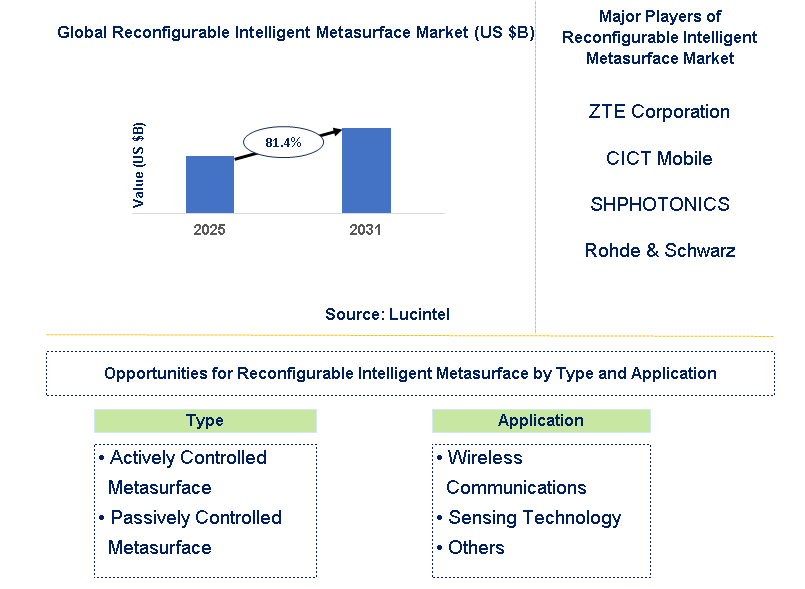
Key data points: The growth forecast = 81.4% annually for the next 7 years. Scroll below to get more insights. This market report covers trends, opportunities and forecasts in reconfigurable intelligent metasurface market to 2031 by type (actively controlled metasurface and passively controlled metasurface), application (wireless communications, sensing technology, and others), and region (North America, Europe, Asia Pacific, and the Rest of the World)
We'll send your sample report shortly.
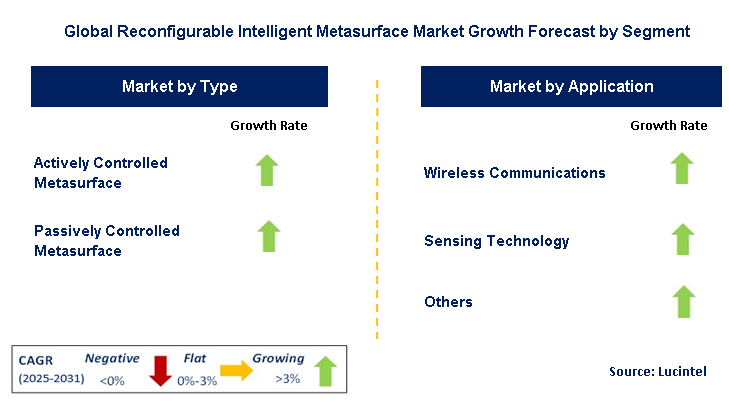
• Lucintel forecasts that, within the type category, actively controlled metasurface is expected to witness higher growth over the forecast period.
• Within the application category, wireless communication is expected to witness higher growth.
• In terms of region, North America is expected to witness the highest growth over the forecast period. Gain valuable insights for your business decisions with our comprehensive 150+ page report. Sample figures with some insights are shown below.
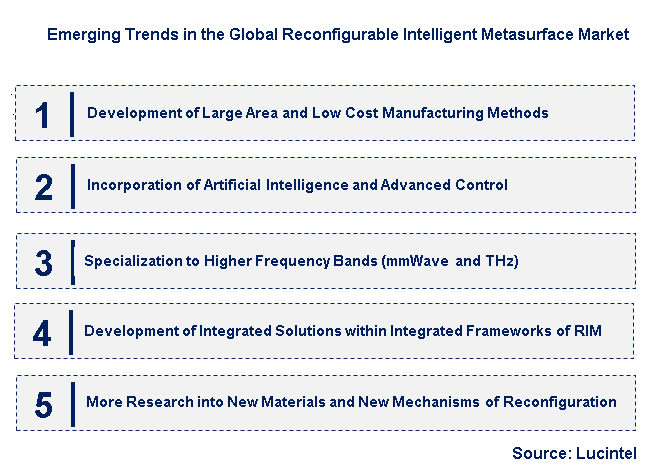
• Development of Large Area and Low Cost Manufacturing Methods: One of the preeminent trends is focused on broad area RIMs scalable and economical manufacturing processes. There is research in roll to roll processes, inkjet printing, and self assembly to reduce costs in the manufacturing of RIMs so that they can be deployed on large areas, such as building facades for smart buildings, and for wireless coverage improvement at wide areas.
• Incorporation of Artificial Intelligence and Advanced Control: Highly advanced control systems are required for the ability of dynamically reconfiguring RIMs. Another prominent trend is the application of AI and machine learning for optimizing RIM configurations in real time considering environmental conditions and user needs. Such control will enable the implementation of adaptive beamforming, interference suppression, and improve overall communication system performance.
• Specialization to Higher Frequency Bands (mmWave and THz): In light of the increased demand for bandwidth, there is a trend towards developing RIMs that function well at mm Wave and THz frequencies for new applications like high-resolution sensing and imaging. Novel designs and materials that can manipulate electromagnetic waves of extremely high frequencies are required.
• Development of Integrated Solutions within Integrated Frameworks of RIM: The trend in RIMs is shifting from single-purpose designs to multifunctional surfaces that can simultaneously perform tasks such as beam steering and polarization control or integrating other senses, such as IntelliJ- gene. These compact and versatile systems will be more efficient than the current RIM-based systems designed for specific applications.
• More Research into New Materials and New Mechanisms of Reconfiguration: The choice of materials and the reconfiguration process within the RIM have a strong influence on its performance. There is a trend towards the use of more materials, such as graphene, liquid crystals, and other phase-change materials, as well as more reconfiguration approaches, including electrical, optical, thermal, and mechanical actuation, to increase the efficiency, speed, and tunability of RIMs. These trends indicate the reconfigurable intelligent meta surface market is very active and evolving, showcasing research potential in manipulating electromagnetic fields and expanding the scope of applicable fields.
• Progress in Liquid Crystal Based RIMs for Dynamic Beam Steering: One of the advancements include the improvement of operating liquid crystal (LC) based RIMs for dynamic beam steering and their increased efficiency and speed. Researchers are integrating novel LC materials with lower switching voltages and faster response times into RIM designs, which bodes well for wireless communication and radar systems.
• Development of RIMs MEMS-Based For High Frequencies: Microelectromechanical systems (MEMS) technology is gaining prominence for the fabrication of RIM elements for higher frequency operations which includes mmWave bands. Recent works focus on reliability and scalability of these MEMS based RIMs for 5G/6G and high precision advanced sensing.
• Capabilities Demonstration of Energy Harvesting in RIMs: Exciting progress is the incorporation of energy harvesting functionalities into the structures of RIMs. Researchers put materials that can harvest nearby electromagnetic energy to reconfigure into the structure which can lead to self-powered and sustainable RIM solutions.
• Progress on Software-Defined Metasurfaces with Multi-Dimensional Control: The automation of control algorithms and system software is important for Remote Intelligent Metasurfaces (RIMs). For example, multi-beam generation and interference cancellation are capable to turn on and off with software-defined metasurfaces and electromagnetic programming.
• Scalable RIM Production by Exploration of Additive Manufacturing Methods: Additive manufacturing is studied as a cost effective method to produce RIMs with complex geometries at large scales. Recent works proved the, theoretically possible, printing of functional metasurface elements and their integration into reconfigurable architectures. These recent advancements demonstrate the dynamic progress in the reconfigurable intelligent metasurface market, advancing the development towards dynamically controllable surfaces with electromagnetic functionalities.
• Advancement of Wireless Communication Networks (5G/6G and Beyond): In the roles that RIMs may take to enhance the performance parameters and effectiveness of remote communication networks, they can improve signal coverage, decrease interference, enhance dynamic beam shaping and steering, among many others. This opportunity showcases the potential of RIM deployment within future mobile networks.
• Disruptive Sensing and Medical Imaging: Ultra-compact, ultra-agile radar systems can be constructed using RIMS for advanced medical imaging, alongside newer sensors with dynamic electromagnetic interaction tunable features. The adept control of electromagnetic waves can interact with many objects, thus broadening growth prospects across several fields of imaging and sensing.
• Intelligence and Energy Efficient Environments: The incorporation of RIMs into furniture, building facades and other ordinary objects can result in controlling electromagnetic waves for energy harvesting, indoor wireless coverage optimization, contactless power transfer and much more, leading to ample prospects in smart homes and cities.
• RIMs can be embedded in vehicles to enhance radar and lidar systems with infrastructure communication, amongst many other capabilities. This presents a lucrative refinement opportunity in the automotive sector regarding safety features, as well as advanced driver-assistance systems.
• With RIMs, the display technology sector has an opportunity to produce high quality, low energy AR/VR systems, holographic displays, and other next-gen displays. RIMs offer unmatched control over electromagnetic wave propagation, allowing for more advanced image processing techniques to be used that significantly enhance the user experience. These examples speak to the growth potential of reconfigurable intelligent metasurface in driving transformation across multiple industries throughout their evolution, worsened only through the unique capabilities of dynamically controlling waves of electromagnetic radiation, enabling advanced technologies.
• ZTE Corporation
• CICT Mobile
• SHPHOTONICS
• Rohde & Schwarz
• Actively Controlled Metasurface
• Passively Controlled Metasurface
• Wireless Communications
• Sensing Technology
• Others
• North America
• Europe
• Asia Pacific
• The Rest of the World
• United States: US leads in RIM research and development. Many universities, start-ups and government labs are heavily involved. Among the most recent developments include advanced control algorithms for dynamic beam steering and shaping, the incorporation of RIMs with new semiconductor technology. This is done to enable faster and more efficient reconfiguration. Additionally, there is some work done on 5G/6G and smart spaces, but a huge focus is placed on defense and aerospace industries.
• China: Current Chinese advancements in RIM fabrication RIM integration into 5G base station prototypes for improved coverage and capacity are major steps towards boosting China’s role in the RIM market. Chinese researchers remain active in subjects like application in smart cities, autonomous vehicles, as well as advanced radar systems. Undoubtedly, government investment in next-gen wireless technologies is paving the way for China to further enhance its involvement in the RIM market.
• Germany: Industrial application as well as fundamental research are key drivers of development in the RIM market in Germany. Recently, lower power consumption for RIM integration with industrial sensors and communication systems has been achieved. In addition, focus on development of reliable and robust RIMs for automotive IoT use has emerged. Moreover, the progress of integrating energy-efficient reconfiguration mechanisms has also been reported.
• India: Unlike other nations, the RIM market in India is quite new and is mainly limited to research activities within academic institutions, government projects, and semiconductors. Although still in the early phases, there is increased attention on designing and simulating RIM structures that could potentially be used in defending systems as well as in communication systems. The technology’s potential in increasing connectivity, sensing, and awareness industries in India helps boost the interest towards the RIM technology
• Japan: Japan has maintained its position in the RIM market owing to its strength in materials science and electronics. Recent work includes designing RIMs that are incredibly efficient, low-loss, and operate at millimeter-wave frequencies. There is also an emphasis in the incorporation of RIMs into small size communication devices and advanced imaging and holographic display systems.


• ZTE Corporation
• CICT Mobile
• SHPHOTONICS
• Rohde & Schwarz Q5. Which reconfigurable intelligent metasurface market segment will be the largest in future? Answer: Lucintel forecasts that, within the type category, actively controlled metasurface is expected to witness higher growth over the forecast period. Q6. In reconfigurable intelligent metasurface market, which region is expected to be the largest in next 5 years? Answer: In terms of region, North America is expected to witness the highest growth over the forecast period. Q7. Do we receive customization in this report? Answer: Yes, Lucintel provides 10% customization without any additional cost.


Choose a license that fits your team. Instant PDF delivery.
Prices exclude taxes. Instant delivery. Custom licensing available on request.
Market Report · July 22, 2026
Market Report · July 17, 2026
Market Report · July 17, 2026
Trusted partner for strategic intelligence and business growth


Receive a complimentary market analysis tailored to your industry. Our analysts will identify key growth opportunities and competitive dynamics specific to your business.

Market size, growth rate, and key trend analysis for your specific sector.

Top competitor positioning and market share analysis.

Strategic recommendations backed by data-driven insights.
Get curated market intelligence and competitive moves straight to your inbox.
By subscribing, you agree to receive our monthly insights. Unsubscribe anytime.
Receive a complimentary market analysis tailored to your industry. Our analysts will identify key growth opportunities and competitive dynamics specific to your business.
Market size, growth rate, and key trend analysis for your specific sector.
Top competitor positioning and market share analysis.
Strategic recommendations backed by data-driven insights.
Get curated market intelligence, emerging trends, and competitive moves straight to your inbox each month.
By subscribing, you agree to receive our monthly insights. Unsubscribe anytime.
We'll send your sample report shortly.