
Market Report · May 18, 2026

This market report covers trends, opportunities, and forecasts in the global reader chips market to 2031 by technology (radio frequency identification, near field communication, and bluetooth low energy), application (access control, inventory management, logistics and transportation, healthcare, retail, and loyalty), and region (North America, Europe, Asia Pacific, and the Rest of the World)
We'll send your sample report shortly.
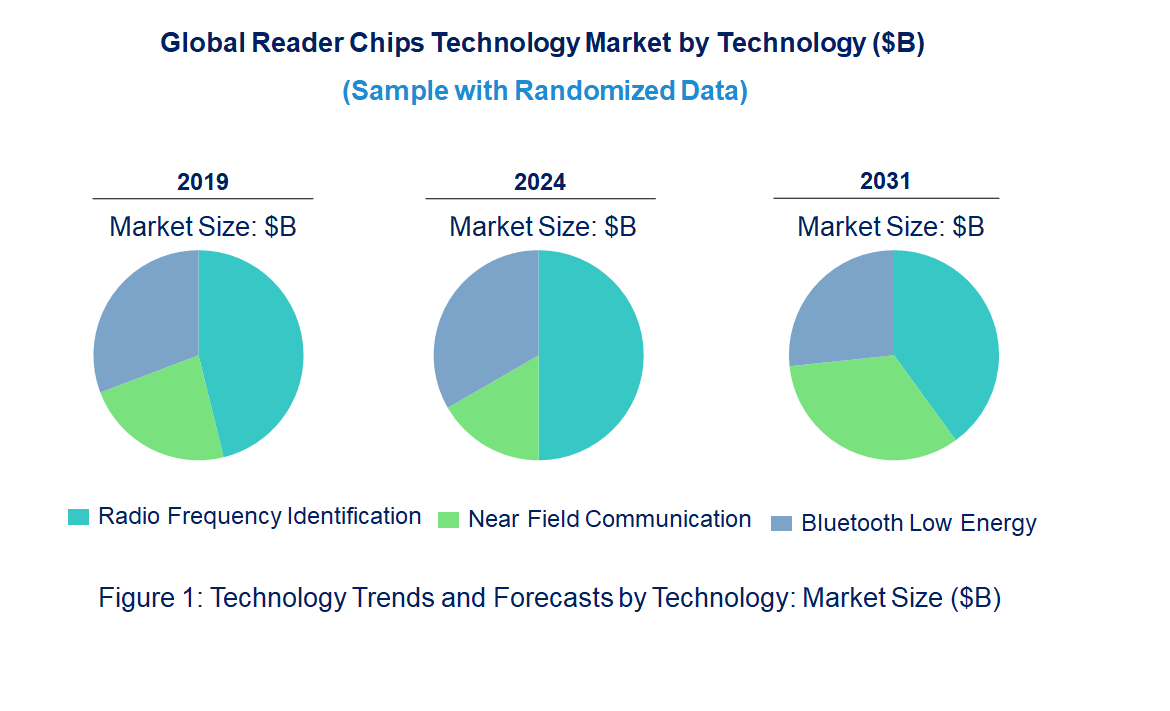
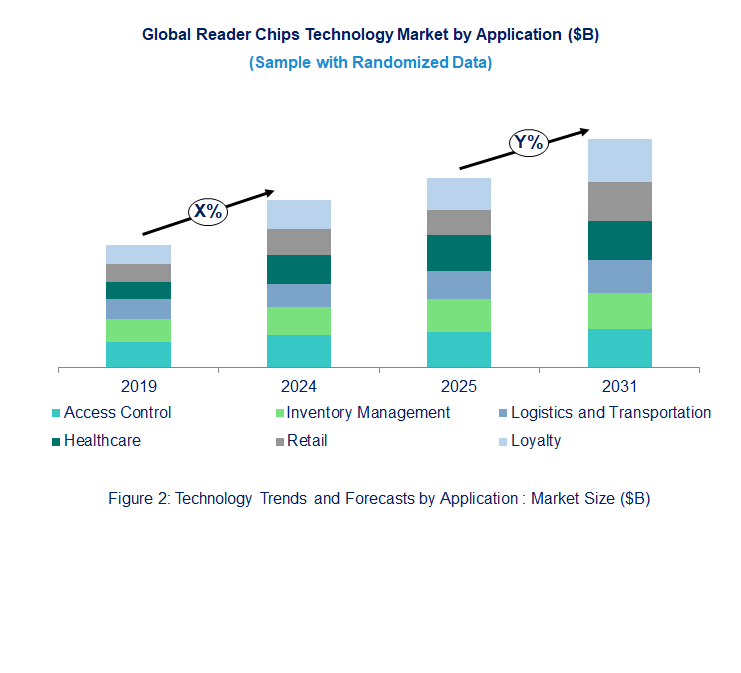
• Moving Toward Multi-Technology Capability: Reader chips are more designed toward supporting multiple technologies like RFID, NFC, and BLE. The increasing tendency has resulted in a lot of businesses making use of just one device in communication with so many systems at cheaper costs and high flexibility.
• More pervasive adoption of IoT-enabled reader chips. Connecting reader chips with IoT (Internet of Things) devices is increasing tremendously. The trend can offer real-time, data-gathering capabilities with resultant prompt analysis and better decision-making sectors that are in utmost need including retail, healthcare, and logistics.
• Miniaturization and Integration: With the increasing demand for compact and highly integrated solutions, reader chips are being miniaturized. Smaller form factors are enabling applications in wearable technology, portable devices, and embedded systems, allowing for greater deployment flexibility.
• Enhanced Security Features: As data privacy and security become more critical, reader chips are incorporating advanced encryption and authentication technologies. This is particularly important in sectors like healthcare and retail, where safeguarding sensitive data is paramount.
• Growth in the Healthcare Industry: Reader chips are in increasing demand in the healthcare industry due to applications such as patient tracking, medication management, and asset management. These technologies increase efficiency, accuracy, and safety for patients. These emerging trends are transforming the reader chips market, with enhanced flexibility, security, and functionality. With more complex technologies being adopted in various industries, reader chips are increasingly being used in a variety of applications, from retail to healthcare.
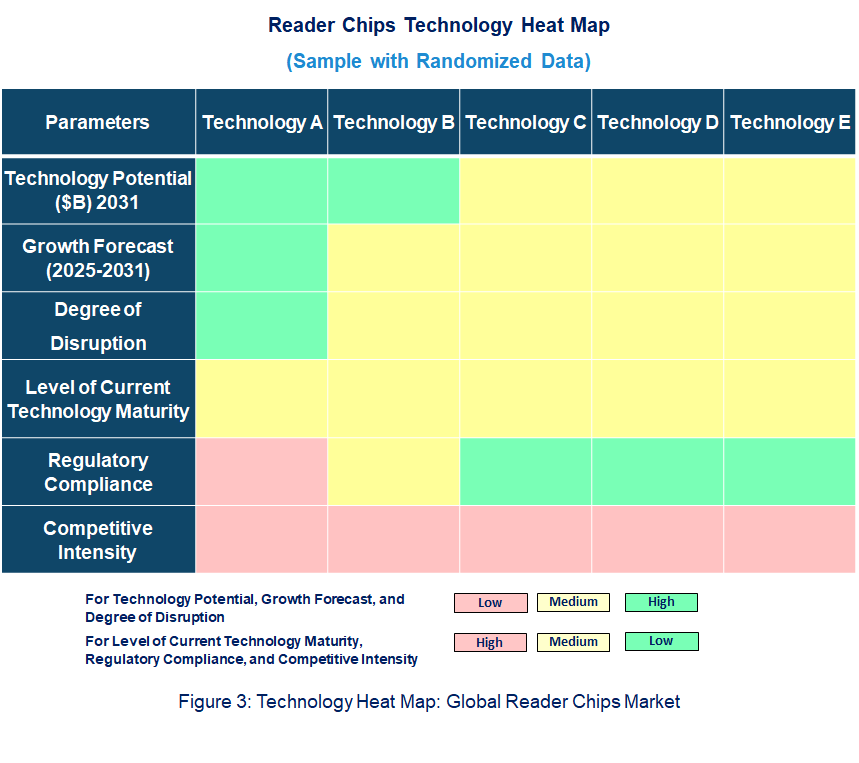
• Technology Potential: Reader chips have huge potential for improving automation, real-time data collection, and inventory management. With the evolution of low-power consumption, faster data processing, and increased integration with IoT devices, they can bring efficiency to multiple industries. As more businesses incorporate smart systems, the need for advanced reader chips will grow.
• Degree of Disruption: In this regard, reader chips will disrupt because they automatically streamline processes that formerly depended on manual data input. With the rise of smart cities, autonomous vehicles, and advanced supply chains, it is going to transform all industries by making faster, better decision-making possible.
• Current Technology Maturity: The technology is mature, with the market providing numerous established players and wide-ranging options available in RFID solutions. It is still evolving in continuous design innovation of chips, energy efficiency, and connectivity, like 5G integration.
• Regulatory Compliance: The standard follows global standards like ISO/IEC 18000 and regional regulations around privacy and data security. As the market expands, interoperability and data handling will be of extreme importance for widespread adoption.
• NXP Semiconductors: NXP has greatly developed and advanced its RFID and NFC reader-chips portfolio by focusing on promoting the internet of things and smart city applications. This helps advance in the fields of contactless payment and access control businesses.
• Infineon Technologies: Infineon Technologies launched highly developed BLE-based solutions to be implemented in the automation and digitalization of industries such as retail and logistics. Their reader chips are designed to deliver more power-efficient, cost-effective, and scalable solutions.
• Texas Instruments: Texas Instruments has been focusing on developing reader chips that utilize both NFC and RFID. This dual functionality allows companies to operate more efficiently within supply chain management and asset tracking applications.
• Renesas: Renesas has invested in IoT-enabled RFID reader chips that make the solution more intelligent and data-driven. These can be used in health care and logistics, where tracking is highly real-time in nature.
• STMicroelectronics: STMicroelectronics launched high-performance, low-power reader chips to cater to mobile and smart card applications. These are a response to the ever-increasing need for safe and efficient solutions in retail and payment systems.
• ON Semiconductor: ON Semiconductor has been developing reader chips that are seamlessly integrated into autonomous systems and smart cities. Its solutions focus on high-speed data transfer and low latency, which are critical for industries like transportation and logistics.
• Microchip Technology: Microchip Technology has heavily invested in BLE and NFC-enabled reader chips, focusing on applications like home automation, healthcare, and retail. Their chips have better energy efficiency and integration capabilities.
• Analog Devices: Analog Devices developed reader chips optimized for healthcare and industrial automation high-precision applications. The chips offer high-performance integration of advanced sensors, thereby enhancing system performance.
• Maxim Integrated: Maxim Integrated reader chips primarily aim at security features for applications in smart cards and payments. The chips possess more advanced encryption capabilities for the protection of transactions and access control.
• Wolfspeed: Wolfspeed is now entering the high-efficiency power device market for reader chips, helping achieve long-lasting and cost-effective operations in continuous operation industry environments. These innovations are part of a developing reader chip market, and key players are constantly innovating to improve security, increase power efficiency, and expand IoT integration into an ever-changing market.
• Technological Advancements: Innovations in NFC, RFID, and BLE technologies are improving performance, energy efficiency, and data security. This drives demand for reader chips in applications like logistics, healthcare, and retail.
• Growth of IoT: Increasing adoption of IoT devices in industries is the main growth driver. Reader chips integrated with IoT technologies ensure smooth communication, real-time data analysis, and automation in manufacturing and healthcare.
• Demand for Contactless Solutions: The upswing demand in contactless payment and access control systems necessitates reader chips, thus fostering their demand. The market mostly drives this requirement in high-tech industries such as banking and retail, along with high transit-based markets like public transport.
• Industry Automation: There is a trend in logistics and supply chain management toward automation. As these reader chips allow for the tracking of assets in real-time and inventory control, adoption has been on the rise concerning efficiency and accuracy. Challenges in the reader chip market are:
• Expensive Development: Currently, developing advanced reader chips that can have multiple capabilities within them is expensive. Small and medium-sized companies need help entering the market in such scenarios
• Incompatibility Issues: The widespread diffusion of different communication standards and protocols creates compatibility problems. Ensuring reader chips are compatible with the already existing systems would be hard and time-consuming.
• Security Risks: Since reader chips are gradually being applied to sensitive areas such as payments and managing healthcare data, security issues, hacking, and other forms of data breaches significantly hinder the adoption and application of these reader chips. While drivers in technological innovation and industry demand propel the growth of the reader chips market, challenges such as the costs of development and security risks have to be addressed to continue this momentum and reach wider adoption. Such factors are changing how businesses deploy reader chip solutions in the market across different sectors.
• NXP Semiconductors
• Infineon Technologies
• Texas Instruments
• Renesas
• STMicroelectronics
• ON Semiconductor
• Technology Readiness by Technology Type: Radio frequency identification (RFID) is mature in supply chain and asset tracking, with high competition. Near field communication (NFC) is mature in mobile payments and access control. Bluetooth low energy (BLE) is newer but is advancing very rapidly, especially in IoT devices. Each technology meets certain regulatory standards: RFID has frequency and privacy standards, NFC has security protocols, and BLE has power and range requirements. Key applications include inventory tracking for RFID, mobile payments for NFC, and IoT connectivity for BLE.
• Competitive Intensity and Regulatory Compliance: The reader chip market for RFID, NFC, and BLE is highly competitive. RFID leads in logistics, NFC in mobile payments, and BLE in IoT applications. Regulatory compliance varies: RFID faces standards on frequency and data privacy, NFC emphasizes security for financial transactions, and BLE focuses on low-power communication. Innovation, cost pressures, and evolving regulations influence the competitive landscape.
• Disruption Potential of Technologies for Reader Chips Market: RFIC, RFID, NFC, and BLE offer different disruption potentials in the reader chips market. RFID has the upper hand in logistics and inventory management through automatic data capture. The ability to engage in short-range communication characterizes NFC as ideal for mobile payment and access control. Its low power consumption makes it popular in IoT applications in healthcare and smart homes. These technologies allow for the real-time exchange of information, changing the retail, healthcare, and transportation industries into efficient new business models.
• Radio Frequency Identification (RFID)
• Near Field Communication (NFC)
• Bluetooth Low Energy (BLE)
• Access Control
• Inventory Management
• Logistics and Transportation
• Healthcare
• Retail
• Loyalty
• North America
• Europe
• Asia Pacific
• The Rest of the World
• Latest Developments and Innovations in the Reader Chips Technologies
• Companies / Ecosystems
• Strategic Opportunities by Technology Type


Choose a license that fits your team. Instant PDF delivery.
Prices exclude taxes. Instant delivery. Custom licensing available on request.
Market Report · May 18, 2026
Market Report · May 18, 2026
Market Report · May 18, 2026
Trusted partner for strategic intelligence and business growth


Receive a complimentary market analysis tailored to your industry. Our analysts will identify key growth opportunities and competitive dynamics specific to your business.

Market size, growth rate, and key trend analysis for your specific sector.

Top competitor positioning and market share analysis.

Strategic recommendations backed by data-driven insights.
Get curated market intelligence and competitive moves straight to your inbox.
By subscribing, you agree to receive our monthly insights. Unsubscribe anytime.
Receive a complimentary market analysis tailored to your industry. Our analysts will identify key growth opportunities and competitive dynamics specific to your business.
Market size, growth rate, and key trend analysis for your specific sector.
Top competitor positioning and market share analysis.
Strategic recommendations backed by data-driven insights.
Get curated market intelligence, emerging trends, and competitive moves straight to your inbox each month.
By subscribing, you agree to receive our monthly insights. Unsubscribe anytime.
We'll send your sample report shortly.