
Market Report · May 18, 2026

This market report covers trends, opportunities, and forecasts in the global raspberry pi development kit market to 2031 by technology (standard raspberry pi kits, advanced raspberry pi kits, starter kits, and customizable kits), application (education and learning, iot applications, home automation, robotics, and media centers), and region (North America, Europe, Asia Pacific, and the Rest of the World)
We'll send your sample report shortly.
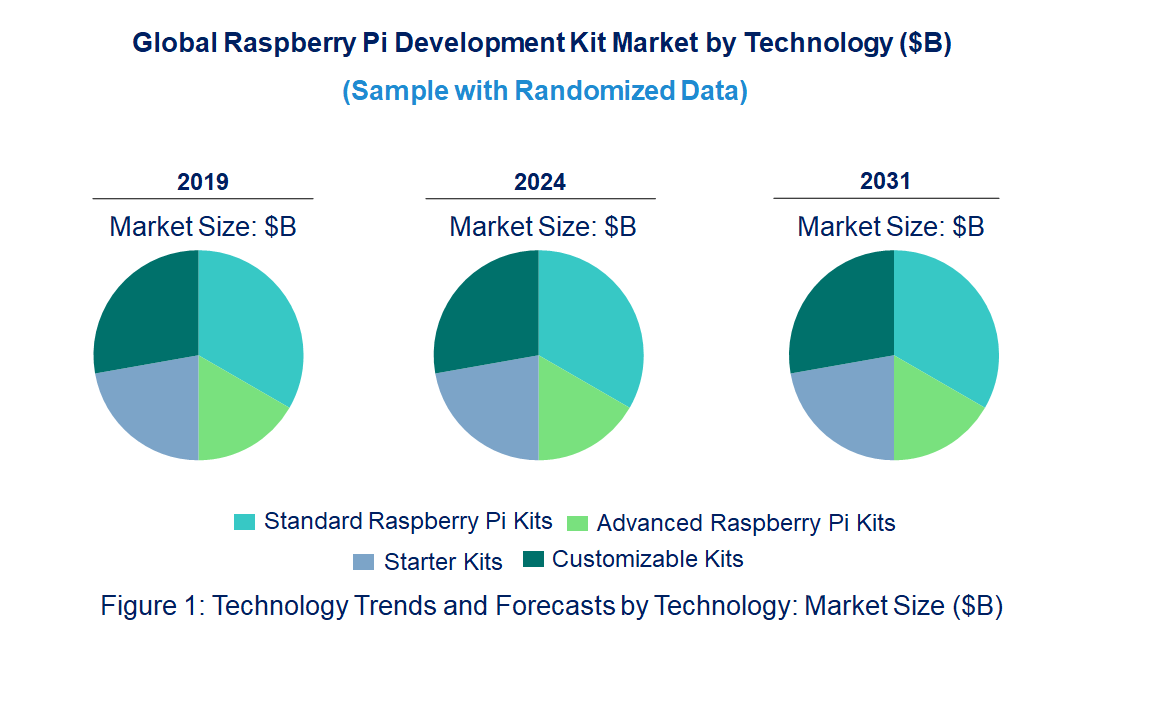
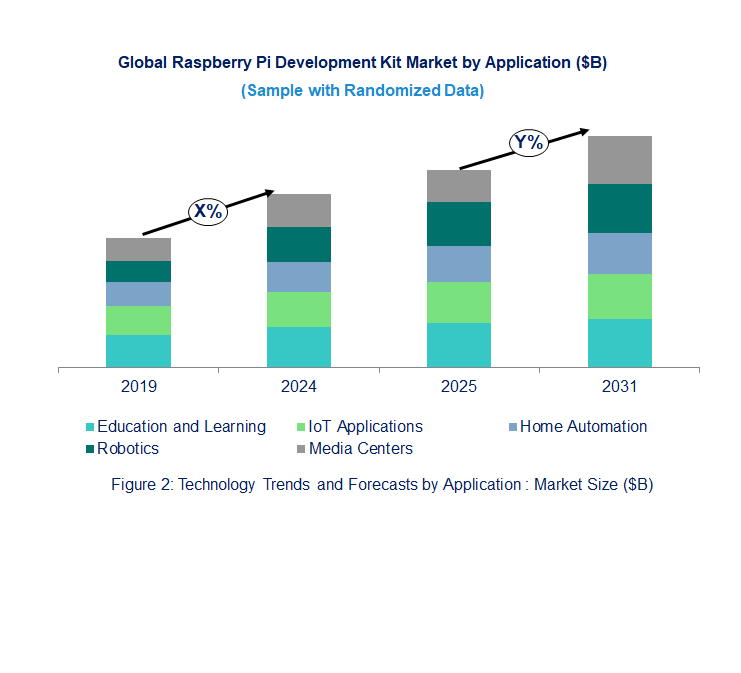
• Integration of Artificial Intelligence Raspberry Pi kits are increasingly incorporating AI capabilities, enabling edge computing applications such as real-time data processing and machine learning tasks. This trend is particularly evident in IoT devices and robotics.
• Expansion in Educational Applications Educational institutions are adopting Raspberry Pi kits to teach programming, electronics, and robotics, aligning with the global push towards STEM education. These kits provide hands-on learning experiences for students.
• Growth in IoT Applications The versatility of Raspberry Pi kits makes them ideal for developing IoT solutions, including smart home devices and industrial automation systems. Their affordability and flexibility drive their adoption in IoT projects.
• Customization and Modular Design There is a growing demand for customizable Raspberry Pi kits that allow users to tailor components to specific project needs. Modular designs enhance the adaptability of these kits in various applications.
• Enhanced Connectivity Features Recent Raspberry Pi kits offer improved connectivity options, such as advanced Wi-Fi and Bluetooth capabilities, facilitating seamless integration into modern networks and systems. These trends indicate a shift towards more powerful, flexible, and user-friendly Raspberry Pi development kits, catering to a broader range of applications and users.
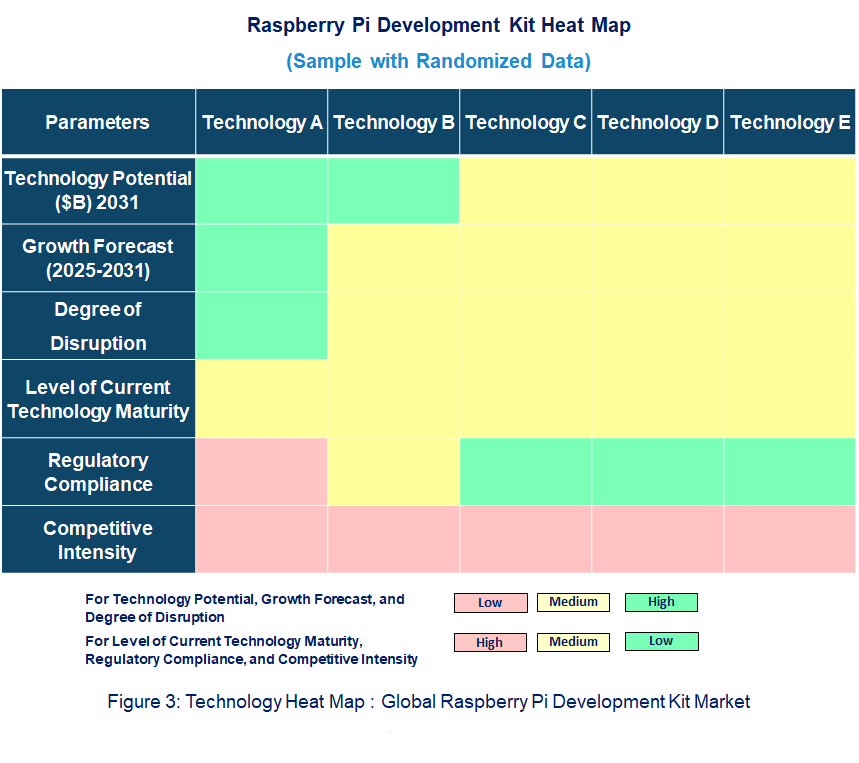
• Technology Potential The raspberry Pi development kit market holds significant technology potential due to its adaptability across diverse applications such as education, IoT, robotics, and home automation. These kits combine computing power, peripheral compatibility, and programmability, making them ideal for both prototyping and deployment in small-scale production systems. The introduction of AI-enabled and performance-optimized variants like Raspberry Pi 4 and Raspberry Pi 5 further extends their use into machine learning, image processing, and real-time analytics at the edge.
• Degree of Disruption The market has shown a moderate to high degree of disruption, especially in the educational and maker communities. Raspberry Pi kits have replaced traditional microcontroller boards in many learning environments due to their ability to run full-fledged operating systems and perform complex tasks. In IoT and automation, they challenge legacy embedded systems by offering cost-effective, Linux-based alternatives with higher flexibility, allowing smaller companies to innovate without large hardware investments.
• Level of Technology Maturity Raspberry Pi development kits are technologically mature, with a well-established hardware ecosystem and strong community support. The consistent release of updated models ensures backward compatibility and longevity. The maturity of software platforms like Raspberry Pi OS and the availability of extensive libraries enable rapid development, making the platform reliable for both beginners and professionals.
• Regulatory Compliance Raspberry Pi kits are designed to meet global compliance standards including CE, FCC, and RoHS for electronic devices. However, when integrated into commercial products or industrial applications, developers must ensure that the overall system also complies with relevant safety, electromagnetic compatibility (EMC), and cybersecurity regulations, especially in sectors like healthcare, smart cities, and critical infrastructure.
• Raspberry Pi Trading Raspberry Pi Trading has introduced the Raspberry Pi 5, enhancing performance with faster processing and improved connectivity. This advancement supports more complex applications in IoT and robotics.
• Adafruit Industries Adafruit has expanded its offerings with the CircuitPython 9.2.5 update, supporting over 600 boards. This update enhances compatibility and simplifies development for users integrating Raspberry Pi with various sensors and actuators.
• DFRobot DFRobot has developed the "SHIM RTC" accessory, a Real-Time Clock module that adds timekeeping functionality without occupying GPIO pins. This addition is crucial for applications requiring accurate timestamps, such as data logging in IoT systems.
• PiFace PiFace has introduced the SHIM Adapter, a GPIO extender that facilitates easy connection of additional accessories and breadboards. This tool enhances the versatility of Raspberry Pi in prototyping and educational projects.
• Designer Systems Designer Systems has been focusing on creating customizable Raspberry Pi kits tailored for specific applications like home automation and robotics. Their approach allows users to select components that best fit their project requirements.
• Educational Adoption Raspberry Pi kits are increasingly used in educational institutions to teach programming and electronics, fostering a new generation of developers.
• IoT Integration The affordability and versatility of Raspberry Pi make it a popular choice for developing IoT solutions, from smart home devices to industrial sensors.
• Community Support A strong online community provides extensive resources, tutorials, and project ideas, encouraging innovation and problem-solving among users. Challenges:
• Supply Chain Issues Global semiconductor shortages have impacted the availability of Raspberry Pi boards, affecting production timelines for developers and educators.
• Technical Limitations While powerful, Raspberry Pi may not meet the performance requirements of high-end applications, necessitating additional components or alternative solutions.
• Regulatory Compliance Ensuring that Raspberry Pi-based solutions comply with industry standards and regulations can be complex, especially in sectors like healthcare and automotive. Addressing these drivers and challenges is crucial for the continued growth and success of the Raspberry Pi Development Kit market.
• Raspberry-Pi
• Dfrobot
• Piface
• Designer Systems
• Adafruit
• Technology Readiness by Kit Type: Standard Raspberry Pi kits are fully mature, widely available, and used across education, hobbyist, and general prototyping. They face moderate competition with low regulatory burden. Starter kits are also market-ready, targeting beginners with simplified assembly and clear documentation, typically requiring minimal compliance checks. Advanced kits are moderately to highly mature, incorporating components for AI, robotics, or IoT, and are ready for sophisticated development needs but must meet higher regulatory standards due to complexity. These kits often compete on performance, bundled software, and added-value modules. Customizable kits are emerging as highly flexible solutions, tailored for industry-specific or advanced maker use cases, but their maturity varies by configuration and supplier. They face intense competition among premium kit providers and must often comply with extensive certifications, especially if intended for commercial or educational deployment. Customizable kits support key applications in automation, environmental sensing, and edge computing. Overall, standard and starter kits dominate basic education and learning, while advanced and customizable kits are more technologically advanced and aligned with future-facing innovation needs.
• Competitive Intensity & Regulatory Compliance: The Raspberry Pi kit market is highly competitive, particularly for standard and starter kits, where multiple vendors offer similar components with little differentiation, leading to price-driven competition. Advanced and customizable kits face rising competitive intensity from firms adding unique value through bundled sensors, AI accelerators, or specialized software stacks. These segments also see competition from larger ecosystem players, including official Raspberry Pi distributors and third-party integrators. Regulatory compliance varies: starter and standard kits typically have fewer compliance requirements, while advanced and customizable kits must consider certifications like CE, FCC, and RoHS due to the inclusion of radio modules, high-speed processing components, or use in commercial/educational settings. As kits become more sophisticated and are used in semi-professional or educational environments, adherence to safety, electromagnetic compatibility, and environmental regulations becomes more critical. Overall, advanced and customizable kits face greater regulatory scrutiny and higher market competition but offer differentiated value.
• Disruption Potential: The Raspberry Pi development kit market exhibits varying levels of disruption potential across different kit types. Standard Raspberry Pi kits are foundational and widely adopted, offering minimal disruption but solid usability for general learning and prototyping. Starter kits simplify access for beginners, but their disruptive capacity is limited due to basic components and fixed functionality. Advanced Raspberry Pi kits, featuring AI modules, IoT integrations, and high-performance accessories, have higher disruption potential by enabling complex, industry-relevant solutions. Customizable kits offer the greatest disruption as they cater to niche applications in education, automation, and product development, adapting to diverse user needs. These kits empower innovators to prototype tailored systems, bridging gaps in hardware-software integration. As demand grows for edge computing and embedded systems, customizable and advanced kits are set to drive significant shifts in how developers and makers build solutions. Overall, the market’s disruption is shaped most by the flexibility and scalability offered by advanced and customizable kits.
• Standard Raspberry Pi Kits
• Advanced Raspberry Pi Kits
• Starter Kits
• Customizable Kits
• Education and Learning
• IoT Applications
• Home Automation
• Robotics
• Media Centers
• North America
• Europe
• Asia Pacific
• The Rest of the World
• Latest Developments and Innovations in the Raspberry Pi Development Kit Technologies
• Companies / Ecosystems
• Strategic Opportunities by Technology Type


Choose a license that fits your team. Instant PDF delivery.
Prices exclude taxes. Instant delivery. Custom licensing available on request.
Market Report · May 18, 2026
Market Report · May 18, 2026
Market Report · May 18, 2026
Trusted partner for strategic intelligence and business growth


Receive a complimentary market analysis tailored to your industry. Our analysts will identify key growth opportunities and competitive dynamics specific to your business.

Market size, growth rate, and key trend analysis for your specific sector.

Top competitor positioning and market share analysis.

Strategic recommendations backed by data-driven insights.
Get curated market intelligence and competitive moves straight to your inbox.
By subscribing, you agree to receive our monthly insights. Unsubscribe anytime.
Receive a complimentary market analysis tailored to your industry. Our analysts will identify key growth opportunities and competitive dynamics specific to your business.
Market size, growth rate, and key trend analysis for your specific sector.
Top competitor positioning and market share analysis.
Strategic recommendations backed by data-driven insights.
Get curated market intelligence, emerging trends, and competitive moves straight to your inbox each month.
By subscribing, you agree to receive our monthly insights. Unsubscribe anytime.
We'll send your sample report shortly.