
Market Report · July 16, 2026

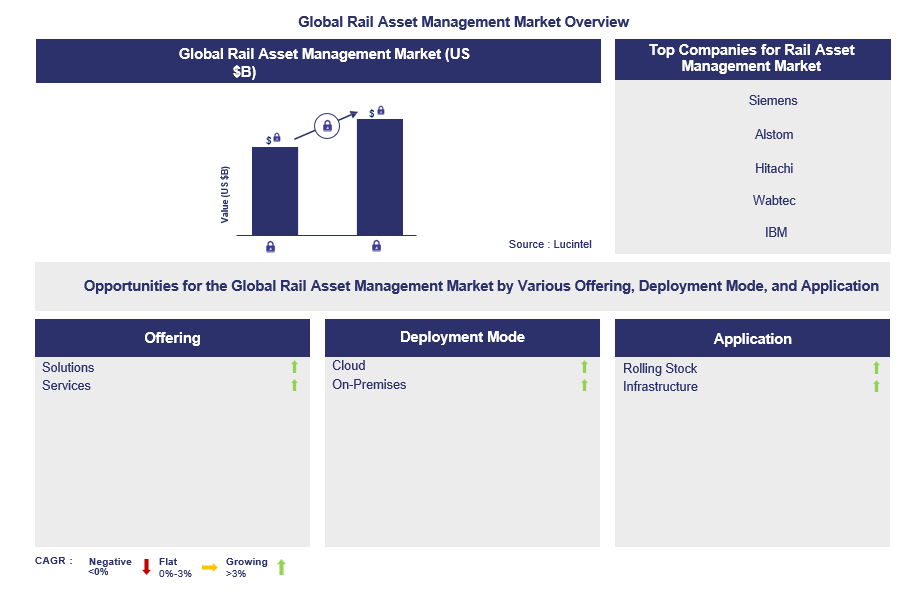
Key data points: The market size in 2030 = $17.3 billion, growth forecast = 6.1% annually for the next 6 years. Scroll below to get more insights. This market report covers trends, opportunities, and forecasts in the global rail asset management market to 2030 by offering (solutions and services), deployment mode (cloud and on-premises), application (rolling stock and infrastructure), and region (North America, Europe, Asia Pacific, and the Rest of the World)
We'll send your sample report shortly.
• Lucintel forecasts that, within the type category, the cloud is expected to witness higher growth over the forecast period due to the increasing use of SaaS-based security services by railways to affordably secure corporate applications.
• Within the application category, Rail infrastructure is expected to witness higher growth over the forecast period due to substantial spending on the development and maintenance of rail infrastructure.
• In terms of region, Europe is expected to witness the highest growth over the forecast period due to favorable investments in the modification of the train infrastructure, increasing use of customer-centric rail solutions, and the existence of a robust rail infrastructure in the region. Gain valuable insight for your business decisions with our comprehensive 150+ page report.
• Revolutionizing Predictive Maintenance with Digital: Digital twin technology has emerged as a critical tool for managing rail assets by creating an exact replica of real-life assets. These digital twins allow for real-time monitoring, predictive maintenance, and informed decision-making, leading to reduced downtimes and lower maintenance costs. Railway system operators can predict potential risks before they escalate through simulation and other proactive measures. This helps reduce system failures caused by random events and extends the system's lifespan.
• Enhancing Real-Time Monitoring and Data Analytics: The integration of the Internet of Things (IoT) into rail asset management is changing how data is collected, analyzed, and used. Real-time data related to asset performance, track conditions, or environmental parameters are provided by sensors embedded in rail infrastructure networks. This data-driven approach enables predictive maintenance, improving safety and minimizing disruptions. Issues that could affect train services can be identified early.
• AI-Powered Analytics Driving Intelligent Decision-Making: Artificial Intelligence (AI) plays a crucial role in processing massive amounts of data generated by railway assets. AI-based analytics tools process both historical and real-time data, predicting failure modes and optimizing maintenance schedules, thus enhancing operational efficiencies. Optimization has significantly improved thanks to complex analysis automation enabled through AI, allowing quicker decision-making by railway operators. This saves costs, maximizes resource use efficiency, and improves service dependability.
• Sustainability Initiatives Promoting Green Asset: Sustainability is now a major focus in rail asset management, with increased emphasis on reducing the environmental impact of rail operations. This includes introducing energy-efficient technologies, renewable energy sources, and sustainable maintenance practices. Rail operators who prioritize sustainability ensure they comply with regulatory requirements related to climate change mitigation and their corporate social responsibility goals.
• Advanced Remote Sensing Technologies: Rail asset management increasingly utilizes advanced remote sensing technologies such as drones and LiDAR for infrastructure monitoring. These technologies offer high-resolution data and can access hard-to-reach areas, providing detailed insights into the state of rail tracks, bridges, and tunnels. Frequent monitoring using remote sensing helps railway operators detect potential infrastructure problems early, enabling timely rectification to ensure safety and minimize service disruption. These emerging trends are reshaping the rail asset management market, driving a shift towards more efficient, data-driven, and sustainable practices. The integration of digital twins, IoT, AI, sustainability, and advanced monitoring is allowing railway system managers to reduce operational costs through increased efficiency. At the same time, they are ensuring safe operations by applying digital twin technology, reducing expenses for companies concerned about their carbon footprints, and improving their risk profiles while complying with transport emissions regulations. As these trends continue to evolve, they will play a critical role in shaping the future of rail asset management, making it more adaptive and resilient to changing industry demands.

• Digitalization and IoT: The integration of digital technologies, like IoT sensors and predictive analytics, is radically changing the face of rail asset management. This has enabled real-time health monitoring of assets, prediction-based maintenance strategies, and optimized resource allocation. The result is better operational efficiency with reduced maintenance costs.
• Condition-Based Maintenance: There is an increasing trend toward condition-based maintenance strategies, replacing traditional time-based schedules. By constantly monitoring the health of assets in real-time, railway operators can detect failures before they happen and address them before they disrupt normal operations or shorten the asset's life cycle.
• Data Analytics and Predictive Modeling: Advanced data analytics and predictive modeling techniques are being used to extract insights from vast amounts of asset data. These insights help railways make data-driven decisions that optimize their maintenance strategies and improve asset performance.
• Sustainability and Environmental Impact: Sustainability is becoming a key focus in rail asset management. Rail operators are adopting green practices that involve energy-efficient technologies and sustainable materials to comply with new regulations and reduce their carbon footprints.
• Automation and Robotics: Automation and robotics are emerging as ways to improve both efficiency and safety within the rail transport industry. This includes autonomous inspection systems and robotized maintenance tasks, which minimize human errors while improving overall performance. These developments have collectively transformed the rail asset management landscape. By embracing digitalization, condition-based maintenance, data analytics, sustainability practices, and automation, railway operators can improve performance levels, reduce costs, and ensure long-term sustainability.
• Predictive Maintenance: Predictive maintenance uses IoT sensors and data analytics to predict equipment failures before they occur, facilitating proactive maintenance and reducing unforeseen downtime. This is gaining prominence because it improves productivity while cutting down on maintenance costs.
• Digital Twin Technology: A digital twin represents a virtual replica of rail infrastructure that allows operators to simulate different scenarios, optimize maintenance strategies, and improve decision-making processes. The adoption of digital twins has accelerated due to their ability to improve risk control and enhance asset performance.
• Blockchain for Supply Chain Management: Blockchain technology offers transparency, traceability, and security benefits for rail supply chains. Streamlining processes through blockchain can contribute to cost savings and improved asset management.
• AI-Powered Anomaly Detection: By analyzing large amounts of data using AI algorithms, potential anomalies in railway infrastructure can be detected, ensuring timely interventions before expensive failures occur, thereby protecting safety and reducing costs.
• Autonomous Rail Systems: The automation of tasks using autonomous systems will increase efficiency and reduce associated costs, positively impacting the bottom line. These five growth opportunities are driving the next steps in rail asset management development. Using advanced technology solutions will help improve asset performance, make operations more efficient, and ensure long-term infrastructure sustainability.
• Technological Advancements in Asset Management: With the integration of IoT, AI, and predictive analytics into rail asset management systems, the industry is being transformed. These technologies enable real-time monitoring, predictive maintenance, and efficient asset utilization, which reduces downtimes and operational costs. As a result, there is a significant increase in demand for advanced asset management solutions from rail operators who seek more efficient and safer operations.
• Increasing Urbanization and Rail Infrastructure Expansion: Developing regions, especially, have seen substantial government investments in railway infrastructure due to urbanization. This has led to a high demand for sophisticated tools used to manage assets and ensure the effective operation of railway networks that can meet sustainability standards, ultimately lowering product prices.
• Growing Emphasis on Safety and Compliance: Rail regulations worldwide are becoming stricter, particularly regarding safety measures during operations. To comply, operators must implement advanced asset management systems that help reduce risks or prevent accidents by continuously monitoring asset conditions to ensure compliance with safety standards.
• Rising Demand for Cost-Effective Operations: Railway management has had to invest in maintaining service quality while reducing budget expenditures. Advanced asset management systems help minimize maintenance costs by optimizing resource allocation and extending asset lifespans. Efficient resource spending leads to increased demand for robust asset management solutions.
• Sustainability and Environmental Concerns: Global climate change initiatives, coupled with increasing environmental regulations, have led railroad companies to adopt eco-friendly practices. Asset management solutions that help reduce carbon emissions, optimize resource use, and facilitate energy-efficient operations are gaining traction. Global environmental goals are driving this market as railway operators make environmentally sustainable choices. Challenges in the rail asset management market include:
• High Initial Investment Costs: Implementing advanced rail asset management systems requires significant investment in technology, infrastructure, and training. For smaller rail operators or those in underdeveloped regions with limited access to capital, this can pose a barrier. The adoption of these systems may be slow, particularly in low-cost-sensitive markets, where balancing investment costs with future returns is a challenge.
• Complexity of Integration with Legacy Systems: Many rail operators still rely on legacy systems that are not easily compatible with modern asset management technologies. Integrating new systems into existing infrastructure is challenging and time-consuming, often resulting in operational disruptions and additional costs. Large-scale implementation of asset management solutions is particularly difficult in areas with outdated rail infrastructure.
• Data Security and Privacy Concerns: As data-driven technologies are increasingly incorporated into asset management, concerns over data security and privacy are rising. Operators may hesitate to fully embrace digital asset management solutions due to the risks of cyberattacks and data breaches. Effective implementation requires robust cybersecurity measures and compliance with data protection regulations. Technological advancements, infrastructure expansion, and a growing focus on safety, cost-efficiency, and sustainability are driving growth in the rail asset management market. However, the market also faces significant challenges, such as high capital investment costs, integration difficulties, and data security concerns. These drivers and constraints collectively shape the industry's progression, meaning key players must skillfully navigate these factors to seize new opportunities while minimizing risks.
• Siemens
• Alstom
• Hitachi
• Wabtec
• IBM
• SAP
• Capgemini
• Cisco
• Huawei
• Accenture
• Solutions
• Services
• Cloud
• On-Premises
• Rolling Stock
• Infrastructure
• North America
• Europe
• Asia Pacific
• The Rest of the World
• United States: In the U.S., there has been significant investment in advanced predictive maintenance technologies and digital solutions for the rail asset management market. The application of IoT and big data analysis enables real-time monitoring of assets, minimizing downtime and improving operational efficiency. Additionally, the government has increased funding to modernize outdated rail infrastructure to enhance safety and performance.
• China: The Chinese rail asset management market has seen rapid deployment of high-speed rail (HSR) systems, along with the integration of AI-driven asset management platforms. These platforms use machine learning techniques to predict and prevent failures. The country continues to expand its rail network to more cities, necessitating sophisticated asset management solutions to sustain this growing infrastructure.
• Germany: Digitalization and sustainability commitments in Germany have positively impacted the rail asset management market. The country uses digital twin technology to enhance asset tracking and predict maintenance needs. Moreover, Germany’s focus on reducing carbon emissions from its railways has led to investments in energy-efficient trains and other environmentally friendly technologies.
• India: Advanced asset management tools have gained traction in projects aimed at improving the physical infrastructure of Indian railways. Centralized asset management systems now make it easier to track locomotives, reducing delays and improving safety. India is also expanding and upgrading its rail lines, which will require more effective methods of managing resources and infrastructure.
• Japan: The Japanese rail asset management market has developed automated maintenance systems, along with the use of AI for predictive analysis. Japan leverages its technological expertise to maintain the reliability of its vast rail network, which includes both high-speed and conventional trains. As a result, there is a continuous demand for more advanced asset management solutions to uphold the country’s reputation for innovation and precision in railway operations.


• Siemens
• Alstom
• Hitachi
• Wabtec
• IBM
• SAP
• Capgemini
• Cisco
• Huawei
• Accenture Q6. Which rail asset management market segment will be the largest in the future? Answer: Lucintel forecast that cloud is expected to witness higher growth over the forecast period due to the increasing use of SaaS-based security services by railways to affordably secure corporate applications. Q7. In the rail asset management market, which region is expected to be the largest in the next 5 years? Answer: Europe is expected to witness the highest growth over the forecast period due to favorable investments in the modification of the train infrastructure, increasing use of customer-centric rail solutions, and the existence of a robust rail infrastructure in the region. Q.8 Do we receive customization in this report? Answer: Yes, Lucintel provides 10% customization without any additional cost.


Choose a license that fits your team. Instant PDF delivery.
Prices exclude taxes. Instant delivery. Custom licensing available on request.
Market Report · July 16, 2026
Market Report · May 18, 2026
Market Report · May 18, 2026
Trusted partner for strategic intelligence and business growth


Receive a complimentary market analysis tailored to your industry. Our analysts will identify key growth opportunities and competitive dynamics specific to your business.

Market size, growth rate, and key trend analysis for your specific sector.

Top competitor positioning and market share analysis.

Strategic recommendations backed by data-driven insights.
Get curated market intelligence and competitive moves straight to your inbox.
By subscribing, you agree to receive our monthly insights. Unsubscribe anytime.
Receive a complimentary market analysis tailored to your industry. Our analysts will identify key growth opportunities and competitive dynamics specific to your business.
Market size, growth rate, and key trend analysis for your specific sector.
Top competitor positioning and market share analysis.
Strategic recommendations backed by data-driven insights.
Get curated market intelligence, emerging trends, and competitive moves straight to your inbox each month.
By subscribing, you agree to receive our monthly insights. Unsubscribe anytime.
We'll send your sample report shortly.