
Market Report · July 15, 2026

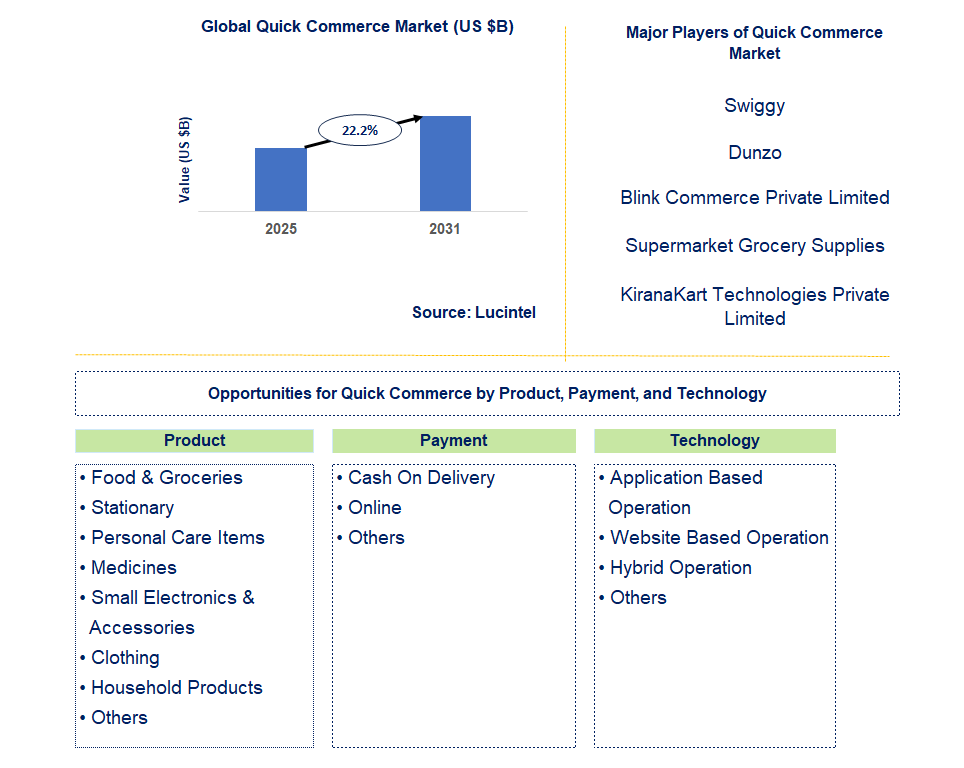
Key data points: The growth forecast = 22.2% annually for the next 7 years. Scroll below to get more insights. This market report covers trends, opportunities and forecasts in quick commerce market to 2031 by product (food & groceries, stationary, personal care items, medicines, small electronics & accessories, clothing, household products, and others), payment (cash on delivery, online, and others), technology (application based operation, website based operation, hybrid operation, and others), and region (North America, Europe, Asia Pacific, and the Rest of the World)
We'll send your sample report shortly.
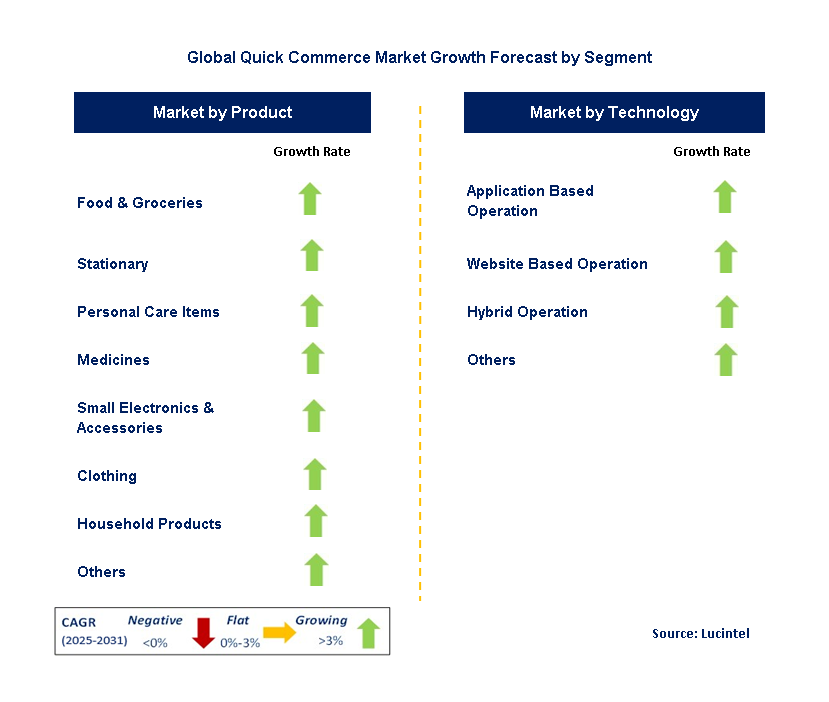
• Lucintel forecasts that, within the product category, food & grocery is expected to witness the highest growth over the forecast period.
• Within the technology category, hybrid operation is expected to witness the highest growth.
• In terms of region, APAC is expected to witness the highest growth over the forecast period. Gain valuable insights for your business decisions with our comprehensive 150+ page report. Sample figures with some insights are shown below.
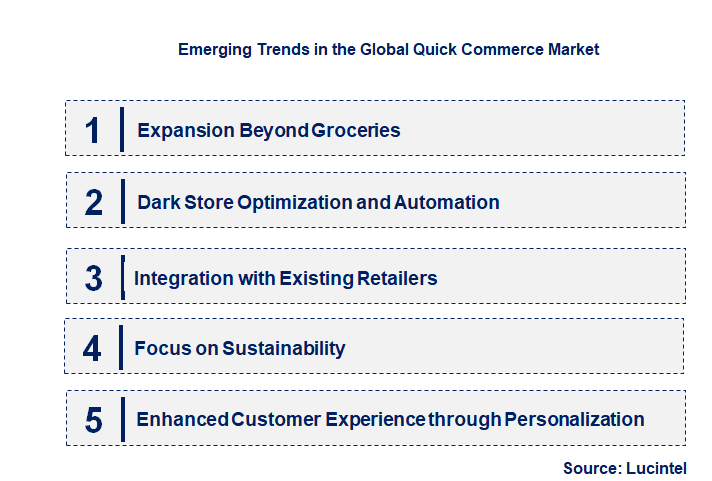
• Expansion Beyond Groceries: Q-commerce platforms are increasingly diversifying their offerings beyond groceries to include prepared meals, pharmacy items, electronics, and even fashion. This broadens their addressable market and caters to a wider range of immediate consumer needs.
• Dark Store Optimization and Automation: Companies are focusing on optimizing their network of dark stores (urban fulfillment centers) through automation and AI-powered inventory management. This aims to improve delivery speed, reduce operational costs, and enhance order accuracy.
• Integration with Existing Retailers: Strategic partnerships between q-commerce players and traditional brick-and-mortar retailers (supermarkets, pharmacies) are becoming more common. This leverages the retailers' established supply chains and brand recognition while providing q-commerce platforms with wider product selections.
• Focus on Sustainability: There's a growing emphasis on sustainable delivery practices, including the use of electric vehicles, bicycles, and optimized routing to reduce environmental impact. This resonates with environmentally conscious consumers and can improve operational efficiency.
• Enhanced Customer Experience through Personalization: Q-commerce platforms are leveraging data analytics and AI to personalize the shopping experience, offering tailored product recommendations, promotions, and faster checkout processes to increase customer loyalty. These emerging trends—expansion beyond groceries, dark store optimization, retailer integration, sustainability focus, and enhanced personalization—are reshaping the quick commerce market. They are driving the industry towards more diverse offerings, efficient operations, environmentally conscious practices, and a more customer-centric approach.
• Increased Focus on Profitability: Following a period of rapid expansion, many q-commerce companies are now prioritizing profitability through measures like optimizing delivery routes, increasing order values, and adjusting service fees. This shift indicates a maturing market.
• Strategic Partnerships and Acquisitions: The market has seen strategic collaborations and acquisitions aimed at consolidating market presence and leveraging synergies in logistics and customer base. This can lead to more integrated and competitive offerings.
• Expansion into Tier-II and Tier-III Cities: Some players are now expanding their q-commerce services beyond major metropolitan areas to tap into the growing demand in smaller cities, requiring adaptations to logistics and product assortment.
• Integration of Value-Added Services: Q-commerce platforms are increasingly offering additional services like quick restaurant delivery or partnerships with local businesses to provide a broader range of instantly available goods and services.
• Experimentation with Autonomous Delivery: While still in early stages, some companies are experimenting with the use of drones and robots for last-mile delivery to further reduce delivery times and costs in specific urban environments. These recent developments, including a focus on profitability, strategic partnerships, expansion into smaller cities, integration of value-added services, and experimentation with autonomous delivery, are impacting the quick commerce market by pushing for more sustainable business models, wider geographic reach, and innovative delivery solutions.
• Instant Grocery and Essentials: The core of q-commerce, providing rapid delivery of groceries, household items, and personal care products, continues to offer substantial growth, especially by expanding product variety and geographic coverage.
• On-Demand Prepared Meals and Beverages: Leveraging the speed of q-commerce for the ultrafast delivery of restaurant meals, coffee, and other prepared foods caters to immediate consumption needs and can attract a high-frequency customer base.
• Rapid Delivery of Pharmacy and Healthcare Products: Providing quick access to over-the-counter medications, personal health items, and even prescription refills offers a valuable service, particularly in urgent situations, and represents a significant growth area.
• Fast Delivery of Electronics and Small Retail Goods: Expanding into the rapid delivery of small electronics, books, stationery, and other retail items caters to immediate purchase needs beyond daily essentials and broadens the market scope.
• Hyperlocal Delivery for Small Businesses: Partnering with local businesses (e.g., bakeries, florists, independent retailers) to offer quick delivery of their products can tap into a unique market segment and support local economies. These strategic growth opportunities in instant groceries, prepared meals, pharmacy/healthcare, small retail goods, and hyperlocal delivery highlight the potential for quick commerce to address a wide spectrum of immediate consumer needs, driving market expansion and diversification.
• Swiggy
• Dunzo
• Blink Commerce Private Limited
• Supermarket Grocery Supplies
• KiranaKart Technologies Private Limited
• Getir
• Flink
• Yemece
• Quickcommerce
• Delivery Hero
• Food & Groceries
• Stationary
• Personal Care Items
• Medicines
• Small Electronics & Accessories
• Clothing
• Household Products
• Others
• Cash On Delivery
• Online
• Others
• North America
• Europe
• Asia Pacific
• The Rest of the World
• United States: The US q-commerce market has witnessed some consolidation, with players like Gopuff adjusting their strategies towards profitability. There's a growing emphasis on partnerships with traditional retailers and expansion into prepared meals and local businesses to broaden offerings and customer reach in urban centers.
• China: China's q-commerce sector remains highly competitive, with established players like Meituan and Alibaba's Ele.me continuing to innovate in delivery infrastructure and expand service areas beyond major cities. The focus is on leveraging their existing logistics networks and integrating q-commerce with broader e-commerce ecosystems.
• Germany: The German market is characterized by a mix of global players and local startups vying for market share. Recent developments include expansions into smaller cities and a growing focus on sustainability in delivery operations, alongside partnerships with local supermarkets to enhance product variety.
• India: India's q-commerce market is experiencing rapid growth, with intense competition among players like Zepto, Blinkit (Zomato), and Dunzo. Recent developments include aggressive expansion into more cities, a focus on instant grocery and essentials delivery, and experiments with drone delivery in select areas.
• Japan: Japan's q-commerce market is evolving more cautiously, with a focus on integrating ultrafast delivery with existing convenience store and supermarket networks. Developments include partnerships between q-commerce platforms and traditional retailers to leverage established supply chains and customer bases, particularly in densely populated urban areas.


• Swiggy
• Dunzo
• Blink Commerce Private Limited
• Supermarket Grocery Supplies
• KiranaKart Technologies Private Limited
• Getir
• Flink
• Yemece
• Quickcommerce
• Delivery Hero Q5. Which quick commerce market segment will be the largest in future? Answer: Lucintel forecasts that, within the product category, food & grocery is expected to witness the highest growth over the forecast period. Q6. In quick commerce market, which region is expected to be the largest in next 5 years? Answer: In terms of region, APAC is expected to witness the highest growth over the forecast period. Q7. Do we receive customization in this report? Answer: Yes, Lucintel provides 10% customization without any additional cost.


Choose a license that fits your team. Instant PDF delivery.
Prices exclude taxes. Instant delivery. Custom licensing available on request.
Market Report · July 15, 2026
Market Report · June 26, 2026
Market Report · June 24, 2026
Trusted partner for strategic intelligence and business growth


Receive a complimentary market analysis tailored to your industry. Our analysts will identify key growth opportunities and competitive dynamics specific to your business.

Market size, growth rate, and key trend analysis for your specific sector.

Top competitor positioning and market share analysis.

Strategic recommendations backed by data-driven insights.
Get curated market intelligence and competitive moves straight to your inbox.
By subscribing, you agree to receive our monthly insights. Unsubscribe anytime.
Receive a complimentary market analysis tailored to your industry. Our analysts will identify key growth opportunities and competitive dynamics specific to your business.
Market size, growth rate, and key trend analysis for your specific sector.
Top competitor positioning and market share analysis.
Strategic recommendations backed by data-driven insights.
Get curated market intelligence, emerging trends, and competitive moves straight to your inbox each month.
By subscribing, you agree to receive our monthly insights. Unsubscribe anytime.
We'll send your sample report shortly.