
Market Report · July 29, 2026

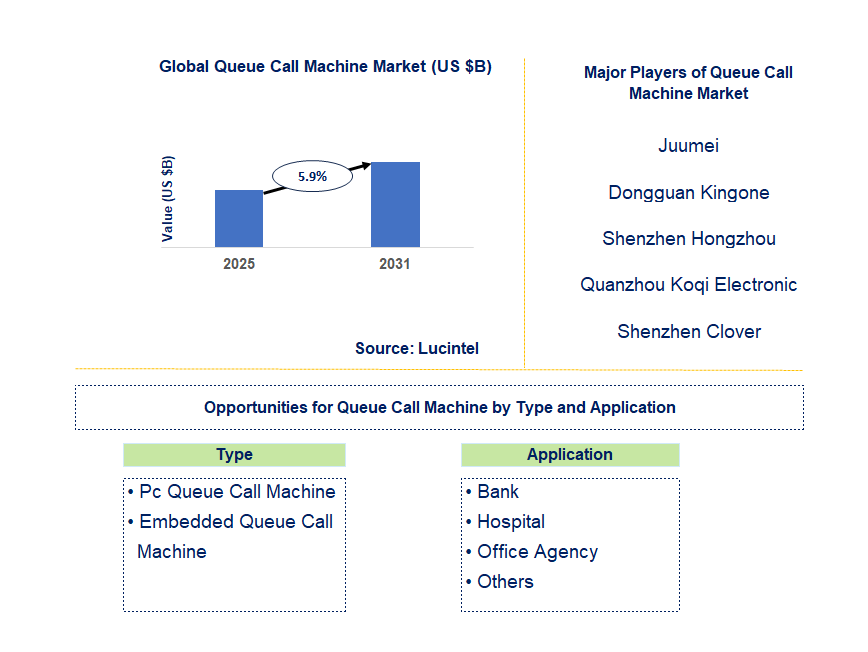
Key data points: The growth forecast = 5.9% annually for the next 7 years. Scroll below to get more insights. This market report covers Trends, opportunity and forecast in queue call machine market to 2031 by type (pc queue call machine and embedded queue call machine), application (bank, hospital, office agency, and others), and region (North America, Europe, Asia Pacific, and the Rest of the World)
We'll send your sample report shortly.
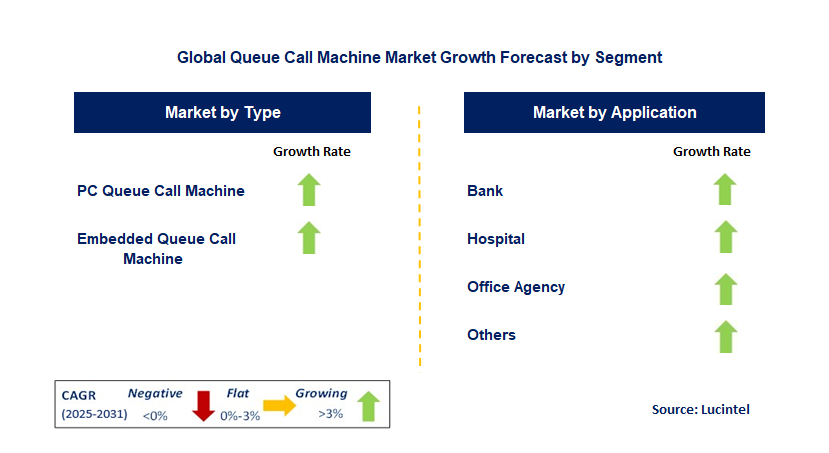
• Lucintel forecasts that, within the type category, pc queue call machines will remain larger segment over the forecast period due to their advanced capabilities, flexibility, and ability to handle more complex queue management tasks compared to embedded systems.
• Within the application category, banks will remain the largest segment due to high customer volumes and the need for efficient queue management to ensure fast and organized service.
• In terms of region, North America is expected to witness the highest growth over the forecast period due to advanced infrastructure, high adoption of technology in service industries, and the growing demand for efficient customer management solutions. Gain valuable insights for your business decisions with our comprehensive 150+ page report. Sample figures with some insights are shown below.
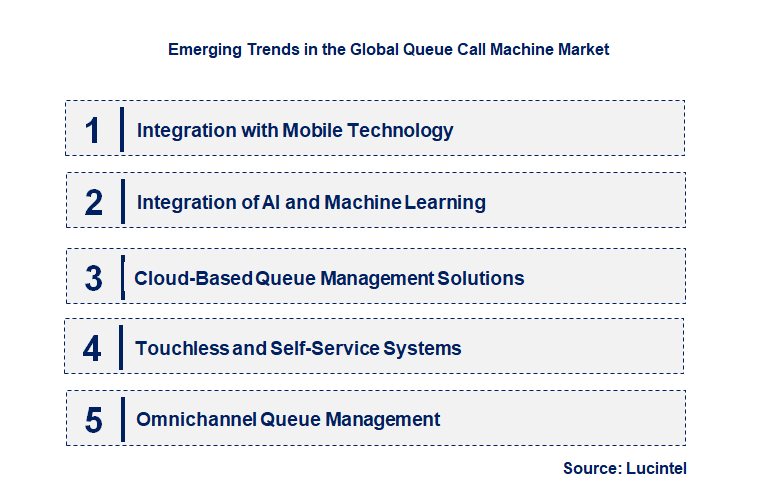
• Integration with Mobile Technology: The integration of queue call systems with mobile technology is among the primary emerging trends in the market. Businesses are now accepting mobile apps, which allow the customers to check-in from a remote location, get the real-time status of the queue, and even reserve a place in advance. It is helping to improve customer convenience and reduce waiting time for the customers. In addition, the mobile-based system allows businesses to track the flow of customers and manage queues more efficiently. With more smartphones and mobile payment solutions becoming popular, industries are further looking into changing to mobile-enabled queue management systems.
• Integration of AI and Machine Learning: AI and machine learning are now being increasingly implemented in queue management systems to create better customer experience and to efficiently run operations. These technologies will predict peak hours, manage flow, and provide the best allocation of staff to the different periods. AI-powered systems can automatically adjust queues based on real-time data, ensuring that customers receive faster and more personalized service. Additionally, machine learning algorithms can analyze customer behavior patterns, allowing businesses to predict demand and proactively manage queues. This trend is gaining traction in sectors such as healthcare, retail, and banking, where operational efficiency and customer satisfaction are critical.
• Cloud-Based Queue Management Solutions: The cloud-based queue call system is highly popular due to its flexibility and scalability. This system allows the management of customer flow from a remote location, centralizes data, and integrates with other business systems. Cloud solutions offer real-time insights into queue performance, helping organizations make data-driven decisions to optimize service delivery. The two main reasons driving the demand for cloud-based systems are ease of access to queue management data from remote places and easy system updations. As the electronic transformation of industries grows, many will require queue management solutions running on the cloud.
• Touchless and Self-Service Systems: The demand for touchless and self-service systems is increasing, driven by the need for safer and more hygienic customer interactions, especially in the wake of the COVID-19 pandemic. Self-service kiosks and digital ticketing systems are becoming more common in industries such as retail, healthcare, and transportation. These systems allow customers to check in, select services, and manage their position in the queue without direct interaction with staff, minimizing contact and improving overall service efficiency. Touchless systems are also helping reduce operational costs and enhance customer satisfaction by providing faster and more seamless service.
• Omnichannel Queue Management: Omnichannel queue management is an emerging trend wherein businesses manage queues across multiple touchpoints, such as physical locations, websites, and mobile applications. This is because the customer increasingly expects seamless service experiences across all channels. Omnichannel solutions enable customers to join a queue online, receive updates through a mobile application, and pick up their service at the location. This approach not only enhances convenience for customers but also enables businesses to optimize queue management by better predicting demand and managing customer expectations. The omnichannel model is becoming especially popular in retail and banking sectors. The emerging trends in the queue call machine market, such as mobile integration, AI-powered solutions, cloud-based systems, touchless technologies, and omnichannel management, are revolutionizing how businesses handle customer queues. Among the developing trends, the primary focus is on ensuring high customer satisfaction through faster and more efficient service along with reduced waiting times. As these technologies advance, more businesses in the retail, healthcare, and banking segments, among others, will embrace advanced queue management solutions. Integration of these innovations may fuel the growth of the queue call machine market around the world, while these organizations can enhance operational efficiency and customer experiences.
• AI-Powered Queue Management Systems: AI-Powered queue management systems are another leading development in queue call machines. These systems use artificial intelligence to analyze customer behavior, predict peak demand, and optimize queue operations in real-time. By integrating AI, businesses can provide more personalized experiences for customers, adjusting service delivery based on individual preferences and needs. AI is also helping organizations better manage staff allocation, ensuring that the right number of staff is available at peak times. This development is enhancing operational efficiency and customer satisfaction, especially in industries that have a large number of customers, such as retail and healthcare.
• Cloud-Based Queue Management Solutions: Cloud-based queue management systems are increasingly popular due to their scalability and ease of implementation. The system enables the business to manage queues remotely, centralize data, and obtain real-time insights into queue performance. Using cloud technology, the operations of the firm can be linked with other systems such as customer relationship management systems in order to integrate service delivery. Cloud-based systems also present alternative solutions for cost savings against the traditional on-premise systems that require large investment and high maintenance costs. In organizations that operate in more than one location, the cloud-based system presents benefits of having centralized control of customer flow management.
• Mobile-Enabled Queue Management: Queue management systems integration with mobile platforms is the most significant development in the market. It allows customers to join queues, track their position in line, and receive an estimated wait time through mobile-enabled systems. The development has enhanced customer convenience, reduced the necessity for customers to wait in line, and enhanced overall satisfaction. Mobile-based solutions also empower enterprises to gather important data related to customer behavior and queue performance on successful service delivery. For any enterprise with increasing mobile phone and app usage, the demand for mobile-enabled queue management systems would therefore escalate.
• Touchless and Contactless Queue Systems: Touchless and contactless queue management systems have become highly important, especially with the public health fears of the COVID-19 pandemic. These systems allow customers to join queues, check-in, and receive service without ever touching the staff or the same device. The minimum interaction of this nature helps prevent germs from spreading and improves the safety of the customer. At the same time, it is also an efficiency tool since the customers are responsible for their queuing experience and therefore service delivery will be quicker and better satisfied. Touchless systems are also now very common in healthcare, retail, and hospitality sectors.
• Self-Service Kiosks and Digital Ticketing: In queue management solutions, self-service kiosks and digital ticketing systems are increasingly being implemented. These enable customers to check in, choose services, and obtain tickets to the queue position without human interaction. This innovation is very effective in high-traffic businesses where there are many customers who need to be handled in the most efficient way possible. By automating check-in, organizations can minimize waiting lines, deliver quality services, and, therefore, satisfy the customers’ needs. In retail, transportation, and health sectors, there is a prominent use of self-service kiosks and digital ticketing. Integration of AI, cloud-based solutions, mobile platforms, touchless systems, and self-service kiosks is some recent developments in the queue call machine market, that is greatly changing how businesses approach managing customer queues. All this improves efficiency and increases customer satisfaction and allows for businesses to accommodate more demands toward speedy and personalized services. These developments will contribute to continuing changing the landscape in the marketplace; they will lead to shifting strategies in the different industries towards developing customer services while helping organizations make effective operations and thus an effortless experience to customers.
• Retail Use Cases: In retail, queue call machine solutions have been increasingly adapted to enhance the customer service provided and reduce long queues at tills. Given the omnichannel shopping boom, retailers utilize queue management systems to optimize customer experiences both offline and online. These systems also help manage peaks, guide the customer to proper service channels, and enhance operational efficiency. Providing personalized queue management services through the mobile application or at self-service kiosks leads the retailers to attain customer satisfaction while providing an increase in sales and loyal customers, meaning retail is set for growth in queue call machines.
• Health care applications It is also deployed in health institutions, such as hospitals and clinic, to add value to a patient’s encounter and optimize control and management of inflow. The queue management systems aid in reducing the waiting time as more patients are brought into the systems, thus keeping the place decongested and making it more efficient. The automated ticketing, tracking of patients in real-time, and mobile notifications would ensure that all patients are promptly attended to. This would mean higher patient satisfaction. Queue management systems in health care also facilitate prioritizing serious cases, thereby constituting a critical opportunity for growth within the queue call machine market.
• Banking and Financial Services: Queue management systems are transforming the way customers approach service counters in banking and financial services. They enable banks to manage the wait time periods, direct clients to their right service personnel, and utilize every resource optimally during peak hours. The introduction of digital queuing systems and mobile applications further improves customer convenience by enabling them to join queues remotely or check the actual queue status in real time. As the demand for seamless banking experiences increases, the banking sector presents a key growth opportunity for queue call machine solutions that improve both customer experience and operational efficiency.
• Transportation and Logistics: Transportation hubs such as airports, bus stations, and train terminals are implementing queue management systems to streamline passenger flow and reduce congestion. Such systems help in handling long queues during peak travel hours and allow the passengers to get real-time wait time information. Additionally, transportation providers are integrating such systems with digital ticketing platforms and mobile applications, which would enable passengers to check-in from remote locations and receive real-time updates about their journey. The transportation and logistics industry has great growth potential with the increasing travel demand in quest for faster and more efficient services.
• Public Services and Government Offices Government offices and public service centers have also adopted queue management systems to make public service delivery more efficient. These systems do help to have organized long queues and the entire flow of management of the service provided during the maximum demand for them. Alongside, through their digital kiosk, online bookings, and on-the-move push notifications, people can easily walk into these establishments, cut shorter the wait hours, and derive greater satisfaction when accessing these governmental services. The public sector is increasingly focusing on digitalization, and government offices and public service centers have become an important growth opportunity for the queue call machine market. The strategic growth opportunities in the queue call machine market across various applications such as retail, healthcare, banking, transportation, and public services are creating a transformative shift in customer service operations. Advanced queue management systems will help businesses and institutions optimize customer flow, reduce wait times, and improve overall efficiency. These opportunities are not only improving the customer experience but also driving operational improvements and contributing to long-term growth in the market. As industries continue embracing digitalization and technological advancement, the queue call machine market is expected to continue its expansion across multiple sectors.
• Juumei
• Dongguan Kingone Electronics
• Shenzhen Hongzhou Technology
• Quanzhou Koqi Electronic
• Shenzhen Clover Industrial
• Pc Queue Call Machine
• Embedded Queue Call Machine
• Bank
• Hospital
• Office Agency
• Others
• North America
• Europe
• Asia Pacific
• The Rest of the World
• United States: In the United States, the queue call machine market has expanded as businesses look to streamline customer flow and improve service efficiency. Advanced systems that integrate with mobile apps, allow real-time queue tracking, and provide personalized notifications are increasingly popular. Healthcare facilities, banks, and government offices are rapidly adopting these solutions to reduce wait times and enhance customer satisfaction. The growing trend of self-service technologies together with the integrating AI is allowing the United States to witness innovations that make customers experience a much more efficient way of accessing services, especially in high-traffic areas.
• China: The queuing call machine market in China has grown rapidly because of the country’s digital transformation and increasing demands in achieving efficiency in service-based industries. This phenomenon of advanced queue management systems adoption cuts across the gamut of retailers, healthcare centers, and other governmental services. China is an active business environment adopting real-time trackable and even remote-manageable queue management systems, and in terms of the adoption and deployment of new technology, with mobile payment integration and QR codes, queue management systems in China are becoming a lot more user-friendly and, above all, more customer experience-related.
• Germany: Germany is known for its innovation and precision in customer service. The queue call machine market in Germany has grown significantly in retail, healthcare, and transportation sectors. The infusion of AI and machine learning in queue management is helping companies optimize their service offerings. Germany: In the last few years, Germany has strongly focused on automation, which means the usage of automated self-service kiosks and virtual queueing systems is gradually increasing in sectors such as customer service, thereby enhancing the customer experience and improving efficiency in high volume environments such as hospitals and airports.
• India: The Indian queue call machine market is also growing with modernization of the country’s service sectors. With an increasing population and demand for better customer experiences, more advanced queue management systems are being adopted by businesses in India to cut down on waiting time and improve service efficiency. Such a system is very useful for sectors like retail, banking, and healthcare. Mobile phone penetration has also led to the implementation of mobile-based queue management systems, through which the customers can check in from a remote location and allow notifications to be received, which further enhances customer satisfaction and convenience.
• Japan: Queue call machine market in Japan is closely related to the country’s esteem on technology and customer satisfaction. Quite advanced queue management systems are used at public places such as hospitals, retail shops, and transport stations. In Japan, the firms are making use of mobile-based solutions and digital ticketing systems for the efficient management of queues. By emphasizing automation and digitalization, AI-driven analytics and real-time monitoring in queue management systems enable organizations to improve the management of customer flow and optimal levels of staffing, hence resulting in efficient operations and improved customer experience.


• Juumei
• Dongguan Kingone Electronics
• Shenzhen Hongzhou Technology
• Quanzhou Koqi Electronic
• Shenzhen Clover Industrial Q5. Which queue call machine market segment will be the largest in future? Answer: Lucintel forecasts that pc queue call machines will remain larger segment over the forecast period due to their advanced capabilities, flexibility, and ability to handle more complex queue management tasks compared to embedded systems. Q6. In queue call machine market, which region is expected to be the largest in next 5 years? Answer: North America is expected to witness the highest growth over the forecast period due to advanced infrastructure, high adoption of technology in service industries, and the growing demand for efficient customer management solutions. Q7. Do we receive customization in this report? Answer: Yes, Lucintel provides 10% customization without any additional cost.


Choose a license that fits your team. Instant PDF delivery.
Prices exclude taxes. Instant delivery. Custom licensing available on request.
Market Report · July 29, 2026
Market Report · July 20, 2026
Market Report · July 20, 2026
Trusted partner for strategic intelligence and business growth


Receive a complimentary market analysis tailored to your industry. Our analysts will identify key growth opportunities and competitive dynamics specific to your business.

Market size, growth rate, and key trend analysis for your specific sector.

Top competitor positioning and market share analysis.

Strategic recommendations backed by data-driven insights.
Get curated market intelligence and competitive moves straight to your inbox.
By subscribing, you agree to receive our monthly insights. Unsubscribe anytime.
Receive a complimentary market analysis tailored to your industry. Our analysts will identify key growth opportunities and competitive dynamics specific to your business.
Market size, growth rate, and key trend analysis for your specific sector.
Top competitor positioning and market share analysis.
Strategic recommendations backed by data-driven insights.
Get curated market intelligence, emerging trends, and competitive moves straight to your inbox each month.
By subscribing, you agree to receive our monthly insights. Unsubscribe anytime.
We'll send your sample report shortly.