
Market Report · July 29, 2026

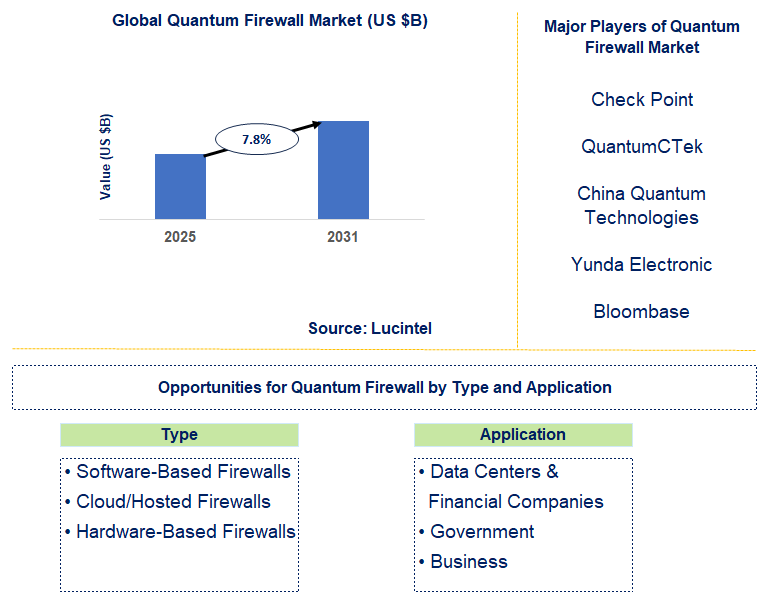
Key data points: The growth forecast = 7.8% annually for the next 7 years. Scroll below to get more insights. This market report covers trends, opportunities and forecasts in quantum firewall market to 2031 by type (software-based firewalls, cloud/hosted firewalls, and hardware-based firewalls), application (data centers & financial companies, government, and business), and region (North America, Europe, Asia Pacific, and the Rest of the World)
We'll send your sample report shortly.
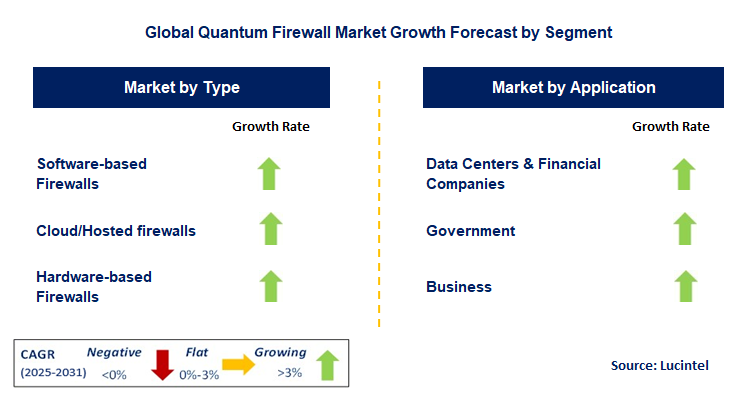
• Lucintel forecasts that, within the type category, cloud/hosted firewall is expected to witness the highest growth over the forecast period.
• Within the application category, government is expected to witness the highest growth.
• In terms of region, APAC is expected to witness the highest growth over the forecast period. Gain valuable insights for your business decisions with our comprehensive 150+ page report. Sample figures with some insights are shown below.
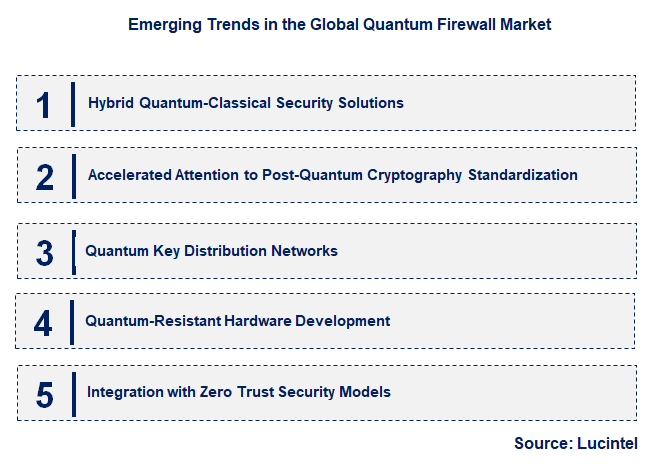
• Hybrid Quantum-Classical Security Solutions: This trend is about combining both classical cryptographic techniques and post-quantum cryptographic or PQC algorithms. Companies are embracing hybrid models to provide real-time protection against today's threats while, at the same time, getting ready for quantum-based attacks in the future. The approach enables a seamless shift since PQC algorithms are still in development. The effect is a more robust and flexible security stance, offering multiple layers of protection that are capable of resisting both conventional as well as new quantum-based cyber-attacks, with reduced disruption throughout the quantum shift.
• Accelerated Attention to Post-Quantum Cryptography Standardization: Governments and top cybersecurity entities, including NIST, are currently engaged in standardizing PQC algorithms which can effectively counter quantum attacks. This is a trend of thorough testing and filtering of such algorithms as lattice-based, code-based, or multivariate polynomial cryptography. The result is a clear map for organizations to transition to quantum-resilient encryption, with interoperability and mass adoption. Standardization in this case is essential to ensure that secure communication protocols still work optimally in a post-quantum environment.
• Quantum Key Distribution Networks: QKD technology uses quantum mechanics to create and distribute cryptographic keys with inherent, un-hackable security. Current developments involve establishing more stable and scalable QKD networks, such as metropolitan, long-haul, and even satellite-based QKD networks. The effect is the creation of ultra-safe communication paths for extremely sensitive information, especially for government, defense, and banking, that offers a level of security above what classic encryption can provide protection against quantum computers that may exist in the future.
• Quantum-Resistant Hardware Development: This trend encompasses the creation and development of hardware elements that are inherently resistant to quantum attacks or can support quantum-safe cryptographic operations at high speeds. These encompass purpose-built chips for PQC algorithms and secure quantum random number generators. The effect is performance gain and lower latency for quantum-safe communication since cryptographic processes are delegated to specially designed hardware, enhancing the viability and performance of quantum-safe solutions for real-world applications in diverse industries.
• Integration with Zero Trust Security Models: With the evolution of cybersecurity, the integration of quantum-safe designs with Zero Trust security models is a growing trend. That is to say, every access request is continually authenticated, no matter its origin, and reinforced with quantum-resistant encryption. The effect is a much enhanced security perimeter where trust is never taken for granted and communications are safeguarded with leading-edge quantum-safe techniques. This delivers end-to-end protection for vital assets in ever more distributed and complex network infrastructures. These are essentially transforming the quantum firewall market by changing the paradigm of cybersecurity from just detect-and-respond to actively creating inherent security within the communication infrastructure. The focus on quantum-resistant algorithms, physical security using QKD, and hardware-accelerated technologies is getting the digital world ready for the post-quantum future, making the long-term integrity and confidentiality of data a reality.
• Successful Quantum Key Distribution Testbeds: One of the most important developments is the number of successful QKD testbeds and pilot implementations in numerous countries. These experiments illustrate the feasibility of practical use of distributing cryptographic keys based on quantum mechanical principles, guaranteeing that any eavesdropping effort changes the quantum state and can be seen at once. The breakthrough is a real-world demonstration of concept of unbackable key exchange, establishing trust in QKD as a building block for ultra-secure communication in critical infrastructure and government networks.
• Publication of Post-Quantum Cryptography Standardization Drafts: NIST has made substantial advances with its PQC standardization effort, publishing draft algorithms for public comment and deployment. These algorithms, which rely on difficult mathematical challenges, are crafted to be immune to attack by quantum computers of the future but still function on classical hardware. The impact is a clear roadmap for software and hardware vendors to start embedding quantum-resistant cryptography so that organizations can begin to strengthen their cryptographic infrastructure well ahead of cryptographically significant quantum computers.
• Advances in Quantum Random Number Generators: Recent advances include smaller, faster, and more reliable quantum random number generators. QRNGs take advantage of quantum phenomena to generate genuinely unpredictable random numbers, which are vital for secure cryptographic keys and communication protocols. The effect is increased security in all cryptographic uses, as the randomness has a direct influence on key strength. This innovation simplifies and lowers the cost of incorporating high-quality randomness into current and future security systems.
• Greater Academic and Industry Cooperation on Quantum-Safe Solutions: There has been a significant rise in collaborative activity between universities, research institutions, and industry stakeholders to drive the development and deployment of quantum-safe technologies. This encompasses co-operative research initiatives, joint test facilities, and public-private cooperation on quantum cybersecurity. The effect is an accelerated rate of innovation, common experience, and optimized resource utilization, resulting in accelerated commercialization and increased uptake of quantum-resistant security solutions in numerous sectors.
• Development of Quantum-Safe VPNs and Secure Communication Platforms: Not complete "firewalls," recent advancements incorporate the advent of virtual private networks or VPNs and secure communication platforms that adopt preliminary implementations of post-quantum cryptography or QKD. These solutions offer end-to-end quantum-secure encryption for data in transit. The effect is up-front increased security for high-risk communications, allowing organizations to begin securing their data against future quantum attacks, especially in financial transactions, control of critical infrastructure, and government communications. These advances are all contributing to the quantum firewall market collectively by setting the ground in place for its eventual implementation. They are pushing the theoretical research, standardization, and applied use of quantum-resistant technologies, bringing the idea from the talk stage to concrete, but foundational, security measures that will safeguard against the potential future capability of quantum computing.
• Government and Defense Sector: Governments and defense departments are top priorities as targets for quantum-based cyberattacks because of the extremely sensitive and classified information that they possess. This sector is a high-growth area for quantum firewalls or quantum-safe communication systems. The effect is a tremendous requirement for intrinsically secure communication pathways, quantum-resistant data storage devices, and robust networks to safeguard national security, intelligence, and military missions from being decrypted in the future by enemy quantum computers.
• Banking and Financial Services: The banking industry, dealing with enormous volumes of monetary transactions and highly sensitive customer information, is another growth area of interest. Quantum firewalls or security solutions using PQC are crucial in protecting financial transactions, preventing fraud, and guaranteeing the long-term integrity of financial records. The effect translates into greater trust in digital banking and financial systems, avoiding disastrous data breaches, and the upkeep of the integrity of the global financial infrastructure against quantum attacks.
• Critical Infrastructure: Operators of critical infrastructure, such as power grids, water treatment plants, and telecom networks, are put at existential risk by quantum attacks that have the potential to compromise fundamental services. This application presents a tremendous growth opportunity for quantum firewalls to secure control systems, data transmission, and communication networks. The effect is increased resilience and reliability of critical services, averting blanket societal disruption and ensuring national security through defense against quantum-powered sabotage.
• Medical and Pharmaceutical Industries: The pharmaceutical and medical industries deal with highly confidential patient information, intellectual property for drug creation, and important research information. Quantum firewalls ensure this data is not harvested in the long term and decrypted in the future. The effect is greater patient confidentiality, safeguarding proprietary research, and data protection compliance, securing the secrecy and integrity of medical and scientific discoveries against quantum threats.
• Cloud Computing and Data Centers: With increasing numbers of organizations moving their data and operations to cloud platforms, protecting these large repositories of data from quantum attacks is now critical. Cloud operators and data center providers are a key growth opportunity for deploying quantum-safe security technologies such as quantum firewalls. The effect is increased data protection for cloud consumers, assurance in cloud infrastructure to hold sensitive data, and the ability to maintain cloud service growth in a quantum-vulnerable world. These strategic growth opportunities are deeply influencing the quantum firewall market by hastening research and development activities in quantum-safe technologies. They are propelling early quantum-resistant solutions' commercialization and deployment, challenging the industry to construct strong and scalable security architectures to safeguard critical assets in various industries from the impending risk of quantum computing.
• Check Point
• QuantumCTek
• China Quantum Technologies
• Yunda Electronic
• Bloombase
• Software-Based Firewalls
• Cloud/Hosted Firewalls
• Hardware-Based Firewalls
• Data Centers & Financial Companies
• Government
• Business
• North America
• Europe
• Asia Pacific
• The Rest of the World
• United States: The United States is also actively investing in post-quantum cryptography (PQC) standards and research on quantum networking. Government organizations, in particular, the National Institute of Standards and Technology (NIST), are at the forefront of standardizing PQC algorithms to take the place of existing cryptographic techniques that are vulnerable to attack by quantum computers. There has been greater recent cooperation among government, academia, and industry to build quantum-resistant solutions. It emphasizes hybrid solutions that blend traditional and post-quantum algorithms to provide immediate and long-term security, with noteworthy research into mechanisms of quantum-resistant key exchange.
• China: China has progressed considerably in quantum communications, especially in quantum key distribution (QKD). The recent advancements involve the installation of vast quantum metropolitan area networks in many of the country's major cities, building a national quantum-secure communication backbone. China has also apparently launched what it says is the world's first commercial quantum cryptography system, integrating QKD and PQC. This ambitious drive reflects China's strategic ambition to dominate quantum-safe technologies, with real-world applications such as quantum-encrypted phone calls and secure platforms for government and financial transactions now being commercially deployed.
• Germany: Germany, a powerhouse of scientific research and cutting-edge engineering, is one of the foremost contributors to quantum technology innovation in Europe. Specific "quantum firewall" product releases are infrequent, but Germany is deeply committed to basic quantum computing science and quantum-resistant cryptography. Research lab, university, and industrial partner collaborations are prevalent, aimed at creating secure quantum communications infrastructure and post-quantum cryptographic algorithms. The focus is on long-term, secure communication solutions for government and critical infrastructure applications with a robust connection to wider European quantum efforts.
• India: India has announced its National Quantum Mission with significant investment to be an international leader in quantum science and technology. Recent news shows significant advancements in quantum software and communication, with hardware fabrication still a gap. Quantum-safe communication chips are being developed for satellite and drone communication that utilize quantum randomness and multiple layers of security. While India's financial services industry is probing quantum-enhanced solutions, there is a known requirement for post-quantum cryptography standards and a clear national security plan to secure sensitive information.
• Japan: Japan is well ahead in quantum computing and networking with heavy public investment and government-funded research facilities. Recent activities involve increased partnerships with global quantum computing leaders, including Ion Q, to promote quantum computing technology in Japan. The emphasis is on utilizing quantum computers for research and development, speeding up real-world applications, and establishing a global quantum business ecosystem. Direct "quantum firewall" products are not yet widespread, but Japan's activities in quantum communication and post-quantum cryptography form the building blocks for future quantum-safe network security.


• Check Point
• QuantumCTek
• China Quantum Technologies
• Yunda Electronic
• Bloombase Q5. Which quantum firewall market segment will be the largest in future? Answer: Lucintel forecasts that, within the type category, cloud/hosted firewall is expected to witness the highest growth over the forecast period. Q6. In quantum firewall market, which region is expected to be the largest in next 5 years? Answer: In terms of region, APAC is expected to witness the highest growth over the forecast period. Q7. Do we receive customization in this report? Answer: Yes, Lucintel provides 10% customization without any additional cost.


Choose a license that fits your team. Instant PDF delivery.
Prices exclude taxes. Instant delivery. Custom licensing available on request.
Market Report · July 29, 2026
Market Report · July 20, 2026
Market Report · July 20, 2026
Trusted partner for strategic intelligence and business growth


Receive a complimentary market analysis tailored to your industry. Our analysts will identify key growth opportunities and competitive dynamics specific to your business.

Market size, growth rate, and key trend analysis for your specific sector.

Top competitor positioning and market share analysis.

Strategic recommendations backed by data-driven insights.
Get curated market intelligence and competitive moves straight to your inbox.
By subscribing, you agree to receive our monthly insights. Unsubscribe anytime.
Receive a complimentary market analysis tailored to your industry. Our analysts will identify key growth opportunities and competitive dynamics specific to your business.
Market size, growth rate, and key trend analysis for your specific sector.
Top competitor positioning and market share analysis.
Strategic recommendations backed by data-driven insights.
Get curated market intelligence, emerging trends, and competitive moves straight to your inbox each month.
By subscribing, you agree to receive our monthly insights. Unsubscribe anytime.
We'll send your sample report shortly.