
Market Report · July 15, 2026

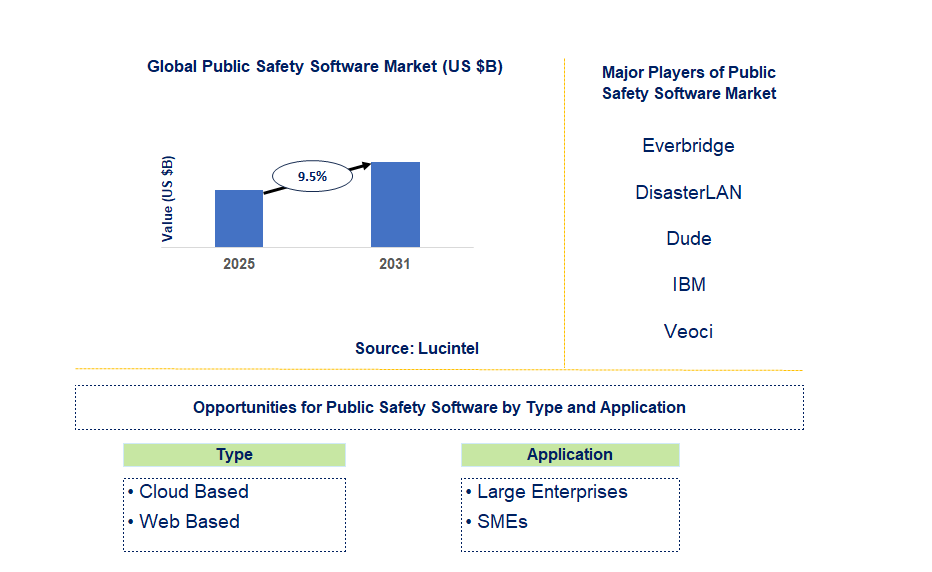
Key data points: The growth forecast = 9.5% annually for the next 7 years. Scroll below to get more insights. This market report covers trends, opportunities and forecasts in public safety software market to 2031 by type (cloud based and web based), application (large enterprises and SMEs), and region (North America, Europe, Asia Pacific, and the Rest of the World)
We'll send your sample report shortly.
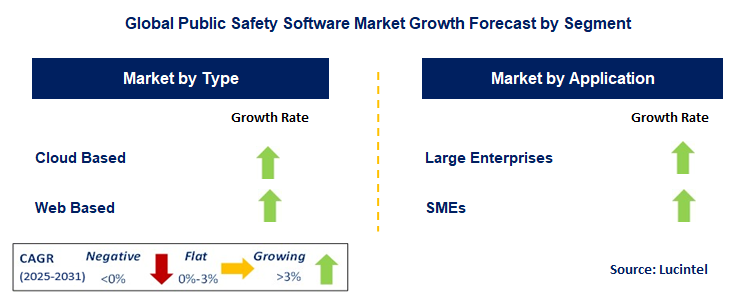
• Lucintel forecasts that, within the type category, web based is expected to witness higher growth over the forecast period.
• Within the application category, SME is expected to witness higher growth.
• In terms of region, APAC is expected to witness the highest growth over the forecast period. Gain valuable insights for your business decisions with our comprehensive 150+ page report. Sample figures with some insights are shown below.
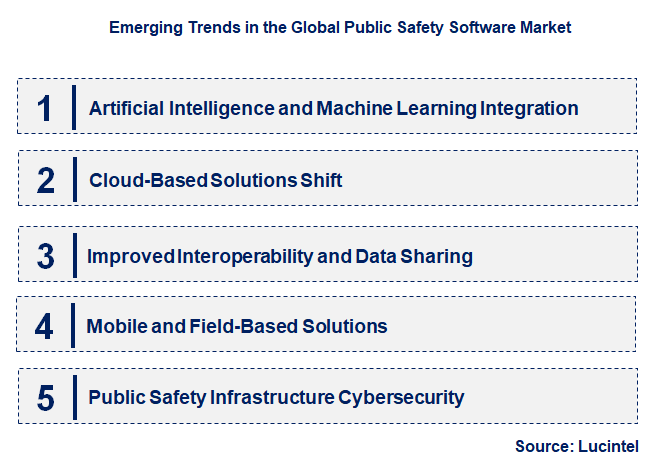
• Artificial Intelligence and Machine Learning Integration: This trend encompasses the growing use of AI and ML algorithms in public safety software for predictive analysis, pattern discovery, and threat detection automated by machines. The result is a move toward proactive instead of reactive policing and emergency response. AI/ML makes it possible for systems to process massive amounts of information from diverse sources, spot possible crime hotspots, forecast future occurrences, and streamline resource allocation, leading to better prevention methods, quicker response times, and enhanced situational awareness for frontline responders.
• Cloud-Based Solutions Shift: This trend represents a forceful shift from traditional on-premises public safety software implementations towards cloud-based platforms. The effect is increased scalability, access, and affordability for public safety organizations. Cloud-based solutions support real-time data exchange and collaboration across various agencies, ensure redundant data backup and easy recovery, and eliminate the need to manage IT infrastructure. These enable agencies to rapidly respond to changing requirements and take advantage of advanced features without huge initial investments.
• Improved Interoperability and Data Sharing: This trend involves creating software products that facilitate the ease of communication and data sharing among different public safety agencies, including police, fire, EMS, and emergency management. The effect is better coordination and a unified response during critical situations. By eliminating data silos, interoperable systems allow all stakeholders to have access to end-to-end, real-time information, which results in improved decision-making, diminished response times, and more efficient cross-agency coordination in the midst of complex emergencies.
• Mobile and Field-Based Solutions: This trend promotes the creation of public safety software intended for use by officers and first responders in the field, such as on ruggedized tablets or smartphones. The effect is a substantial increase in frontline functions and real-time data collection. Mobile applications grant officers instant access to vital information such as suspect records, incident reports, and mapping capabilities, allowing them to make informed decisions, send reports on-scene, and stay aware of the situation while off-site from the standard dispatch offices.
• Public Safety Infrastructure Cybersecurity: This trend entails heightened investment and growth in strong cybersecurity protection specifically designed to shield public safety software systems and critical infrastructure from cyber threats. The effect is the protection of sensitive information, communications networks, and operational integrity. With public safety networks becoming more digital and networked, securing them against ransomware, data breaches, and other cyberattacks is critical to avert disruptions, preserve public confidence, and ensure uninterrupted and secure operation of emergency services. These new trends are radically transforming the public safety software market by creating a paradigm shift toward smart, networked, and robust systems. The marketplace is shifting from siloed, reactive tools to connected, proactive platforms that take advantage of the latest technology for greater situational awareness, faster response, and collaborative operations. It is in the evolution of this shift that agencies can better address the rising expectations of public safety in the modern era, knowing that they have the most cutting-edge tools to safeguard communities and effectively respond to increasingly sophisticated threats.
• Cloud Adoption and Software-as-a-Service Models: One major development is the rapid uptake of cloud-based public safety software solutions as well as SaaS models. This affects the market by providing agencies with increased flexibility, scalability, and lower initial infrastructure expenses. Cloud-based deployments enable more convenient data sharing, real-time updates, and remote access for field workers, making operations more efficient and allowing for quicker deployment of new features. This change is making innovative public safety technologies more democratized, especially for smaller agencies with tight IT budgets.
• Artificial Intelligence Integration for Predictive Policing and Analytics: The key innovation is the large-scale integration of AI and Machine Learning into public safety software for predictive analytics, crime pattern detection, and resource allocation. It affects the market by making it possible to engage in proactive prevention of crime and better resource optimization. AI-driven solutions review historical information to determine the likelihood of hot spots, evaluate risk, and forecast future events, enabling agencies to act before crimes happen and distribute staff more efficiently, redefining conventional policing practices.
• Better Data Interoperability and Information Sharing Platforms: Another development is the emphasis on building platforms that enable seamless data sharing and interoperability across disparate public safety agencies, including police, fire, and emergency medical services. This affects the market by promoting increased cooperation and collective response in multi-agency incidents. Through facilitation of real-time exchange of information such as incident data, dispatch records, and patient information, these platforms greatly enhance coordination, eliminate delays, and make overall emergency operations more effective.
• Evolutions in Advanced Mobile and Wearable Solutions: Recent advancements have seen the establishment of advanced mobile applications and wearables with incorporated public safety software for frontline responders. This influences the market by making officers and emergency responders more capable through real-time access to critical information while in the field. These solutions offer features such as mobile reporting, biometric identification, live video streaming, and GPS tracking, thus raising situational awareness, increasing officer safety, and making data capture at an incident scene more efficient.
• Emphasis on Cybersecurity and Data Privacy in Public Safety Systems: An essential development is the increased focus on solid cybersecurity practices and data privacy standards in public safety software. This affects the market by providing protection for extremely sensitive information, securing unauthorized access, and preserving the integrity of mission-critical communications. With public safety networks becoming more interconnected and processing large volumes of personal data, robust cybersecurity regimes and compliance with data protection requirements are most important to foster confidence and provide operational resilience. These innovations are deeply affecting the public safety software market by ushering in a radical change towards smarter, more integrated, and secure solutions. The market is shifting away from mere record-keeping to include predictive insights, real-time information sharing, and mobile accessibility, all anchored in strong cybersecurity. This transformation is transforming the way public safety agencies work, equipping them with sophisticated tools to drive efficiency, reduce response times, and ultimately build safer communities in a more complex and networked world.
• Emergency Medical Services Management Software: The need for effective pre-hospital care and optimized emergency medical operations is on the rise, offering a large growth opportunity. This ranges from real-time ambulance tracking software, patient data software, electronic patient care reporting (ePCR) software, and hospital system integration. The potential is to create intuitive, interoperable EMS software that lowers response times, enhances patient outcomes through more effective data sharing, and increases coordination among dispatch, field resources, and healthcare institutions, resulting in more efficient emergency medical interventions.
• Law Enforcement and Criminal Justice Solutions: This is a foundational and growing opportunity. It involves computer-aided dispatch (CAD), records management systems (RMS), mobile policing software, investigative analytics, and court management software. The project includes the creation of sophisticated AI-driven predictive policing tools, crime mapping tools, facial recognition software, and digital evidence management solutions. Safety improvement for officers, automation of administrative processes, and data-driven decision-making will witness high demand due to the constant need to deal with changing criminal operations.
• Operations Management for Fire and Rescue: With fire departments growing their mission beyond the familiar firefighting and into hazardous materials response and technical rescue, the need for specialized software increases. Solutions for incident command, resource management, pre-incident planning, and enforcement of fire codes fall into this category. The potential is to offer integrated platforms that build situational awareness in the course of emergencies, maximize resource allocation, allow for communication across units, and maintain fire prevention programs, essentially maximizing the safety and efficiency of fire and rescue operations.
• Smart City Public Safety Integration: The growing smart city trend creates a significant growth opportunity by consolidating different public safety software elements into a unified urban management platform. This entails integrating surveillance networks, traffic control, emergency services, and citizen reporting apps. The possibility lies in creating combined command and control centers that use IoT data and AI analysis to deliver real-time insights, support predictive safety initiatives, and allow swift, coordinated responses across a whole city network, making cities safer and more resilient.
• Jail and Correctional Management Systems: The requirement for secure and effective management of correctional facilities is a critical opportunity for growth. This encompasses inmate tracking, booking, scheduling, health records, and incident reporting software within jails and prisons. The opportunity is to build strong, secure systems that improve operational effectiveness, increase inmate safety, decrease administrative hassles, and provide compliance with correctional regulations. Solutions offering end-to-end data for risk analysis and budgeting will be particularly sought after in this niche segment. These growth opportunities of a strategic nature are significantly shaping the public safety software market by pushing a trend towards extremely specialized yet integrated solutions developed specifically to address the particular needs of every public safety function. The market is growing more application-driven, with innovation aimed at improving efficiency, advancing response potential, and deploying advanced technologies in targeted operational environments. This targeted focus is driving the development of advanced tools that are essential for upscaling public safety infrastructure and promoting community wellness across the world.
• Everbridge
• DisasterLAN
• Dude
• IBM
• Veoci
• ArcGIS
• BeSafe
• CoBRA
• Priority
• Crisis360
• Cloud Based
• Web Based
• Large Enterprises
• SMEs
• North America
• Europe
• Asia Pacific
• The Rest of the World
• United States: The US public safety software market is a dominant player, marked by heavy investment in sophisticated solutions to address increasing crime levels and cyber threats. Recent trends involve high-pressure movement towards cloud-based deployments for increased scalability and accessibility, with the inclusion of AI for predictive policing and real-time data analysis. Industry giants such as Motorola Solutions and Tyler Technologies continue to add new offerings, with a significant emphasis on interoperability among disparate agencies and the deployment of mobile police software for frontline responders.
• China: The Chinese public safety software market is growing rapidly, driven by ambitious smart city plans and high government investments in national security infrastructure. Trends include a heavy focus on surveillance systems combined with AI and facial recognition technologies for massive-scale public monitoring and crime prevention. The market also witnesses strong growth in law enforcement software, especially data analysis and critical communication networks, driven by state-driven programs to boost public safety and social stability.
• Germany: The German public safety software market is characterized by an emphasis on high-quality, secure, and compliant products, with a heavy focus on data protection and privacy laws. Developments include widespread embrace of cloud-based platforms and the inclusion of AI for sophisticated threat detection within the security space, which indirectly benefits public safety. There is also a significant shift towards total security solutions that blend technology and services, fueled by the demand for more efficient, capable security operations, especially in critical infrastructure protection.
• India: The Indian public safety software market is witnessing strong growth, fueled by rising urbanization, growing crime rates, and significant government initiatives such as the Smart City project. Recent trends point towards major investments in AI, machine learning, and data analytics for border protection and public safety, such as AI-based video analytics for crowd monitoring. The market is also witnessing the growing emphasis on police modernization efforts, with increasing use of digital tools for real-time tracking, crime analysis, and digital case management systems to maximize law enforcement capabilities.
• Japan: The Japanese public safety software market is transforming with a firm focus on disaster management, crime prevention, and improving emergency response capabilities. Recent activity has seen the implementation of sophisticated surveillance systems, data analysis, and communication solutions to enhance urban security and resilience to natural disasters. There is increased interest in leveraging IoT devices and AI to implement predictive safety measures, indicating Japan’s proactive stance on leveraging technology to protect its population and infrastructure.


• Everbridge
• DisasterLAN
• Dude
• IBM
• Veoci
• ArcGIS
• BeSafe
• CoBRA
• Priority
• Crisis360 Q5. Which public safety software market segment will be the largest in future? Answer: Lucintel forecasts that, within the type category, web based is expected to witness higher growth over the forecast period. Q6. In public safety software market, which region is expected to be the largest in next 5 years? Answer: In terms of region, APAC is expected to witness the highest growth over the forecast period. Q7. Do we receive customization in this report? Answer: Yes, Lucintel provides 10% customization without any additional cost.


Choose a license that fits your team. Instant PDF delivery.
Prices exclude taxes. Instant delivery. Custom licensing available on request.
Market Report · July 15, 2026
Market Report · June 26, 2026
Market Report · June 24, 2026
Trusted partner for strategic intelligence and business growth


Receive a complimentary market analysis tailored to your industry. Our analysts will identify key growth opportunities and competitive dynamics specific to your business.

Market size, growth rate, and key trend analysis for your specific sector.

Top competitor positioning and market share analysis.

Strategic recommendations backed by data-driven insights.
Get curated market intelligence and competitive moves straight to your inbox.
By subscribing, you agree to receive our monthly insights. Unsubscribe anytime.
Receive a complimentary market analysis tailored to your industry. Our analysts will identify key growth opportunities and competitive dynamics specific to your business.
Market size, growth rate, and key trend analysis for your specific sector.
Top competitor positioning and market share analysis.
Strategic recommendations backed by data-driven insights.
Get curated market intelligence, emerging trends, and competitive moves straight to your inbox each month.
By subscribing, you agree to receive our monthly insights. Unsubscribe anytime.
We'll send your sample report shortly.