
Market Report · July 15, 2026

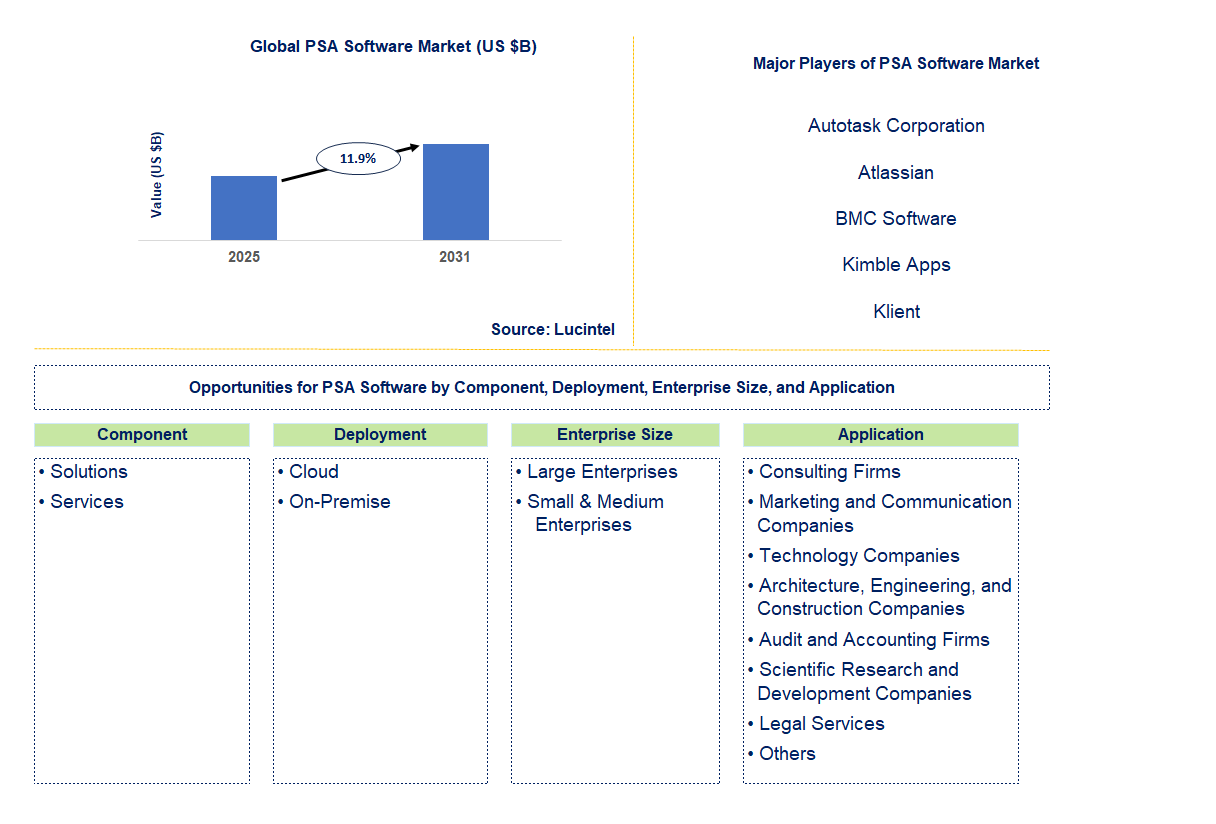
Key data points: The growth forecast = 11.9% annually for the next 7 years. Scroll below to get more insights. This market report covers trends, opportunities and forecasts in PSA software market to 2031 by component (solutions and services), deployment (cloud and on-premise), enterprise size (large enterprises and small & medium enterprises), application (consulting firms, marketing and communication companies, technology companies, architecture, engineering, and construction companies, audit and accounting firms, scientific research and development companies, legal services, and others), and region (North America, Europe, Asia Pacific, and the Rest of the World)
We'll send your sample report shortly.
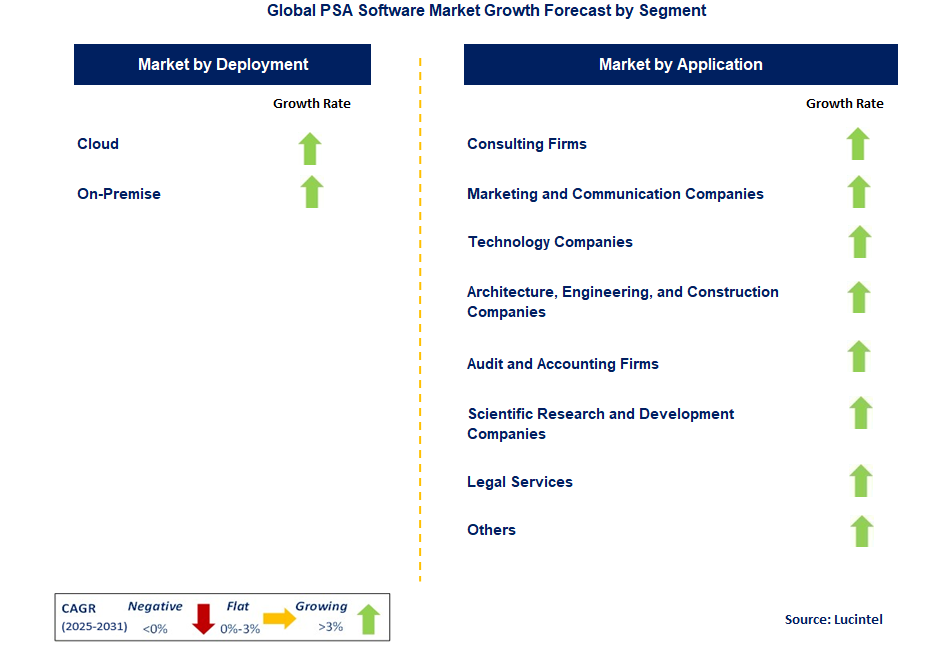
• Lucintel forecasts that, within the deployment category, on-premise will remain a larger segment over the forecast period.
• Within the application category, marketing and communication companies are expected to witness the highest growth.
• In terms of region, APAC is expected to witness the highest growth over the forecast period.
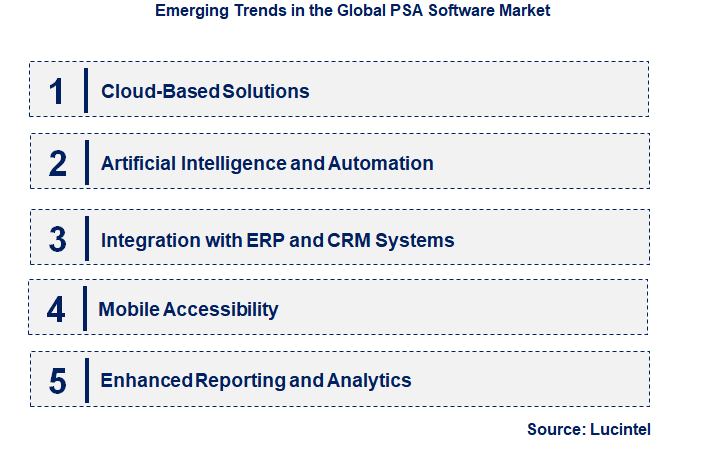
• Cloud-Based Solutions: PSA software adoption is now easier than before due to the cost-effective scalability and remote access provided by cloud technology. With increased flexibility and ease of integration with CRMs and ERPs, companies are moving toward cloud-enabled PSA platforms. This transition enables businesses to manage global teams and projects effectively without the constraints of on-premise infrastructure.
• Artificial Intelligence and Automation: Allocation of resources, tracking of time, and project forecasting are some of the processes that PSA software is automating with AI and automation technology. Companies are better able to forecast project success, maximize resource utilization, and reduce human error because of these capabilities. Allowing AI integration aids in better decision-making by analyzing available data and creating insights that can be acted upon.
• Integration with ERP and CRM Systems: In the pursuit of optimizing business processes, PSA solutions are now commonly integrated with ERP and CRM systems. With this integration, data silos are eliminated, ensuring consistency while reducing redundancy. Facilitating collaboration across business departments becomes easy. A more holistic approach to business operations management is made possible through the merger of project management, finance, and customer relationship functions provided by PSA tools.
• Mobile Accessibility: As remote and mobile workforces become more prevalent, accessibility on mobile devices has become equally important. A growing number of providers are working on mobile-friendly platforms that allow project managers, teams, and even clients to access data, communicate, and manage tasks regardless of their location. This trend enables more flexible working arrangements and encourages real-time collaboration.
• Enhanced Reporting and Analytics: Businesses have shown a desire to utilize more granular reporting and tracking features related to project performance and resource usage. PSA software is adopting more robust reporting and analytics features around resource, project, and financial tracking. Companies using big data and predictive analytics will have better insight into a project’s dynamics, enabling them to make better decisions that will improve project outcomes. The adoption of mobile accessibility and advanced reporting features is a trend that is shifting PSA software toward more sophisticated, integrated, and flexible solutions that enhance project resource management and efficiency.
• Cloud Adoption: These days, several PSA suppliers are providing SaaS products, which enable organizations to scale their operations easily, gain access to data in real-time, and integrate with existing business applications. This allows firms to respond to changing needs and global business activities with greater agility.
• AI-Powered Features: PSA software is automated with Artificial Intelligence tools, which help manage mundane tasks like scheduling, allocating resources, and tracking time. AI-powered predictive analytics also assist an organization in anticipating project risks as well as managing costs and resources more efficiently.
• Mobile-First Platforms: PSA vendors are investing in mobile-centric software to enable users to work on the platform from any location, enhancing the flexibility of projects and enabling teams to work remotely. This is essential for sectors that have teams in the field or a distributed workforce worldwide.
• Enhanced Integration Capabilities: There has been an increase in demand for PSA software that integrates with other enterprise applications such as ERP, CRM, and financial management systems. Integration enables the automation of processes, increases the accuracy of information, and eliminates operational silos.
• User Experience and Interface Improvements: In order to increase adoption and user satisfaction, PSA software providers are trying to improve the user interface (UI) and user experience (UX) to make the tools simple and user-friendly. This is more critical for organizations that have a wide variety of employees and customers. The ongoing changes make PSA software highly productive, easier to use, and more essential for carrying out business activities and facilitating better project management.
• Cloud Solutions: Cloud technology is transforming the PSA software market. Flexibility and scalability, coupled with lower costs, make cloud-enabled solutions attractive to businesses that need remote access to project information while also wanting to cut down on infrastructure expenses. Such trends are growing, resulting in PSA software becoming increasingly available to small and medium-sized enterprises (SMEs).
• Integration of AI Technology: PSA software providers are taking advantage of AI automation and AI predictive technologies. With AI integration, projects can be forecasted in real-time, resources can be allocated intelligently, and risks can be managed accordingly. There is a greater possibility for PSA vendors to provide advanced solutions needed by firms today.
• Integration with Other Business Systems: The need for more integrated enterprise systems is particularly one of PSA software vendors’ opportunities. Integrating PSA software with ERP, CRM, and other business tools simplifies and enhances the accuracy of data and information provided by different departments in the organization.
• Industry-Specific Solutions: Construction, IT, and consulting sectors are served with industry-specialized PSA, which is a remarkable opportunity. These solutions address unique challenges of different industries with project management, regulatory compliance, and ensure client satisfaction when adopted.
• Mobile and Remote Workforce Solutions: The development of mobile and remote workforces is an opportunity for PSA software providers. These businesses can more easily implement solutions with significant mobile functionality, allowing for the effective management of remote staff and giving an advantage to firms with field operations or global teams. These growth opportunities represent the continual change within the PSA software market, as companies more and more look for solutions that are flexible, smart, and integrated with other systems.
• Autotask Corporation
• Atlassian
• BMC Software, Inc.
• Kimble Apps
• Klient, Inc,
• Microsoft Corporation
• SAP SE
• Solutions
• Services
• Cloud
• On-Premise
• North America
• Europe
• Asia Pacific
• The Rest of the World
• United States: In the US, there is wider use of PSA software in the technology and consulting industries. The main drivers include a high level of automation, better resource distribution, and improved project visibility. Recently, American firms have started using cloud computing to integrate PSA tools with ERP systems. Companies have also begun using AI and machine learning to predict resource requirements and optimize project schedules.
• China: Due to the rapid growth of China’s manufacturing and technology industries, the PSA software market is experiencing significant growth. Companies are shifting toward digitalization to improve project management, and there is a general increase in this phenomenon. China’s companies are using PSA software to improve operational efficiency, lower operational costs, and enhance service provision. The implementation of smart cities and the improvement in technology, emphasized by the government, provide a ready market for PSA tools.
• Germany: Germany is a powerhouse of industrial and engineering activities and has recently adopted PSA software in the engineering, construction, and manufacturing industries. Firms are using these systems to automate project activities, allocate resources effectively, and meet diverse and stringent legal requirements. At the same time, PSA systems are essential for improving business and operational efficiency in the context of increasing global competition and environmental sustainability.
• India: In India, the PSA software market is growing rapidly, particularly in the IT and consulting industries. Indian companies are increasingly adopting PSA tools to handle large project portfolios, ensure timely completion, and enhance team collaboration. The adoption of cloud technologies is also growing, resulting in a clear movement toward SaaS-based PSA solutions where companies can lower infrastructure spending and scale more easily. Moreover, India’s expanding startup ecosystem also increases the need for these tools.
• Japan: Japan has been experiencing a surge in the use of PSA software among large businesses in the IT and service sectors. Japanese companies are now using PSA tools to automate project tracking, billing, and resource allocation. In a bid to increase efficiency and reduce operational costs in the public and private sectors, the use of PSA solutions is critical to remaining competitive. Furthermore, Japan’s focus on digital transformation has created a greater need for sophisticated PSA solutions that utilize AI and advanced analytics, further fueling the need for such software.


• Autotask Corporation
• Atlassian
• BMC Software, Inc.
• Kimble Apps
• Klient, Inc,
• Microsoft Corporation
• SAP SE Q5. Which PSA software market segment will be the largest in future? Answer: Lucintel forecasts that, within the deployment category, on-premise will remain a larger segment over the forecast period. Q6. In PSA software market, which region is expected to be the largest in next 5 years? Answer: In terms of region, APAC is expected to witness the highest growth over the forecast period. Q7. Do we receive customization in this report? Answer: Yes, Lucintel provides 10% customization without any additional cost.


Choose a license that fits your team. Instant PDF delivery.
Prices exclude taxes. Instant delivery. Custom licensing available on request.
Market Report · July 15, 2026
Market Report · June 26, 2026
Market Report · June 24, 2026
Trusted partner for strategic intelligence and business growth


Receive a complimentary market analysis tailored to your industry. Our analysts will identify key growth opportunities and competitive dynamics specific to your business.

Market size, growth rate, and key trend analysis for your specific sector.

Top competitor positioning and market share analysis.

Strategic recommendations backed by data-driven insights.
Get curated market intelligence and competitive moves straight to your inbox.
By subscribing, you agree to receive our monthly insights. Unsubscribe anytime.
Receive a complimentary market analysis tailored to your industry. Our analysts will identify key growth opportunities and competitive dynamics specific to your business.
Market size, growth rate, and key trend analysis for your specific sector.
Top competitor positioning and market share analysis.
Strategic recommendations backed by data-driven insights.
Get curated market intelligence, emerging trends, and competitive moves straight to your inbox each month.
By subscribing, you agree to receive our monthly insights. Unsubscribe anytime.
We'll send your sample report shortly.