
Market Report · July 29, 2026

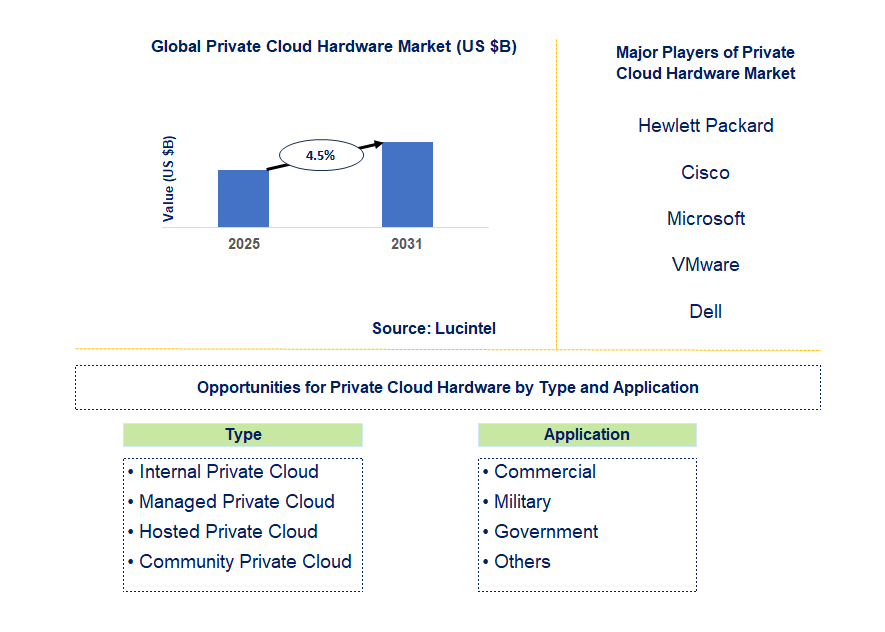
Key data points: The growth forecast = 4.5% annually for the next 7 years. Scroll below to get more insights. This market report covers Trends, opportunity and forecast in private cloud hardware market to 2031 by type (internal private cloud, managed private cloud, hosted private cloud, and community private cloud), application (commercial, military, government, and others), and region (North America, Europe, Asia Pacific, and the Rest of the World)
We'll send your sample report shortly.
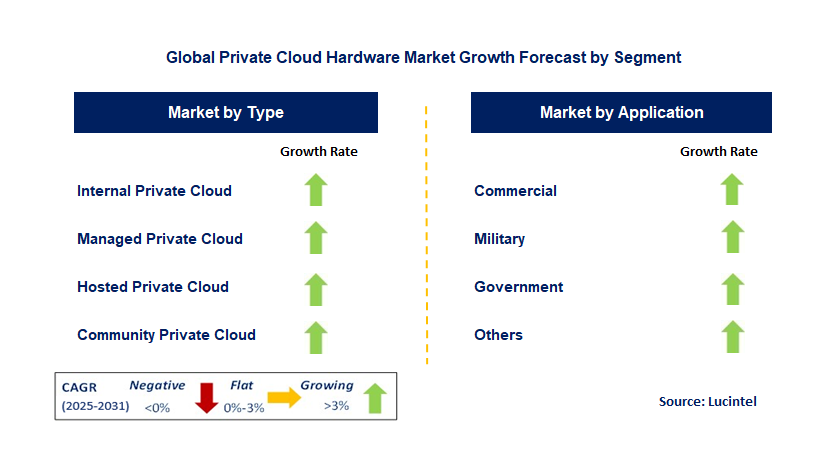
• Lucintel forecasts that, within the type category, internal private cloud is expected to witness the highest growth over the forecast period due to growing demand for data sovereignty and regulatory compliance is driving adoption of internal private clouds.
• Within the application category, commercial is expected to witness the highest growth due to increasing adoption of digital transformation initiatives is driving private cloud investments in the commercial sector.
• In terms of region, North America is expected to witness the highest growth over the forecast period due to its technological advancements. Gain valuable insights for your business decisions with our comprehensive 150+ page report. Sample figures with some insights are shown below.
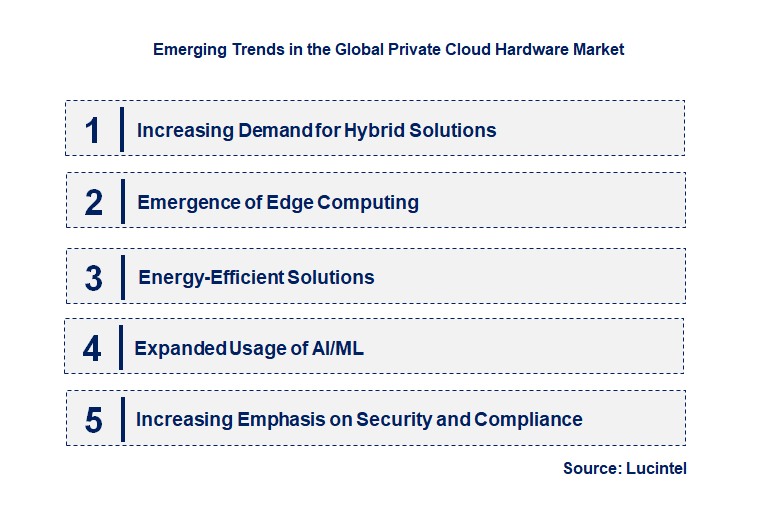
• Increasing Demand for Hybrid Solutions: Hybrid cloud solutions are gaining popularity because businesses are trying to integrate the flexibility of public clouds with the control of private clouds. Hybrid architectures enable organizations to store sensitive data in private clouds while utilizing public clouds for less-critical workloads. This flexibility allows businesses to optimize costs and performance while meeting regulatory compliance requirements. Hybrid cloud solutions provided by companies such as IBM and Microsoft integrate the best of private and public cloud infrastructure, hence balancing and scaling a cloud environment for enterprises.
• Emergence of Edge Computing: Edge computing has become one of the emerging trends in private cloud infrastructure. As data processing happens closer to the source where data is being generated, latency decreases and makes the applications working on the cloud faster. This is especially relevant for manufacturing, healthcare, and smart cities applications where real-time data processing plays a crucial role. Private cloud hardware solutions that have integrated edge computing capabilities are increasingly prevalent, allowing organizations to deploy faster, more responsive applications and improve operational efficiency across distributed environments.
• Energy-Efficient Solutions: As the demand for private cloud infrastructure continues to rise, there is an increasing need for energy-efficient hardware solutions. Data centers are amongst the biggest energy consumers, thus business organizations strive for the consumption of minimum energy along with fulfilling the required performance for the cloud platforms. Better cooling technologies and the usage of energy-efficient processors as well as the utilization of renewable energy sources are improving data center efficiencies, aiding organizations in designing a sustainable private cloud infrastructure. This trend also decreases the carbon footprints as well as lowering operating expenses of a private cloud deployments.
• Expanded Usage of AI/ML: The applications of Artificial Intelligence and machine learning in hardware offerings are fast-becoming vital aspects of private clouds. With the assistance of AI-driven, self-driving mechanisms that utilize these mechanisms to govern resources allocation and data analytics processes as well as the automation of their workload, their effectiveness enhances over all of their private clouds infrastructure. Businesses are using AI and ML to improve their private cloud operations, performance, and the ability to predict future capacity requirements. As AI and ML capabilities are increasingly integrated into cloud hardware, organizations can leverage new opportunities for automation and data-driven decision-making.
• Increasing Emphasis on Security and Compliance: Data security and regulatory compliance remain top of mind for businesses deploying private cloud infrastructures. As more and more sensitive data are now being stored on the cloud, companies are now investing in higher security measures, which include encryption, multi-factor authentication, and intrusion detection systems. There is also the increasing number of data privacy regulations around the globe, including GDPR and CCPA, which forces businesses to comply through private cloud solutions. The main concentration of companies which offer private cloud hardware solutions remains on offering secured and compliant infrastructures to support enterprises operating in heavily regulated industries. Hybrid cloud adoption, edge computing, energy efficiency, integration of AI and ML, and enhanced security and compliance are changing the nature of the private cloud hardware market. These are trends that drive innovations in cloud infrastructure, making them scalable, efficient, and secure for businesses across multiple industries.
• Advancements in Hybrid Cloud Integration: Hybrid cloud solutions have become a key focus in the private cloud hardware market. More and more companies are looking for private cloud infrastructure that can be integrated with public cloud platforms seamlessly. This development helps businesses optimize cost efficiency, scalability, and data management. Hybrid cloud solutions are particularly important for businesses that require flexibility in their cloud deployment while ensuring the security of sensitive data.
• Emergence of AI-Driven Cloud Hardware: Artificial intelligence is now playing a vital role in private cloud hardware solutions. AI-based systems can manage cloud resources, optimize workloads, and analyze data in real time, thereby making businesses more operationally efficient. AI is also being used to upgrade security features, for example, in identifying potential vulnerabilities and automatically taking protective measures. This trend is compelling the development of more advanced AI-based hardware solutions integrated into private cloud platforms.
• Sustainability at the Data Centre Level: The development of hardware for private cloud has been characterized by the introduction of sustainability. For instance, it is observed that the increasing energy needs from data centers have led various businesses to produce energy-efficient infrastructures. Renewable sources of energy and efficient cooling systems and ecologically friendly materials add to the evolution of sustainable solutions for private cloud. This sense of sustainability can help businesses become environmentally friendly with growing demands for services in the cloud.
• Integration of Edge Computing with Private Cloud: Edge computing integration with private hardware in the cloud is also a significant development. Edge computing reduces latency by processing data close to where it is generated. It helps improve applications' performance. In such applications, real-time data processing is critical: for example, health care, smart cities, and manufacturing industries. Private cloud infrastructure, which is integrated with edge computing, is making it possible for companies to deploy cloud-based solutions that are faster and more efficient.
• Enhanced Security Capabilities in Cloud Hardware: With data security at the forefront of business needs, there has been a surge in the development of private cloud hardware that incorporates advanced security features. Hardware-based encryption, multi-factor authentication, and intrusion detection systems that are designed to protect sensitive data stored in private clouds are a few examples of such innovations. These innovations will ensure that businesses are able to keep their data secure from cyber threats while still retaining the flexibility and scalability of their cloud infrastructure. Current advancements in private cloud hardware represent more focus on hybrid cloud, integration of AI capabilities, sustainability in operations, use of edge computing, and incorporation of better security functions. All this is supporting more agile, effective, and safe infrastructure creation in a cloud.
• Telecom: Most recently, telecommunications have been using more private cloud hardware than ever before due to its applications in improving a company's provision of services, structure, and connectivity. With regard to 5G networks that also require low latencies in data processes, the need to have control or security is further amplified in opting for private clouds. For more efficient network handling and offering sure-fast connectivity to subscribers, private clouds are crucial.
• Healthcare: The healthcare industry is rapidly considered one of the fastest-growing sectors regarding the adoption of private cloud use, allied to the ability of secure data storage and compliance with regulations such as HIPAA. Private cloud hardware provides healthcare providers with a secure environment for managing patient data, electronic health records, and medical applications. The growing demand for telemedicine and digital health solutions presents a significant opportunity for private cloud hardware providers.
• Financial Services: A second key industry sector that strongly leads demand for private cloud hardware lies in the financial services sector. Financial institutions strongly need security solutions and adhere to strict regulations like PCI DSS. Private cloud hardware provides a secure and scalable solution in managing financial transactions, customer data, and analytics. Digital banking and fintech solutions are on the rise, driving further demand for private cloud in the financial sector.
• Manufacturing: Private cloud hardware is becoming more commonly adopted by manufacturers in support of their digital transformation efforts, including automation, IoT, and smart manufacturing. Private cloud solutions help manufacturers process enormous amounts of data that connected devices produce in real time, thus allowing them to streamline their operations and minimize operational costs. Growth in private cloud hardware is therefore being driven by Industry 4.0 and the necessity of high-performance computing.
• Government and Public Sector: Improving data security, privacy, and compliance with regulatory requirements, government agencies and public sector organizations shift to private cloud hardware. Private cloud infrastructure allows governments to ensure sensitive data securely and boosts operational efficiency. With the speed of digital transformation initiatives in the public sector, the demand for private cloud hardware solutions will explode. The strategic growth opportunities in the private cloud hardware market cut across various sectors: telecommunications, healthcare, financial services, manufacturing, and government. The higher demand for safe scalable private cloud solutions will push the growth of the market as businesses continue to invest in digital transformation.
• Hewlett Packard Enterprise
• Cisco
• Microsoft
• VMware
• Dell
• Oracle
• IBM
• NetApp
• Red Hat
• Amazon Web Services
• Internal Private Cloud
• Managed Private Cloud
• Hosted Private Cloud
• Community Private Cloud
• Commercial
• Military
• Government
• Others
• North America
• Europe
• Asia Pacific
• The Rest of the World
• United States: Private cloud adoption has picked up pace in the United States because of growing data security concerns and the need for customized infrastructure. The major players like Dell Technologies, Cisco, and HPE have been focusing on private cloud solutions that support businesses in highly regulated industries such as healthcare and finance. Additionally, with the ongoing expansion of 5G and edge computing, U.S. businesses are demanding more localized cloud hardware to reduce latency and improve service efficiency. This growth is fueling innovations in hardware solutions designed to optimize private cloud performance while maintaining strict control over data and infrastructure.
• China: The push of China toward self-reliance in technology and data sovereignty has made it a key player in the private cloud hardware market. With digital transformation and data localization taking priority, companies are investing in private cloud solutions that will abide by local data regulations. Huawei and Alibaba Cloud are among the companies offering private cloud hardware solutions to businesses in light of the rising demand for scalability, security, and high performance. As smart cities and industrial IoT develop rapidly, private cloud infrastructure in China will also have a role to play in the future.
• Germany: Germany is at the forefront of private cloud adoption in Europe, especially in industries such as manufacturing, automotive, and healthcare. The country’s strong emphasis on data privacy and security regulations under GDPR has driven demand for private cloud hardware solutions. German companies are increasingly choosing private clouds over public alternatives to ensure compliance and protect sensitive data. Companies like Deutsche Telekom and SAP are offering tailored private cloud solutions, including hybrid cloud systems, which help businesses enhance their operational efficiency while maintaining full control over data management and security.
• India: India is witnessing growing demand for private cloud solutions as more businesses move towards digital transformation. Factors such as rising concerns over data privacy and the need for cost-effective, scalable cloud solutions are pushing the adoption of private clouds across sectors such as IT, banking, and healthcare. Indian companies are seeking solutions that offer flexible deployment models and integration with existing infrastructures. As part of its “Digital India” initiative, the government is also supporting private cloud adoption by investing in local data centers and promoting cloud-native technologies. This shift is driving the growth of private cloud hardware solutions in the country.
• Japan: In Japan, the private cloud hardware market is evolving as businesses look to improve operational efficiency, support digital innovation, and comply with strict data protection laws. Japanese companies, particularly in the financial and manufacturing sectors, are increasingly adopting private cloud solutions for their flexibility and enhanced security. Companies like Fujitsu and NEC are offering state-of-the-art hardware solutions for private cloud deployments, focusing on scalability, automation, and integration with existing enterprise systems. Additionally, Japan’s focus on IoT and automation in its smart factories is contributing to the growth of private cloud hardware.


• Hewlett Packard Enterprise
• Cisco
• Microsoft
• VMware
• Dell
• Oracle
• IBM
• NetApp
• Red Hat
• Amazon Web Services Q5. Which private cloud hardware market segment will be the largest in future? Answer: Lucintel forecasts that internal private cloud is expected to witness the highest growth over the forecast period due to growing demand for data sovereignty and regulatory compliance is driving adoption of internal private clouds. Q6. In private cloud hardware market, which region is expected to be the largest in next 5 years? Answer: North America is expected to witness the highest growth over the forecast period due to its technological advancements. Q7. Do we receive customization in this report? Answer: Yes, Lucintel provides 10% customization without any additional cost.


Choose a license that fits your team. Instant PDF delivery.
Prices exclude taxes. Instant delivery. Custom licensing available on request.
Market Report · July 29, 2026
Market Report · July 20, 2026
Market Report · July 20, 2026
Trusted partner for strategic intelligence and business growth


Receive a complimentary market analysis tailored to your industry. Our analysts will identify key growth opportunities and competitive dynamics specific to your business.

Market size, growth rate, and key trend analysis for your specific sector.

Top competitor positioning and market share analysis.

Strategic recommendations backed by data-driven insights.
Get curated market intelligence and competitive moves straight to your inbox.
By subscribing, you agree to receive our monthly insights. Unsubscribe anytime.
Receive a complimentary market analysis tailored to your industry. Our analysts will identify key growth opportunities and competitive dynamics specific to your business.
Market size, growth rate, and key trend analysis for your specific sector.
Top competitor positioning and market share analysis.
Strategic recommendations backed by data-driven insights.
Get curated market intelligence, emerging trends, and competitive moves straight to your inbox each month.
By subscribing, you agree to receive our monthly insights. Unsubscribe anytime.
We'll send your sample report shortly.