
Market Report · July 29, 2026

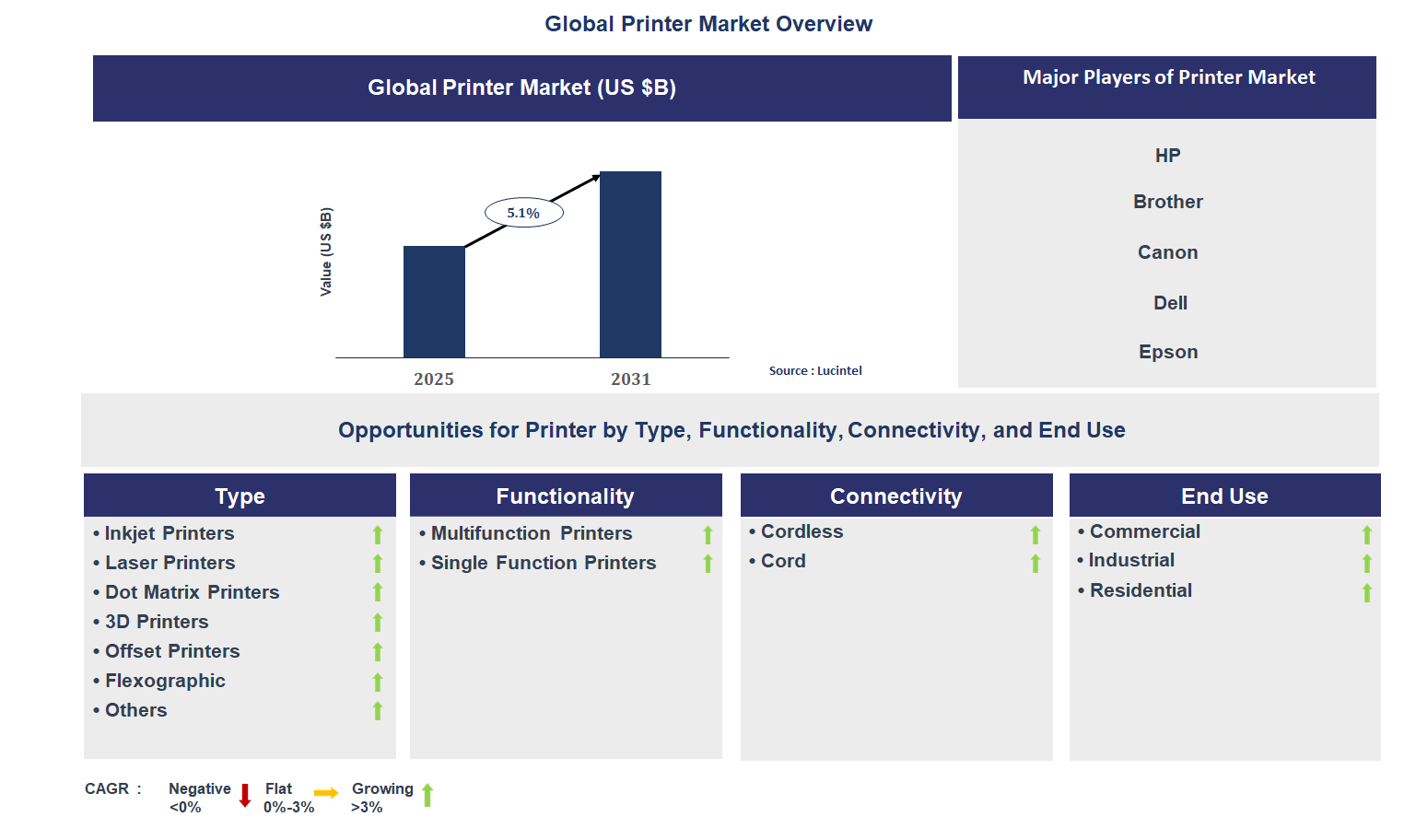
Key data points: The growth forecast = 5.1% annually for the next 7 years. Scroll below to get more insights. This market report covers trends, opportunities and forecasts in printer market to 2031 by type (inkjet printers, laser printers, dot matrix printers, 3d printers, offset printers, flexographic, and others), functionality (multifunction printers and single function printers), connectivity (cordless and cord), end use (commercial, industrial, and residential), and region (North America, Europe, Asia Pacific, and the Rest of the World)
We'll send your sample report shortly.
• Lucintel forecasts that, within the type category, inkjet printer is expected to witness the highest growth over the forecast period.
• Within the end use category, commercial is expected to witness the highest growth.
• In terms of region, APAC is expected to witness the highest growth over the forecast period. Gain valuable insights for your business decisions with our comprehensive 150+ page report. Sample figures with some insights are shown below.
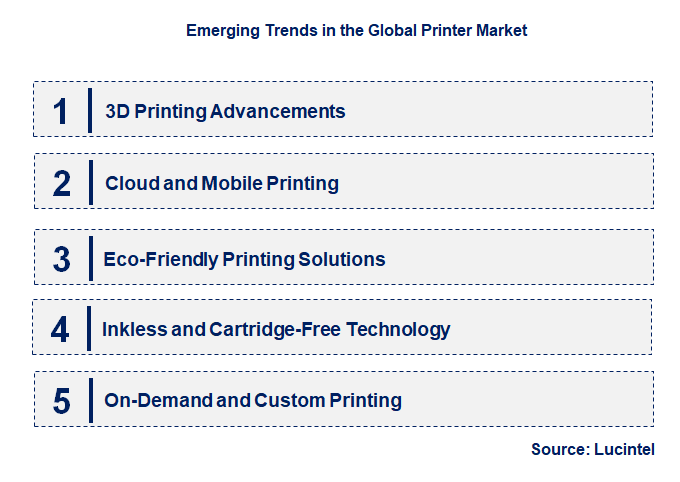
• 3D Printing Advancements: 3D printing is a rapidly growing segment, with applications across industries like manufacturing, healthcare, and automotive. This trend is not only reshaping traditional printing but also enabling new forms of production and prototyping. It allows companies to create custom products on-demand, reducing waste and increasing efficiency, and is poised to revolutionize various manufacturing sectors.
• Cloud and Mobile Printing: With the rise of mobile and cloud technologies, printers are becoming more integrated into the digital ecosystem. Cloud printing allows users to print from any device, anywhere, enhancing convenience and productivity. Mobile printing is increasingly popular in businesses where workers are on the go, and it is facilitating remote and flexible work environments.
• Eco-Friendly Printing Solutions: The demand for sustainable and eco-friendly printers is growing. Manufacturers are introducing energy-efficient models and using recycled materials for ink cartridges and printer components. Eco-conscious consumers are also opting for printers with low carbon footprints, in line with global sustainability goals. This trend is expected to drive innovation in both product design and operational practices.
• Inkless and Cartridge-Free Technology: There is an increasing shift toward inkless and cartridge-free printing technologies. Innovations like Epson’s EcoTank, which uses refillable ink tanks, are helping to reduce the environmental impact and cost of printing. These systems lower the frequency of cartridge replacements and significantly reduce waste, appealing to both consumers and businesses focused on sustainability.
• On-Demand and Custom Printing: The rise of on-demand and custom printing solutions is transforming industries such as textiles, packaging, and marketing. Businesses are increasingly offering customized printing services that cater to personalized consumer demands. This trend is fueled by advancements in digital printing, which enables faster production times and the ability to produce small batches of unique products at competitive prices. The printer market is being reshaped by trends such as 3D printing, cloud and mobile integration, eco-friendly solutions, inkless technology, and on-demand customization. These innovations are enhancing convenience, sustainability, and productivity for businesses and consumers. As these trends continue to develop, the printer market will likely experience further growth and diversification across different industries.
• Growth of 3D Printing: The expansion of 3D printing technologies has become a game-changer across various industries, from healthcare to automotive. Companies are using 3D printers for rapid prototyping, reducing production time and costs. This development has created new revenue streams for printer manufacturers while offering users the ability to create customized parts on-demand.
• Introduction of Ink Tank Printers: Ink tank printers, such as Epson’s EcoTank, have been introduced to meet the growing demand for lower-cost printing and reduced environmental impact. These printers use refillable ink tanks instead of traditional cartridges, offering significant savings on ink over time and reducing waste, making them more appealing to both consumers and businesses.
• Shift to Cloud-Based Printing: Many printer manufacturers are incorporating cloud-based printing systems that allow users to print from any device, anywhere. This shift toward digitalization is particularly beneficial for businesses that have mobile or remote workforces, allowing for seamless, flexible printing solutions and enhancing workplace productivity.
• Eco-Friendly Ink and Paper Solutions: As sustainability becomes a top priority, more printer manufacturers are focusing on eco-friendly ink and paper products. Biodegradable ink cartridges and recycled paper options are being introduced to reduce waste. This development is in line with the broader trend of reducing environmental impact across the tech industry.
• Integration with Smart Home Devices: With the rise of IoT and smart home technologies, printers are now being integrated with other smart devices, including home assistants like Amazon Alexa and Google Home. Users can send print jobs using voice commands, streamlining printing tasks and adding convenience to both home and office environments. Recent developments in the printer market, such as 3D printing growth, ink tank printers, cloud-based solutions, eco-friendly products, and smart home integrations, are pushing the industry towards greater innovation and sustainability. These advancements not only enhance user experience but also provide businesses with more efficient, cost-effective, and environmentally conscious printing solutions.
• 3D Printing for Manufacturing: 3D printing offers a strategic growth opportunity in industries like automotive, healthcare, and manufacturing. It allows companies to produce customized and intricate parts on-demand, reducing costs and lead times. Businesses that invest in 3D printing technology can capture a share of the growing demand for rapid prototyping and additive manufacturing solutions.
• Inkless and Refillable Printers: The growing focus on sustainability presents an opportunity for businesses to develop inkless or refillable printer systems. These printers, which use ink tanks instead of cartridges, appeal to both environmentally conscious consumers and those seeking to reduce operational costs. Manufacturers who focus on these technologies will likely see increased adoption from businesses and home users alike.
• Cloud-Based Printing Services: Cloud-based printing services offer tremendous growth potential, especially with the rise of remote and hybrid work models. Businesses can provide secure and flexible printing solutions to employees, enhancing workplace productivity and reducing the need for on-site infrastructure. As cloud adoption increases, printer manufacturers and service providers can capitalize on this trend.
• Eco-Friendly Solutions: As consumers and businesses alike demand more sustainable products, offering eco-friendly printing solutions provides a strong growth opportunity. This includes printers with low energy consumption, recyclable ink cartridges, and paper made from sustainable sources. Companies that prioritize sustainability can gain a competitive advantage in the growing green technology market.
• Mobile and On-Demand Printing Solutions: With the increasing reliance on mobile devices, businesses can tap into the mobile printing trend by offering products that enable users to print from smartphones and tablets. Additionally, on-demand printing solutions allow businesses to produce custom products such as posters, flyers, and textiles in small batches. This trend offers scalability and customization in various industries. Strategic growth opportunities in the printer market are centered around 3D printing, inkless solutions, cloud services, eco-friendly products, and mobile printing. By capitalizing on these trends, businesses can drive innovation, reduce costs, and meet the evolving needs of both consumers and enterprises, positioning themselves for future growth in a competitive market.
• HP
• Brother
• Canon
• Dell
• Epson
• Fujifilm
• Konica Minolta
• Kyocera
• Lexmark
• Oki
• Inkjet Printers
• Laser Printers
• Dot Matrix Printers
• 3D Printers
• Offset Printers
• Flexographic
• Others
• Multifunction Printers
• Single Function Printers
• Cordless
• Cord
• Commercial
• Industrial
• Residential
• North America
• Europe
• Asia Pacific
• The Rest of the World
• United States: In the U.S., there is a growing demand for 3D printers, particularly in industries like healthcare, automotive, and manufacturing. Companies are increasingly adopting inkjet and laser printers with advanced connectivity options, such as Wi-Fi and cloud-based services. Additionally, sustainable printing solutions, such as ink refill stations and energy-efficient models, are gaining traction as businesses seek to reduce their environmental footprint.
• China: China’s printer market is experiencing rapid growth, driven by the increasing demand for both consumer and industrial printers. With a focus on low-cost production and high efficiency, Chinese manufacturers are becoming key players globally. In addition, the government’s push for digitalization has led to significant investments in high-tech printers, such as 3D printers, catering to sectors like electronics, automotive, and healthcare.
• Germany: Germany remains a leader in industrial and high-quality commercial printing. The market is seeing a shift towards smart printing solutions with advanced automation, aiming for efficiency and reducing costs. Additionally, there is a growing interest in eco-friendly printers, including those that use sustainable materials, reflecting Germanys strong emphasis on environmental consciousness. The country is also embracing digital printing technologies for faster and more customized production.
• India: India’s printer market is expanding as small and medium-sized businesses (SMBs) increasingly adopt modern printing technologies to improve operations. The demand for affordable inkjet printers is rising among consumers, while larger businesses are moving toward high-efficiency laser printers for cost-effectiveness. Furthermore, the growing push for education and digitalization has led to an increase in printer demand across educational institutions and government projects.
• Japan: Japans printer market is characterized by high-quality printing technologies, with a strong focus on innovation and automation. Companies are adopting cloud-based printing solutions, enabling users to print from any device. Japanese consumers are increasingly opting for eco-friendly printers, in line with the country’s commitment to sustainability. Furthermore, the rise of 3D printing in Japan is transforming industries such as electronics, medical devices, and manufacturing.


• HP
• Brother
• Canon
• Dell
• Epson
• Fujifilm
• Konica Minolta
• Kyocera
• Lexmark
• Oki Q5. Which printer market segment will be the largest in future? Answer: Lucintel forecasts that, within the type category, inkjet printer is expected to witness the highest growth over the forecast period. Q6. In printer market, which region is expected to be the largest in next 5 years? Answer: In terms of region, APAC is expected to witness the highest growth over the forecast period. Q7. Do we receive customization in this report? Answer: Yes, Lucintel provides 10% customization without any additional cost.


Choose a license that fits your team. Instant PDF delivery.
Prices exclude taxes. Instant delivery. Custom licensing available on request.
Market Report · July 29, 2026
Market Report · July 20, 2026
Market Report · July 20, 2026
Trusted partner for strategic intelligence and business growth


Receive a complimentary market analysis tailored to your industry. Our analysts will identify key growth opportunities and competitive dynamics specific to your business.

Market size, growth rate, and key trend analysis for your specific sector.

Top competitor positioning and market share analysis.

Strategic recommendations backed by data-driven insights.
Get curated market intelligence and competitive moves straight to your inbox.
By subscribing, you agree to receive our monthly insights. Unsubscribe anytime.
Receive a complimentary market analysis tailored to your industry. Our analysts will identify key growth opportunities and competitive dynamics specific to your business.
Market size, growth rate, and key trend analysis for your specific sector.
Top competitor positioning and market share analysis.
Strategic recommendations backed by data-driven insights.
Get curated market intelligence, emerging trends, and competitive moves straight to your inbox each month.
By subscribing, you agree to receive our monthly insights. Unsubscribe anytime.
We'll send your sample report shortly.