
Market Report · July 24, 2026

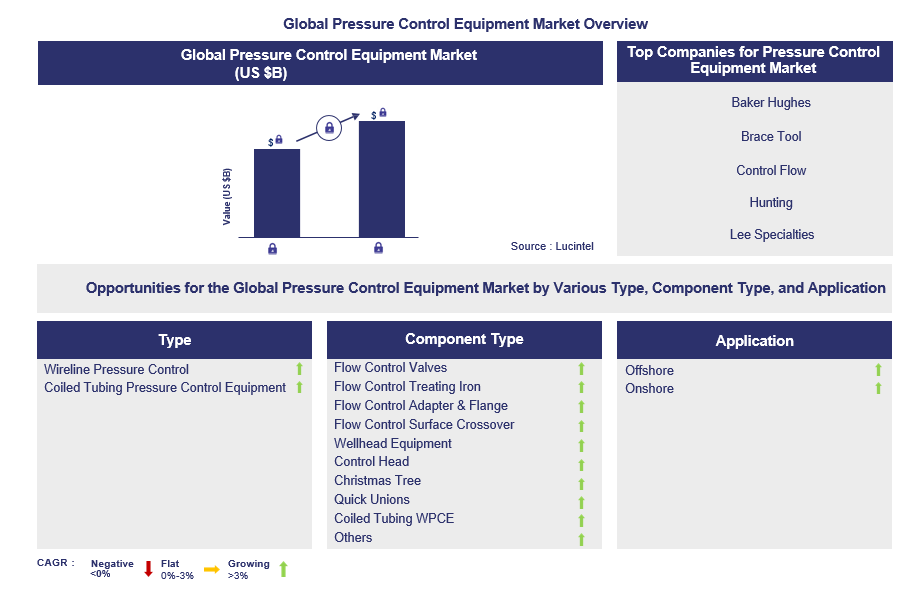
Key data points: The market size in 2030 = $9.9 billion, growth forecast = 5.8% annually for the next 6 years. Scroll below to get more insights. This market report covers trends, opportunities, and forecasts in the global pressure control equipment market to 2030 by type (wireline pressure control and coiled tubing pressure control equipment), component type (flow control valves, flow control treating iron, flow control adapter & flange, flow control surface crossover, wellhead equipment, control head, Christmas tree, quick unions, coiled tubing wpce, and others), application (offshore and onshore), and region (North America, Europe, Asia Pacific, and the Rest of the World)
We'll send your sample report shortly.
• Lucintel forecasts that, within the type category, the wireline pressure control equipment segment will remain the largest segment over the forecast period.
• Within the application category, onshore will remain the largest segment.
• In terms of region, North America is expected to witness the highest growth over the forecast period. Gain valuable insight for your business decisions with our comprehensive 150+ page report.
• Smart and Connected Technologies Adoption: The use of smart technologies, such as the Internet of Things (IoT) and artificial intelligence (AI), is gaining popularity in the pressure control equipment market. These technologies enable real-time monitoring, predictive maintenance, and optimized performance, ultimately leading to enhanced safety during drilling operations, reduced downtime, and increased efficiency. In addition to facilitating better data analysis, decision-making abilities are improved, resulting in overall operational effectiveness through the integration of smart technologies.
• More Focus on Offshore Drilling: There is an increasing need for pressure control equipment in offshore drilling due to the demand for accessing deeper and more complex reservoirs. The pressure control equipment market has been growing due to advances in offshore drilling technologies, such as subsea production systems and floating production storage and offloading (FPSO) units. Consequently, manufacturers have developed special equipment that can withstand high pressures experienced at sea, as these pressures may cause damage when exposed to unforeseen forces.
• Environmental Sustainability Priority: With a growing focus on environmental sustainability among industry stakeholders, the market’s attention is shifting towards this aspect, leading companies to consider ways to reduce carbon emissions, minimize waste, and conserve the environment. For example, eco-friendly pressure control equipment, compliant with stringent regulations and industrial standards, is being produced by manufacturers. This trend is driven by the need to mitigate the impacts of oil exploration on the environment and the growing demand for renewable energy sources.
• Innovations in Unconventional Oil and Gas Production: The rising demand for unconventional oil and gas production, such as shale gas or tight oil, has pushed the pressure control equipment market to adapt to these new realities. These resources require specialized pressure control equipment designed to handle the unique challenges of hydraulic fracturing and horizontal drilling. To address this, manufacturers are heavily investing in research and development to create innovative solutions that effectively manage the high pressures and complex formations found in unconventional oil and gas production.
• Emphasis on Worker Safety and Training: Worker safety and training are major focus areas in the pressure control equipment market, due to increasing awareness of the importance of well-trained workers in operating pressure control equipment safely and efficiently. Manufacturers are working together with industry associations and training companies to develop comprehensive safety programs and certification courses. The objective behind this trend is to reduce accidents while fostering a safety-conscious culture among employees in the sector. These emerging trends are reshaping the pressure control equipment market by driving innovation, improving efficiency, and enhancing safety during drilling operations. As such, manufacturers and service providers must embrace these changing dynamics by investing in appropriate technologies to remain competitive within the evolving industry, which has growing demands from the oil and gas sector.

• Advancements in Pressure Sensing Technologies: The development of highly sensitive and accurate pressure sensors has enabled precise and efficient control of pressure. These sensors have generally enhanced the overall performance and reliability of pressure control equipment.
• Incorporation of IoT and Industry 4.0: Today’s generation of pressure control equipment has become intelligent, interconnected devices through integration with the Internet of Things (IoT) and Industry 4.0 technologies. This enables them to be monitored in real time, analyzed for predictive purposes, and maintained using predictive maintenance models to enhance operational efficiency while minimizing downtime.
• Miniaturization and Compact Design: The size of modern pressure control equipment has decreased, allowing for easier integration into other systems or applications. This has opened up possibilities for use in aerospace, automotive, medical devices, and more.
• Improvement in Materials and Manufacturing Processes: The development of new materials and processes has enabled the production of pressure control equipment that lasts longer, resists corrosion better, and performs better than its predecessors. This reduces maintenance costs while extending the equipment’s lifespan.
• Energy Efficiency and Sustainability Preferences: The need for energy-efficient and environmentally sustainable equipment has driven manufacturers to create pressure control systems that consume less power and reduce environmental impacts, making them ideal for companies aiming to improve their sustainability records. These developments are influencing innovation by promoting creativity in designing cost-effective products that perform multiple functions across diverse platforms. As a result, pressure control equipment is increasingly becoming indispensable in various sectors of the economy, improving profitability, reducing costs, and enhancing sustainability.
• Oil and Gas Industry: In the oil and gas sector, where extraction processes are becoming more complex and require better safety measures, there is increasing demand for sophisticated pressure control solutions. For example, remote monitoring tools and automated systems have been developed to improve efficiency in oil fields by reducing risks associated with operations performed at wells.
• Chemical Processing: Pressure control systems capable of handling high-pressure reactions while adhering to strict safety standards are being adopted in chemical processing plants. These systems will involve the development of equipment that provides precise setpoint control along with real-time monitoring of critical process parameters, ensuring product quality and operational safety while improving chemical manufacturing efficiency.
• Energy Sector: With an increase in renewable energy projects and the modernization of power plants, there is a need for pressure control systems capable of managing diversified energy sources. This involves creating flexible pressure controls that integrate into various power systems, enabling efficient production and distribution of energy.
• Water and Wastewater Treatment: Pressure controllers that can manage changing pressures and flow rates during fluctuating intake volumes from municipal or industrial water treatment facilities would be valuable. Given this new challenge, there is a need to develop robust and reliable pressure control systems for wastewater treatment, enhancing environmental compliance and operational efficiency for sustainable water management.
• Pharmaceutical Manufacturing: Pharmaceutical manufacturing requires highly accurate precision pressure control systems to ensure the safety and efficacy of drug production processes. To meet regulatory requirements within pharmaceutical settings, manufacturers are developing devices that reduce errors and improve consistency. In summary, the demand for pressure control equipment is growing significantly across various key applications. The oil and gas sector, chemical processing, energy sector, water and wastewater treatment, and the pharmaceutical industry are the main drivers of growth and innovation. These changes reflect a move towards more advanced and efficient control solutions that are also reliable in essential industries that are undergoing transformation.
• Technological Advancements: The development of sophisticated materials and control systems has led to the creation of more efficient and reliable pressure control equipment. As a result, there is increased demand for these systems across various industries, from oil and gas to manufacturing.
• Industrialization and Urbanization: The rapid rise in industrialization and urbanization has led to an increase in demand for pressure control equipment. This trend is especially noticeable in developing economies, where infrastructure development and industrialization are driving the demand.
• Stringent Safety Regulations: Governments worldwide are enacting stricter safety regulations to prevent accidents and environmental hazards. To comply with these regulations, industries must invest in proper pressure control equipment, which in turn promotes market demand.
• Increasing Energy Demand: There is a global rise in energy consumption, driven by economic growth and population increases. This has led to greater exploration and production activities in the oil and gas sector, thus driving the demand for pressure control equipment.
• Rising Awareness of Energy Efficiency: Industrial sectors are increasingly focused on reducing energy consumption due to the growing emphasis on energy efficiency. As a result, there is greater demand for pressure control equipment that can help streamline processes and reduce energy costs. Challenges in the pressure control equipment market include:
• Economic Fluctuations: Global economic fluctuations can affect investments in capital goods, including the acquisition of pressure control equipment. When economic conditions worsen, there is typically a reduction in demand and pressure on pricing.
• Supply Chain Disruptions: The global supply chain can be disrupted by factors such as natural disasters, geopolitical tensions, or trade restrictions. These disruptions can affect the availability of raw materials, components, and finished products, which in turn impacts the market.
• Regulatory Complexity: Compliance with emerging regulations can pose a challenge and may come at a significant cost for industry participants. These regulations can raise operating expenses and stifle market growth due to the regulatory burden. Technological advancements, industrialization, regulatory demands, and increasing energy needs are the main drivers of change within the pressure control equipment market. However, economic fluctuations, supply chain disruptions, and complex regulatory frameworks are major challenges that companies face. The way these factors unfold will determine whether the market experiences growth or faces a decline.
• Baker Hughes
• Brace Tool
• Control Flow
• Hunting
• Lee Specialties
• National Oilwell Varco
• Schlumberger Limited
• The Weir Group
• Tis Manufacturing
• Weatherford International
• Wireline Pressure Control
• Coiled Tubing Pressure Control Equipment
• Flow Control Valves
• Flow Control Treating Iron
• Flow Control Adapter & Flange
• Flow Control Surface Crossover
• Wellhead Equipment
• Control Head
• Christmas Tree
• Quick Unions
• Coiled Tubing WPCE
• Others
• Offshore
• Onshore
• North America
• Europe
• Asia Pacific
• The Rest of the World
• United States: The US market is advancing with innovations such as digital pressure control systems, which have improved accuracy and automation. A noticeable transformation has occurred in the integration of IoT for real-time monitoring and predictive maintenance, driven by the need for enhanced safety and efficiency in the oil and gas sector, including the manufacturing industry.
• China: The Chinese market is growing rapidly due to massive infrastructure projects and industrial expansion. The country is developing advanced pressure control technologies that support large-scale manufacturing and energy projects. Additionally, government policies are promoting the adoption of highly efficient and environmentally friendly equipment.
• Germany: Germany is a leader in the development of smart pressure control solutions, with a focus on Industry 4.0 integration. Sustainable practices are increasingly promoted alongside energy efficiency, supported by the country’s strong industrial base and innovation in automation and control systems technology.
• India: The Indian market is expanding, with a focus on cost-effective yet robust pressure control systems suitable for emerging industrial sectors. Key areas of improvement include low-cost automation technologies and the increasing adoption of these solutions in sectors such as pharmaceuticals and chemicals for more reliable operations.
• Japan: The Japanese market is characterized by cutting-edge advancements in precision pressure control systems. Engineering efforts focused on improving safety are mainly concentrated in high-tech areas, such as electronics and automotive industries. Moreover, there have been significant efforts to integrate state-of-the-art robots and automation technologies.


• Baker Hughes
• Brace Tool
• Control Flow
• Hunting
• Lee Specialties
• National Oilwell Varco
• Schlumberger Limited
• The Weir Group
• TIS Manufacturing
• Weatherford International Q6. Which pressure control equipment market segment will be the largest in the future? Answer: Lucintel forecasts that the wireline pressure control equipment segment will remain the largest segment over the forecast period. Q7. In the pressure control equipment market, which region is expected to be the largest in the next 5 years? Answer: North America is expected to witness the highest growth over the forecast period. Q.8 Do we receive customization in this report? Answer: Yes, Lucintel provides 10% customization without any additional cost.


Choose a license that fits your team. Instant PDF delivery.
Prices exclude taxes. Instant delivery. Custom licensing available on request.
Market Report · July 24, 2026
Market Report · July 20, 2026
Market Report · July 20, 2026
Trusted partner for strategic intelligence and business growth


Receive a complimentary market analysis tailored to your industry. Our analysts will identify key growth opportunities and competitive dynamics specific to your business.

Market size, growth rate, and key trend analysis for your specific sector.

Top competitor positioning and market share analysis.

Strategic recommendations backed by data-driven insights.
Get curated market intelligence and competitive moves straight to your inbox.
By subscribing, you agree to receive our monthly insights. Unsubscribe anytime.
Receive a complimentary market analysis tailored to your industry. Our analysts will identify key growth opportunities and competitive dynamics specific to your business.
Market size, growth rate, and key trend analysis for your specific sector.
Top competitor positioning and market share analysis.
Strategic recommendations backed by data-driven insights.
Get curated market intelligence, emerging trends, and competitive moves straight to your inbox each month.
By subscribing, you agree to receive our monthly insights. Unsubscribe anytime.
We'll send your sample report shortly.