
Market Report · May 16, 2026

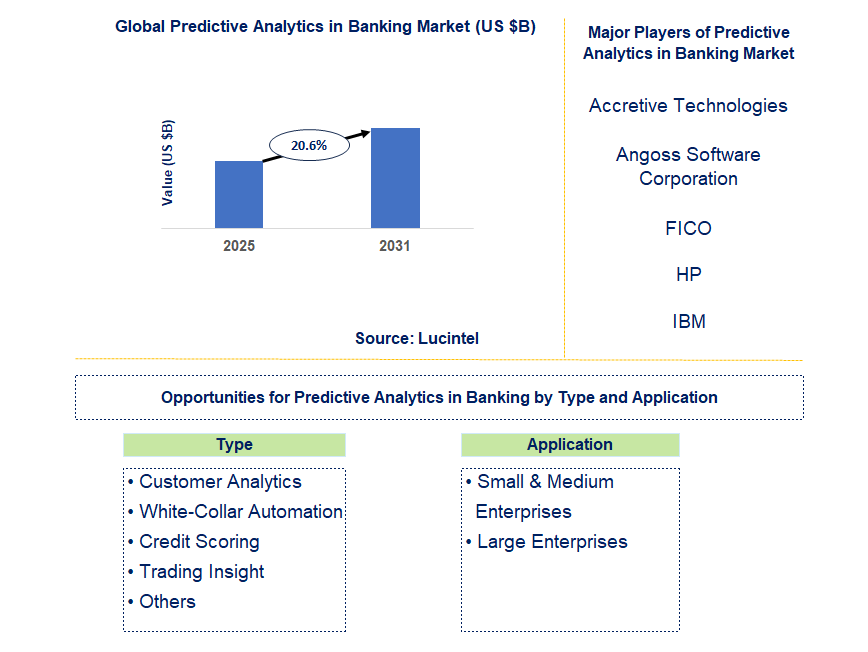
Key data points: The growth forecast = 20.6% annually for the next 7 years. Scroll below to get more insights. This market report covers trends, opportunities and forecasts in predictive analytics in banking market to 2031 by type (customer analytics, white-collar automation, credit scoring, trading insight, and others), application (small & medium enterprises and large enterprises), and region (North America, Europe, Asia Pacific, and the Rest of the World)
We'll send your sample report shortly.
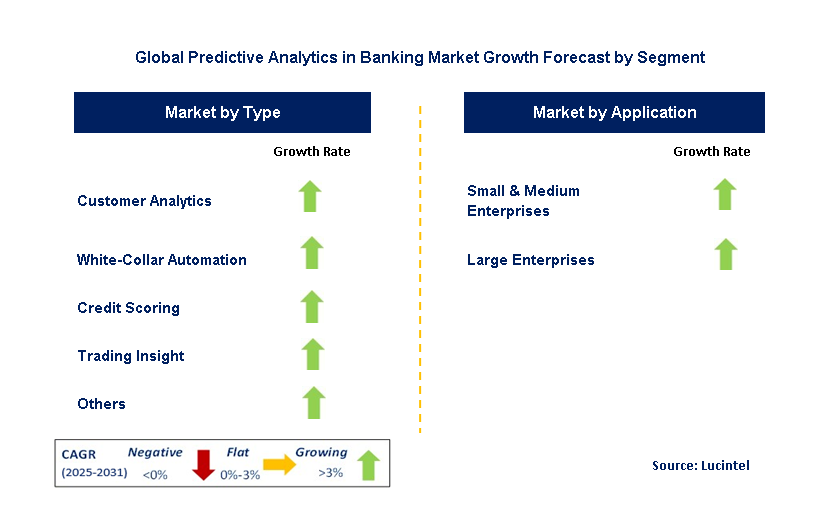
• Lucintel forecasts that, within the type category, customer analytics is expected to witness the highest growth over the forecast period.
• Within the application category, small & medium enterprise is expected to witness higher growth.
• In terms of region, APAC is expected to witness the highest growth over the forecast period. Gain valuable insights for your business decisions with our comprehensive 150+ page report. Sample figures with some insights are shown below.
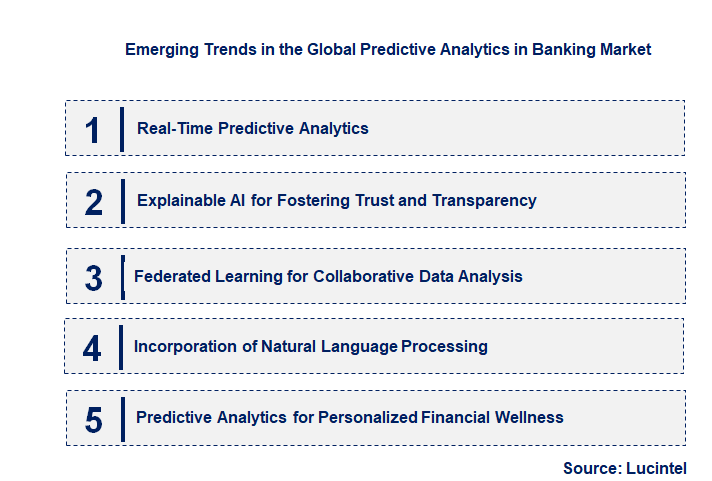
• Real-Time Predictive Analytics: Banks are fast embracing real-time predictive analytics in order to take instant decisions like instant loan disbursements, fraud warnings in the middle of a transaction, and targeted offerings at the moment of engagement, improving customer experience and lowering risk. This in-the-moment nature enhances response and customer delight.
• Explainable AI for Fostering Trust and Transparency: As more sophisticated AI models find increased application, there is increasing demand for explainable AI that gives insight into how predictions were arrived at. This is imperative for regulatory needs, customer trust, and the ability to exercise human oversight of automated decisions within banking.
• Federated Learning for Collaborative Data Analysis: Banks are considering federated learning to overcome data privacy issues and regulatory barriers. Federated learning enables multiple institutions to train AI models jointly without exchanging sensitive customer data, facilitating more comprehensive and robust predictive insights. The collaborative method preserves data privacy.
• Incorporation of Natural Language Processing: NLP is more and more used by banks to analyze unstructured data from non-traditional sources such as customer service calls, social media, and news feeds to develop a better understanding of customer attitudes, emerging risk, and market trends, boosting predictive power. This opens up rich information from non-traditional sources.
• Predictive Analytics for Personalized Financial Wellness: Aside from legacy banking products, there's a new trend of utilizing predictive analytics to provide personalized financial wellness guidance, budgeting capabilities, and proactive suggestions to empower customers to better manage their finances, creating deeper customer relationships and loyalty. This is beyond transactional banking. These trends collectively are transforming the predictive analytics in banking market into more real-time, transparent, collaborative, and customer-centric solutions that facilitate better decision-making and improve the overall banking experience.
• Emerging Innovations in AutoML Platforms Facilitating Quick Deployment of Models: AutoML platforms are advancing by leaps and bounds, making it possible for banks to develop predictive models faster using less human effort, driving quick adoption of analytics across many bank functions.
• Greater Emphasis on Feature Engineering and Selection: Banks are putting more money into sophisticated feature engineering methods to draw useful signals out of their data and using advanced feature selection techniques to enhance the accuracy and interpretability of their predictive models.
• Development of Strong Model Monitoring and Governance Models: Understanding the ever-changing nature of customer data and behavior, banks are developing strong models for constant monitoring of their predictive models' performance and governance to control bias and sustain accuracy over time.
• Graph Database Integration for Improved Relationship Analysis: Banks are increasingly using graph databases to better analyze intricate relationships in their data, including customer networks and patterns of transactions, to make more precise predictions in fraud detection and credit risk analysis.
• Focus on Privacy-Preserving AI Methods: As increasing data privacy laws, banks are adopting and integrating privacy-preserving AI methods, including differential privacy and homomorphic encryption, to use data for predictive analytics without compromising customer data. These trends are influencing the banking predictive analytics in market by facilitating quicker deployment of more accurate and trustworthy models, better understanding of intricate data relationships, and focus on ethics and privacy-driven use of data.
• Improved Customer Acquisition and Retention: Predictive analytics can detect potential high-value customers and forecast churn risk, allowing banks to execute targeted marketing campaigns and proactive retention initiatives, resulting in higher market share and customer loyalty.
• Better Credit Risk Evaluation and Loan Origination: Using advanced predictive models to evaluate creditworthiness, predict default probabilities, and automate loan origination processes can result in better lending decisions and lower credit losses.
• Proactive Fraud Detection and Prevention: Predictive analytics in real-time can recognize unusual patterns in transactions and foresee fraudulent activities more accurately, keeping financial losses by the bank as well as customers to a bare minimum.
• Personalized Product Recommendations and Cross-Selling: Using predictive models, banks can comprehend individual customers' needs and likes and recommend very relevant products as well as opportunities for cross-selling, thus maximizing revenue and satisfaction.
• Optimized Branch Operations and Resource Planning: Predictive analytics can predict customer traffic, transaction levels, and branch staffing requirements, allowing for optimized resource planning, lower operational expenses, and enhanced customer service efficiency. These strategic growth prospects demonstrate the value creation potential of predictive analytics throughout the banking value chain, from customer acquisition and retention to risk management and operation optimization, ultimately leading to profitability and competitiveness enhancement.
• Accretive Technologies
• Angoss Software Corporation
• FICO
• HP
• IBM
• Information Builders
• KXEN
• Microsoft
• Oracle
• Salford Systems
• Customer Analytics
• White-Collar Automation
• Credit Scoring
• Trading Insight
• Others
• Small & Medium Enterprises
• Large Enterprises
• North America
• Europe
• Asia Pacific
• The Rest of the World
• United States: Emphasis on fraud detection and custom individual experiences. The latest innovations involve advanced AI-driven systems for real-time fraud detection and the application of prediction models in providing highly customized products and services to enhance customer retention and acquisition in a competitive marketplace.
• China: Accelerating adoption in digital banking and credit scoring. China's banks are fast embracing predictive analytics, specifically digital banking platforms for risk assessment, credit scoring for an extensive unbanked population, and targeted marketing in their expansive digital ecosystems.
• Germany: Regulatory compliance and risk management focus. Current developments in Germany center on using predictive analytics for more effective risk management, such as credit risk measurement and anti-money laundering initiatives, while meeting strict data privacy rules and compliance measures.
• India: Expansion of digital lending and financial inclusion programs. India is experiencing greater application of predictive analytics to the growing space of digital lending to determine creditworthiness and extend financial inclusion to underpenetrated markets, frequently relying on alternative sources of data.
• Japan: Customer retention and operational effectiveness in a saturated market. New trends in Japan highlight the deployment of predictive analytics to enhance customer retention in an established banking industry and operational efficiency through forecasting and resource management.


• Accretive Technologies
• Angoss Software Corporation
• FICO
• HP
• IBM
• Information Builders
• KXEN
• Microsoft
• Oracle
• Salford Systems Q5. Which predictive analytics in banking market segment will be the largest in future? Answer: Lucintel forecasts that, within the type category, customer analytics is expected to witness the highest growth over the forecast period. Q6. In predictive analytics in banking market, which region is expected to be the largest in next 5 years? Answer: In terms of region, APAC is expected to witness the highest growth over the forecast period. Q7. Do we receive customization in this report? Answer: Yes, Lucintel provides 10% customization without any additional cost.


Choose a license that fits your team. Instant PDF delivery.
Prices exclude taxes. Instant delivery. Custom licensing available on request.
Market Report · May 16, 2026
Market Report · September 4, 2025
Market Report · June 11, 2025
Trusted partner for strategic intelligence and business growth


Receive a complimentary market analysis tailored to your industry. Our analysts will identify key growth opportunities and competitive dynamics specific to your business.

Market size, growth rate, and key trend analysis for your specific sector.

Top competitor positioning and market share analysis.

Strategic recommendations backed by data-driven insights.
Get curated market intelligence and competitive moves straight to your inbox.
By subscribing, you agree to receive our monthly insights. Unsubscribe anytime.
Receive a complimentary market analysis tailored to your industry. Our analysts will identify key growth opportunities and competitive dynamics specific to your business.
Market size, growth rate, and key trend analysis for your specific sector.
Top competitor positioning and market share analysis.
Strategic recommendations backed by data-driven insights.
Get curated market intelligence, emerging trends, and competitive moves straight to your inbox each month.
By subscribing, you agree to receive our monthly insights. Unsubscribe anytime.
We'll send your sample report shortly.