
Market Report · July 15, 2026

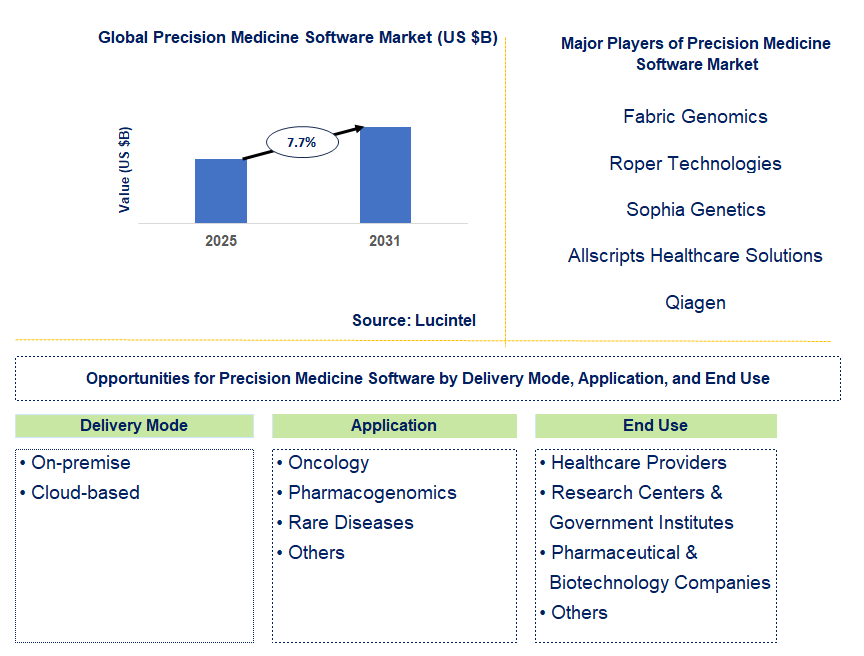
Key data points: The growth forecast = 7.7% annually for the next 7 years. Scroll below to get more insights. This market report covers trends, opportunities and forecasts in precision medicine software market to 2031 by delivery mode (on-premise and cloud-based), application (oncology, pharmacogenomics, rare diseases, and others), end use (healthcare providers, research centers & government institutes, pharmaceutical & biotechnology companies, and others), and region (North America, Europe, Asia Pacific, and the Rest of the World)
We'll send your sample report shortly.
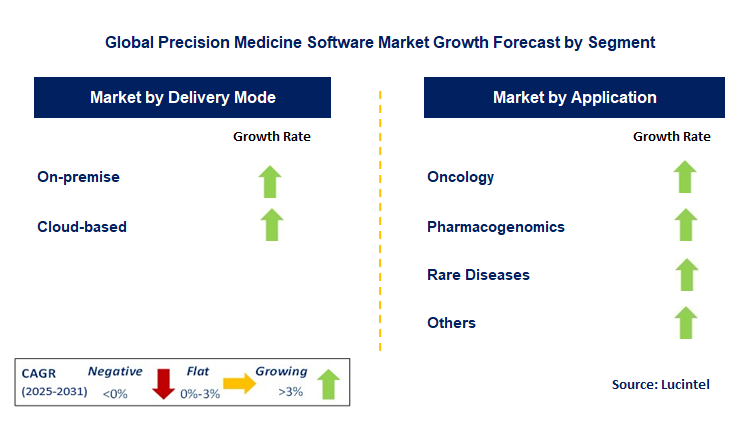
• Lucintel forecasts that, within the delivery mode category, cloud-based is expected to witness higher growth over the forecast period.
• Within the application category, healthcare provider is expected to witness the highest growth.
• In terms of region, APAC is expected to witness the highest growth over the forecast period. Gain valuable insights for your business decisions with our comprehensive 150+ page report. Sample figures with some insights are shown below.
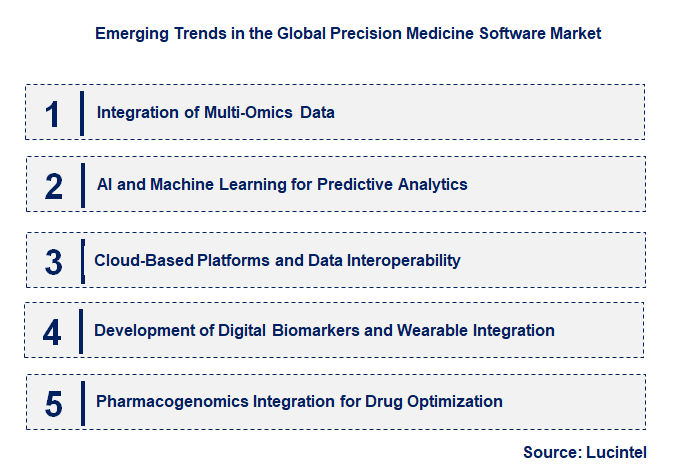
• Integration of Multi-Omics Data: A key trend is the integration of multi-omics data (genomics, proteomics, metabolomics, etc.) within precision medicine software. This allows for a comprehensive understanding of an individual’s biological makeup, leading to more precise disease stratification, biomarker discovery, and personalized treatment strategies beyond single-omics approaches.
• AI and Machine Learning for Predictive Analytics: AI and machine learning are increasingly used for predictive analytics in precision medicine. These technologies analyze vast datasets to predict disease risk, treatment response, and potential adverse drug reactions, enabling proactive and preventive healthcare, and optimizing drug dosage for individual patients.
• Cloud-Based Platforms and Data Interoperability: The shift towards cloud-based platforms is prominent, offering scalable data storage, real-time analytics, and enhanced interoperability between diverse healthcare systems. This facilitates seamless data sharing among researchers, clinicians, and pharmaceutical companies, accelerating research and clinical translation while ensuring data accessibility.
• Development of Digital Biomarkers and Wearable Integration: There is a growing focus on digital biomarkers derived from wearable devices and other digital health tools. Precision medicine software is integrating data from these sources to monitor patient health in real-time, assess treatment efficacy, and provide personalized interventions based on continuous physiological and behavioral data.
• Pharmacogenomics Integration for Drug Optimization: Integration of pharmacogenomics into precision medicine software is expanding. PGx helps predict an individual’s response to drugs based on their genetic makeup, enabling clinicians to select the most effective medications and optimal dosages, thereby minimizing adverse drug reactions and improving therapeutic outcomes. These emerging trends are fundamentally reshaping the precision medicine software market by driving the development of more intelligent, integrated, and accessible solutions. They empower healthcare providers to deliver highly personalized treatments, enhance predictive capabilities, and ultimately improve patient care outcomes.
• Advanced AI for Genomic Interpretation: Recent developments include highly sophisticated AI algorithms capable of rapidly interpreting complex genomic data, identifying disease-causing mutations, and predicting drug responses with unprecedented accuracy. This accelerates diagnosis and informs targeted therapeutic strategies, particularly in oncology and rare diseases.
• Enhanced Data Integration and Interoperability: There’s a strong focus on developing software solutions that seamlessly integrate diverse data types—genomic, clinical (EHR), lifestyle, and environmental—from various sources. This improved interoperability creates a holistic patient view, crucial for effective personalized treatment planning and clinical decision-making.
• Rise of Clinical Decision Support Systems: New precision medicine software increasingly incorporates advanced CDSS, providing clinicians with real-time, evidence-based recommendations tailored to individual patient profiles. These systems leverage AI to analyze patient data against vast medical knowledge, aiding in diagnosis, treatment selection, and risk assessment.
• Expansion of Cloud-Native Solutions: The market is seeing a surge in cloud-native precision medicine software, offering enhanced scalability, flexibility, and remote accessibility. This allows for massive data processing and collaborative research, making precision medicine solutions more widely available to healthcare providers without extensive on-premise IT infrastructure.
• Patient-Centric Portals and Engagement Tools: Recent developments include the creation of more intuitive patient portals and engagement tools within precision medicine software. These platforms empower patients to access their health data, understand their genomic profiles, and actively participate in their personalized treatment plans, fostering greater patient involvement. These recent developments are profoundly impacting the precision medicine software market by making advanced personalized diagnostics and treatments more precise, integrated, accessible, and patient-centric. They are accelerating the translation of genomic research into actionable clinical insights, improving overall healthcare delivery.
• Precision Oncology: Oncology remains the largest and most dynamic segment, driven by the growing understanding of cancer genomics and the development of targeted therapies. Software that enables comprehensive genomic profiling of tumors, identifies actionable mutations, and guides immunotherapy selection offers immense growth potential, revolutionizing cancer treatment.
• Pharmacogenomics: The application of PGx to optimize drug prescribing represents a significant growth opportunity. Software that analyzes an individual’s genetic makeup to predict drug efficacy and adverse reactions for various therapeutic areas (e.g., cardiovascular, psychiatric, pain management) helps clinicians select the right drug at the right dose, reducing trial-and-error.
• Rare Diseases: Diagnosing and treating rare diseases is often challenging due to their genetic heterogeneity and limited patient cohorts. Precision medicine software, through genomic sequencing and data analysis, can accelerate diagnosis, identify potential therapies (including repurposed drugs), and facilitate patient matching for clinical trials, addressing a critical unmet need.
• Infectious Diseases: Precision medicine software is increasingly being applied to infectious diseases for rapid pathogen identification, antimicrobial resistance profiling, and guiding targeted therapy. Opportunities exist in developing software that leverages genomic data to track outbreaks, inform vaccine development, and optimize antibiotic stewardship programs.
• Cardiovascular Diseases: While oncology leads, cardiovascular diseases present a burgeoning opportunity for precision medicine software. This includes software for genetic risk stratification for conditions like inherited cardiomyopathies, pharmacogenomic guidance for anti-coagulants, and personalized lifestyle recommendations based on an individual’s genetic predisposition. These strategic growth opportunities are significantly impacting the precision medicine software market by fostering specialized product development and expanding its clinical utility across a broader spectrum of diseases. They underscore the software’s crucial role in delivering highly effective, individualized healthcare solutions.
• Fabric Genomics
• Roper Technologies
• Sophia Genetics
• Allscripts Healthcare Solutions
• Qiagen
• Roche Holdings
• Human Longevity
• Gene42
• Synapse
• PierianDx
• On-premise
• Cloud-based
• Oncology
• Pharmacogenomics
• Rare Diseases
• Others
• North America
• Europe
• Asia Pacific
• The Rest of the World
• United States: The U.S. market is a global leader, with significant investments in AI-driven precision oncology software and comprehensive genomic analysis platforms. Strong collaboration between academic institutions, biotech firms, and government initiatives like the Precision Medicine Initiative are accelerating the integration of genomic data into clinical practice.
• China: China’s precision medicine software market is rapidly expanding, fueled by substantial government funding and a growing focus on genomic research. Local companies are developing innovative solutions, particularly in oncology and rare diseases, leveraging large patient cohorts and advancing AI to accelerate drug discovery and personalized diagnostics.
• Germany: Germany emphasizes robust, secure, and highly compliant precision medicine software, driven by stringent data privacy regulations like GDPR. Key advancements focus on integrating genomic and clinical data for personalized therapies, with a strong commitment to ethical AI and building national genomic data infrastructure for research and clinical use.
• India: India’s precision medicine software market is in a nascent but rapidly growing stage, driven by increasing disease burden and rising healthcare investments. There’s a strong focus on developing cost-effective, scalable solutions for personalized diagnostics and therapeutics, leveraging its large and diverse population for genomic research.
• Japan: Japan’s market is characterized by a strong emphasis on integrating advanced genomic technologies and clinical data to support personalized medicine, especially in oncology and rare diseases. Developments include collaborations between industry and academia to advance biomarker discovery and implement sophisticated bioinformatics platforms.


• Fabric Genomics
• Roper Technologies
• Sophia Genetics
• Allscripts Healthcare Solutions
• Qiagen
• Roche Holdings
• Human Longevity
• Gene42
• Synapse
• PierianDx Q5. Which precision medicine software market segment will be the largest in future? Answer: Lucintel forecasts that, within the delivery mode category, cloud-based is expected to witness higher growth over the forecast period. Q6. In precision medicine software market, which region is expected to be the largest in next 5 years? Answer: In terms of region, APAC is expected to witness the highest growth over the forecast period. Q7. Do we receive customization in this report? Answer: Yes, Lucintel provides 10% customization without any additional cost.


Choose a license that fits your team. Instant PDF delivery.
Prices exclude taxes. Instant delivery. Custom licensing available on request.
Market Report · July 15, 2026
Market Report · June 26, 2026
Market Report · June 24, 2026
Trusted partner for strategic intelligence and business growth


Receive a complimentary market analysis tailored to your industry. Our analysts will identify key growth opportunities and competitive dynamics specific to your business.

Market size, growth rate, and key trend analysis for your specific sector.

Top competitor positioning and market share analysis.

Strategic recommendations backed by data-driven insights.
Get curated market intelligence and competitive moves straight to your inbox.
By subscribing, you agree to receive our monthly insights. Unsubscribe anytime.
Receive a complimentary market analysis tailored to your industry. Our analysts will identify key growth opportunities and competitive dynamics specific to your business.
Market size, growth rate, and key trend analysis for your specific sector.
Top competitor positioning and market share analysis.
Strategic recommendations backed by data-driven insights.
Get curated market intelligence, emerging trends, and competitive moves straight to your inbox each month.
By subscribing, you agree to receive our monthly insights. Unsubscribe anytime.
We'll send your sample report shortly.