
Market Report · May 16, 2026

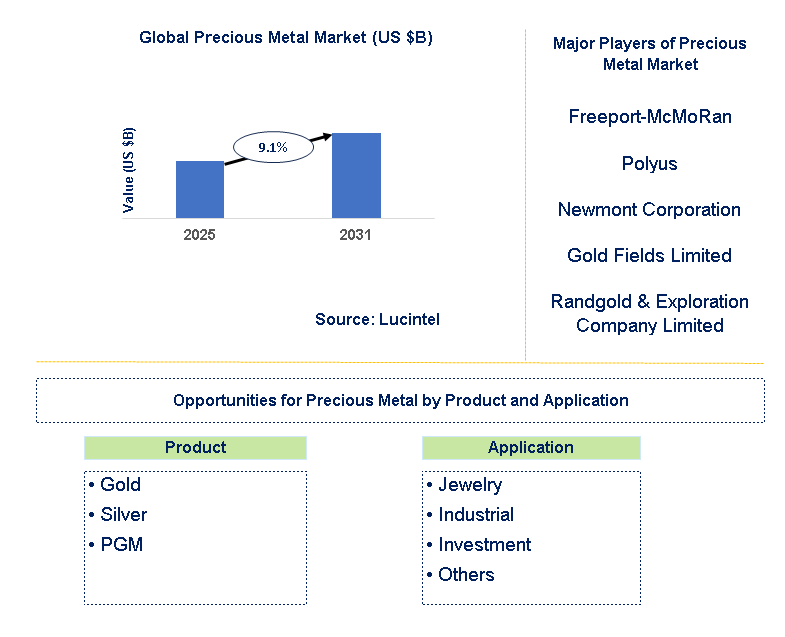
Key data points: The growth forecast = 9.1% annually for the next 7 years. Scroll below to get more insights. This market report covers trends, opportunities and forecasts in precious metal market to 2031 by product (gold, silver, and PGM), application (jewelry, industrial, investment, and others), and region (North America, Europe, Asia Pacific, and the Rest of the World)
We'll send your sample report shortly.
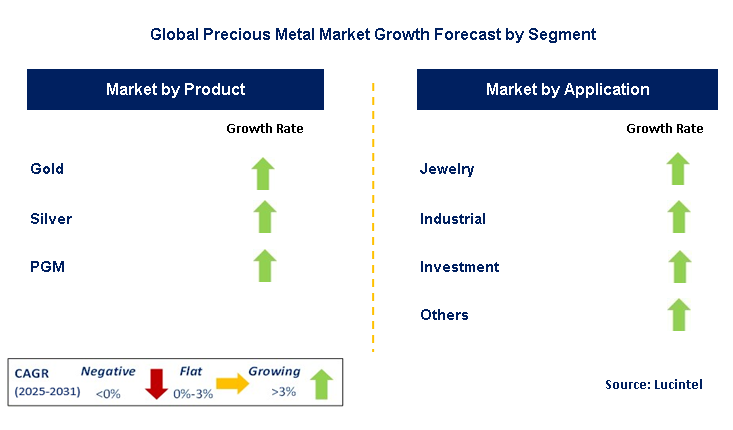
• Lucintel forecasts that, within the product category, gold is expected to witness the highest growth over the forecast period.
• Within the application category, investment is expected to witness the highest growth.
• In terms of region, APAC is expected to witness the highest growth over the forecast period. Gain valuable insights for your business decisions with our comprehensive 150+ page report. Sample figures with some insights are shown below.
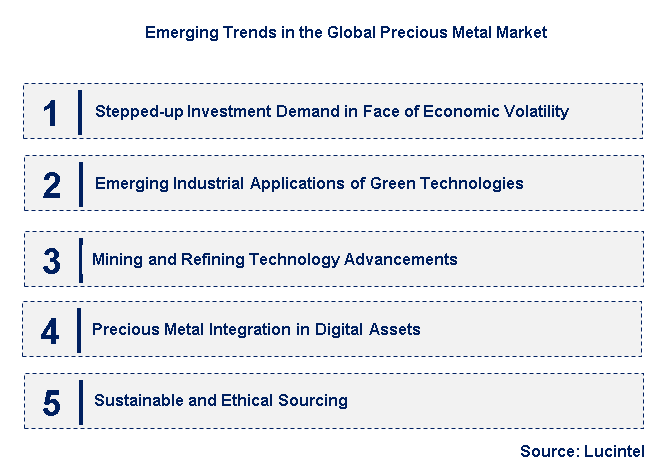
• Stepped-up Investment Demand in Face of Economic Volatility: Geopolitical tension, inflation fear, and exchange rate volatility are pushing investors toward precious metals, especially gold and silver, as safe-haven investments. These metals‘ appeal as value holders in times of economic stress and their capacity for inflation hedging are major determinants driving demand. This demand from investment creates price volatility and acts as a fundamental support mechanism for precious metal prices.
• Emerging Industrial Applications of Green Technologies: The global momentum towards a green and sustainable economy is immensely propelling demand for some of these precious metals. Silver has key applications in solar panels with their high conductivity requirement, and platinum and palladium are imperative to fuel cells as well as other green technologies. This shift should persist with the world converting into cleaner energies and thereby inducing emerging and emerging industrial applications of precious metals.
• Mining and Refining Technology Advancements: Advances in mining and refining technologies are enhancing the efficiency and sustainability of precious metals extraction. Automated mining equipment, artificial intelligence-driven ore discovery, and upgraded refining processes are minimizing costs and environmental damage. In addition, advances in recycling technologies are improving the extraction of precious metals from electronic waste and other sources, supporting a more circular economy.
• Precious Metal Integration in Digital Assets: The development of digital assets collateralized by physical precious metals, including gold-backed ETFs and tokenized gold, is making the market more accessible and liquid. These products enable investors to access precious metals without the hassles of physical storage and handling. This trend is drawing a wider pool of investors and updating the manner in which precious metals are traded and held.
• Sustainable and Ethical Sourcing: Increasing attention is being given to the environmental and social consequences of precious metal mining. Industries and consumers alike are calling for metals that are sustainably and ethically sourced, with increasing pressure on supply chains. Campaigns to advance responsible mining practices, transparent sourcing, and elimination of "dirty gold" are taking hold and shaping market forces. These new trends are all combining to reshape the precious metal market. Investment demand is supporting prices, and expanding industrial uses in green technologies are opening up new growth opportunities. Efficiency and sustainability are being enhanced by technological progress, and the inclusion of precious metals in digital assets is making it more accessible. The growing emphasis on sustainable and responsible sourcing is promoting increased responsibility in the industry. These trends point towards a future in which precious metals continue to be critical assets with changing functions in the world economy and technological environment.
• Increase in Central Bank Gold Purchases: A very interesting development has been the substantial rise in gold acquisitions by central banks around the world, especially in emerging economies. The trend is an indication of a move to diversify foreign reserves away from traditional currencies and as a hedge against economic and geopolitical risks. The consistent purchasing by central banks is a strong support to gold prices and changes the conventional supply-demand dynamics.
• Growing Volatility Driven by Geopolitical Factors: Geopolitical tensions and trade conflicts have fueled growing price volatility in the precious metal market. With investors looking for safe-haven assets during times of uncertainty, prices of gold and silver fluctuate widely in relation to world events. This volatility presents both opportunity and risk to traders and investors.
• Technologies in Precious Metal Recycling: There has been tremendous advancement in precious metal recycling technologies from different sources such as electronic waste, industrial scrap, and jewelry. These advancements enhance the recovery efficiencies and minimize the environmental footprint of mining. Growing emphasis on a circular economy is encouraging even more investment and development in this direction, strengthening secondary precious metal supply.
• Increasing Application of Precious Metals in Electric Vehicles and Energy Storage: The explosive expansion of the electric vehicle (EV) market and the need for energy storage are spurring new demand for some precious metals. Although platinum and palladium are conventionally applied in catalytic converters (of lesser importance for EVs), other precious metals such as silver are gaining more application in battery technology and charging infrastructure. This new demand segment has the power to greatly influence the market over the long term.
• More Transparency and Traceability Programs: There is increasingly a focus on enhancing transparency and traceability of the precious metals supply chain in order to limit illegal mining as well as facilitate ethical sourcing. Programs that rely on blockchain technology and other forms of tracking solutions are under development to make supply chains more visible regarding where the precious metals came from and where they go. This effort serves to instill confidence between the consumers, industry, and foster responsible practice. These critical advancements are affecting the precious metal industry by shaping price dynamics, supply sources, and areas of application. The rise in central bank gold buying gives a solid base of demand, while geopolitical tensions bring volatility. Recycling advances and new uses in EVs and energy storage are driving future demand. Increased transparency efforts seek to create a more ethical and sustainable market. These trends altogether suggest a market going through immense change to keep up with changing global economic and technological environments.
• Investment Product (ETFs and Digital Assets): Growing usage of gold and silver Exchange Traded Funds (ETFs) and the presence of other precious metals-backed digital assets provide considerable growth potential. Such investment instruments are highly liquid and convenient, allowing greater investors to take part in investing. Additional innovation and promotion of the product can gain traction in investing in precious metals as a means of diversification and hedging.
• Electronics Market (Silver for Conductivity): The electronics market is a core growth driver for silver based on its excellent electrical conductivity. With the advancement of smartphones, computers, and other electronic technology, the market for silver-containing parts keeps growing. In addition, the emerging technology for advanced electronics and miniaturization requires high-purity silver, which provides opportunities for focused suppliers.
• Renewable Energy (Silver in Solar Panels): The shift towards renewable energy sources, especially solar power, globally offers a huge growth prospect for silver. Silver is an essential element in photovoltaic (PV) cells because of its high conductivity. With the rise in solar energy usage across the world, the use of silver in this sector is expected to increase tremendously. Advances in solar technology that maximize the use of silver can further boost this prospect.
• Motor Vehicle Industry (Platinum Group Metals in Catalytic Converters and Future EV Applications): Although the transition to electric vehicles could lower the long-term demand for platinum and palladium in conventional catalytic converters, these metals are developing new markets in EV technology, including in fuel cells and some battery materials. Moreover, tougher emission standards for hybrid cars will also keep the demand for PGMs afloat in the near to medium term. Innovation and development of these new uses present strategic opportunities for growth.
• Healthcare and Medical Devices (Silver for Antimicrobial Uses): Silver‘s antimicrobial nature makes it increasingly important in medical devices, coatings, and wound dressings to avoid infections. The increasing healthcare industry and awareness of hospital-acquired infections are fueling demand for silver-based products. The innovation in integrating silver into medical applications offers a huge growth opportunity for the precious metal industry. Such growth opportunities through strategic growth in the investment, electronics, renewable energy, automotive, and healthcare usage indicate the expansive and changing precious metal demand. Seizing on the growing investors‘ interest using easily accessible digital products, leveraging silver‘s specialized uses in solar technology and electronics, repurposing the utilization of platinum group metals in the changing automotive business, and pushing silver‘s utility in medical purposes represent potential ways of growth and innovation in the precious metal space.
• Freeport-McMoRan
• Polyus
• Newmont Corporation
• Gold Fields Limited
• Randgold & Exploration Company Limited
• Barrick Gold
• AngloGold Ashanti
• Gold
• Silver
• PGM
• Jewelry
• Industrial
• Investment
• Others
• North America
• Europe
• Asia Pacific
• The Rest of the World
• United States: The US market for precious metals has witnessed growing investor appetite for gold and silver as safe-haven investments in times of economic uncertainty and inflation fears. Federal Reserve monetary policies and interest rate modifications have played a major role in price volatility. There is also rising demand for silver in industrial use, especially in the renewable energy industry and electronics. Strategic disposals by some key players and purchases signaling market consolidation have been striking trends. Additionally, the US continues to be a prominent center for trading and investment in precious metals.
• China: China is a leading consumer of precious metals, particularly gold for jewelry and investment purposes, fueled by cultural preference and expanding middle class. Government policies on economic growth and industrialization continue to influence demand. China‘s expanding role in world manufacturing, especially electronics and solar panels, drives its demand for silver. Its central bank‘s policy of gold hoarding to diversify reserves has also been an important recent trend.
• Germany: The German precious metals market is driven by its robust industrial base, especially in the automotive industry, which fuels demand for platinum and palladium utilized in catalytic converters. Investment in gold as a value store in times of economic uncertainty is also common. Recent trends involve emphasis on sustainable sourcing and recycling of precious metals. The market is also impacted by wider European Union regulation and economic trends.
• India: India is one of the world‘s largest consumers of gold and silver, largely for jewelry as a result of cultural practices and ceremonial events such as weddings. Increased disposable incomes and lifestyle changes are further stimulating demand. The government has implemented schemes to tap domestic gold holdings, although with limited success. India‘s increasing industrial base, including electronics, is also fueling silver consumption. Volatility in the Indian Rupee relative to the US dollar affects import prices and local prices.
• Japan: Japan‘s precious metal market is dominated by a mature jeweler sector with substantial industrial application in electronics and automobile industries. Japan has established highly advanced methods for value addition in the form of importing ores, recycling, and precious metal recovery from electronic scrap despite having limited domestic mining activities. Historically low prices of platinum have encouraged limited substitution of white gold with platinum in jewellery. Depreciation of the yen has influenced domestic precious metal price.


• Freeport-McMoRan
• Polyus
• Newmont Corporation
• Gold Fields Limited
• Randgold & Exploration Company Limited
• Barrick Gold
• AngloGold Ashanti Q5. Which precious metal market segment will be the largest in future? Answer: Lucintel forecasts that, within the product category, gold is expected to witness the highest growth over the forecast period. Q6. In precious metal market, which region is expected to be the largest in next 5 years? Answer: In terms of region, APAC is expected to witness the highest growth over the forecast period. Q7. Do we receive customization in this report? Answer: Yes, Lucintel provides 10% customization without any additional cost.


Choose a license that fits your team. Instant PDF delivery.
Prices exclude taxes. Instant delivery. Custom licensing available on request.
Market Report · May 16, 2026
Market Report · December 11, 2025
Market Report · October 10, 2024
Trusted partner for strategic intelligence and business growth


Receive a complimentary market analysis tailored to your industry. Our analysts will identify key growth opportunities and competitive dynamics specific to your business.

Market size, growth rate, and key trend analysis for your specific sector.

Top competitor positioning and market share analysis.

Strategic recommendations backed by data-driven insights.
Get curated market intelligence and competitive moves straight to your inbox.
By subscribing, you agree to receive our monthly insights. Unsubscribe anytime.
Receive a complimentary market analysis tailored to your industry. Our analysts will identify key growth opportunities and competitive dynamics specific to your business.
Market size, growth rate, and key trend analysis for your specific sector.
Top competitor positioning and market share analysis.
Strategic recommendations backed by data-driven insights.
Get curated market intelligence, emerging trends, and competitive moves straight to your inbox each month.
By subscribing, you agree to receive our monthly insights. Unsubscribe anytime.
We'll send your sample report shortly.