
Market Report · July 22, 2026

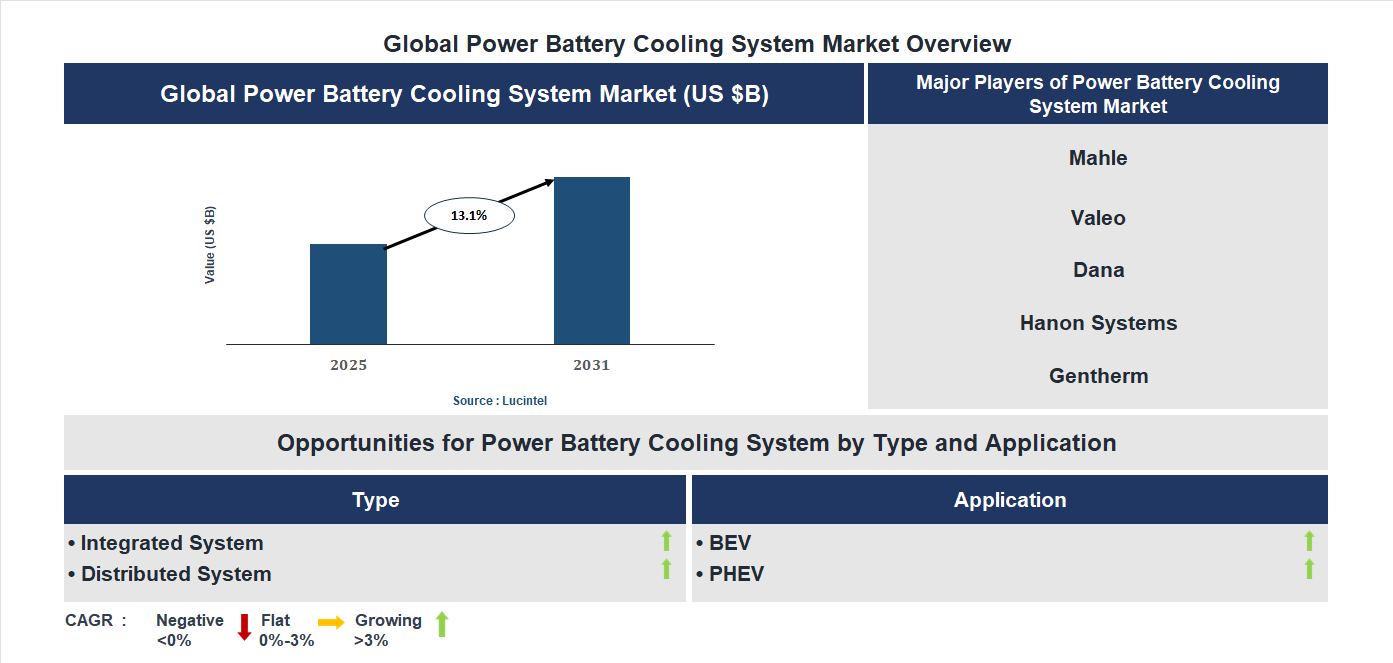
Key data points: The growth forecast = 13.1% annually for the next 7 years. Scroll below to get more insights. This market report covers trends, opportunities and forecasts in power battery cooling system market to 2031 by type (integrated system and distributed system), application (BEV and PHEV), and region (North America, Europe, Asia Pacific, and the Rest of the World)
We'll send your sample report shortly.
• Lucintel forecasts that, within the type category, integrated system is expected to witness higher growth over the forecast period.
• Within the application category, BEV is expected to witness higher growth.
• In terms of region, APAC is expected to witness the highest growth over the forecast period. Gain valuable insights for your business decisions with our comprehensive 150+ page report. Sample figures with some insights are shown below.
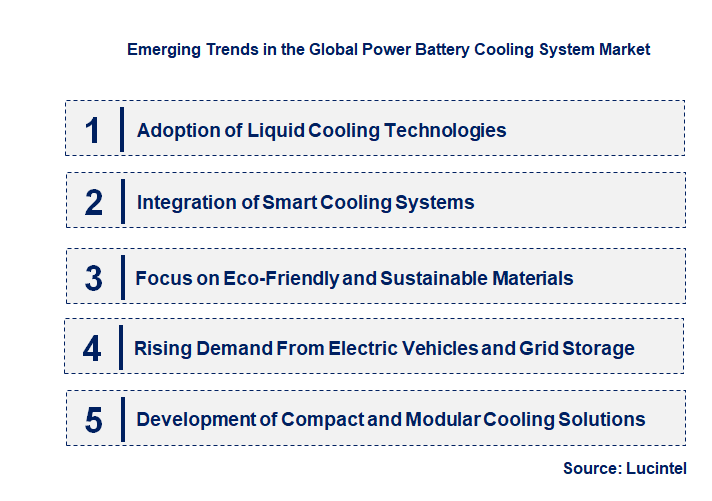
• Adoption of Liquid Cooling Technologies: Liquid cooling systems are gaining prominence due to their superior heat dissipation capabilities compared to traditional air cooling. They enable more uniform temperature control, which enhances battery performance and safety, especially in high-power applications. This trend is driven by the need for higher energy densities and faster charging times, making liquid cooling systems essential for next-generation electric vehicles and large-scale energy storage solutions. The impact includes improved battery longevity, reduced thermal runaway risks, and increased market competitiveness for manufacturers adopting these advanced cooling methods.
• Integration of Smart Cooling Systems: The integration of IoT and sensor technologies into cooling systems is creating smarter, more responsive solutions. These systems can monitor battery temperature in real-time, optimize cooling performance, and predict maintenance needs, thereby reducing downtime and operational costs. The adoption of smart cooling systems enhances safety and efficiency, especially in fleet management and grid storage applications. This trend is transforming traditional cooling approaches into intelligent systems that adapt dynamically to operational conditions, leading to more reliable and cost-effective energy storage and electric vehicle operations.
• Focus on Eco-Friendly and Sustainable Materials: Environmental concerns are prompting the industry to develop cooling systems using eco-friendly, recyclable, and biodegradable materials. This shift aligns with global sustainability goals and regulatory pressures to reduce the carbon footprint of manufacturing processes. Sustainable cooling solutions not only minimize environmental impact but also appeal to eco-conscious consumers and corporate clients. The impact includes the development of greener supply chains, compliance with stricter regulations, and a competitive advantage for companies leading in sustainable innovation within the market.
• Rising Demand from Electric Vehicles and Grid Storage: The exponential growth of electric vehicles and renewable energy integration into power grids is significantly boosting demand for efficient cooling systems. As battery capacities increase and charging speeds accelerate, effective thermal management becomes critical to ensure safety and performance. This trend is driving manufacturers to innovate and scale up production of advanced cooling solutions tailored for diverse applications. The market impact includes increased revenue opportunities, expanded product portfolios, and heightened competition among key players striving to meet the evolving needs of these high-growth sectors.
• Development of Compact and Modular Cooling Solutions: The demand for space-efficient and easily scalable cooling systems is rising, especially for compact electric vehicles and modular energy storage units. These solutions offer flexibility in design, ease of installation, and maintenance, making them attractive for various applications. The trend is fostering innovation in miniaturization and modular design, enabling manufacturers to deliver customizable cooling systems that can be integrated into different form factors. The impact includes broader market applicability, reduced installation costs, and enhanced adaptability to emerging energy storage and transportation solutions. In summary, these emerging trends are collectively reshaping the power battery cooling system market by driving technological innovation, promoting sustainability, and addressing the increasing performance demands of electric vehicles and energy storage systems. As a result, the market is becoming more efficient, environmentally friendly, and aligned with the future of clean energy and mobility solutions.
• Adoption of Liquid Cooling Technologies: Liquid cooling systems are gaining popularity due to their superior heat dissipation capabilities, enabling batteries to operate at optimal temperatures. This reduces thermal runaway risks and extends battery life, significantly improving safety and performance. Manufacturers are integrating advanced liquid cooling solutions into electric vehicles and stationary storage systems, which enhances efficiency and reliability. The shift towards liquid cooling is also driven by the need for higher energy densities and faster charging times, making it a pivotal development in the market.
• Integration of Smart Cooling Systems: The incorporation of IoT and AI in cooling systems allows real-time monitoring and adaptive control of battery temperatures. Smart cooling solutions optimize energy consumption, improve safety, and extend battery lifespan by adjusting cooling intensity based on usage patterns. This technological integration enhances overall system efficiency and reduces operational costs. The deployment of smart cooling is particularly impactful in electric vehicles, where precise temperature management is critical for performance and safety.
• Development of Phase Change Material (PCM) Cooling: PCM-based cooling systems utilize materials that absorb and release heat during phase transitions, providing efficient thermal regulation. These systems are lightweight, compact, and environmentally friendly, making them suitable for various applications. PCM cooling enhances battery safety by preventing overheating and thermal runaway, especially during high-demand scenarios. The innovation in PCM technology is expected to open new avenues for safer and more sustainable cooling solutions across the market.
• Focus on Eco-Friendly and Sustainable Cooling Solutions: Market players are emphasizing environmentally sustainable cooling options, such as biodegradable coolants and energy-efficient designs. These eco-friendly solutions aim to reduce the carbon footprint of battery systems and comply with stringent environmental regulations. The shift towards sustainability is also driven by consumer demand for greener products and government incentives. This development is fostering innovation in materials and system design, contributing to a more sustainable and responsible market landscape.
• Expansion of Cooling System Standards and Regulations: Governments and industry bodies are establishing stricter standards for battery safety and thermal management. These regulations are prompting manufacturers to adopt advanced cooling technologies that meet safety and performance benchmarks. Enhanced standards ensure better safety, reliability, and interoperability of battery systems, fostering consumer confidence and market growth. The evolving regulatory landscape is a key driver for technological innovation and market expansion in the power battery cooling system sector. In summary, these recent developments are significantly transforming the power battery cooling system market by improving safety, efficiency, and sustainability. The adoption of advanced cooling technologies and smart systems is enabling higher performance batteries, supporting the growth of electric vehicles and renewable energy storage. Stricter regulations are further accelerating innovation, ensuring safer and more reliable battery systems. Overall, these trends are fostering a more competitive, sustainable, and technologically advanced market environment.
• Electric Vehicles: Enhanced Battery Performance and Safety : As electric vehicle adoption accelerates, the need for advanced cooling systems to prevent overheating and extend battery life becomes critical. Improved cooling solutions directly impact vehicle range, safety, and durability, making them a key growth driver in the EV sector.
• Stationary Energy Storage: Optimizing Battery Efficiency and Longevity : With the rise of renewable energy integration, efficient cooling systems are vital for large-scale energy storage. They ensure consistent performance, reduce degradation, and improve the economic viability of grid storage solutions.
• Consumer Electronics: Miniaturization and Thermal Management : As devices become more compact and powerful, effective cooling systems are essential to manage heat dissipation. This enhances device performance, extends lifespan, and supports the development of next-generation electronics.
• Industrial Equipment: Reliability and Safety in Heavy-Duty Applications : Industrial applications demand robust cooling solutions to maintain battery stability under harsh conditions. This reduces downtime, prevents failures, and ensures safety in critical operations.
• Aerospace: High-Performance Cooling for Extreme Conditions : Aerospace applications require cooling systems capable of operating under extreme temperatures and vibrations. Innovations here improve battery reliability for aircraft and space missions, supporting advancements in aerospace technology. In summary, these growth opportunities are significantly impacting the power battery cooling system market by driving innovation, expanding application scopes, and increasing demand across diverse sectors. They are fostering competitive differentiation and enabling market players to meet evolving technological and safety standards, ultimately accelerating market growth and adoption.
• Technological Innovation: The rapid development of advanced cooling technologies, such as liquid cooling and phase change materials, enhances battery performance and safety. These innovations enable higher energy densities and longer lifespan of batteries, which are crucial for EV manufacturers aiming to meet consumer demands for longer-range vehicles. As technology progresses, cooling systems become more efficient, compact, and cost-effective, encouraging wider adoption across various applications. The integration of smart cooling solutions with IoT capabilities also allows real-time monitoring and management, further optimizing battery performance and safety.
• Growing Electric Vehicle Market: The surge in electric vehicle production globally is a primary driver for the power battery cooling system market. As automakers shift towards EVs to reduce carbon emissions, the demand for reliable thermal management solutions increases. Efficient cooling systems are vital for maintaining battery safety, performance, and longevity under diverse operating conditions. The expanding EV market, supported by government initiatives and consumer awareness, directly correlates with increased demand for advanced cooling systems, creating significant growth opportunities for manufacturers.
• Stringent Regulatory Standards: Governments worldwide are implementing strict safety and environmental regulations for battery systems in EVs and other applications. These standards mandate the use of effective cooling solutions to prevent thermal runaway and ensure safety during operation. Compliance with these regulations compels manufacturers to adopt advanced cooling technologies, thereby fueling market growth. Additionally, regulations aimed at reducing the environmental impact of cooling systems, such as eco-friendly refrigerants and recyclable materials, influence product development and market dynamics.
• Cost Reduction and Economies of Scale: As the power battery cooling system market matures, manufacturers benefit from economies of scale, leading to reduced production costs. Cost-effective cooling solutions make EVs more affordable, boosting consumer adoption. Innovations in manufacturing processes and material sourcing further contribute to cost reductions. Lower costs also enable integration of cooling systems into a broader range of applications, including smaller electric devices and energy storage systems, expanding market reach and driving overall growth.
• Increasing Focus on Safety and Reliability: The critical importance of safety in battery management drives the development of highly reliable cooling systems. Thermal management is essential to prevent overheating, thermal runaway, and potential fires. Market players are investing in research to improve system robustness, redundancy, and real-time monitoring capabilities. Enhanced safety features not only comply with regulatory requirements but also build consumer trust, which is vital for market expansion. The focus on reliability ensures longer battery life and better performance, reinforcing the market’s growth prospects. The challenges facing this power battery cooling system market include:
• High Development and Implementation Costs: Developing advanced cooling systems involves significant R&D investments, specialized manufacturing processes, and high-quality materials. These costs can hinder market entry for smaller players and increase the overall price of EVs and battery systems. Additionally, integrating cooling solutions into existing battery designs requires substantial engineering efforts, which can delay product launches and increase time-to-market. Overcoming cost barriers is essential for widespread adoption, especially in price-sensitive markets.
• Technological Complexity and Integration Issues: The integration of sophisticated cooling systems with battery packs presents technical challenges. Ensuring compatibility, efficient heat transfer, and minimal added weight requires complex engineering solutions. Moreover, maintaining system reliability under diverse operating conditions adds to design complexity. These issues can lead to increased development time, higher costs, and potential performance inconsistencies, which may slow market growth and affect consumer confidence.
• Regulatory Uncertainty and Compliance Challenges: Evolving safety and environmental regulations create uncertainty for manufacturers. Keeping pace with changing standards requires continuous product redesigns and testing, increasing costs and development timelines. Non-compliance risks include legal penalties, product recalls, and damage to brand reputation. Navigating diverse regulatory landscapes across regions complicates global market expansion, posing a significant challenge for manufacturers aiming for widespread adoption. In summary, the power battery cooling system market is driven by technological advancements, expanding EV adoption, regulatory requirements, cost efficiencies, and safety priorities. However, high development costs, technological complexities, and regulatory uncertainties pose notable challenges. These factors collectively influence market dynamics, requiring stakeholders to innovate continuously and adapt to evolving standards. The overall impact is a market poised for growth, provided that technological and regulatory hurdles are effectively managed, ensuring safer, more efficient, and cost-effective cooling solutions for batteries worldwide.
• Mahle
• Valeo
• Dana
• Hanon Systems
• Gentherm
• Zhejiang Yinlun Machinery Co.,Ltd
• Webasto
• Integrated System
• Distributed System
• BEV
• PHEV
• North America
• Europe
• Asia Pacific
• The Rest of the World
• United States: The US market is witnessing significant innovation with a focus on advanced liquid cooling systems to improve battery safety and longevity. Major automakers are investing heavily in R&D, and collaborations with tech firms are fostering new cooling technologies. The government’s push for EV adoption through incentives and infrastructure development is boosting demand. Additionally, startups are emerging with novel cooling solutions, emphasizing efficiency and sustainability. The US also sees increased integration of smart cooling systems that optimize performance based on real-time data, aligning with broader trends in connected vehicle technology.
• China: China remains the largest market for power battery cooling systems, driven by aggressive EV adoption and government policies promoting green transportation. Domestic companies are leading in developing cost-effective and scalable cooling solutions, including innovative air and liquid cooling technologies. The government’s subsidies and mandates for new energy vehicles (NEVs) are encouraging manufacturers to upgrade cooling systems for better safety and performance. China is also investing in research to improve thermal management for high-capacity batteries, aiming to enhance vehicle range and safety standards. Strategic partnerships between local firms and international players are further accelerating technological advancements.
• Germany: Germany’s market is characterized by a focus on high-performance cooling systems for premium electric vehicles. Leading automakers like Volkswagen and BMW are integrating sophisticated liquid cooling technologies to ensure safety and efficiency. The country’s emphasis on sustainability is driving innovations in eco-friendly cooling solutions, including the use of recyclable materials. Germany’s strong automotive R&D ecosystem and collaborations with universities are fostering cutting-edge thermal management research. Additionally, government incentives for EVs and stringent safety regulations are prompting manufacturers to adopt advanced cooling systems to meet global standards.
• India: The Indian market is rapidly evolving with a focus on affordable and efficient cooling solutions suitable for mass-market EVs. Local manufacturers are developing cost-effective air and liquid cooling systems to cater to the growing demand for electric two-wheelers and compact cars. Government initiatives like the Faster Adoption and Manufacturing of Hybrid & Electric Vehicles (FAME) scheme are boosting market growth. There is also increasing investment in R&D to improve thermal management and extend battery life in Indian climatic conditions. Strategic collaborations with international firms are helping Indian companies adopt advanced cooling technologies to enhance vehicle safety and performance.
• Japan: Japan’s market is characterized by technological innovation and high-quality cooling systems for electric vehicles. Leading companies such as Panasonic and Toyota are developing advanced liquid cooling solutions that prioritize safety, efficiency, and durability. Japan’s focus on sustainable and eco-friendly materials is influencing the development of environmentally conscious cooling systems. The country’s strong automotive R&D infrastructure supports continuous innovation in thermal management. Government policies promoting EV adoption and stringent safety standards are encouraging manufacturers to implement sophisticated cooling technologies. Japan also emphasizes integrating cooling systems with vehicle electronics for smarter thermal regulation.


• Mahle
• Valeo
• Dana
• Hanon Systems
• Gentherm
• Zhejiang Yinlun Machinery Co.,Ltd
• Webasto Q5. Which power battery cooling system market segment will be the largest in future? Answer: Lucintel forecasts that, within the type category, integrated system is expected to witness higher growth over the forecast period. Q6. In power battery cooling system market, which region is expected to be the largest in next 5 years? Answer: In terms of region, APAC is expected to witness the highest growth over the forecast period. Q7. Do we receive customization in this report? Answer: Yes, Lucintel provides 10% customization without any additional cost.


Choose a license that fits your team. Instant PDF delivery.
Prices exclude taxes. Instant delivery. Custom licensing available on request.
Market Report · July 22, 2026
Market Report · July 22, 2026
Market Report · July 17, 2026
Trusted partner for strategic intelligence and business growth


Receive a complimentary market analysis tailored to your industry. Our analysts will identify key growth opportunities and competitive dynamics specific to your business.

Market size, growth rate, and key trend analysis for your specific sector.

Top competitor positioning and market share analysis.

Strategic recommendations backed by data-driven insights.
Get curated market intelligence and competitive moves straight to your inbox.
By subscribing, you agree to receive our monthly insights. Unsubscribe anytime.
Receive a complimentary market analysis tailored to your industry. Our analysts will identify key growth opportunities and competitive dynamics specific to your business.
Market size, growth rate, and key trend analysis for your specific sector.
Top competitor positioning and market share analysis.
Strategic recommendations backed by data-driven insights.
Get curated market intelligence, emerging trends, and competitive moves straight to your inbox each month.
By subscribing, you agree to receive our monthly insights. Unsubscribe anytime.
We'll send your sample report shortly.