
Market Report · July 15, 2026

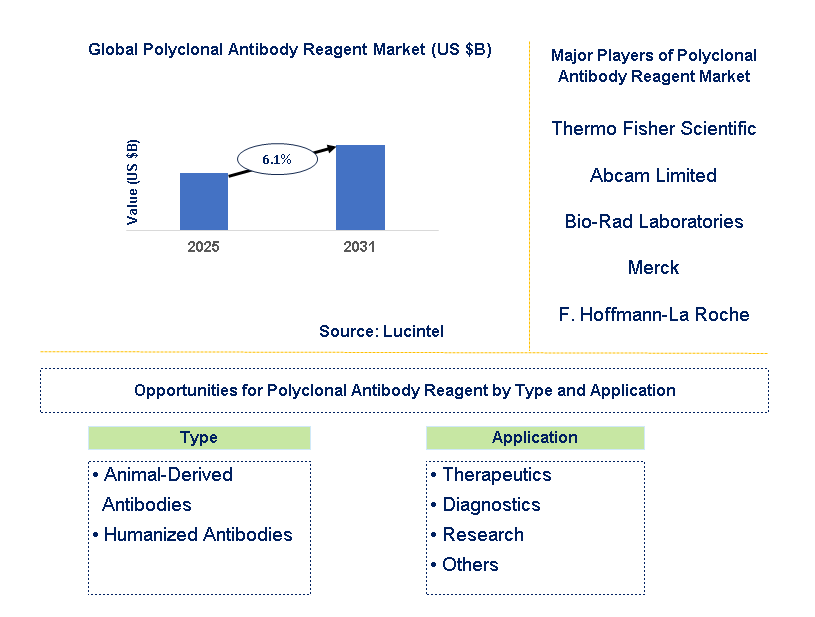
Key data points: The growth forecast = 6.1% annually for the next 7 years. Scroll below to get more insights. This market report covers trends, opportunities and forecasts in polyclonal antibody reagent market to 2031 by type (animal-derived antibodies and humanized antibodies), application (therapeutics, diagnostics, research, and others), and region (North America, Europe, Asia Pacific, and the Rest of the World)
We'll send your sample report shortly.
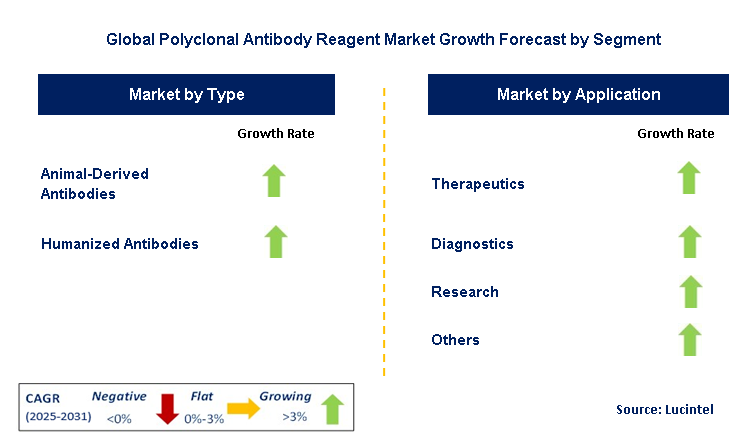
• Lucintel forecasts that, within the type category, animal-derived antibody is expected to witness higher growth over the forecast period.
• Within the application category, research is expected to witness the highest growth.
• In terms of region, North America is expected to witness the highest growth over the forecast period. Gain valuable insights for your business decisions with our comprehensive 150+ page report. Sample figures with some insights are shown below.
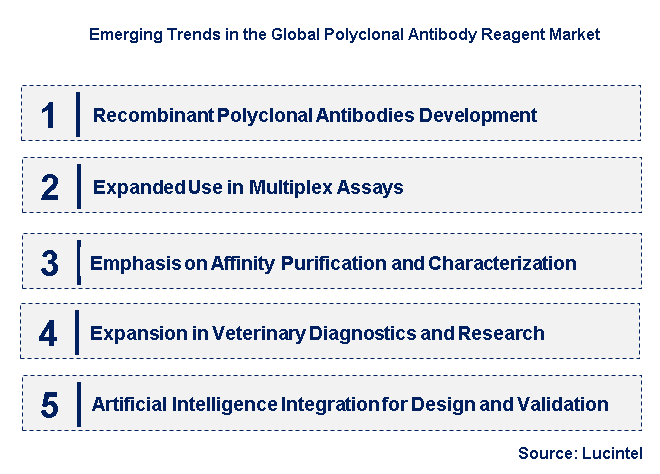
• Recombinant Polyclonal Antibodies Development: This trend encompasses the design of antibody blends with known compositions by recombinant DNA technology, as opposed to conventional animal immunization. The effect is a considerable enhancement of batch-to-batch consistency and scalability, correcting an historical drawback of polyclonal antibodies. Recombinant polyclonal antibodies provide a renewable material with lower variability, ideal for regulated environments and high-throughput assays, hence improving reproducibility in diagnostics and research.
• Expanded Use in Multiplex Assays: Polyclonal antibodies are being used more and more in multiplex assays that detect and measure several analytes at once. The effect is increased efficiency and diagnostic capability, especially in biomarker discovery and profiling of disease. Since they can bind to many epitopes on a target, they are perfect for catching a variety of forms of an antigen present in complex samples, resulting in greater sensitivity and wider detection capabilities in these sophisticated diagnostic platforms.
• Emphasis on Affinity Purification and Characterization: There is an increasing focus on thorough affinity purification and characterization of polyclonal antibodies to increase their specificity and minimize cross-reactivity. The effect is better quality reagents that provide more trustworthy and reproducible results in immunoassays. This follows concerns over non-specific binding, allowing the researcher or clinician to have confidence in the data generated by employing these antibodies, resulting in more solid experimental results and diagnostic accuracy.
• Expansion in Veterinary Diagnostics and Research: Polyclonal antibodies are increasingly being used in veterinary diagnostics to identify animal disease and in veterinary research to investigate animal health and disease models. The effect is massive expansion in a niche, but growing, market segment. Due to their versatility and resilience, they are ideally suited to a wide range of different animal species as well as various sample types, and this is helping to enhance animal welfare, agricultural productivity, and the creation of new therapies for animal disease.
• Artificial Intelligence Integration for Design and Validation: The emerging trend entails the use of artificial intelligence (AI) and machine learning (ML) to aid in the design, selection, and validation of target-specific polyclonal antibodies. The result is faster antibody development and better predictive performance. AI is capable of interpreting large sets of antibody-antigen interactions to inform immunization strategies and predict possible off-target binding, thus facilitating the discovery process and elevating the quality and specificity of newly developed polyclonal antibody reagents. These new trends are together revolutionizing the polyclonal antibody reagent market by overcoming conventional drawbacks and widening their application in modern scientific and diagnostic settings. The trend toward recombinant methods, improved characterization, multiplexing, and AI support is revolutionizing polyclonal antibody development and use. This change assures them of sustaining relevance and expansion in parallel with monoclonal antibodies, making them valuable and resilient tools in life science research and clinical diagnosis.
• Enhanced Affinity Purification Techniques: One notable advancement is the improvement of affinity purification methods, including antigen-specific affinity chromatography. This enables the purification of very specific polyclonal antibodies out of crude antisera, eliminating non-specific antibodies. The effect is an extremely high level of purity and specificity in the final reagent, resulting in less background noise and more precise results in immunoassays.
• Improved Immunization Protocols and Adjuvants: Some of the recent advances involve the creation of more advanced immunization strategies and new adjuvants capable of inducing stronger and more specific immune responses in host animals. The effect is the production of increased titers of antibodies of particular polyclonal specificity with enhanced affinity and wider epitope complementarity. Such improvement in the immunization technology results in increased output of quality antibodies and potentially lower numbers of animals to be used in their production.
• Emphasis on Specific Animal Sources and Ethical Production: Greater focus is being placed on the procurement of polyclonal antibodies from accurately described animal species and the use of more humane animal husbandry practices. The effect is better consistency and less batch-to-batch variation, as the animal genetic background and health are controlled more effectively. This advancement also speaks to ethical issues involving animal welfare, appealing to more stakeholders among researchers and institutions dedicated to ethical scientific conduct.
• Generation of Conjugated Polyclonal Antibodies: One major advancement is the growing supply of pre-conjugated polyclonal antibodies with a range of labels, including fluorophores, enzymes, and biotin. The consequence is streamlined experimental procedures and higher detection sensitivity in multiple applications such as Western blotting, ELISA, and immunohistochemistry. These pre-labeled reagents eliminate laboratory effort and time, assuring labeling uniformity and signal amplification for more consistent assay outcomes.
• Integration with Automation and High-Throughput Screening: Although polyclonal antibodies are essentially produced by animal immunization, more recent advances have seen them integrated into automated platforms for downstream processing, purification, and quality control. The effect is improved efficiency and throughput in the production and characterization of antibodies. This enables quicker delivery of high-quality reagents and assists in their application in large-scale screening processes in drug discovery and diagnostics. All of these advances are combined to influence the Polyclonal Antibody Reagent market, causing them to become more consistent and higher quality as well as more adaptable. These advances are overcoming past issues with specificity and reproducibility, along with taking advantage of developments in purification and conjugation, to keep polyclonal antibodies in their essential position within life science research and diagnostics. This development maintains their ongoing applicability and development within a competitive world so that they can remain worthwhile assets for numerous scientific and clinical uses.
• Research and Development in Academia and Industry: A significant opportunity for growth is in making high-quality polyclonal antibody reagents available for basic research in cell biology, molecular biology, immunology, and proteomics. The effect is a stable and growing market fueled by new findings and the demand for handy tools to confirm results. Opportunities include providing a broad range of antibodies against new targets, tailored production services, and bulk supply for large-scale research projects, as convenient tools for scientific investigation.
• Infectious Disease Diagnostics and Surveillance: Polyclonal antibodies play a central role in diagnostic tests for the detection of different infectious pathogens, especially in rapid diagnostic tests and ELISA formats. The effect is a strong growth opportunity fueled by the worldwide demand for rapid and reliable diagnosis and surveillance of diseases, particularly for newly emerging pathogens. Their capacity to capture multiple epitopes renders them very sensitive in detecting various strains or variants of pathogens and, therefore, are suitable for use in initial screening tests in clinical and public health applications.
• Cancer Research and Biomarker Discovery: The rising global cancer burden and the intense interest in elucidating disease mechanisms and identifying new biomarkers create a tremendous growth opportunity for polyclonal antibodies. Their influence is their application in immunohistochemistry, Western blotting, and other assays to validate putative cancer biomarkers and investigate protein expression within tumor tissue. Opportunities exist in the generation of targeted polyclonal antibodies to specific cancer-related proteins that contribute to research as well as to early diagnostic applications.
• Drug Discovery and Development: Polyclonal antibodies are a must-have in the drug discovery pipeline for target validation, screening assays, and pharmacokinetic studies. The result is an essential contribution to speeding the development of new drugs with consistent reagents for measuring drug efficacy and characterizing their biological activity. Potential lies in providing custom antibody services, high-throughput screening-compliant reagents, and bulk amounts for pharma and biotech companies.
• Agricultural and Veterinary Diagnostics: Outside of human medicine, polyclonal antibodies are finding growing applications in agriculture to detect plant disease and in veterinary medicine to diagnose animal disease and food safety testing. The effect is a burgeoning, niche market fueled by demand for speedy and precise detection techniques in these industries. Possibilities include creating custom antibody panels for particular pathogens to hit crops or livestock, enhancing food security and animal health management. These growth opportunities of strategic importance are greatly influencing the polyclonal antibody reagent market by expanding its applications and stimulating innovation. The flexibility and inherent benefits of polyclonal antibodies guarantee their ongoing salience in a competitive environment. This emphasis on extending their utility across many sectors, from basic research to essential diagnostics in human, animal, and plant health, reinforces their market foundation and encourages ongoing development in antibody technology.
• Thermo Fisher Scientific
• Abcam Limited
• Bio-Rad Laboratories
• Merck
• F. Hoffmann-La Roche
• Santa Cruz Biotechnology
• Proteintech Group
• Antibodies Incorporated
• Sysmex Corporation
• Sino Biological
• Animal-Derived Antibodies
• Humanized Antibodies
• Therapeutics
• Diagnostics
• Research
• Others
• North America
• Europe
• Asia Pacific
• The Rest of the World
• United States: The United States market is the leader in the Polyclonal Antibody Reagent market due to massive investment in biomedical studies and a substantial industry presence of pharmaceutical and biotech firms. Recent advances have seen expanded emphasis on the production of highly characterized polyclonal antibodies with enhanced batch-to-batch reproducibility for high-stakes research and diagnostic applications. A trend of creating recombinant polyclonal antibodies to bypass conventional production constraints is also gaining prominence. Academic and industry partnerships are also inspiring innovation in various applications ranging from infectious disease detection to cancer research.
• China: China is experiencing significant growth in its Polyclonal Antibody Reagent market, driven by growing life science research, a rising biotechnology industry, and demand for economical diagnostic products. Domestic manufacturers are stepping up their game swiftly, providing more diverse range of polyclonal antibodies for research and therapeutic applications. There is considerable emphasis being placed on creating domestic technologies for antibody production to minimize dependence on imports. Government programs supporting domestic research and healthcare infrastructure complement market growth and technology development.
• Germany: The German Polyclonal Antibody Reagent market is dominated by a significant focus on high-quality, rigorously validated reagents due to strong academic research and an established diagnostics industry. Recent changes include innovation in purification methods for improving antibody purity and specificity. German firms are investing in research to create new polyclonal antibody formulations for use in challenging applications such as immunohistochemistry and Western blotting. The market rewards dependability and reproducibility, ensuring that products are of high European quality for reliable performance.
• India: India’s Polyclonal Antibody Reagent market is growing rapidly, mainly because of intensified investment in biomedical research, an increasing number of diagnostic laboratories, and growing awareness of disease diagnosis. Although cost-effectiveness is an important consideration, there is growing demand for high-performance and reliable polyclonal antibodies. Local producers are increasing production and global players are increasing their presence to meet the vast and changing health care needs. The market is also helped by government efforts toward enhancing local research and development in the life sciences industry.
• Japan: The Polyclonal Antibody Reagent market in Japan targets high-precision uses in cutting-edge biomedical research and niche diagnostics. Some recent advances include attempts to produce highly specific polyclonal antibodies from a wide range of animal sources with low cross-reactivity and greater affinity for hard-to-deal-with antigens. Japanese research centers and diagnostic firms place strong emphasis on quality and performance, so the demand for reagents that provide unimpeachable accuracy and reliability is strong. There is also a desire to look for new applications in new areas such as regenerative medicine and personalized diagnostics.


• Thermo Fisher Scientific
• Abcam Limited
• Bio-Rad Laboratories
• Merck
• F. Hoffmann-La Roche
• Santa Cruz Biotechnology
• Proteintech Group
• Antibodies Incorporated
• Sysmex Corporation
• Sino Biological Q5. Which polyclonal antibody reagent market segment will be the largest in future? Answer: Lucintel forecasts that, within the type category, animal-derived antibody is expected to witness higher growth over the forecast period. Q6. In polyclonal antibody reagent market, which region is expected to be the largest in next 5 years? Answer: In terms of region, North America is expected to witness the highest growth over the forecast period. Q7. Do we receive customization in this report? Answer: Yes, Lucintel provides 10% customization without any additional cost.


Choose a license that fits your team. Instant PDF delivery.
Prices exclude taxes. Instant delivery. Custom licensing available on request.
Market Report · July 15, 2026
Market Report · May 18, 2026
Market Report · May 18, 2026
Trusted partner for strategic intelligence and business growth


Receive a complimentary market analysis tailored to your industry. Our analysts will identify key growth opportunities and competitive dynamics specific to your business.

Market size, growth rate, and key trend analysis for your specific sector.

Top competitor positioning and market share analysis.

Strategic recommendations backed by data-driven insights.
Get curated market intelligence and competitive moves straight to your inbox.
By subscribing, you agree to receive our monthly insights. Unsubscribe anytime.
Receive a complimentary market analysis tailored to your industry. Our analysts will identify key growth opportunities and competitive dynamics specific to your business.
Market size, growth rate, and key trend analysis for your specific sector.
Top competitor positioning and market share analysis.
Strategic recommendations backed by data-driven insights.
Get curated market intelligence, emerging trends, and competitive moves straight to your inbox each month.
By subscribing, you agree to receive our monthly insights. Unsubscribe anytime.
We'll send your sample report shortly.