
Market Report · July 22, 2026

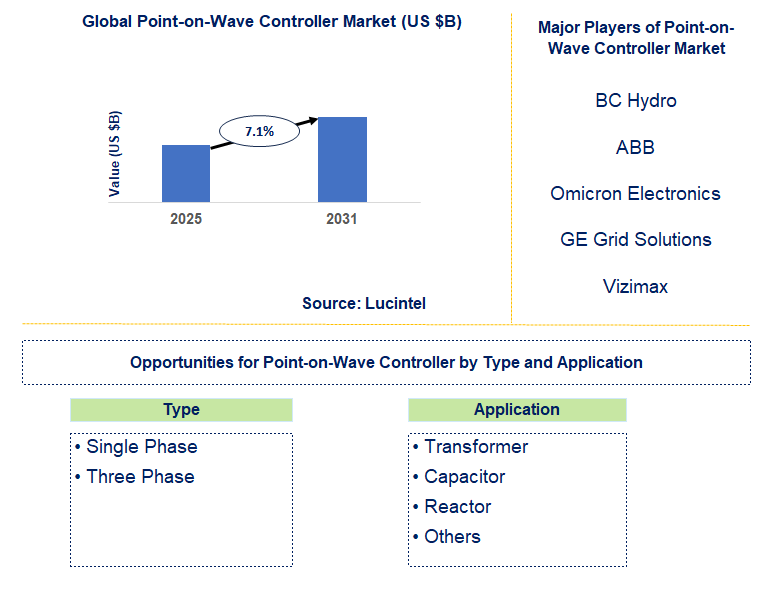
Key data points: The growth forecast = 7.1% annually for the next 7 years. Scroll below to get more insights. This market report covers Trends, opportunities and forecasts in point-on-wave controller market to 2031 by type (single phase and three phase), application (transformer, capacitor, reactor, and others), and region (North America, Europe, Asia Pacific, and the Rest of the World)
We'll send your sample report shortly.
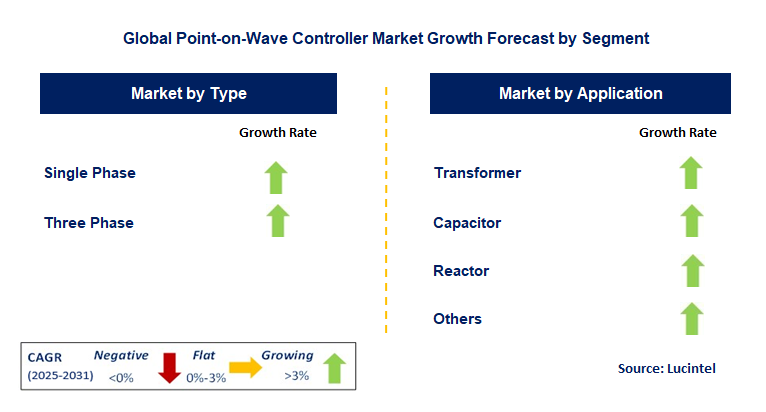
• Lucintel forecasts that, within the type category, three phase is expected to witness higher growth over the forecast period due to greater and stable power supply.
• Within the application category, transformer is expected to witness the highest growth.
• In terms of region, APAC is expected to witness the highest growth over the forecast period due to the increasing adoption of renewable energy sources.
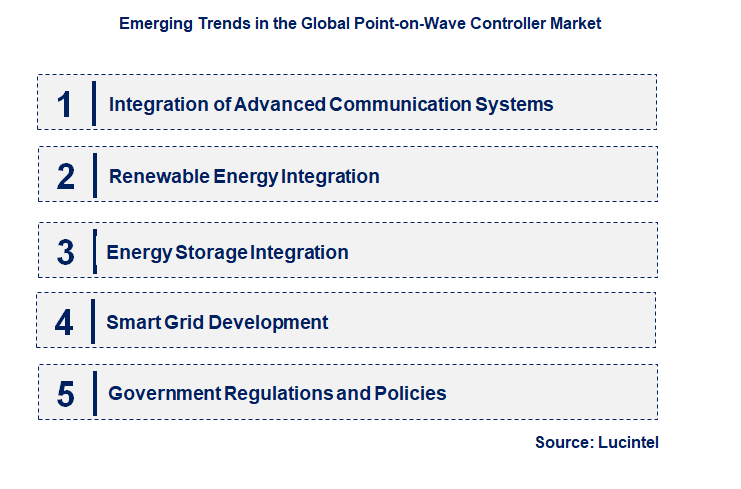
• Integration of Advanced Communication Systems: Modern power grids can integrate technologies and automate real-time monitoring, data transfer and power response actions due to deployment of sophisticated communication technologies. Integration of Internet of Things (IoT) technologies and Artificial Intelligence (AI) into point-on-wave communication devices allows control and predictive analytics making the power grid more reliable.
• Renewable Energy Integration: The rise in the use of wind and solar energy as renewable sources increases the requirement for using point-on-wave controllers to ensure the stability of the grids. These controllers are used to counter the unstable nature of power generation enabling the integration of renewables to the grid without causing any disturbances in the voltage and frequency of the system.
• Energy Storage Integration: Point-on-wave controllers are being used more frequently with energy storage systems in order to augment the performance of the grid. By trying to balance stored energy with renewable energy generation, these controllers ensure consistent power output, minimize waste, and mitigate fluctuations, thereby creating a more stable and dependable energy system.
• Smart Grid Development: The ongoing development of the smart grid creates some gaps that point-on-wave controllers can fill. More automation, control, and monitoring are required for smart grids. The controllers that are needed are those which can automatically adapt their actions and settings based on the real-time condition of the grid. Point-on-wave controllers are becoming fundamental components of these systems as they respond to the real-time needs of the grid to help enhance its performance and reduce outages.
• Government Regulations and Policies: Stricter regulations concerning the integration of renewable energy and grid stability is supporting the proliferation of point-on-wave controllers. Governments worldwide are requiring grid operators to adopt advanced technologies that bolster grid resilience, which is leading to the increased acceptance of point-on-wave controllers to meet these regulatory requirements. Modernizing the power grids and integrating renewable energy sources is no easy task, but these emerging trends sure try to make it easier. These technologies, shifts in policies, and the positive movement towards cleaner energy systems will ensure that controllers continue to serve in the management and stability of the grid for years to come.
• Advanced Control Algorithms: The creation of advanced control algorithms has improved the operation of controllers that are managed on a point-on-wave basis. This is useful for renewable-rich areas because its predictive capabilities allow it to respond to power fluctuations with precision, subsequently increase grid stability.
• Integration with Energy Storage Systems: The integration of point-on-wave controllers with energy storage systems allows for better grid management, especially in regions that experience unpredictable power generation. Reducing voltage and frequency variations leads to more precise and reduced power supply, and thus less energy waste.
• IoT and AI Capabilities: The use of the Internet of Things (IoT) and Artificial Intelligence (AI) technology into point-on-wave controllers’ automation and control systems is enhancing automation and adaptability. Controllers can now gather real-time data, and forecast power requirements, and make necessary changes to the grid in a timely manner, increasing efficiency and reducing blackout possibilities.
• High-Efficiency Grid Stabilization: With the growing importance of grid reliability, point-on-wave controllers have emerged with high-efficiency stabilization features. These systems are capable of interrupting grid performance to disrupts during the high renewable generation and stabilize the grid to enhance performance.
• Modular and Scalable Solutions: There is a shift among manufacturers to develop point-on-wave controllers that are modular and scalable. These new designs make it easier to integrate with the existing infrastructure, which enables utilities to adopt the controllers with no major changes to the systems. These developments in the point-on-wave controller market are focusing on improving grid stability and efficiency. As modern energy systems become more complex and the need for integration of renewable energy sources increases, these innovations are becoming more important.
• Grid Modernization: Point-on-wave controllers offer superior solutions for the modernized grid. These controllers help improve grid efficiency, minimize non-productive time, and increase system reliability. This opportunity is being further enhanced by the need for smart grids.
• Renewable Energy Integration: Point-on-wave controllers enable better integration with the existing electrical grids for renewables, which is the most needed option for renewables interconnection. There is a lot of development needed in equipment that stabilizes and manages variable power sources, which point-on-wave controllers can fulfill.
• Energy Storage Systems: An increase in energy storage options is a new growth opportunity for point-on-wave controllers. These controllers help interconnect energy storage systems with the grid, improving power consistency while reducing waste and enhancing grid resilience.
• Electric Vehicle Charging Networks: The charging stations and electric vehicles (EVs) integration is creating new opportunities for point-on-wave controllers. These controllers assist in managing power fluctuations caused by EV charging which can destabilize the grid during peak charging times.
• Microgrids: When it comes to microgrids, particularly those that are remote or off-grid, point-on-wave controllers are indispensable. They help stabilize and control power generation and distribution within specific boundaries, thereby enhancing energy security and sustainability. These opportunities demonstrate the evolution of power systems and highlight the versatility of point-on-wave controllers from grid modernization to renewable energy integration. With the growing need for robust and sustainable power systems, there are no doubts that these systems and controllers will gain more prominence.
• BC Hydro
• ABB
• Omicron Electronics
• GE Grid Solutions
• Vizimax
• Schneider Electric
• Hitachi Energy
• Siemens
• Tavrida Electric
• Mitsubishi Electric
• Single Phase
• Three Phase
• Transformer
• Capacitor
• Reactor
• Others
• North America
• Europe
• Asia Pacific
• The Rest of the World
• United States: The Point-on-wave controller market in the United States is mainly centered on the energy sector due to the ever-increasing need for reliable and controlled energy distribution systems. The most recent market growth is associated with the development of more sophisticated controllers featuring advanced communication and monitoring systems. Some of the other reasons that have resulted in the increased demand for these controllers is the interest in integrating renewable energy sources such as solar and wind, which require grid stabilization to manage fluctuations in frequency and voltage.
• China: The implementation of point-on-wave controllers in China has grown tremendously, especially in the context of reinforcing its power grids. China's government has invested heavily in advanced point-on-wave technologies due to a commitment to reach carbon neutrality by 2060. These controllers are essential for reconciling the ever-increasing renewable energy sources like solar and wind with traditional fossil fuels as well as stabilizing and increasing the efficiency of the electrical grid.
• Germany: Germany has spearheaded the use of point-on-wave controllers POC’s most significantly with the integration of renewables. The country’s evergreened initiative has created a surge in the necessity for grid stabilization. Point-on-wave controllers POC have also become essential in counteracting the irregularity of renewable sources of energy such as wind and solar. As the country increases the share of renewables in energy production, the demand for more precise control of the generated voltage to ensure stability of the grid increases.
• India: The use of point-on-wave controllers is relatively new in India, but it is evolving quickly. Urbanization and development of renewable energy have made grid control increasingly important. Point-on-wave controllers aid in voltage and frequency control resulting from the shift to renewable energy sources. With the growth of modern infrastructure in India’s energy industry, there is a need for a dependable power supply, which is ensured by point-on-wave controllers.
• Japan: Japan has been active in the development of point-on-wave controllers, especially after the Fukushima incident which prompted a change toward renewables. The movement away from dependence on nuclear energy has opened up new possibilities for harnessing renewable energy sources such as solar and wind. These sources put greater demand on point-on-wave controllers as the need for stability and control in the grid increases. To cope with exceptional load conditions and lower output from renewable sources, Japan has been adopting advanced technologies to safeguard the grid and maintain power supply throughout the country.


• BC Hydro
• ABB
• Omicron Electronics
• GE Grid Solutions
• Vizimax
• Schneider Electric
• Hitachi Energy
• Siemens
• Tavrida Electric
• Mitsubishi Electric Q5. Which point-on-wave controller market segment will be the largest in future? Answer: Lucintel forecasts that, within the type category, three phase is expected to witness higher growth over the forecast period due to greater and stable power supply. Q6. In point-on-wave controller market, which region is expected to be the largest in next 5 years? Answer: In terms of region, APAC is expected to witness the highest growth over the forecast period due to the increasing adoption of renewable energy sources. Q7. Do we receive customization in this report? Answer: Yes, Lucintel provides 10% customization without any additional cost.


Choose a license that fits your team. Instant PDF delivery.
Prices exclude taxes. Instant delivery. Custom licensing available on request.
Market Report · July 22, 2026
Market Report · July 22, 2026
Market Report · July 17, 2026
Trusted partner for strategic intelligence and business growth


Receive a complimentary market analysis tailored to your industry. Our analysts will identify key growth opportunities and competitive dynamics specific to your business.

Market size, growth rate, and key trend analysis for your specific sector.

Top competitor positioning and market share analysis.

Strategic recommendations backed by data-driven insights.
Get curated market intelligence and competitive moves straight to your inbox.
By subscribing, you agree to receive our monthly insights. Unsubscribe anytime.
Receive a complimentary market analysis tailored to your industry. Our analysts will identify key growth opportunities and competitive dynamics specific to your business.
Market size, growth rate, and key trend analysis for your specific sector.
Top competitor positioning and market share analysis.
Strategic recommendations backed by data-driven insights.
Get curated market intelligence, emerging trends, and competitive moves straight to your inbox each month.
By subscribing, you agree to receive our monthly insights. Unsubscribe anytime.
We'll send your sample report shortly.