
Market Report · July 29, 2026

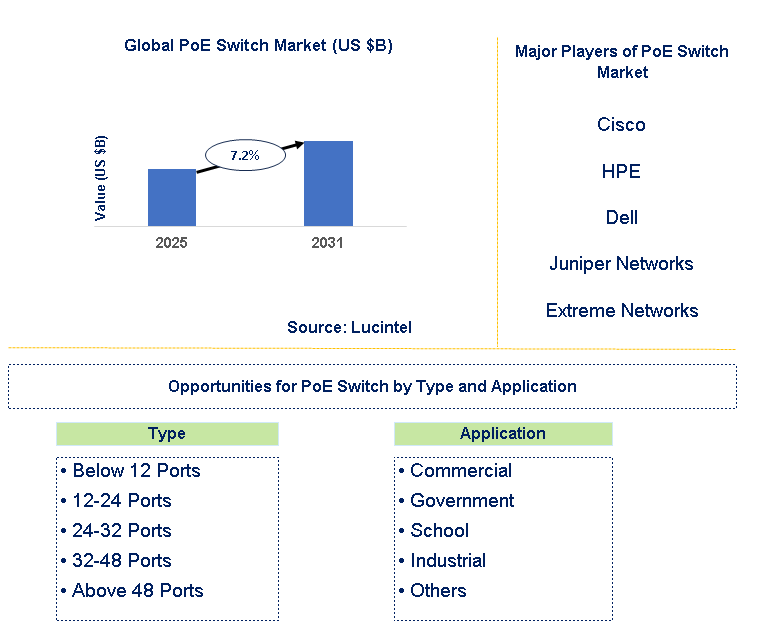
Key data points: The growth forecast = 7.2% annually for the next 7 years. Scroll below to get more insights. This market report covers trends, opportunities and forecasts in PoE switch market to 2031 by type (below 12 ports, 12-24 ports, 24-32 ports, 32-48 ports, and above 48 ports), application (commercial, government, school, industrial, and others), and region (North America, Europe, Asia Pacific, and the Rest of the World)
We'll send your sample report shortly.
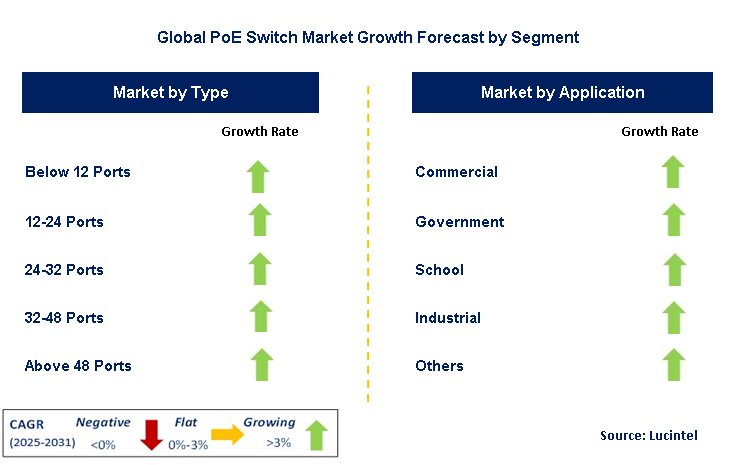
• Lucintel forecasts that, within the type category, 12-24 port is expected to witness the highest growth over the forecast period.
• Within the application category, commercial is expected to witness the highest growth.
• In terms of region, APAC is expected to witness the highest growth over the forecast period. Gain valuable insights for your business decisions with our comprehensive 150+ page report. Sample figures with some insights are shown below.
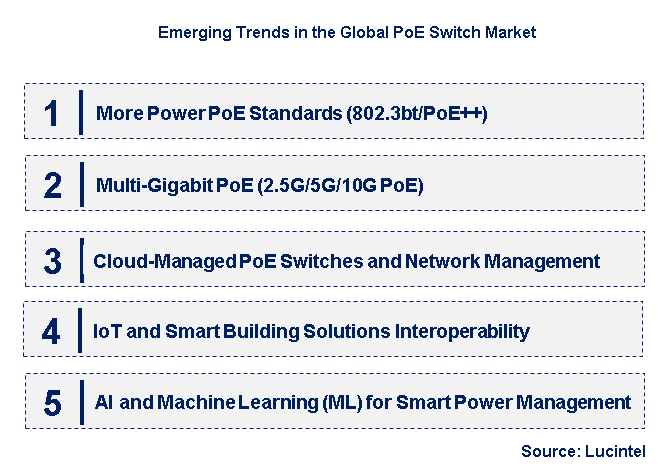
• More Power PoE Standards (802.3bt/PoE++): This trend is about the mass adoption of newer PoE standards offering much higher power per port, e.g., IEEE 802.3bt (PoE++ or 4PPoE), which can offer up to 90-100W. This increased power output allows PoE switches to power a wider variety of power-hungry devices, such as PTZ cameras, LED lighting systems, video conferencing devices, and high-performance wireless access points (Wi-Fi 6/7). The effect is a significant increase in the applicability of PoE, diminishing the necessity for individual power outlets for far more devices, easing installations, and decreasing infrastructure expenditure in commercial, industrial, and smart building spaces, extending what can be powered by PoE.
• Multi-Gigabit PoE (2.5G/5G/10G PoE): This trend integrates PoE capability with multi-gigabit Ethernet rates (2.5 Gbps, 5 Gbps, 10 Gbps) over existing Cat5e/Cat6 cabling. When devices such as Wi-Fi 6 access points and high-definition IP cameras require increased bandwidth, old Gigabit Ethernet (1Gbps) is a bottleneck. Multi-gigabit PoE switches remedy this by delivering increased power and increased data speed. The result is improved network performance and future-proofing of network infrastructure, making it possible to upgrade easily to meet bandwidth-hungry applications without expensive recalling, ultimately enhancing user experience and data throughput.
• Cloud-Managed PoE Switches and Network Management: This trend is concentrated around the rising popularity of cloud-managed PoE switches, which enable remote configuration, monitoring, and troubleshooting of network appliances on a centralized cloud platform. This eases network management, lowers the cost of operation, and offers proactive management of power distribution and device status in distributed environments. Cloud management offers higher flexibility and scalability for deploying and managing large-scale PoE networks. The effect is simplified network operations, increased efficiency for IT staff, and the capacity to manage highly complex networks remotely, resulting in more robust and easily scalable implementations.
• IoT and Smart Building Solutions Interoperability: PoE switches are becoming part of the growing IoT and smart building projects ecosystem. They offer a single infrastructure to power and interconnect a wide range of IoT sensors, lighting, HVAC systems, and security. The combination makes deployment simpler by avoiding the requirement of discrete power infrastructure for every device. The effect is the speeding up of smart building construction, facilitating intelligent automation, energy saving, and improved security. PoE allows easy deployment of connected devices, enabling more responsive and cohesive operational spaces in buildings.
• AI and Machine Learning (ML) for Smart Power Management: This new trend integrates artificial intelligence and machine learning algorithms into PoE switches. AI/ML can be used to dynamically allocate power based on device usage patterns, power critical devices first, identify anomalies, and even anticipate potential network problems. This smart power management maximizes energy use and increases network reliability. The effect is more efficient and robust PoE networks that can adapt independently to evolving conditions, minimize intervention, maximize energy utilization, and enhance the overall stability and performance of connected systems by making power delivery smarter and adaptive. These new trends are collectively transforming the PoE switch market by forcing into higher power outputs, higher data speeds, more advanced management, and greater interaction with IoT and smart building infrastructures. The market is transforming to provide more adaptable, cost-effective, and easy-to-use solutions that are needed for the more complex and networked world of the present digital age.
• Standardization and Adoption of IEEE 802.3bt (PoE++): One of the significant recent developments is the mass adoption and greater market availability of switches supporting the IEEE 802.3bt standard, also referred to as PoE++ or 4PPoE. This standard effectively doubles the amount of power delivered per port, with an up to 90-100W support for Powered Devices (PDs). The effect is the capability to power a next generation of high-power devices, including high-end PTZ security cameras, interactive screens, Wi-Fi 6/7 access points, and even thin clients, broadening the application and usefulness of PoE to more conventional devices.
• Development of Multi-Gigabit PoE Switches: The advent and increasing availability of multi-gigabit (2.5G/5G/10G) PoE switches is another significant development. These technologies are changing the landscape of the data center, premises, and campus networks. These switches integrate faster Ethernet speeds with PoE functionality, enabling organizations to use existing Cat5e/Cat6 cabling to achieve greater network performance. This innovation is important to enable bandwidth-hungry applications and newer wireless standards such as Wi-Fi 6, which require more than 1 Gbps. The effect is increased network throughput and fewer costs to upgrade infrastructure, since older cabling can be used to enable higher speeds and offer a cost-saving transition to network modernization.
• Integration of Enhanced Security Features: Due to the growing threat of cyberattacks, one important development is the integration of stronger security features directly into the PoE switches. These features involve secure boot, encrypted management interfaces, the ability of network segmentation (VLANs), and enhanced access control lists (ACLs). These features are designed to safeguard the network against unauthorized access and malicious attacks. The impact is improved network security and device integrity, ensuring that critical data and powered devices are safeguarded from potential vulnerabilities, which is paramount in today's connected environments.
• Enhanced Power Management and Monitoring Capabilities: Recent developments also include significant advancements in the intelligent power management and monitoring capabilities of PoE switches. Modern switches offer features like scheduled power delivery, power prioritization, and real-time power consumption monitoring through intuitive dashboards. This enables administrators to manage power resources efficiently, maximize energy consumption, and diagnose power problems remotely. The effect is enhanced operational efficiency, lower energy expenses, and increased network reliability through more intelligent power distribution and early problem detection.
• Denser Ports and Smaller Designs: Vendors are constantly creating PoE switches with greater port densities in smaller form factors, especially for enterprise, data center, and industrial deployments. This enables more devices to be powered and connected within a smaller space footprint. Also, ruggedized industrial-grade PoE switches are increasingly common, which can survive unforgiving environments. The effect is maximized space usage, simpler deployment in tight spaces, and greater flexibility for network designers building high-density installations, meeting the increasing need for effective space management. These innovations as a whole are together transforming the PoE switch market with PoE technology becoming more powerful, faster, secure, and manageable. The market is transforming to offer more flexible and strong solutions that are needed to address the growing number of connected devices and the rising demands of modern network infrastructures in different industries.
• IP Surveillance and Security Systems: This application offers one of the largest and most stable growth opportunities. The growing use of high-resolution IP cameras, NVRs, and access control systems for increased security in commercial, residential, and public establishments fuels demand for PoE switches. Strategic expansion encompasses providing high-power PoE++ switches with the ability to power PTZ cameras and advanced analytics solutions, along with strong security features and remote manageability features to make deployment and maintenance easy for sprawling surveillance networks.
• Wireless Local Area Network (WLAN) and Wi-Fi 6/7 Deployments: With the increasing number of mobile devices and the need for greater bandwidth, Wireless Access Point (WAP) deployment, particularly Wi-Fi 6 and emerging Wi-Fi 7 standards, is a significant growth area. Such high-end WAPs tend to demand greater power, so PoE switches become crucial for their efficient and flexible installation. Strategic potential is to offer multi-gigabit PoE switches that are capable of providing sufficient power and high-speed data to such next-generation WAPs, making wireless connectivity seamless.
• IoT Infrastructure and Smart Buildings: The smart building concept, which encompasses IoT sensors, smart lighting (PoE lighting), HVAC controls, and intelligent automation systems, presents huge growth possibilities. PoE switches offer an integrated, streamlined cabling platform for these disparate devices, lowering installation costs and complexity. Strategic expansion includes creating PoE switches tailored for smart building applications, delivering smart power management, cloud control, and integration with building management systems for improved energy efficiency and operations intelligence.
• Voice over IP (VoIP) Phones and Communications Systems: Even in the face of VoIP maturity, it continues to be a steady growth engine, particularly within enterprise and contact center infrastructures. PoE makes it easy to install VoIP phones by delivering power through the Ethernet cable, avoiding the use of AC adapters at every workstation. Strategic potential exists in offering dependable, affordable PoE switches with Quality of Service (QoS) capabilities to give voice traffic priority, guaranteeing clear, uninterrupted communication for small and large businesses alike.
• Industrial Automation and Iao (Industrial Internet of Things): The continued Industry 4.0 revolution and the growth of the Industrial Internet of Things (Iao) offer a large growth potential for ruggedized PoE switches. Industrial settings need hardened networking solutions for sensors, robotics, and automated devices that can operate in demanding environments. Strategic expansion includes providing industrial-grade PoE switches with longer temperature ranges, vibration tolerances, and high electromagnetic compatibility (EMC) for guaranteed power and data supply in factories, smart grids, and critical infrastructure. These strategic growth prospects are making a big difference in the PoE switch market by pushing the innovation trend toward more specialized, high-performance, and application-oriented solutions. The market is diversifying to address the specific requirements of different industries, ensuring further growth and making PoE technology an integral part of advanced network infrastructure.
• Cisco
• HPE
• Dell
• Juniper Networks
• Extreme Networks
• Alcatel-Lucent Enterprise
• Netgear
• Broadcom
• D-Link
• Adtran
• Below 12 Ports
• 12-24 Ports
• 24-32 Ports
• 32-48 Ports
• Above 48 Ports
• Commercial
• Government
• School
• Industrial
• Others
• North America
• Europe
• Asia Pacific
• The Rest of the World
• United States: The US market for PoE switches is seeing strong growth on account of widespread use of IP-based surveillance, wireless access points, and IoT devices. The demand for simplified networking infrastructure and lower cabling expenses in commercial complexes, data centers, and enterprise networks is driving the market. There is a prominent trend towards more-powerful PoE standards such as PoE++ (802.3bt) to enable power-intensive devices, as well as heightened demand for managed PoE switches with sophisticated features for cloud-based network management and enhanced security policies.
• China: China's PoE switch market is experiencing tremendous growth, driven by massive investment in smart city projects, industrial automation, and the large-scale deployment of IoT devices. The market is defined by an aggressive drive for local development and cost-effectiveness. Developments recently have been in the direction of enhanced higher wattage capability to accommodate more power-hungry devices such as high-resolution IP surveillance cameras and AI-based IoT sensors. Chinese vendors are also applying AI and machine learning in PoE switches for predictive care and dynamic power distribution.
• Germany: Germany's PoE switch market is influenced by its sophisticated digital foundation and strong IT expenditures, especially within industrial automation, smart buildings, and the healthcare industry. Trends consist of an increasing need for high-speed connectivity and a transition to cloud-based solutions. PoE is increasingly being used by German companies for connecting IoT devices and improving network efficiency. Major players are concentrating on continuous innovation, marrying PoE with advanced analytics and cloud environments for better network management, and facilitating the digitalization strategies of the country.
• India: India's market for PoE switches is expanding at a fast rate, driven by accelerating demand for automation, IoT adoption, and the development of smart infrastructure in manufacturing, transport, and energy industries. Latest developments include enhanced power delivery in unmanaged industrial PoE switches to accommodate more demanding devices. There is a rising emphasis on cloud-based monitoring and management solutions for remote access and real-time control, as well as a push for power-efficient solutions that fit into sustainability agendas and accommodate the rising numbers of connected devices.
• Japan: The Japanese PoE switch market is growing steadily, fueled by the rise in demand for high-power network devices and growing IoT infrastructure. The nation is witnessing a movement towards smart buildings, smart lighting systems, and industrial automation. Activities include the increased adoption of security surveillance systems and increased use of cloud-based solutions. Japanese firms are concentrating on improving PoE solutions with increased wattage support to cater to devices such as PTZ cameras and Wi-Fi 6 access points, and compliance with government initiatives for smart city creation.


• Cisco
• HPE
• Dell
• Juniper Networks
• Extreme Networks
• Alcatel-Lucent Enterprise
• Netgear
• Broadcom
• D-Link
• Adtran Q5. Which PoE switch market segment will be the largest in future? Answer: Lucintel forecasts that, within the type category, 12-24 port is expected to witness the highest growth over the forecast period. Q6. In PoE switch market, which region is expected to be the largest in next 5 years? Answer: In terms of region, APAC is expected to witness the highest growth over the forecast period. Q7. Do we receive customization in this report? Answer: Yes, Lucintel provides 10% customization without any additional cost.


Choose a license that fits your team. Instant PDF delivery.
Prices exclude taxes. Instant delivery. Custom licensing available on request.
Market Report · July 29, 2026
Market Report · July 20, 2026
Market Report · July 20, 2026
Trusted partner for strategic intelligence and business growth


Receive a complimentary market analysis tailored to your industry. Our analysts will identify key growth opportunities and competitive dynamics specific to your business.

Market size, growth rate, and key trend analysis for your specific sector.

Top competitor positioning and market share analysis.

Strategic recommendations backed by data-driven insights.
Get curated market intelligence and competitive moves straight to your inbox.
By subscribing, you agree to receive our monthly insights. Unsubscribe anytime.
Receive a complimentary market analysis tailored to your industry. Our analysts will identify key growth opportunities and competitive dynamics specific to your business.
Market size, growth rate, and key trend analysis for your specific sector.
Top competitor positioning and market share analysis.
Strategic recommendations backed by data-driven insights.
Get curated market intelligence, emerging trends, and competitive moves straight to your inbox each month.
By subscribing, you agree to receive our monthly insights. Unsubscribe anytime.
We'll send your sample report shortly.