
Market Report · July 15, 2026

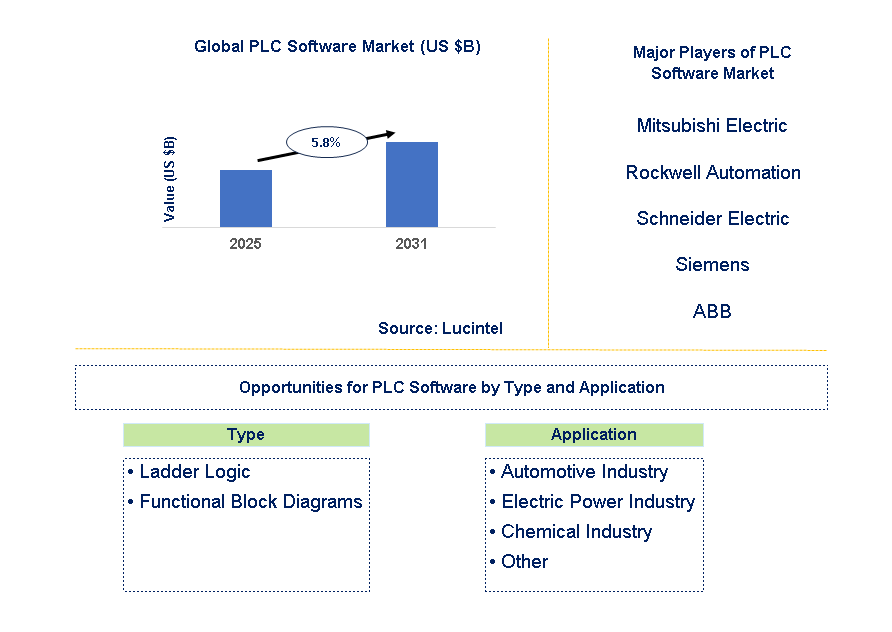
Key data points: The growth forecast = 5.8% annually for the next 7 years. Scroll below to get more insights. This market report covers Trends, opportunity and forecast in plc software market to 2031 by type (ladder logic and functional block diagram), application (automotive industry, electric power industry, chemical industry, and other), and region (North America, Europe, Asia Pacific, and the Rest of the World)
We'll send your sample report shortly.
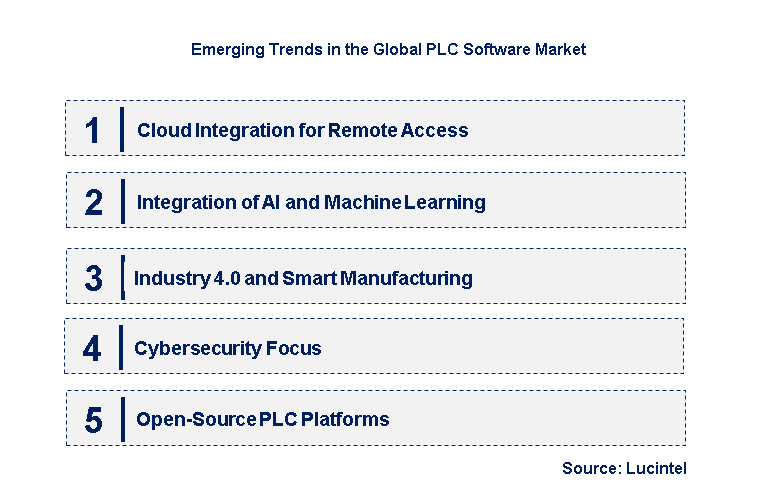
• Cloud Integration for Remote Access: The integration of PLC software with cloud platforms allows for real-time data monitoring, centralized control, and remote access, which significantly enhances operational efficiency. Cloud-based systems allow companies to monitor and manage operations from anywhere in the world, improving response times and reducing the need for on-site personnel. This trend is particularly beneficial for industries with multiple production sites or remote operations, where centralized oversight is essential for optimal performance.
• Integration of AI and Machine Learning: PLC software is now increasingly integrated with AI and machine learning to ensure predictive maintenance, optimization of automation, and adaptive control. In this way, PLC systems will be able to analyze data in real time, predict potential failures or inefficiencies, and trigger proactive actions, reducing downtime while improving system performance. AI has also been employed to optimize schedules of production as well as consumption of energy; this has enhanced the productivity as well as the sustainability of production for manufacturers.
• Industry 4.0 and Smart Manufacturing: Industry 4.0 and smart manufacturing are increasingly demanding for more sophisticated PLC software solutions that can be effortlessly worked in conjunction with IoT devices, sensors, and robotics to provide real-time data acquisition and analysis. With the growth of more complex automation in factories, better production quality, and increased operational efficiency, PLC software is most important in handling the complexity of operations. This is largely observed in industries like automotive, electronics, and consumer goods.
• Cybersecurity Focus: As PLC systems grow in terms of getting more interconnected through IoT and cloud platforms, cybersecurity becomes an important issue for concern. The safety and integrity of control systems must be ensured to prevent cyberattacks that may disrupt operations. PLC software providers are now including robust security measures such as encryption, multi-factor authentication, and real-time threat monitoring to protect industrial systems from cyber threats. As industrial control systems become more connected, the need for strong cybersecurity solutions will continue to grow.
• Open-Source PLC Platforms: This is another current trend in the market, because open-source platforms are more versatile and cost-efficient than proprietary solutions. Open-source solutions allow a manufacturer to adjust and customize PLC software according to specific needs; therefore, openness allows for adaptability and innovation. This will be very useful for SMEs that need an affordable and scalable PLC solution. In addition, the open-source platforms facilitate interoperability among various systems to enhance the integration of disparate production environments. Such trends point toward PLC software moving in the direction of increased connectivity, smarter automation, and improved flexibility. Increasing levels of AI, cloud computing, and IoT coupled with augmented security measures have increased the efficiency and resilience of industrial operations while offering more personalized and cost-effective solutions through open-source platforms.
• Advancements in Cloud Capabilities: Cloud-based PLC systems are widely used, as they offer superior scalability, remote access, and centralized control. Such systems also allow for real-time monitoring and predictive maintenance, which reduces the time spent in downtime and thereby improves overall efficiency. The access and management of systems from any corner of the world are major drivers for adopting cloud-based PLC software, mainly in industries where operations are dispersed geographically.
• With IOT and Big Data: IOT devices and platforms are making automation systems capable in the PLC domain. With such connections to sensors, machines, and other related devices, real-time collection of data in tremendous volumes can be made through PLC software for improvement of operations in a plant or any such factory. Companies now can optimize their production and even predict failures due to data-based decisions.
• Energy Efficiency: With sustainability being the focus for industries, PLC software is now being developed to optimize energy usage and reduce waste. PLC systems can now monitor energy consumption and adjust processes in real time to minimize energy waste. This is particularly important in manufacturing industries where energy costs form a significant portion of operating expenses.
• Predictive Maintenance: AI-powered predictive maintenance is the new buzz in PLC systems. It makes possible the analysis of historical data, identification of patterns, and thus prediction of the failure of equipment. The downtime is minimized, and machinery lives longer with higher operational efficiency. AI in PLC software has now become the standard in most complex machinery-dependent industries.
• Industry-Specific Customization: The PLC software is being customized for industries. Manufacturers are looking for solutions that cater to their unique requirements, whether it is automotive, food processing, or pharmaceuticals. This development allows for better integration with existing systems, optimized workflows, and increased productivity. Industry-specific solutions are becoming a key differentiator in the PLC software market. These advancements are forcing the PLC software market to develop increasingly efficient, adaptive, and intelligent systems. Integration with cloud computing, IOT, AI, and predictive maintenance improves the general system performance and productivity overall in industries.
• Smart Manufacturing: The growth of Industry 4.0 and smart manufacturing is a significant growth opportunity for PLC software providers. The increasing demand for automation, real-time data analysis, and interconnected systems creates a need for more advanced PLC solutions. Manufacturers can leverage PLC software to streamline operations, reduce costs, and improve production efficiency.
• Automotive Industry: The automotive industry has a large growth potential in PLC software. As the automotive industry is gaining momentum with trends of automation and electric vehicles, the demand for advanced control systems is increasing. PLC software manages assembly lines, robotics, and testing processes in the automotive industry. The increasing trend of smart factories and connected vehicles in the automotive industry accelerates this requirement.
• Renewable Energy: The renewable energy sector is also heavily dependent on PLC software to manage and optimize power generation processes. PLCs are used in wind farms, solar power plants, and energy storage systems for monitoring performance, ensuring efficiency, and reducing downtime. As the world shifts to sustainable energy, PLC software becomes an important element in improving energy management and distribution.
• Healthcare: It is getting into the medical equipment, monitoring patients, and the automated laboratories processes. Demand in healthcare toward the remote monitoring and automation in it has now placed PLC as one of the tools to meet this requirement so as to deliver excellent care efficiently.
• Water treatment and utilities: Increasingly stringent demands for efficient management of water treatment and utilities open doors for PLC software providers. PLC systems are being implemented to track and regulate water supply, sewage treatment, and power distribution in utilities. The resultant need for automation in this sector is driving demand for more sophisticated PLC software solutions. Strategic growth opportunities in the PLC software market are emerging across industries that prioritize automation, energy efficiency, and digital transformation. As more sectors adopt automation technologies, PLC software will play a pivotal role in driving operational efficiency and sustainability.
• Mitsubishi Electric
• Rockwell Automation
• Schneider Electric
• Siemens
• ABB
• Beckhoff
• Bosch Rexroth
• GE
• Honeywell International
• IDEC
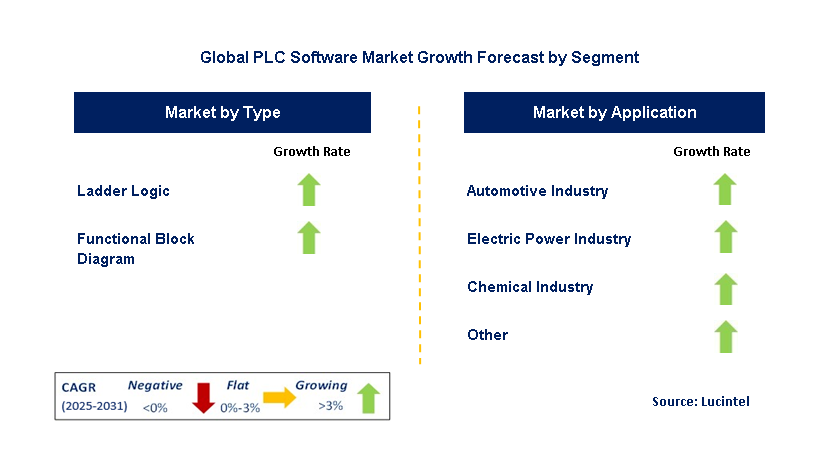
• Ladder Logic
• Functional Block Diagram
• Automotive Industry
• Electric Power Industry
• Chemical Industry
• Other
• North America
• Europe
• Asia Pacific
• The Rest of the World
• United States: The PLC software market in the United States has shifted towards Industry 4.0, where automation, data integration, and real-time analytics have become of greater importance. Cloud-based PLC systems are being adopted rapidly because they offer central control and remote monitoring capabilities; thus, efficiency can be enhanced in operations. It is the ability of integrating PLC software with AI and machine learning, which allow predictive maintenance and adaptive control. Moreover, as systems become more connected, so does cybersecurity, which is the new trend. There is an increasing need for very customized and user-friendly software for high-end manufacturing and industrial sectors.
• China: The PLC software market in China is rapidly growing with huge investments in industrial automation and smart manufacturing technologies. Industry 4.0 is promoted by the government, and there is a drive for advanced PLC software solutions, especially in the automotive, electronics, and heavy industries. More and more local PLC software companies are being developed by Chinese companies to meet the specific needs of the industries with better compatibility and customization. The integration of AI, IoT, and machine learning is optimising production processes and reducing energy consumption and the impact of a probable accident.
• Germany: Germany leads industrial automation worldwide and PLC software continues to expand the market share due to Germany's growth manufacturing. German companies embrace advanced PLC solutions that integrate IoT, AI, and robotics capabilities to improve efficiency in operations. Industry 4.0 digitalization is taking center stage with a focus on the development of PLC software capable of giving immediate insights into the production process as well as predictive maintenance. In addition, open-source PLC platforms are being spearheaded by Germany to enhance interoperability between systems in different industrial settings. Automation and energy-efficient systems are also the major focuses in the country's industrial and manufacturing sectors.
• India: The PLC software market is growing rapidly in India with the increased industrialization and modernization efforts in various sectors, including manufacturing, automotive, and energy. As Indian manufacturers seek efficiency and cost savings, the demand for advanced PLC solutions has grown. Cloud integration is gaining popularity, allowing better scalability and real-time monitoring. The increasing adoption of AI and IoT is driving the demand for more intelligent, adaptable PLC systems, which can deal with complex operations. The push from the Indian government to adopt digitization and automation in the industries is further fueling the growth of the PLC software market.
• Japan: Japan is the largest market player in the PLC software market in the automotive, robotics, and electronics sectors. Japanese companies have been focusing more on integrating PLC software with AI, machine learning, and IoT to optimize their manufacturing processes. Moreover, as the complexity in automation increases within smart factories, there is growing demand for PLC software that will manage this. Japan's penchant for efficiency and precision makes it a critical piece of software in its industries. Collaborative robotics, or cobots, is another factor that increases the demand for more advanced and intuitive PLC systems to ensure a smooth interaction between humans and machines.


• Mitsubishi Electric
• Rockwell Automation
• Schneider Electric
• Siemens
• ABB
• Beckhoff
• Bosch Rexroth
• GE
• Honeywell International
• IDEC Q5. Which plc software market segment will be the largest in future? Answer: Lucintel forecasts that, within the type category, ladder logic is expected to witness higher growth over the forecast period. Q6. In plc software market, which region is expected to be the largest in next 5 years? Answer: In terms of region, APAC is expected to witness the highest growth over the forecast period. Q7. Do we receive customization in this report? Answer: Yes, Lucintel provides 10% customization without any additional cost.


Choose a license that fits your team. Instant PDF delivery.
Prices exclude taxes. Instant delivery. Custom licensing available on request.
Market Report · July 15, 2026
Market Report · June 26, 2026
Market Report · June 24, 2026
Trusted partner for strategic intelligence and business growth


Receive a complimentary market analysis tailored to your industry. Our analysts will identify key growth opportunities and competitive dynamics specific to your business.

Market size, growth rate, and key trend analysis for your specific sector.

Top competitor positioning and market share analysis.

Strategic recommendations backed by data-driven insights.
Get curated market intelligence and competitive moves straight to your inbox.
By subscribing, you agree to receive our monthly insights. Unsubscribe anytime.
Receive a complimentary market analysis tailored to your industry. Our analysts will identify key growth opportunities and competitive dynamics specific to your business.
Market size, growth rate, and key trend analysis for your specific sector.
Top competitor positioning and market share analysis.
Strategic recommendations backed by data-driven insights.
Get curated market intelligence, emerging trends, and competitive moves straight to your inbox each month.
By subscribing, you agree to receive our monthly insights. Unsubscribe anytime.
We'll send your sample report shortly.