
Market Report · July 15, 2026

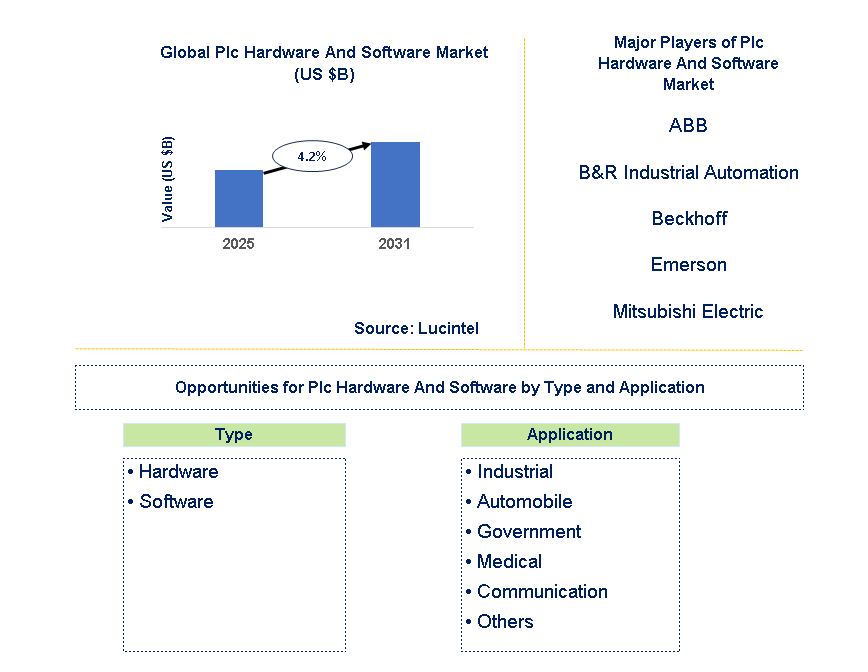
Key data points: The growth forecast = 4.2% annually for the next 7 years. Scroll below to get more insights. This market report covers Trends, opportunity and forecast in PLC hardware and software market to 2031 by type (hardware and software), application (industrial, automobile, government, medical, communication, and other), and region (North America, Europe, Asia Pacific, and the Rest of the World)
We'll send your sample report shortly.
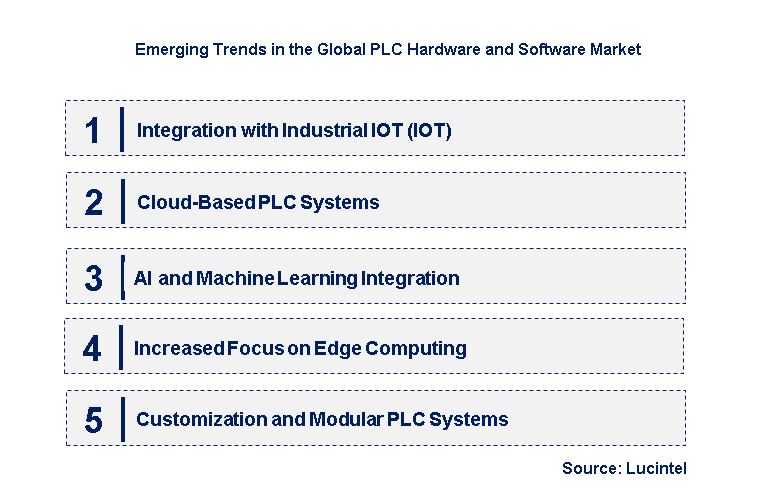
• Integration with Industrial IOT (IOT): PLC systems are now increasingly being integrated with the Industrial Internet of Things (IIoT) to facilitate real-time monitoring, data collection, and predictive maintenance. The integration of IIoT in PLC systems facilitates seamless communication between various devices and sensors in a manufacturing environment, thereby providing deeper insights into operations for manufacturers to optimize performance. The integration of IIoT with PLCs enhances data-driven decision-making and allows better resource management, especially in automotive, energy, and manufacturing industries.
• Cloud-Based PLC Systems: Cloud computing is revolutionizing the PLC market at a very swift pace through scalable, flexible, and remote control capabilities. Cloud-based PLC systems can monitor, store data, and access the system in real-time, thereby allowing manufacturers to have much more flexibility when managing automation systems across multiple sites. These systems are cost-effective because they reduce on-site infrastructure and maintenance requirements. This is because the demand for cloud-integrated PLC systems will only rise with time, especially for those businesses trying to streamline their operations and bring costs down while enhancing the efficiency of their systems.
• AI and Machine Learning Integration: Integration of artificial intelligence (AI) and machine learning (ML) into PLC systems for enhanced predictive maintenance, fault detection, and optimized overall process. Analyzing historical data through AI and ML algorithms, PLC systems can determine equipment failure patterns in advance, preventing actual failures from happening. Downtime is minimized, and operational costs are reduced because machinery is kept functional for longer. Industries like manufacturing, energy, and automotive are adopting AI and ML integration in PLC systems as crucial operational efficiency plays a key role in such sectors.
• Increased Focus on Edge Computing: Further, edge computing is gradually evolving into a backbone component of PLC systems, allowing data to be processed closer to the source of generation. This minimizes latency and reduces the need to transmit large volumes of data to central cloud servers. PLC systems will, therefore, offer much faster decision-making capabilities, enhanced real-time control, and reduced bandwidth need for the transmission of data. This trend is especially useful in applications where high-speed, real-time control is required, such as robotics and automated manufacturing lines.
• Customization and Modular PLC Systems: The need for more flexible and adaptable automation solutions has led to the development of customizable and modular PLC systems. Manufacturers are increasingly offering modular PLC hardware that allows for easy addition of components and customization of software to meet specific operational needs. These systems offer scalability and can be tailored to different production environments, reduce downtime, and do not require expensive replacements. With more flexible and efficient solutions in demand by industries, modular PLC systems are finding popularity in automotive, food processing, and electronics industries. These emerging trends IoT integration, cloud-based systems, AI and machine learning, edge computing, and modular systems are transforming the PLC hardware and software market. As industries shift toward smarter, more flexible, and efficient automation systems, PLC manufacturers are adapting by offering integrated solutions that improve operational efficiency, reduce costs, and enhance scalability. These trends are likely to continue shaping the future of PLC technology, with industries benefiting from greater connectivity, enhanced control, and advanced predictive capabilities.
• Hybrid PLC Systems Adoption: Hybrid PLC systems, which combine traditional programmable logic control with advanced technologies like cloud computing, AI, and IoT, are gaining popularity. These systems offer greater flexibility and scalability, enabling manufacturers to adapt to changing production requirements. Hybrid PLC systems enable integration with existing infrastructure while incorporating new capabilities for real-time data analytics and remote control. This development is particularly beneficial in industries undergoing digital transformation, such as automotive and consumer electronics.
• Integration of Advanced Security Features: With increasing interconnectivity, the concern for security of automation systems has been growing. The recent PLC hardware and software developments are geared toward enhancing security through encryption, multi-factor authentication, and intrusion detection systems. These security features are important for protecting PLC systems from cyber threats and maintaining the integrity of critical industrial processes. With the ever-growing use of PLCs in sensitive applications, such as energy management and manufacturing, the need for secure and robust systems is ever increasing.
• Energy Efficiency: Energy efficiency is emerging as a primary concern in the development of PLC hardware and software. Manufacturers are implementing energy-saving technologies, including optimized power consumption and low-voltage operation, in PLC systems to decrease energy costs and environmental impact. Energy-efficient PLCs are of particular interest in industries such as manufacturing and energy management, where operational costs are directly correlated with energy use. The development of energy-efficient PLC systems assists companies in achieving sustainability objectives while lowering long-term operational costs.
• Industry 4.0 Support: Industry 4.0 will continue to move forward, and PLC systems will also evolve to accommodate advanced automation and data exchange technologies. The current developments in PLC hardware and software are aimed at improving connectivity, interoperability, and data sharing across machines and systems. This facilitates the development of smart factories with automated, optimized, and monitored processes in real time. PLC systems that are Industry 4.0 compliant are becoming a necessity for businesses that want to stay ahead in the increasingly connected and automated industrial landscape.
• Modular and Scalable Systems: Modular and scalable PLC systems are finding favor as manufacturers call for more flexible automation solutions. They allow users to add or remove components accordingly, depending on the needs they have to fulfill within their operation at any given time, thereby adding value in terms of flexibility and cost-cutting. It is especially useful where frequent changes in production lines are needed or quick scalability of operations is required. These systems significantly minimize instances of down times and reduce costs associated with operations. The most important developments in the PLC hardware and software market are hybrid systems, enhanced security features, energy efficiency, Industry 4.0 support, and modular solutions. These developments are driving the industry toward greater flexibility, efficiency, and connectivity. The innovations are helping manufacturers streamline their operations, improve security, and reduce costs, positioning PLC systems as integral components of modern industrial automation.
• Industrial IOT Integration: The integration of PLC systems with industrial IoT (IOT) technologies is a significant growth opportunity. IOT-enabled PLC systems allow for real-time monitoring, remote control, and predictive maintenance, providing manufacturers with deeper insights into operations. This integration improves efficiency, reduces downtime, and allows for smarter decision-making. As more industries adopt IIoT, the demand for PLC systems that support these capabilities is expected to grow, particularly in manufacturing, energy, and automotive sectors.
• Cloud-based Solutions: Cloud computing is revolutionizing the PLC market as it offers scalability, remote access, and real-time data storage. Cloud-based PLC system gives manufacturers control over managing automation systems spread across multiple sites, thereby utilizing big data analytics for improved decision-making. With the trend of cloud adoption growing within all the sectors, manufacturing industries increasingly focus on PLC solutions compatible with cloud platforms, providing a significant area of growth potential for PLC providers in the future.
• AI and Machine Learning in Automation: AI and ML are the current drivers of next-generation innovation into PLC systems, as their deployment in PLC hardware and software will help advance predictive maintenance while optimizing production lines and enhancing operational efficiency. Adopting AI/ML in industry automation is being seen in the growing sectors of automobile, consumer electronic, and energy verticals, meaning a huge window of growth lies ahead for any PLC vendor in delivering intelligent solutions based on a data-driven mechanism.
• Sustainability and Energy Efficiency: There is a significant opportunity for PLC manufacturers in this regard as people are growing their emphasis on sustainability and reducing carbon footprints. Incorporating energy-saving features like low-voltage operation and optimized power consumption into the systems, PLC providers can help businesses reduce energy costs and comply with environmental regulations. The demand for green manufacturing has generated energy-efficient PLC solutions, particularly for manufacturing, utilities, and renewable energy industries.
• Robotics and automation integration: Increased requirement for PLC-based advanced systems has been growing over time as robotics and automation evolve further. The possibility of PLC integration with these modern technologies opens more avenues in terms of applications for robotics in manufacturing, logistics, and automotive industries and PLC control for robotic arms and other conveyor belts along with other automated machineries. This opportunity of growth in a new market area can be easily exploited by manufacturing organizations using modular and scalable PLC systems which are compatible with robotics. Growth opportunities in the PLC hardware and software market will be based on the integration of IIoT, cloud computing, AI, sustainability, and robotics. Since most industries will focus on optimization, cost-cutting, and efficiency improvement, PLC manufacturers will find enormous opportunities for expanding their market share and responding to the emerging needs of customers.
• ABB
• B&R Industrial Automation
• Beckhoff
• Emerson
• Mitsubishi Electric
• Omron
• Phoenix Contact
• Rexroth Bosch
• Rockwell Automation
• Schneider Electric
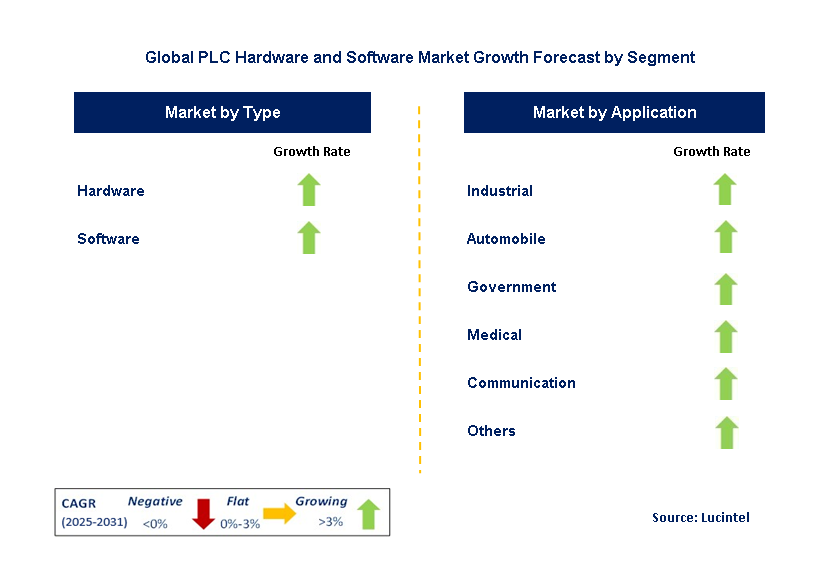
• Hardware
• Software
• Industrial
• Automobile
• Government
• Medical
• Communication
• Other
• North America
• Europe
• Asia Pacific
• The Rest of the World
• United States: The U.S. market for PLC hardware and software is rapidly advancing with strong emphasis on the usage of IoT and AI. Manufacturers are increasingly implementing smart PLC systems that allow remote monitoring, predictive maintenance, and real-time data analytics. This trend is being encouraged by the need to transform industries into digital ones, such as manufacturing, automotive, and food processing. Advancements in cloud-based PLC systems are also enhancing scalability and flexibility. In addition, hybrid PLC systems that integrate traditional control functionalities with advanced capabilities, such as machine learning and AI, are developed to optimize operations in U.S. markets.
• China: The PLC hardware and software market in China is booming due to the expansion of its manufacturing sector and push for smart industrial automation. The Chinese government's "Made in China 2025" initiative to upgrade manufacturing capabilities has greatly impacted the adoption of advanced PLC technologies. Chinese manufacturers have increasingly focused on producing low-cost, efficient PLC systems while integrating AI and IoT technologies to enhance automation. More powerful and flexible PLC systems in electronics, automotive, and heavy machinery are in the demand as China is striving to modernize its industrial base.
• Germany: Germany remains one of the leading markets in the PLC hardware and software market. The well-established manufacturing sector and the country's commitment to Industry 4.0 remain strong reasons for Germany's leading position in the PLC hardware and software market. The country focuses on the development of highly reliable and energy-efficient PLC systems to automate its production processes. Smart technologies like IoT, cloud computing, and AI are integrated into PLC solutions by German manufacturers for greater flexibility and scalability. The push toward sustainable industrial practice is also compelling Germany to develop innovative energy-efficient PLC systems, which can be mainly found in manufacturing and automotive industries. The demand for PLC systems that support flexible and customizably configurable production is also increasing.
• India: India's hardware and software markets for PLC are seeing a growth with the rising industrialization of the country and expansion in automotive, textiles, and food processing sectors. Whenever industries want to modernize and optimize their operations, this demand for automation solutions such as PLC is going to rise. The trend in India has now become more affordable, scalable PLC systems for the small and medium-sized enterprises (SME). As industries try to make operations more efficient and reduce the cost of operational output, integration of PLC with IoT technologies is catching up very strongly in India. With the current growth experienced in the manufacturing sector in India, the uptake of PLC solutions is also increasing.
• Japan: Japan is experiencing constant innovation in the PLC hardware and software market, focusing on high-performance, energy-efficient automation systems. The manufacturing industry in Japan, famous for its advanced robotics and automation technologies, has adopted smart PLCs that integrate IoT and AI for predictive maintenance and real-time data processing. Japan's push toward smart factories and Industry 4.0 is driving demand for more advanced PLC systems. Japanese manufacturers are also exploring the use of edge computing in PLCs to reduce latency and improve system performance. The market is poised for further growth, particularly in automotive and electronics sectors.


• ABB
• B&R Industrial Automation
• Beckhoff
• Emerson
• Mitsubishi Electric
• Omron
• Phoenix Contact
• Rexroth Bosch
• Rockwell Automation
• Schneider Electric Q5. Which PLC hardware and software market segment will be the largest in future? Answer: Lucintel forecasts that hardware is expected to witness higher growth over the forecast period. Q6. In PLC hardware and software market, which region is expected to be the largest in next 5 years? Answer: APAC is expected to witness the highest growth over the forecast period. Q7. Do we receive customization in this report? Answer: Yes, Lucintel provides 10% customization without any additional cost.


Choose a license that fits your team. Instant PDF delivery.
Prices exclude taxes. Instant delivery. Custom licensing available on request.
Market Report · July 15, 2026
Market Report · June 26, 2026
Market Report · June 24, 2026
Trusted partner for strategic intelligence and business growth


Receive a complimentary market analysis tailored to your industry. Our analysts will identify key growth opportunities and competitive dynamics specific to your business.

Market size, growth rate, and key trend analysis for your specific sector.

Top competitor positioning and market share analysis.

Strategic recommendations backed by data-driven insights.
Get curated market intelligence and competitive moves straight to your inbox.
By subscribing, you agree to receive our monthly insights. Unsubscribe anytime.
Receive a complimentary market analysis tailored to your industry. Our analysts will identify key growth opportunities and competitive dynamics specific to your business.
Market size, growth rate, and key trend analysis for your specific sector.
Top competitor positioning and market share analysis.
Strategic recommendations backed by data-driven insights.
Get curated market intelligence, emerging trends, and competitive moves straight to your inbox each month.
By subscribing, you agree to receive our monthly insights. Unsubscribe anytime.
We'll send your sample report shortly.