
Market Report · July 29, 2026

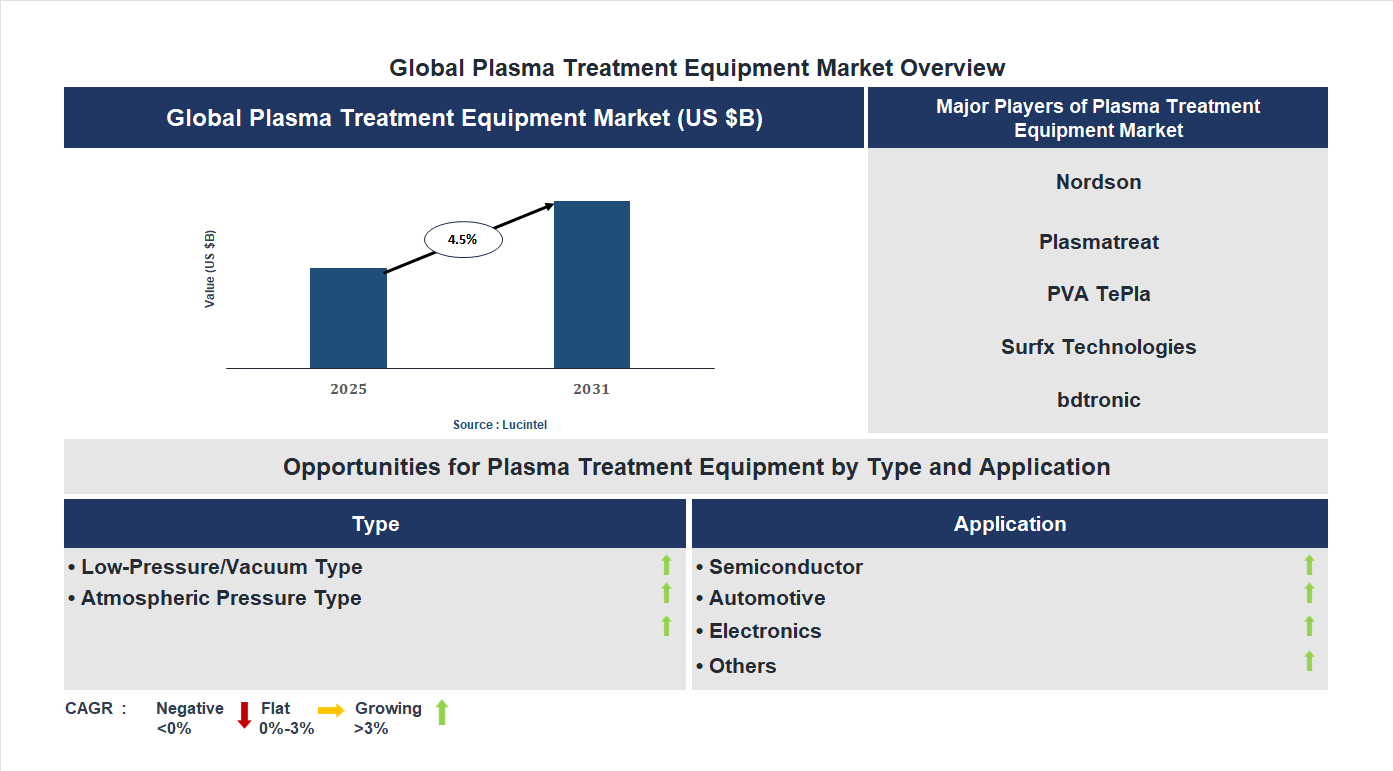
Key data points: The growth forecast = 4.5% annually for the next 7 years. Scroll below to get more insights. This market report covers trends, opportunities and forecasts in plasma treatment equipment market to 2031 by type (low-pressure/vacuum type and atmospheric pressure type), application (semiconductor, automotive, electronics, and others), and region (North America, Europe, Asia Pacific, and the Rest of the World)
We'll send your sample report shortly.
• Lucintel forecasts that, within the type category, low-pressure/vacuum type is expected to witness higher growth over the forecast period.
• Within the application category, semiconductor is expected to witness the highest growth.
• In terms of region, APAC is expected to witness the highest growth over the forecast period. Gain valuable insights for your business decisions with our comprehensive 150+ page report. Sample figures with some insights are shown below.
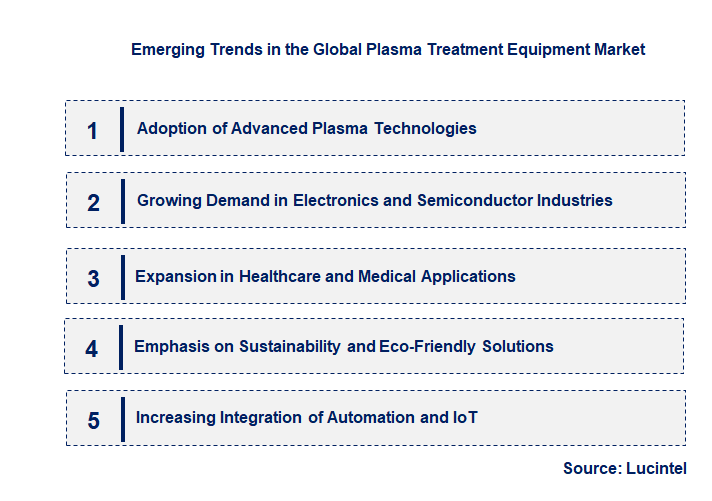
• Adoption of Advanced Plasma Technologies: The market is witnessing a shift towards more sophisticated plasma systems, such as atmospheric pressure plasma and cold plasma. These technologies offer benefits like reduced processing times, lower costs, and the ability to treat heat-sensitive materials. Their adoption is driven by the need for more efficient, eco-friendly, and versatile surface modification solutions, enabling industries to meet stringent regulatory standards and improve product quality.
• Growing Demand in Electronics and Semiconductor Industries: As electronic devices become more compact and complex, the need for precise surface treatments increases. Plasma equipment is increasingly used for cleaning, etching, and depositing thin films on semiconductor wafers and electronic components. This trend is propelled by the rapid growth of consumer electronics, IoT devices, and advancements in semiconductor manufacturing, which demand high-performance, contamination-free surfaces.
• Expansion in Healthcare and Medical Applications: The healthcare sector is increasingly utilizing plasma treatment for sterilization, surface modification of medical devices, and tissue engineering. Plasma technology offers a chemical-free, residue-free, and efficient method for sterilizing sensitive equipment and enhancing biocompatibility. This trend is driven by rising healthcare standards, the need for safer medical devices, and innovations in regenerative medicine, expanding the market’s scope into new biomedical applications.
• Emphasis on Sustainability and Eco-Friendly Solutions: Environmental concerns are pushing industries to adopt greener manufacturing processes. Plasma treatment is seen as an eco-friendly alternative to chemical treatments, reducing the use of hazardous substances and waste. The market is responding with the development of energy-efficient plasma systems that align with sustainability goals, appealing to environmentally conscious manufacturers and regulatory bodies.
• Increasing Integration of Automation and IoT: The integration of automation, robotics, and IoT in plasma treatment equipment is enhancing process control, precision, and scalability. Smart plasma systems enable real-time monitoring, data collection, and remote operation, improving efficiency and reducing human error. This trend is driven by Industry 4.0 initiatives, aiming to optimize manufacturing workflows and enable predictive maintenance, thus transforming the operational landscape of plasma treatment equipment. In summary, these emerging trends are significantly reshaping the plasma treatment equipment market by fostering technological innovation, expanding application areas, and emphasizing sustainability. They are driving increased adoption across diverse industries, leading to more efficient, eco-friendly, and precise surface treatment solutions that are set to define the market’s future trajectory.
• Technological Innovations: New plasma sources with higher efficiency and precision have been introduced, enabling better surface treatment outcomes. These innovations improve process control, reduce treatment times, and enhance the quality of treated surfaces, thereby expanding application possibilities and increasing market adoption.
• Expansion in Medical Applications: Plasma treatment equipment is increasingly used for sterilization, surface modification, and coating of medical devices. This expansion enhances device performance, reduces contamination risks, and meets stringent regulatory standards, thereby boosting market growth in the healthcare sector.
• Automation and Integration: The integration of automation and IoT-enabled systems into plasma equipment has improved operational efficiency and process consistency. Automated systems reduce labor costs, minimize errors, and enable real-time monitoring, making plasma treatment more accessible and appealing to various industries.
• Environmental and Regulatory Focus: Rising environmental concerns have led to the development of eco-friendly plasma processes that eliminate the need for hazardous chemicals. Compliance with environmental regulations and sustainability goals has driven manufacturers to innovate greener plasma treatment options, influencing market dynamics positively.
• Geographic Market Expansion: Countries in the Asia-Pacific and Latin America are witnessing rapid industrialization, leading to increased demand for plasma treatment equipment. Market players are expanding their presence in these regions through strategic partnerships and localized manufacturing, fueling overall market growth. In summary, these recent developments are significantly impacting the plasma treatment equipment market by enhancing technological capabilities, broadening application scopes, and promoting sustainable practices. The integration of automation and expansion into emerging markets are further driving growth, making the market more competitive and innovative. As these trends continue, the market is poised for sustained expansion and diversification across multiple industries.
• Electronics Industry: Adoption of plasma treatment for microfabrication and surface activation enhances device performance and miniaturization, driving demand for precise, scalable solutions that improve product reliability and enable advanced electronic components.
• Healthcare Sector: Plasma equipment is increasingly used for sterilization, surface modification of medical devices, and wound healing, leading to safer, more effective healthcare products and expanding market share in medical device manufacturing.
• Automotive Applications: Plasma treatments improve adhesion, paintability, and corrosion resistance of automotive parts, supporting the development of lightweight, durable vehicles and meeting stringent environmental standards.
• Packaging Industry: Plasma technology enhances surface properties of packaging materials, improving printability, barrier properties, and product shelf life, which boosts packaging efficiency and sustainability.
• Textile Industry: Plasma treatment modifies fabric surfaces to improve dye uptake, water repellency, and durability, enabling innovative textile products and expanding market applications in fashion and technical textiles. In summary, these key growth opportunities are significantly impacting the plasma treatment equipment market by fostering innovation, improving product quality, and expanding application scopes. This dynamic evolution is attracting investments, encouraging technological advancements, and positioning the market for sustained growth across diverse industries.
• Technological Innovation: The continuous development of advanced plasma technologies enhances treatment precision, efficiency, and versatility. Innovations such as low-temperature plasma and plasma-enhanced chemical vapor deposition enable new applications and improve existing processes. These technological advancements reduce processing times and energy consumption, making plasma equipment more attractive to manufacturers seeking cost-effective solutions. As research progresses, the integration of automation and IoT capabilities further boosts operational efficiency, expanding market opportunities. The ongoing evolution of plasma treatment methods ensures that industries can meet increasingly stringent quality and safety standards, fueling market growth.
• Growing Automotive and Electronics Industries: The expansion of automotive and electronics manufacturing sectors significantly drives demand for plasma treatment equipment. In automotive applications, plasma processes improve paint adhesion, corrosion resistance, and surface cleanliness, essential for vehicle durability and aesthetics. Similarly, in electronics, plasma treatments are crucial for surface activation, cleaning, and etching of semiconductors and display panels. The rising production volumes in these sectors, especially in emerging economies, create a substantial market for plasma equipment. As these industries prioritize lightweight, durable, and high-performance products, the need for advanced surface treatment solutions becomes more pronounced, supporting market expansion.
• Increasing Focus on Sustainability and Environmental Regulations: Stringent environmental regulations and a global shift towards sustainable manufacturing practices are key drivers for the plasma treatment market. Plasma processes are eco-friendly alternatives to chemical treatments, producing minimal waste and reducing hazardous emissions. Governments worldwide are implementing stricter standards for surface treatment processes, encouraging industries to adopt cleaner technologies. This regulatory landscape incentivizes manufacturers to invest in plasma equipment that complies with environmental norms, thereby expanding market opportunities. Additionally, the ability of plasma treatments to enhance product lifespan and reduce material waste aligns with sustainability goals, further propelling market growth.
• Rising Adoption of Automation and Industry 4.0: The integration of automation, Industry 4.0, and smart manufacturing practices significantly influences the plasma treatment equipment market. Automated plasma systems improve process consistency, reduce labor costs, and enhance throughput, making them highly attractive to manufacturers aiming for operational excellence. The adoption of IoT-enabled plasma equipment allows real-time monitoring, predictive maintenance, and data-driven process optimization, leading to increased efficiency and reduced downtime. As industries increasingly embrace digital transformation, the demand for intelligent plasma treatment solutions grows, fostering innovation and expanding market reach across various sectors.
• Increasing R&D Activities and New Application Development: Ongoing research and development efforts are expanding the application scope of plasma treatment equipment. Innovations in plasma chemistry and process customization enable new uses in biomedical devices, flexible electronics, and renewable energy sectors. R&D investments by key players and academic institutions facilitate the development of specialized plasma systems tailored to emerging needs. These advancements open up new markets and enhance the versatility of plasma equipment, encouraging adoption in niche and high-value applications. The continuous evolution driven by R&D ensures the market remains dynamic and responsive to technological and industrial shifts. The challenges facing this plasma treatment equipment market include:
• High Capital Investment and Operating Costs: The initial purchase price of plasma treatment equipment is substantial, often limiting adoption among small and medium-sized enterprises. Additionally, operational costs such as maintenance, energy consumption, and consumables contribute to the overall expense, impacting profitability. These high costs can deter companies from upgrading or expanding their existing systems, slowing market growth. To mitigate this, manufacturers are focusing on developing more cost-effective solutions, but the financial barrier remains a significant challenge, especially in price-sensitive markets.
• Technological Complexity and Skill Gap: The sophisticated nature of plasma treatment technology requires specialized knowledge for operation, maintenance, and process optimization. A lack of skilled personnel can lead to suboptimal performance and increased downtime, affecting productivity. The complexity of plasma systems also necessitates ongoing training and technical support, adding to operational costs. This skill gap hampers widespread adoption, particularly in regions with limited technical expertise, and underscores the need for user-friendly designs and comprehensive training programs to facilitate market penetration.
• Stringent Regulatory and Safety Standards: Compliance with evolving safety, environmental, and quality regulations poses a significant challenge for market players. Ensuring that plasma equipment meets diverse international standards requires continuous modifications and testing, increasing development costs and time-to-market. Non-compliance can result in legal penalties, product recalls, and damage to brand reputation. Navigating complex regulatory landscapes demands substantial resources and expertise, which can hinder innovation and slow down the deployment of new plasma treatment solutions, especially for smaller companies. In summary, the plasma treatment equipment market is driven by technological advancements, expanding industrial sectors, sustainability initiatives, automation integration, and ongoing R&D efforts. However, high costs, technological complexity, and regulatory hurdles present notable challenges. These factors collectively influence the pace and direction of market growth. While opportunities for innovation and application expansion are substantial, addressing cost and skill barriers is crucial for broader adoption. Overall, the markets future will depend on how effectively stakeholders can leverage technological progress while overcoming these challenges to meet evolving industry demands.
• Nordson
• Plasmatreat
• PVA TePla
• Surfx Technologies
• bdtronic
• Diener Electronic
• Panasonic
• Shenzhen OKSUN Technology
• Vision Semicon
• Yield Engineering Systems
• Low-Pressure/Vacuum Type
• Atmospheric Pressure Type
• Semiconductor
• Automotive
• Electronics
• Others
• North America
• Europe
• Asia Pacific
• The Rest of the World
• United States: The U.S. market has seen rapid adoption of plasma treatment equipment in electronics, automotive, and healthcare industries. Innovations focus on increasing process efficiency and reducing environmental impact. Major players are investing in R&D to develop portable and versatile systems, while regulatory standards push for eco-friendly solutions. The growth of the semiconductor industry and advancements in medical device manufacturing are significant drivers. Additionally, increased automation and integration with Industry 4.0 technologies are enhancing operational capabilities, making plasma equipment more accessible and efficient for diverse applications.
• China: China is experiencing robust growth in plasma treatment equipment due to expanding manufacturing and electronics sectors. The government’s focus on high-tech industries and infrastructure development fuels demand. Local companies are investing in advanced plasma technologies to improve surface treatment quality and reduce production costs. The adoption of plasma equipment in automotive, textiles, and consumer electronics is rising rapidly. Moreover, China’s emphasis on environmental regulations is encouraging the development of eco-friendly plasma solutions. The market is also benefiting from increased foreign investment and collaborations with international firms to enhance technological capabilities.
• Germany: Germany remains a key player in the plasma treatment equipment market, driven by its strong automotive, aerospace, and precision engineering sectors. The focus is on developing high-precision, energy-efficient systems that meet strict European environmental standards. German companies are pioneering innovations in plasma surface modification for lightweight materials and complex geometries. The integration of digital technologies and automation is improving process control and productivity. Additionally, Germany’s emphasis on sustainable manufacturing practices is fostering the development of environmentally friendly plasma solutions, positioning it as a leader in high-quality, innovative surface treatment equipment.
• India: The Indian market is witnessing rapid growth due to expanding electronics, automotive, and packaging industries. Increasing investments in manufacturing infrastructure and government initiatives like Make in India are boosting demand for plasma treatment equipment. Local manufacturers are adopting advanced plasma technologies to improve product quality and reduce costs. The rising focus on sustainable and eco-friendly processes aligns with global standards, encouraging innovation. Additionally, the growing automotive and textile sectors are utilizing plasma equipment for surface modification, which enhances product durability and performance. The market is expected to continue expanding as industrialization accelerates and technological awareness increases.
• Japan: Japan’s market is characterized by advanced technological development and high adoption rates in electronics, automotive, and industrial sectors. Japanese companies are focusing on miniaturization and precision in plasma equipment to meet the demands of high-tech manufacturing. Innovations include plasma systems with enhanced energy efficiency and automation capabilities. The country’s emphasis on environmental sustainability is driving the development of eco-friendly plasma solutions. Japan’s strong R&D infrastructure and collaborations with global firms are fostering continuous innovation. The market benefits from a mature industrial base, high-quality standards, and a focus on integrating plasma technology into smart manufacturing processes, maintaining its leadership position in the industry.


• Nordson
• Plasmatreat
• PVA TePla
• Surfx Technologies
• bdtronic
• Diener Electronic
• Panasonic
• Shenzhen OKSUN Technology
• Vision Semicon
• Yield Engineering Systems Q5. Which plasma treatment equipment market segment will be the largest in future? Answer: Lucintel forecasts that, within the type category, low-pressure/vacuum type is expected to witness higher growth over the forecast period. Q6. In plasma treatment equipment market, which region is expected to be the largest in next 5 years? Answer: In terms of region, APAC is expected to witness the highest growth over the forecast period. Q7. Do we receive customization in this report? Answer: Yes, Lucintel provides 10% customization without any additional cost.


Choose a license that fits your team. Instant PDF delivery.
Prices exclude taxes. Instant delivery. Custom licensing available on request.
Market Report · July 29, 2026
Market Report · July 20, 2026
Market Report · July 20, 2026
Trusted partner for strategic intelligence and business growth


Receive a complimentary market analysis tailored to your industry. Our analysts will identify key growth opportunities and competitive dynamics specific to your business.

Market size, growth rate, and key trend analysis for your specific sector.

Top competitor positioning and market share analysis.

Strategic recommendations backed by data-driven insights.
Get curated market intelligence and competitive moves straight to your inbox.
By subscribing, you agree to receive our monthly insights. Unsubscribe anytime.
Receive a complimentary market analysis tailored to your industry. Our analysts will identify key growth opportunities and competitive dynamics specific to your business.
Market size, growth rate, and key trend analysis for your specific sector.
Top competitor positioning and market share analysis.
Strategic recommendations backed by data-driven insights.
Get curated market intelligence, emerging trends, and competitive moves straight to your inbox each month.
By subscribing, you agree to receive our monthly insights. Unsubscribe anytime.
We'll send your sample report shortly.