
Market Report · July 24, 2026

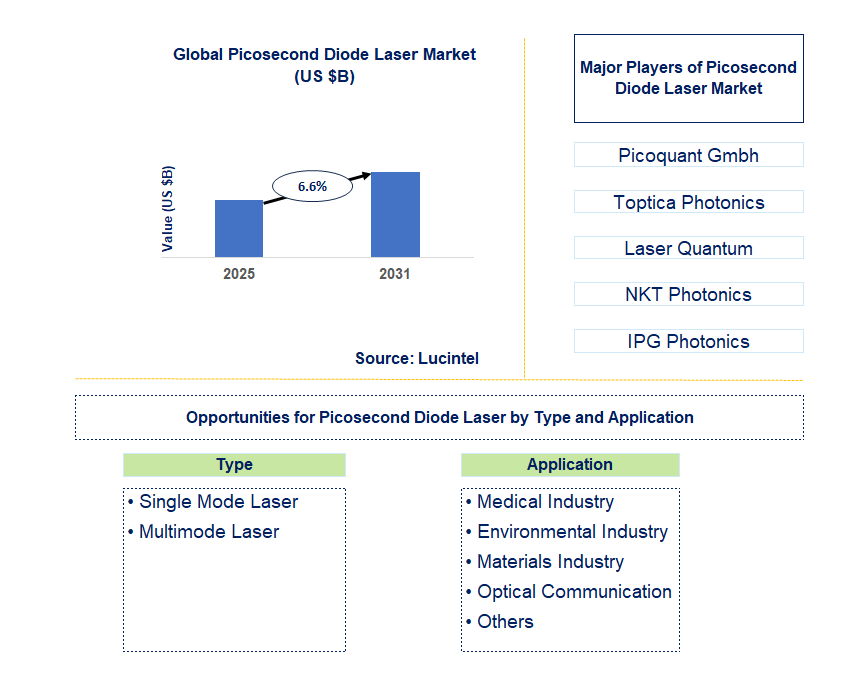
Key data points: The growth forecast = 6.6% annually for the next 7 years. Scroll below to get more insights. This market report covers Trends, opportunity and forecast in picosecond diode laser market to 2031 by type (single mode laser and multimode laser), application (medical industry, environmental industry, materials industry, optical communication, and others), and region (North America, Europe, Asia Pacific, and the Rest of the World)
We'll send your sample report shortly.
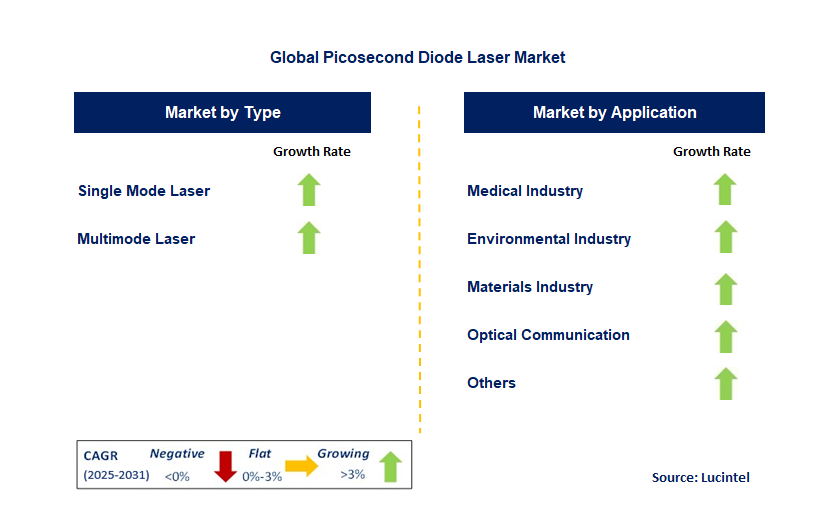
• Lucintel forecasts that, within the type category, single mode laser is expected to witness higher growth over the forecast period due to its high precision and narrow beam focus, making it essential for high-precision applications across industries like semiconductor manufacturing.
• Within the application category, medical industry is expected to witness the highest growth due to the widespread use of picosecond lasers in medical treatments such as cosmetic procedures, laser surgery, and diagnostic imaging.
• In terms of region, North America is expected to witness the highest growth over the forecast period due to its strong presence in electronics, manufacturing, and healthcare. Gain valuable insights for your business decisions with our comprehensive 150+ page report. Sample figures with some insights are shown below.
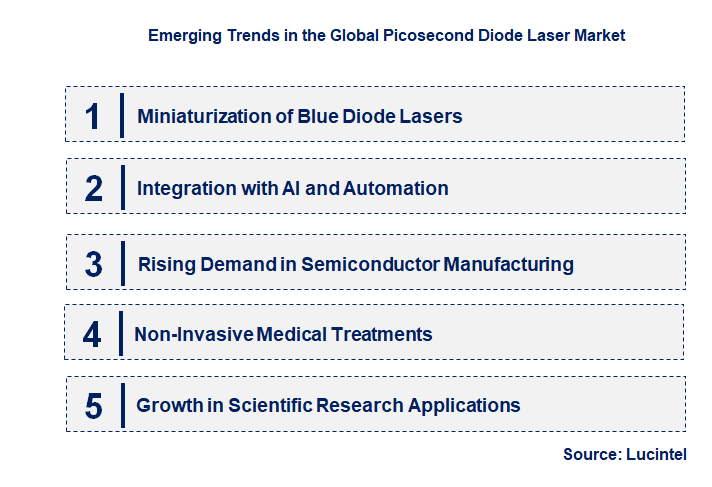
• Miniaturization of Laser Systems: As demand grows for portable, cost-effective, and efficient laser systems, miniaturization is becoming a key trend. Manufacturers are focusing on developing smaller picosecond diode lasers that maintain high performance but reduce size and energy consumption. This trend is particularly important in medical applications such as dermatology and cosmetic surgery, where portable and easy-to-use systems are gaining popularity. Compact lasers are also beneficial for industries like electronics and aerospace, where space and weight constraints are critical.
• Integration with AI and Automation: The integration of Picosecond Diode Lasers with artificial intelligence (AI) and automation systems is becoming increasingly common. In industrial settings, lasers are now part of automated production lines where AI controls laser parameters for optimal precision and efficiency. This trend enhances productivity by enabling real-time adjustments, predictive maintenance, and improved yield in manufacturing. In medical applications, AI algorithms are being employed to optimize laser settings, improving outcomes and reducing treatment times in dermatological procedures.
• Rising Demand in Semiconductor Manufacturing: As the semiconductor industry continues to push for smaller, more powerful chips, the demand for Picosecond Diode Lasers is growing. These lasers offer precise, high-speed material processing capabilities essential for cutting, engraving, and micro-machining semiconductor components. The trend is amplified by the rise of advanced technologies like 5G, AI, and IoT, which require increasingly smaller and more intricate components. Picosecond lasers provide the precision necessary for these demanding applications, making them indispensable in modern semiconductor fabrication.
• Non-invasive Medical Treatments: Picosecond lasers are gaining traction in non-invasive medical treatments, particularly in dermatology and aesthetic procedures. Unlike traditional lasers, picosecond lasers minimize thermal damage, making them ideal for procedures like tattoo removal, acne scar treatment, and skin rejuvenation. With their ability to break down pigments and stimulate collagen production at a cellular level, they offer superior results with reduced downtime. As awareness and demand for non-invasive cosmetic treatments rise globally, picosecond lasers are expected to see widespread adoption.
• Growth in Scientific Research Applications: The use of Picosecond Diode Lasers in scientific research is on the rise. These lasers are essential tools in fields such as spectroscopy, material science, and quantum computing due to their ability to produce extremely short and precise light pulses. Researchers are using picosecond lasers for experiments involving ultrafast phenomena and time-resolved spectroscopy, which require high temporal resolution. This trend is particularly significant in physics and chemistry research, where such lasers allow the study of molecular and atomic interactions at unprecedented speeds. Emerging trends in the picosecond diode laser market—such as miniaturization, integration with AI, rising demand in semiconductor manufacturing, non-invasive medical treatments, and growth in scientific research—are significantly transforming the landscape. These innovations are driving greater adoption of picosecond lasers across a wide range of applications, from healthcare to industrial manufacturing, making them essential in modern technological advancements.
• Enhanced Pulse Duration Control: Manufacturers have made significant strides in improving the pulse duration control of Picosecond Diode Lasers. By refining the ability to precisely control pulse width, these lasers can offer greater flexibility and precision across various applications, from medical treatments to materials processing. This development enhances the quality of laser treatments and expands their range of uses, particularly in dermatology, where fine control over pulse duration leads to better results with minimal tissue damage.
• Increased Energy Efficiency: One of the major recent developments in Picosecond Diode Lasers is the focus on improving energy efficiency. By optimizing diode designs and reducing power consumption, manufacturers are able to produce lasers that deliver high performance while using less energy. This is especially important in portable medical devices, where energy efficiency directly impacts the size and weight of the systems. It also helps reduce operational costs, making the technology more affordable and accessible for a broader range of users.
• Integration with Digital Systems: The integration of Picosecond Diode Lasers with digital control systems is a growing trend. Digital integration allows for greater precision and automation in controlling laser parameters, improving both the effectiveness and ease of use of the lasers. In medical devices, for example, digital systems can adjust laser settings in real-time to optimize treatment outcomes. In industrial applications, digital integration helps automate the laser cutting or engraving process, enhancing precision and efficiency on production lines.
• Laser Systems for Micro-Machining: Picosecond Diode Lasers are increasingly being used for micro-machining in semiconductor and electronics manufacturing. The ability to cut and engrave materials with extremely high precision and minimal heat impact makes these lasers ideal for intricate processes such as PCB manufacturing, microchip production, and the cutting of thin films. This development is making picosecond lasers indispensable in industries that require exacting standards and highly detailed components.
• Advanced Medical Applications: The application of Picosecond Diode Lasers in medical treatments has seen major developments. New innovations are making these lasers more effective in treating a variety of skin conditions, from tattoos to acne scars to wrinkles. The ability to target tissue with greater precision while minimizing damage to surrounding areas has led to a surge in adoption by dermatologists and cosmetic surgeons. These lasers are also being used in ophthalmic surgery and other delicate procedures, further expanding their medical applications. Recent developments in the picosecond diode laser market—such as enhanced pulse control, improved energy efficiency, digital integration, micro-machining capabilities, and expanded medical applications—are significantly enhancing the technology’s performance and versatility. These innovations are contributing to the broader adoption of picosecond lasers across diverse sectors, creating new growth opportunities and applications for this advanced laser technology.
• Medical Aesthetics and Dermatology: The demand for non-invasive treatments in dermatology and medical aesthetics is rapidly increasing, creating a growth opportunity for Picosecond Diode Lasers. These lasers are ideal for treating conditions such as acne scars, wrinkles, and tattoos, offering precision without significant skin damage. As more consumers seek alternatives to invasive procedures, the market for Picosecond Diode Lasers in aesthetic medicine continues to expand.
• Semiconductor Manufacturing: As the semiconductor industry grows, particularly with the rise of advanced technologies like 5G, IoT, and AI, the demand for high-precision Picosecond Diode Lasers for micro-machining applications is increasing. These lasers are perfect for engraving, cutting, and processing delicate materials in semiconductor manufacturing, where accuracy is paramount. This presents significant growth opportunities in the electronics and semiconductor sectors.
• Precision Materials Processing: Picosecond lasers are essential for high-precision materials processing in industries such as aerospace, automotive, and electronics. These lasers are capable of micromachining with minimal thermal damage, making them ideal for high-quality material cutting and engraving. As industries continue to demand smaller, more intricate components, the demand for Picosecond Diode Lasers is set to rise.
• Scientific Research and Development: The demand for Picosecond Diode Lasers in scientific research, particularly in areas like spectroscopy, quantum physics, and material science, is growing. Researchers are using these lasers to study ultrafast phenomena, making them critical tools in fields that require high temporal precision. The continued focus on R&D, particularly in emerging fields like quantum computing, will create further opportunities for these lasers.
• Telecommunication and Optical Communications: The expansion of high-speed optical networks and communication technologies presents a growth opportunity for Picosecond Diode Lasers. These lasers are used in high-speed communication systems, where their ability to transmit ultra-fast pulses is essential for data transmission. With the global increase in demand for faster, more reliable communication, the role of Picosecond Diode Lasers will continue to grow. Strategic growth opportunities for Picosecond Diode Lasers exist in several high-demand sectors, including medical aesthetics, semiconductor manufacturing, materials processing, scientific research, and telecommunications. As these industries expand, the need for precise, efficient, and high-performance lasers will drive continued innovation and adoption of Picosecond Diode Lasers across the globe.
• Picoquant Gmbh
• Toptica Photonics
• Laser Quantum
• NKT Photonics
• IPG Photonics
• Fianium
• Jenoptik
• Alnair Labs Corporation
• Femtolasers Produktions Gmbh
• Rpmc Lasers
• Single Mode Laser
• Multimode Laser
• Medical Industry
• Environmental Industry
• Materials Industry
• Optical Communication
• Others
• North America
• Europe
• Asia Pacific
• The Rest of the World
• United States: In the United States, the picosecond diode laser market is expanding rapidly, particularly in medical and industrial applications. The medical sector, especially in dermatology, utilizes these lasers for skin resurfacing and tattoo removal due to their ability to deliver precise energy without causing significant damage to surrounding tissue. In the industrial sector, picosecond lasers are being used for micro-machining and semiconductor manufacturing, where high precision is essential. The U.S. is also home to leading research institutions focusing on advancing laser technology, contributing to innovations in speed, efficiency, and laser performance, which are driving market growth.
• China: China is experiencing substantial growth in the picosecond diode laser market, primarily driven by the expanding industrial and medical sectors. In the medical field, picosecond lasers are being adopted for advanced skin treatments and cosmetic surgeries. The rise in disposable income and growing interest in non-invasive treatments are fueling this demand. On the industrial front, China’s focus on semiconductor manufacturing and material processing is accelerating the use of picosecond lasers, which are ideal for precision cutting and engraving. Government investments in research and development (R&D) further support the country’s position as a key player in the laser technology market.
• Germany: Germany is at the forefront of laser technology advancements, particularly in the industrial and scientific sectors. The use of Picosecond Diode Lasers in Germany has increased due to their application in micro-manufacturing and materials processing, where high precision and minimal thermal effects are crucial. The German automotive and electronics industries, in particular, benefit from the precision these lasers offer in component cutting and micro-machining. Research and development activities in Germany are highly advanced, with local companies and universities focused on improving the performance of picosecond lasers, leading to more efficient, compact, and cost-effective solutions.
• India: India’s picosecond diode laser market is growing steadily, particularly in medical applications and electronics manufacturing. The increasing demand for advanced dermatology treatments such as tattoo removal, acne scar treatment, and skin rejuvenation has led to greater adoption of picosecond laser technology in the country’s rapidly expanding healthcare sector. Additionally, with the rise in semiconductor manufacturing and a push toward local production of electronic devices, picosecond lasers are gaining traction for micro-machining and component manufacturing. The government’s initiatives to support high-tech industries and R&D are contributing to the growth of this technology in India.
• Japan: In Japan, the picosecond diode laser market is driven by the strong demand for advanced laser technologies in electronics, automotive, and medical applications. Japanese manufacturers are leveraging picosecond lasers for high-precision material processing and component manufacturing, particularly in the production of semiconductors and electronic devices. In the medical field, these lasers are gaining popularity in cosmetic and dermatological treatments due to their ability to provide non-invasive solutions with minimal downtime. Japan’s focus on technological innovation and precision manufacturing ensures that it remains a key market for advanced laser technologies like picosecond lasers.


• Picoquant Gmbh
• Toptica Photonics
• Laser Quantum
• NKT Photonics
• IPG Photonics
• Fianium
• Jenoptik
• Alnair Labs Corporation
• Femtolasers Produktions Gmbh
• Rpmc Lasers Q5. Which picosecond diode laser market segment will be the largest in future? Answer: Lucintel forecasts that single mode laser is expected to witness higher growth over the forecast period due to its high precision and narrow beam focus, making it essential for high-precision applications across industries like semiconductor manufacturing. Q6. In picosecond diode laser market, which region is expected to be the largest in next 5 years? Answer: North America is expected to witness the highest growth over the forecast period due to its strong presence in electronics, manufacturing, and healthcare. Q7. Do we receive customization in this report? Answer: Yes, Lucintel provides 10% customization without any additional cost.


Choose a license that fits your team. Instant PDF delivery.
Prices exclude taxes. Instant delivery. Custom licensing available on request.
Market Report · July 24, 2026
Market Report · July 20, 2026
Market Report · July 20, 2026
Trusted partner for strategic intelligence and business growth


Receive a complimentary market analysis tailored to your industry. Our analysts will identify key growth opportunities and competitive dynamics specific to your business.

Market size, growth rate, and key trend analysis for your specific sector.

Top competitor positioning and market share analysis.

Strategic recommendations backed by data-driven insights.
Get curated market intelligence and competitive moves straight to your inbox.
By subscribing, you agree to receive our monthly insights. Unsubscribe anytime.
Receive a complimentary market analysis tailored to your industry. Our analysts will identify key growth opportunities and competitive dynamics specific to your business.
Market size, growth rate, and key trend analysis for your specific sector.
Top competitor positioning and market share analysis.
Strategic recommendations backed by data-driven insights.
Get curated market intelligence, emerging trends, and competitive moves straight to your inbox each month.
By subscribing, you agree to receive our monthly insights. Unsubscribe anytime.
We'll send your sample report shortly.