
Market Report · July 15, 2026

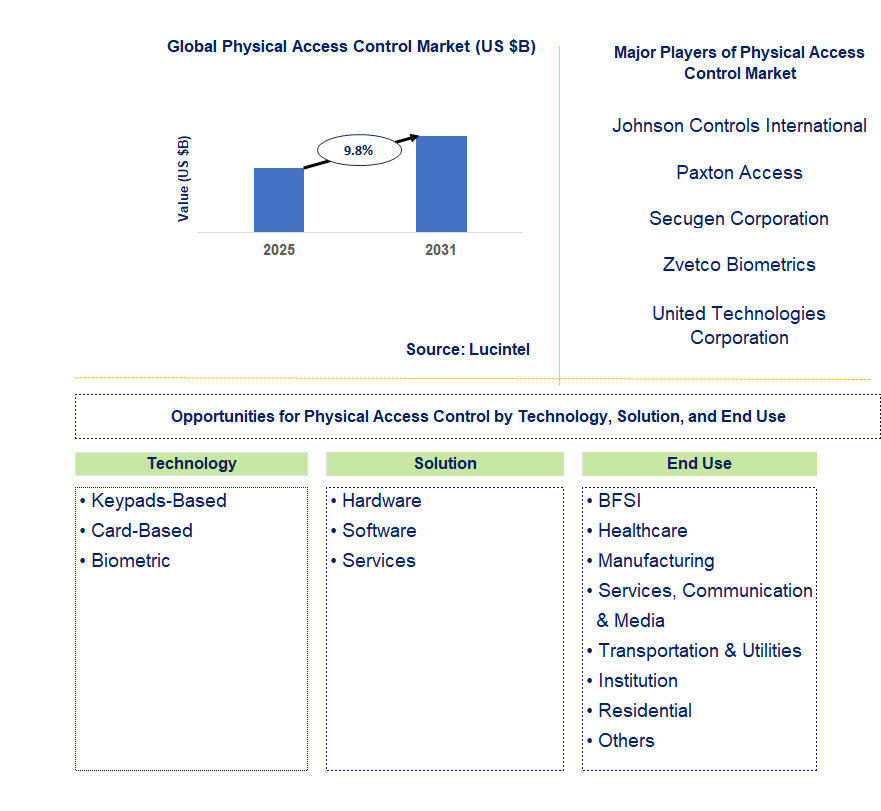
Key data points: The growth forecast = 9.8% annually for the next 7 years. Scroll below to get more insights. This market report covers trends, opportunities and forecasts in physical access control market to 2031 by technology (keypads-based, card-based, and biometric), solution (hardware, software, and services), end use (BFSI, healthcare, manufacturing, services, communication & media, transportation & utilities, institution, residential, and others), and region (North America, Europe, Asia Pacific, and the Rest of the World)
We'll send your sample report shortly.
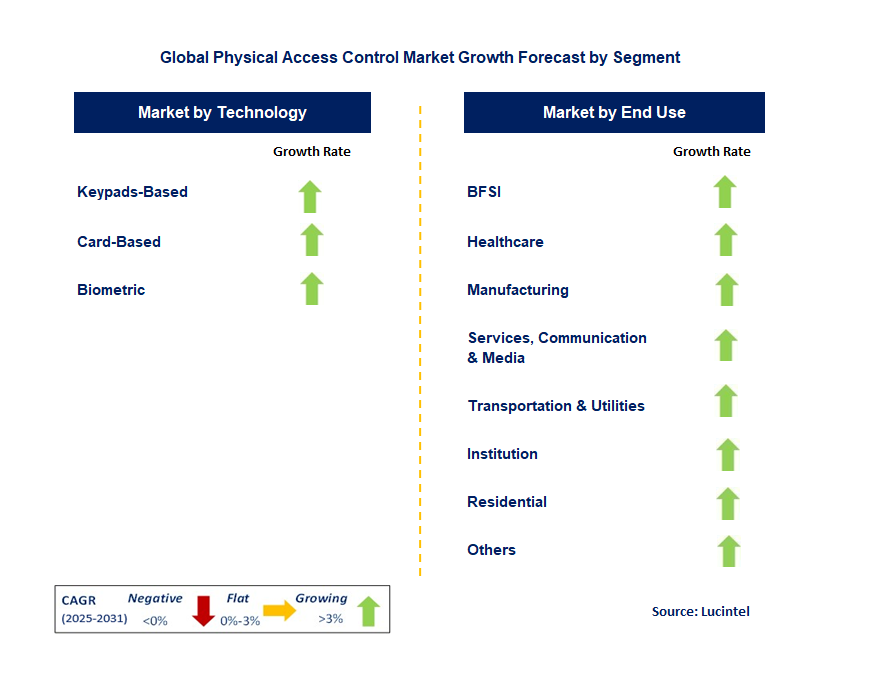
• Lucintel forecasts that, within the technology category, biometric is expected to witness the highest growth over the forecast period.
• Within the end use category, manufacturing is expected to witness the highest growth.
• In terms of region, APAC is expected to witness the highest growth over the forecast period. Gain valuable insights for your business decisions with our comprehensive 150+ page report. Sample figures with some insights are shown below.
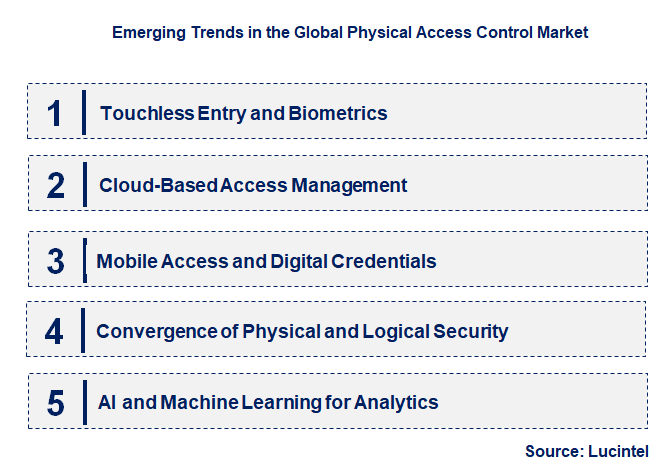
• Touchless Entry and Biometrics: There is a strong and accelerating trend towards touchless access control, primarily driven by hygiene concerns and the demand for seamless entry. Biometric technologies like facial recognition, iris scans, and touchless fingerprint readers are gaining widespread adoption, offering enhanced security and convenience without physical contact.
• Cloud-Based Access Management: The shift to cloud-based physical access control solutions is a dominant trend, offering significant advantages in scalability, remote management, and reduced infrastructure costs. Cloud platforms enable organizations to manage access rights from anywhere, integrate with other systems, and benefit from real-time updates and data analytics.
• Mobile Access and Digital Credentials: Mobile access, where smartphones serve as credentials, is rapidly becoming a ubiquitous trend. This allows users to access secured areas using Bluetooth, NFC, or QR codes on their mobile devices, offering unparalleled convenience, reducing reliance on physical cards, and simplifying credential management.
• Convergence of Physical and Logical Security: A critical emerging trend is the convergence of physical and logical (IT) security systems. This integration provides a holistic security posture, enabling unified identity management, streamlined access policies, and comprehensive audit trails across both physical spaces and digital assets, enhancing overall organizational security.
• AI and Machine Learning for Analytics: The integration of Artificial Intelligence (AI) and Machine Learning (ML) is an emerging trend, enhancing the intelligence of physical access control systems. AI/ML can analyze access patterns, detect anomalies, predict potential security threats, and automate decision-making, leading to more proactive and efficient security operations. These trends are profoundly reshaping the physical access control market by making systems more intelligent, flexible, and user-centric. They are driving a shift towards seamless, secure, and integrated solutions that leverage advanced technologies to meet evolving security challenges and operational demands.
• Rise of Biometric Authentication: A significant development is the widespread adoption and continuous improvement of biometric authentication methods. Fingerprint, facial, and iris recognition technologies are becoming more accurate, faster, and cost-effective, leading to their increased deployment in commercial, government, and even residential applications for enhanced security.
• Growth of Cloud-Based Solutions: Recent developments highlight the rapid growth of cloud-based physical access control systems. These solutions offer benefits such as remote management, scalability, real-time updates, and reduced upfront infrastructure costs, making advanced security accessible to a wider range of businesses, including SMEs.
• Increased Use of Mobile Credentials: There’s a notable development in the increasing preference for mobile credentials, where smartphones or wearables act as access cards. This trend offers convenience, reduces the need for physical badges, and allows for easier management of access rights, fitting seamlessly into modern mobile-centric lifestyles.
• Integration with IoT and Smart Buildings: A key recent development is the deeper integration of physical access control with IoT devices and smart building automation systems. This allows for unified control over security, energy management, and environmental controls, creating smarter, more efficient, and responsive building ecosystems.
• Emphasis on Cybersecurity in Physical Systems: With the increasing connectivity of physical access control systems, there’s a significant development focusing on enhancing cybersecurity measures. Robust encryption, secure network protocols, and vulnerability management are crucial to protect these systems from cyber threats and unauthorized access, ensuring data integrity. These developments are profoundly impacting the physical access control market by making systems more intelligent, efficient, and user-friendly, expanding their reach into diverse sectors, and addressing the growing need for integrated and highly secure physical environments in an increasingly connected world.
• Commercial and Enterprise Sector: The largest growth opportunity lies in providing advanced physical access control solutions for corporate offices, data centers, and industrial facilities. The increasing need to protect intellectual property, sensitive data, and physical assets, coupled with evolving hybrid work models, drives demand for scalable, integrated, and flexible systems.
• Healthcare and Life Sciences: The healthcare sector presents a robust growth avenue, driven by the need to secure patient data, restricted areas, and valuable medical equipment. Implementing advanced biometric and mobile access solutions in hospitals, clinics, and research labs ensures compliance with privacy regulations (like HIPAA) and enhances security.
• Government and Critical Infrastructure: Ensuring national security and protecting critical infrastructure (e.g., power plants, transportation hubs, defense facilities) offers a high-value, strategic growth opportunity. Providing robust, multi-factor authentication, and resilient access control systems is paramount for mitigating threats and ensuring operational continuity in these sensitive environments.
• Residential and Smart Home Integration: The burgeoning smart home market provides a significant growth opportunity. Developing user-friendly, integrated physical access control solutions like smart locks, video doorbells, and mobile-managed systems for residential properties caters to homeowner demands for convenience, enhanced security, and seamless home automation.
• Education and Campus Security: The increasing focus on student and staff safety drives a growing opportunity in educational institutions. Implementing comprehensive access control systems, including visitor management, emergency lockdown capabilities, and integrated surveillance across schools, colleges, and universities, is crucial for creating secure learning environments. These opportunities are profoundly impacting the physical access control market by driving innovation for application-specific solutions, fostering integration with broader security and automation ecosystems, and addressing critical security needs across diverse public and private sectors, thereby expanding market reach and value.
• Johnson Controls International
• Paxton Access
• Secugen Corporation
• Zvetco Biometrics
• United Technologies Corporation
• Honeywell Security
• Allegion
• Brivo Systems
• 3M Cogent Incorporation
• Acc-Time System
• Keypads-based
• Card-based
• Biometric
• Hardware
• Software
• Services
• North America
• Europe
• Asia Pacific
• The Rest of the World
• United States: The U.S. market is a leader in adopting advanced physical access control solutions, particularly biometrics and cloud-based systems. Recent developments include increased deployment of facial recognition in airports and commercial spaces, along with a strong push for mobile access credentials, driven by both convenience and security needs.
• China: China physical access control market is experiencing robust growth, heavily influenced by government surveillance initiatives and a large manufacturing base. Recent developments include widespread adoption of biometric solutions, especially facial recognition, in public security, residential complexes, and enterprises, often integrated with broader smart city infrastructures.
• Germany: Germany market emphasizes high security, data privacy, and the integration of access control into smart building management systems. Recent developments show a steady adoption of advanced credential technologies, including mobile access and secure smart cards, focusing on robust cybersecurity and compliance with stringent European data protection regulations.
• India: India physical access control market is growing rapidly due to increasing urbanization, infrastructure development, and rising security awareness. Recent developments include a surge in demand for biometric systems in commercial and government sectors, alongside the adoption of cloud-based solutions for scalability in smart city projects.
• Japan: Japan market is characterized by a strong focus on high-reliability, user-friendly, and technologically advanced access control systems. Recent developments highlight the integration of contactless solutions, including advanced biometric technologies, in corporate environments and critical infrastructure, driven by a preference for efficiency and seamless user experience.


• Johnson Controls International
• Paxton Access
• Secugen Corporation
• Zvetco Biometrics
• United Technologies Corporation
• Honeywell Security
• Allegion
• Brivo Systems
• 3M Cogent Incorporation
• Acc-Time System Q5. Which physical access control market segment will be the largest in future? Answer: Lucintel forecasts that, within the technology category, biometric is expected to witness the highest growth over the forecast period. Q6. In physical access control market, which region is expected to be the largest in next 5 years? Answer: In terms of region, APAC is expected to witness the highest growth over the forecast period. Q7. Do we receive customization in this report? Answer: Yes, Lucintel provides 10% customization without any additional cost.


Choose a license that fits your team. Instant PDF delivery.
Prices exclude taxes. Instant delivery. Custom licensing available on request.
Market Report · July 15, 2026
Market Report · June 26, 2026
Market Report · June 24, 2026
Trusted partner for strategic intelligence and business growth


Receive a complimentary market analysis tailored to your industry. Our analysts will identify key growth opportunities and competitive dynamics specific to your business.

Market size, growth rate, and key trend analysis for your specific sector.

Top competitor positioning and market share analysis.

Strategic recommendations backed by data-driven insights.
Get curated market intelligence and competitive moves straight to your inbox.
By subscribing, you agree to receive our monthly insights. Unsubscribe anytime.
Receive a complimentary market analysis tailored to your industry. Our analysts will identify key growth opportunities and competitive dynamics specific to your business.
Market size, growth rate, and key trend analysis for your specific sector.
Top competitor positioning and market share analysis.
Strategic recommendations backed by data-driven insights.
Get curated market intelligence, emerging trends, and competitive moves straight to your inbox each month.
By subscribing, you agree to receive our monthly insights. Unsubscribe anytime.
We'll send your sample report shortly.