
Market Report · July 24, 2026

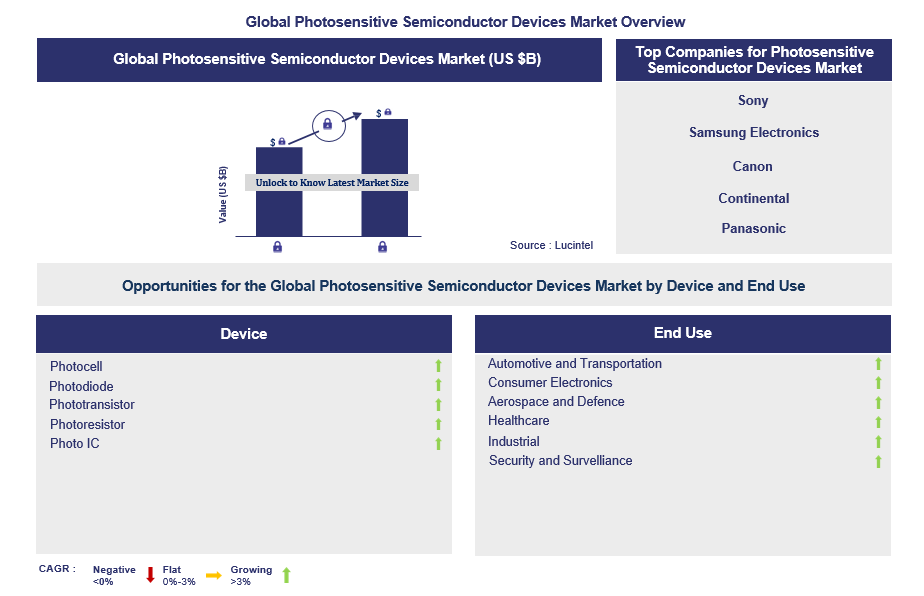
Key data points: The market size in 2031 = $6.9 billion, growth forecast = 8.7% annually for the next 7 years. Scroll below to get more insights. This market report covers trends, opportunities, and forecast in the global photosensitive semiconductor devices market to 2031 by device (photocell, photodiode, phototransistor, photoresistor, and photo IC), end use (automotive and transportation, consumer electronics, aerospace and defence, healthcare, industrial, and security and survelliance), and region (North America, Europe, Asia Pacific, and the Rest of the World)
We'll send your sample report shortly.
• Lucintel forecasts that, within the device category, photodiode will remain the largest segment over the forecast period.
• In terms of regions, APAC is expected to witness the highest growth over the forecast period due to the growth in middle-class expenditure in the area on consumer electronics items like TVs, iPads, and smartphones, as well as significant expenditures made in the area to build the military’s infrastructure. Gain valuable insights for your business decisions with our comprehensive 150+ page report.
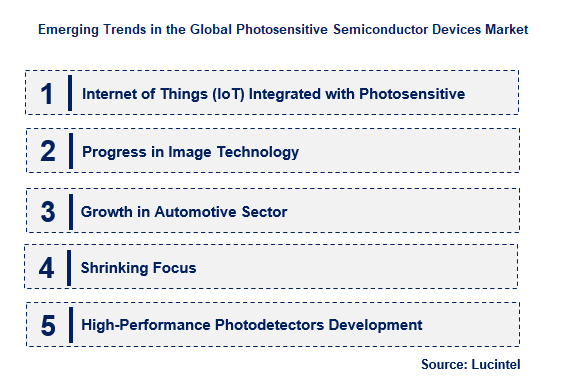
• Internet of Things (IoT) Integrated with Photosensitive Semiconductors: More and more photosensitive semiconductors are being connected to IoT devices for added functionality, like better imaging and environmental sensing. This trend is promoting smart homes and cities through more data accuracy as well as control.
• Progress in Image Technology: New improvements realized in various fields such as consumer electronics or medical diagnosis have led to high-resolution and highly sensitive imaging sensors. For this reason, these improvements make possible innovations that affect cameras, medical devices, and surveillance systems.
• Growth in Automotive Sector: The importance of photosensitive devices is increasing for automotive technologies including self-driving cars and advanced driver assistance systems (ADAS). By imposing better sensors and imaging systems, this trend strongly supports a safe driving experience.
• Shrinking Focus: People nowadays tend to miniaturize photosensitive semiconductor devices so that they can fit smaller form factors. This development will lead to increased demand for compact electronic gadgets as well as sophisticated wearable technologies.
• High-Performance Photodetectors Development: Innovations such as high-performance photodetectors are responsible for the progress seen within multiple industries including aerospace and telecommunications. It also means enhanced data transmission capacity as well as high-precision applications support. Technological advances in the photosensitive semiconductor device sector are being driven by these trends that are opening up new application areas. Integration with IoT, advancements in imaging technology, automotive applications, miniaturization focus, and high-performance photodetectors are some key drivers influencing market growth.
• Better Imaging Sensors: Other developments include the making of high-resolution imaging sensors that can see more information. The importance of these sensors is seen in their application within medical imaging, consumer electronics, and security systems.
• Integration with AI Technologies: Photosensitive semiconductor devices are being integrated with artificial intelligence (AI) to enhance image processing and data analysis. This will enable various applications to be more intelligent and adaptive.
• Advances in Photodetector Materials: In order to improve performance and reduce costs, photodetectors are being made from new materials and technologies. This improves sensor capabilities used in telecommunications as well as industrial applications.
• Improved Manufacturing Techniques: Cost reduction and improved photosensitive semiconductors quality have come from innovations like advanced lithography and deposition techniques.
• Expansion into New Applications: For instance, photosensitive semiconductors are increasingly incorporated into systems such as self-driving cars and smart city infrastructure for emerging applications. This move facilitates new market segments expansion as well as technology areas growth. These developments affect the photosensitive semiconductor device market by improving product performance rates, lowering costs, and extending application fields, among others. Market expansion is driven by innovative imaging sensors, AI integration, materials, manufacturing advancements, and recently discovered applications.
• Consumer Electronics: The increasing demand for higher-performing cameras and sensors in smartphones, tablets, and wearables creates ample room for growth. This sector thrives on the evolution of imaging technology and miniaturization.
• Automotive Industry: With autonomous vehicles and ADAS systems taking over, there is a window for photosensitive semiconductor devices. For safety purposes, high-resolution sensors that are dependable are needed in navigation systems.
• Healthcare Sector: Healthcare requires sophisticated imaging and diagnostic tools which create an opening for future business expansion. Medical imaging, diagnosing devices, and monitoring equipment may incorporate photosensitive semiconductors.
• Industrial Automation: Photosensitive devices that are used in machine vision along with quality control benefit from the expansion of industrial automation, including control systems. Manufacturing processes that require precision have their efficiency levels ramped up by having high-precision sensors, hence ensuring accuracy.
• Aerospace and Defense: Satellite imagery has been made possible through the use of highly efficient sensors with advanced communication capabilities within the aerospace market as well as defense sectors. These critical applications receive some of their most advanced functionalities from photosensitive semiconductor devices. The above strategic growth opportunities point out key areas where there is a need to grow markets in the photosensitive semiconductor device sector. Therefore, the consumer electronics industry, automotive industry, healthcare industry, industrial automation/industrial control industry, and aerospace industries have significant potential for growth-driving investments, enhancing technological development.
• Technological Innovations: Progress in imaging and photodetector technologies to improve performance and expand application areas accelerates market growth. Innovations in materials and processes boost device capabilities.
• Growing Demand for Consumer Electronics: The rise in smartphone, tablet, and wearable adoption necessitates photosensitive devices with high performance. For this sector, advanced imaging sensors and photodetectors are needed.
• Expansion of Automotive Technologies: With an increase in autonomous vehicles as well as ADAS systems, there comes a demand for reliable high-resolution sensors. Safety and navigation systems depend on photosensitive semiconductor devices.
• Healthcare Advancements: The need to develop more sophisticated medical imaging tools supports the use of photosensitive devices. Improved healthcare technology has led to increased demand for quality imaging sensors.
• Industrial Automation Growth: As industries continue expanding their automation controls, there is a rising need for photosensitive devices used in machine vision applications as well as quality control applications. Challenges in the photosensitive semiconductor devices market are:
• High Production Costs: Advanced manufacturing processes entail high costs which may affect pricing mechanisms, hence profitability. Research and development activities, production processes, and other factors contribute towards the total cost involved.
• Regulatory Compliance: Manufacturers may face difficulties meeting regulatory standards or certifications. Failing to comply with industry rules or meeting quality standards could be costly and complicated.
• Market Competition: The competition is fierce, leading to price pressures from manufacturers causing reduced profit margins. Therefore, intense competition between producers affects market dynamics and profitability levels. By determining opportunities for growth alongside industry dynamics, these drivers and challenges impact the photosensitive semiconductor device market structure. Advancing the market while overcoming such issues is important in serving rapidly changing industry trends.
• Sony
• Samsung Electronics
• Canon
• Continental
• Panasonic
• Photocell
• Photodiode
• Phototransistor
• Photoresistor
• Photo Ic
• Automotive and Transportation
• Consumer Electronics
• Aerospace and Defence
• Healthcare
• Industrial
• Security and Survelliance
• North America
• Europe
• Asia Pacific
• The Rest of the World
• United States: The U.S. has seen significant advancements in integrating photosensitive semiconductors with IoT devices and advanced imaging systems. Innovations include high-resolution image sensors and improved photodetector arrays for use in autonomous vehicles and medical imaging.
• China: In order to facilitate the development of cost-effective photosensitive semiconductor manufacturing, China’s focus is on enhancing its manufacturing capabilities. Recent developments include advanced photodetectors for consumer electronics as well as smart city applications.
• Germany: In Germany, there is a strong emphasis on developing high-precision photodetectors for industrial and automotive applications. This involves innovations like advanced imaging systems for autonomous driving and better sensors for quality control during the manufacturing process.
• India: India is witnessing growth in the application of photosensitive semiconductor devices in healthcare and consumer electronics. They have developed some affordable imaging sensors used in medical diagnostics or electronic devices that are cheaper compared to other solutions available today.
• Japan: Japan leads in aerospace as well as defense technology where they have made recent breakthroughs in their photosensitive semiconductor devices. Innovations include high-sensitivity sensors for satellite imaging and advanced photodetectors for secure communications.


• Sony
• Samsung Electronics
• Canon
• Continental
• Panasonic Q6. Which photosensitive semiconductor devices market segment will be the largest in future? Answer: Lucintel forecasts that photodiode will remain the largest segment over the forecast period. Q7. In photosensitive semiconductor devices market, which region is expected to be the largest in next 5 years? Answer: APAC is expected to witness highest growth over the forecast period due to the growth in middle-class expenditure in the area on consumer electronics items like TVs, iPads, and smartphones, as well as, significant expenditures made in the area to build the military’s infrastructure. Q.8 Do we receive customization in this report? Answer: Yes, Lucintel provides 10% customization without any additional cost.


Choose a license that fits your team. Instant PDF delivery.
Prices exclude taxes. Instant delivery. Custom licensing available on request.
Market Report · July 24, 2026
Market Report · July 20, 2026
Market Report · July 20, 2026
Trusted partner for strategic intelligence and business growth


Receive a complimentary market analysis tailored to your industry. Our analysts will identify key growth opportunities and competitive dynamics specific to your business.

Market size, growth rate, and key trend analysis for your specific sector.

Top competitor positioning and market share analysis.

Strategic recommendations backed by data-driven insights.
Get curated market intelligence and competitive moves straight to your inbox.
By subscribing, you agree to receive our monthly insights. Unsubscribe anytime.
Receive a complimentary market analysis tailored to your industry. Our analysts will identify key growth opportunities and competitive dynamics specific to your business.
Market size, growth rate, and key trend analysis for your specific sector.
Top competitor positioning and market share analysis.
Strategic recommendations backed by data-driven insights.
Get curated market intelligence, emerging trends, and competitive moves straight to your inbox each month.
By subscribing, you agree to receive our monthly insights. Unsubscribe anytime.
We'll send your sample report shortly.