
Market Report · July 29, 2026

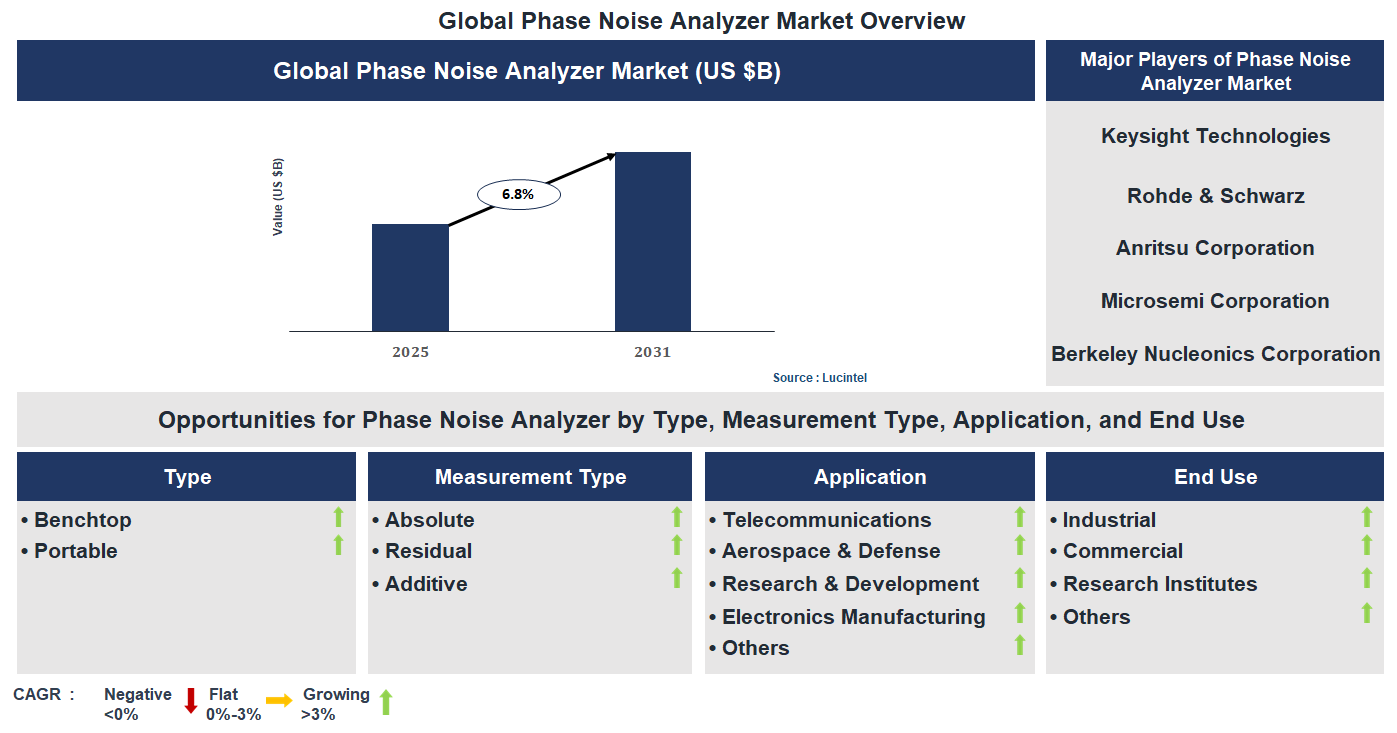
Key data points: The growth forecast = 6.8% annually for the next 7 years. Scroll below to get more insights. This market report covers trends, opportunities and forecasts in phase noise analyzer market to 2031 by type (benchtop and portable), measurement type (absolute, residual, and additive), application (telecommunications, aerospace & defense, research & development, electronics manufacturing, and others), end use (industrial, commercial, research institutes, and others), and region (North America, Europe, Asia Pacific, and the Rest of the World)
We'll send your sample report shortly.
• Lucintel forecasts that, within the type category, benchtop is expected to witness higher growth over the forecast period.
• Within the end use category, industrial is expected to witness the highest growth.
• In terms of region, APAC is expected to witness the highest growth over the forecast period. Gain valuable insights for your business decisions with our comprehensive 150+ page report. Sample figures with some insights are shown below.
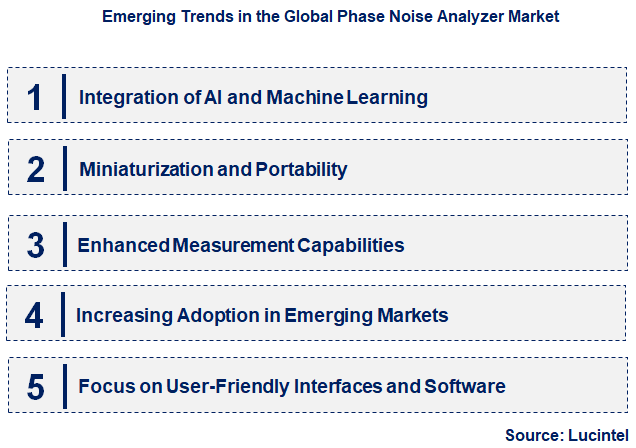
• Integration of AI and Machine Learning: The incorporation of AI and machine learning algorithms into phase noise analyzers enhances measurement accuracy and automation. These technologies enable real-time data analysis, anomaly detection, and predictive maintenance, reducing human error and increasing efficiency. As a result, users can achieve faster, more reliable results, which is critical in high-stakes applications like aerospace and telecommunications. This trend also fosters the development of smarter analyzers that adapt to different measurement scenarios, ultimately improving overall system performance and reducing operational costs.
• Miniaturization and Portability: The market is witnessing a shift towards compact, portable phase noise analyzers that offer high performance in a smaller form factor. Advances in semiconductor technology and design miniaturization allow for lightweight devices suitable for field testing and on-site diagnostics. This trend expands the usability of phase noise analyzers beyond traditional laboratory settings, enabling engineers and technicians to perform measurements in remote or challenging environments. The increased portability enhances flexibility, accelerates troubleshooting, and broadens application possibilities across industries such as aerospace, defense, and telecommunications.
• Enhanced Measurement Capabilities: Modern phase noise analyzers now feature broader frequency ranges, higher resolution, and improved sensitivity. These enhancements allow for more precise characterization of phase noise in complex signals, supporting the development of advanced communication systems and radar technologies. The ability to measure ultra-low phase noise levels is particularly vital for next-generation 5G and satellite communication systems. These advanced capabilities help manufacturers optimize system performance, ensure compliance with stringent standards, and innovate with new high-frequency applications, thereby driving market growth and technological progress.
• Increasing Adoption in Emerging Markets: Growing infrastructure development and technological adoption in emerging economies are fueling demand for phase noise analyzers. Countries investing in 5G networks, satellite communications, and defense systems are expanding their measurement capabilities. This trend opens new revenue streams for market players and encourages local innovation. As emerging markets often require cost-effective yet high-quality solutions, manufacturers are developing affordable analyzers tailored to these regions. The increased adoption accelerates market expansion and fosters a more competitive landscape, ultimately supporting global technological advancement.
• Focus on User-Friendly Interfaces and Software: There is a significant push towards developing intuitive interfaces and advanced software solutions for phase noise analyzers. User-friendly designs reduce the learning curve, enabling technicians and engineers to operate complex equipment efficiently. Enhanced software features, such as automated calibration, data logging, and remote operation, improve workflow and data management. This trend caters to a broader user base, including those with limited technical expertise, and facilitates integration with other measurement tools. As a result, the market sees increased adoption, improved productivity, and better data accuracy, supporting overall industry growth. In summary, these trends are transforming the phase noise analyzer market by making devices more intelligent, portable, precise, accessible, and user-friendly. They are expanding application possibilities, enabling faster deployment, and fostering innovation across industries. As a result, the market is becoming more competitive and dynamic, with opportunities for new entrants and established players to develop cutting-edge solutions that meet evolving technological demands.
• Technological Advancements: Enhanced measurement accuracy and resolution have been achieved through the integration of digital signal processing and high-frequency components, enabling more precise phase noise analysis. This development improves the reliability of communication systems and reduces testing time, thereby increasing market adoption among manufacturers and research institutions.
• Miniaturization of Devices: The trend toward smaller, portable phase noise analyzers has gained momentum, driven by the demand for field testing and on-site diagnostics. These compact devices offer ease of use and cost efficiency, expanding market reach into emerging regions and smaller enterprises.
• Integration with 5G and Satellite Technologies: The increasing deployment of 5G networks and satellite communication systems has necessitated advanced phase noise analyzers capable of handling higher frequencies and complex signal environments. This integration has opened new revenue streams and positioned the market as a critical enabler for next-generation communication infrastructure.
• Software and Automation Enhancements: The adoption of sophisticated software solutions and automation features has streamlined testing processes, improved data analysis, and reduced human error. These improvements have made phase noise analyzers more accessible to a broader user base, including non-specialists, thus expanding market penetration.
• Regulatory and Standardization Developments: The establishment of international standards for phase noise measurement has increased demand for compliant testing equipment. This regulatory focus ensures quality and interoperability, fostering market growth and encouraging innovation in measurement technologies. In summary, these recent developments are significantly impacting the phase noise analyzer market by enhancing device capabilities, expanding application areas, and improving user accessibility. The market is becoming more competitive and innovative, driven by technological progress and increasing industry demands for precise, reliable phase noise measurement solutions. This evolution is expected to sustain growth and open new opportunities across various high-tech sectors.
• Enhanced network performance : The demand for high-quality signal analysis in telecommunications is rising, driven by 5G deployment and satellite communications. Accurate phase noise measurement ensures signal integrity, reduces interference, and improves overall network reliability, fostering growth in this sector.
• Precision in signal analysis : The aerospace and defense industry requires highly precise phase noise analysis for radar, satellite, and communication systems. This need for accuracy enhances system performance, security, and reliability, creating significant market opportunities.
• Improving device performance : As consumer electronics become more sophisticated, phase noise analyzers help optimize device performance, especially in wireless and IoT devices. This application drives market growth by supporting innovation in smart devices and wearables.
• Advanced vehicle communication systems : The automotive industry leverages phase noise analyzers for vehicle-to-everything (V2X) communication and autonomous vehicle systems. These tools improve signal clarity and safety, fueling growth in automotive applications.
• Innovation and testing : R&D activities across industries utilize phase noise analyzers for developing new technologies and testing prototypes. This application supports technological advancements and expands the market scope. In summary, these key growth opportunities across applications are significantly impacting the phase noise analyzer market by driving demand, fostering innovation, and expanding its application scope. As industries increasingly rely on precise signal analysis, the market is poised for sustained growth and technological evolution.
• Technological Advancements: Rapid innovations in communication and radar systems demand high-precision phase noise analyzers. As wireless communication, satellite, and radar technologies evolve, the need for accurate measurement tools becomes critical to ensure signal integrity and system performance. These advancements push manufacturers to develop more sophisticated analyzers, fueling market growth. Additionally, the integration of AI and machine learning into analyzers enhances measurement accuracy and automation, further boosting demand. The continuous evolution of technology ensures a steady need for advanced phase noise analyzers, making this a key growth driver.
• Growing Adoption in Aerospace and Defense: The aerospace and defense sectors require highly reliable and precise phase noise measurements for radar, satellite communication, and navigation systems. Increasing defense budgets and the expansion of satellite constellations for global connectivity are driving demand for advanced analyzers. These industries prioritize signal stability and performance, which necessitate sophisticated measurement solutions. As global security concerns rise and space exploration intensifies, the adoption of phase noise analyzers in these sectors is expected to grow significantly, contributing substantially to market expansion.
• Expansion of 5G and Wireless Communication Networks: The deployment of 5G networks and the expansion of wireless communication infrastructure are major growth catalysts. These technologies require high-frequency, low-noise oscillators and components, which need precise phase noise analysis for optimal performance. The increasing number of 5G base stations and devices amplifies the demand for advanced analyzers capable of handling higher frequencies and complex signals. This expansion not only boosts sales of phase noise analyzers but also encourages innovation in measurement techniques, reinforcing the market’s growth trajectory.
• Rising Investment in R&D: Continuous research and development activities in telecommunications, aerospace, and electronics sectors are fostering innovation in phase noise measurement technologies. Companies and governments are investing heavily to improve measurement accuracy, reduce costs, and develop portable solutions. These R&D efforts lead to the creation of more efficient, user-friendly analyzers, expanding their application scope. The focus on miniaturization and integration with other testing tools further enhances market opportunities, making R&D a vital driver for future growth.
• Increasing Focus on Signal Integrity and Compliance: Regulatory standards for electromagnetic compatibility and signal integrity are becoming more stringent worldwide. Industries are investing in advanced phase noise analyzers to ensure compliance with these standards, which is crucial for product certification and market access. The emphasis on high-quality, interference-free signals in communication and aerospace applications drives demand for precise measurement tools. This focus on regulatory compliance and signal integrity not only sustains market growth but also encourages technological innovation to meet evolving standards. The challenges facing this phase noise analyzer market include:
• Technological Complexity and High Costs: Developing and maintaining advanced phase noise analyzers involves significant technological complexity, requiring specialized expertise and substantial investment. High manufacturing costs translate into expensive products, limiting accessibility for smaller organizations and emerging markets. This cost barrier can slow market penetration and restrict adoption, especially in regions with budget constraints. Additionally, the rapid pace of technological change necessitates continuous upgrades, further increasing expenses and complicating procurement decisions for end-users.
• Rapid Technological Obsolescence: The fast-paced evolution of communication and measurement technologies leads to frequent product obsolescence. Companies must continually innovate to stay competitive, which can be resource-intensive. Customers may hesitate to invest in expensive analyzers that could become outdated quickly, impacting sales and revenue. This rapid obsolescence also pressures manufacturers to offer frequent updates and support, increasing operational costs and complicating product lifecycle management.
• Stringent Regulatory and Standardization Challenges: Evolving regulatory standards and compliance requirements across different regions pose significant hurdles. Navigating diverse standards for electromagnetic compatibility, signal integrity, and safety can be complex and costly. Non-compliance risks product rejection, legal penalties, and reputational damage. Additionally, the need to adapt analyzers to meet new standards quickly can delay product launches and increase R&D expenses, impacting overall market growth and profitability. In summary, the phase noise analyzer market is driven by technological innovation, expanding applications in aerospace and telecommunications, and increasing R&D investments. However, challenges such as high costs, rapid obsolescence, and regulatory complexities pose significant hurdles. These factors collectively influence market dynamics, requiring stakeholders to balance innovation with cost management and regulatory compliance. Overall, the market’s growth potential remains strong, provided companies can navigate these challenges effectively and leverage emerging technological opportunities.
• Keysight Technologies
• Rohde & Schwarz
• Anritsu Corporation
• Microsemi Corporation
• Berkeley Nucleonics Corporation
• Holzworth Instrumentation
• AnaPico AG
• Stanford Research Systems
• Cobham Plc
• National Instruments Corporation
• Benchtop
• Portable
• Absolute
• Residual
• Additive
• Telecommunications
• Aerospace & Defense
• Research & Development
• Electronics Manufacturing
• Others
• Industrial
• Commercial
• Research Institutes
• Others
• North America
• Europe
• Asia Pacific
• The Rest of the World
• United States: The US market has seen substantial growth driven by advancements in 5G infrastructure, satellite communications, and defense applications. Leading companies are developing portable, high-precision analyzers with integrated AI capabilities for real-time analysis. Increased government funding for aerospace and defense projects has accelerated innovation, while collaborations between tech giants and research institutions foster new product development. The US also emphasizes compliance with stringent regulatory standards, ensuring high-quality measurement tools for commercial and military use.
• China: China is rapidly expanding its phase noise analyzer capabilities, focusing on domestic innovation to reduce reliance on imported technology. The government’s strategic initiatives in 5G, satellite navigation, and aerospace have spurred investments in research and manufacturing. Chinese firms are developing cost-effective, compact analyzers tailored for local telecom and defense markets. The country’s emphasis on technological self-sufficiency and increasing export of advanced measurement equipment are key drivers of recent developments.
• Germany: Germany’s market is characterized by a strong focus on precision engineering and integration with existing test and measurement systems. Leading companies are enhancing analyzer accuracy and stability, especially for automotive radar and industrial applications. Germany’s emphasis on quality standards and innovation in optical and RF components has led to the development of highly reliable phase noise analyzers. Collaborations with European research institutions further support advancements in measurement techniques and device miniaturization.
• India: India is witnessing rapid growth in the phase noise analyzer market, driven by expanding telecom infrastructure, defense modernization, and aerospace projects. Local manufacturers are increasingly adopting advanced technologies to produce affordable, portable analyzers suitable for diverse applications. Government initiatives like Make in India and increased R&D funding are fostering innovation. The focus remains on developing cost-effective solutions to meet the rising demand for high-performance measurement tools in domestic markets.
• Japan: Japan continues to lead in high-precision measurement technology, with a focus on applications in satellite communications, space exploration, and advanced manufacturing. Japanese firms are investing in miniaturization and integration of phase noise analyzers with other test systems. The country’s emphasis on quality and reliability has resulted in highly sophisticated analyzers capable of supporting cutting-edge research and industrial applications. Collaborations with global tech companies and government agencies further drive innovation and market expansion.


• Keysight Technologies
• Rohde & Schwarz
• Anritsu Corporation
• Microsemi Corporation
• Berkeley Nucleonics Corporation
• Holzworth Instrumentation
• AnaPico AG
• Stanford Research Systems
• Cobham Plc
• National Instruments Corporation Q5. Which phase noise analyzer market segment will be the largest in future? Answer: Lucintel forecasts that, within the type category, benchtop is expected to witness higher growth over the forecast period. Q6. In phase noise analyzer market, which region is expected to be the largest in next 5 years? Answer: In terms of region, APAC is expected to witness the highest growth over the forecast period. Q7. Do we receive customization in this report? Answer: Yes, Lucintel provides 10% customization without any additional cost.


Choose a license that fits your team. Instant PDF delivery.
Prices exclude taxes. Instant delivery. Custom licensing available on request.
Market Report · July 29, 2026
Market Report · July 20, 2026
Market Report · July 20, 2026
Trusted partner for strategic intelligence and business growth


Receive a complimentary market analysis tailored to your industry. Our analysts will identify key growth opportunities and competitive dynamics specific to your business.

Market size, growth rate, and key trend analysis for your specific sector.

Top competitor positioning and market share analysis.

Strategic recommendations backed by data-driven insights.
Get curated market intelligence and competitive moves straight to your inbox.
By subscribing, you agree to receive our monthly insights. Unsubscribe anytime.
Receive a complimentary market analysis tailored to your industry. Our analysts will identify key growth opportunities and competitive dynamics specific to your business.
Market size, growth rate, and key trend analysis for your specific sector.
Top competitor positioning and market share analysis.
Strategic recommendations backed by data-driven insights.
Get curated market intelligence, emerging trends, and competitive moves straight to your inbox each month.
By subscribing, you agree to receive our monthly insights. Unsubscribe anytime.
We'll send your sample report shortly.