
Market Report · July 15, 2026

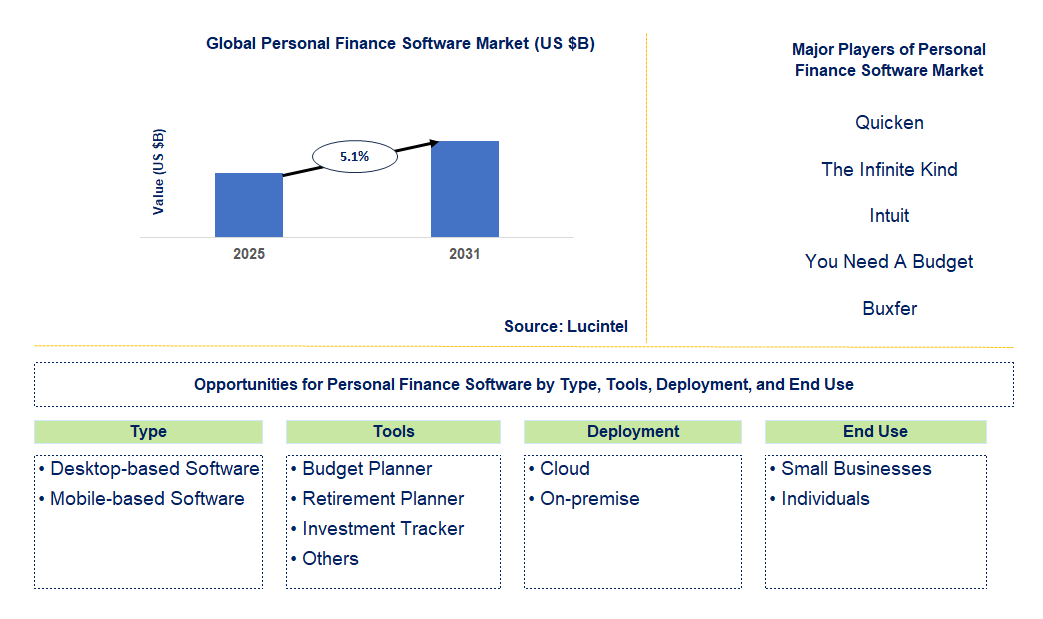
Key data points: The growth forecast = 5.1% annually for the next 7 years. Scroll below to get more insights. This market report covers trends, opportunities and forecasts in personal finance software market to 2031 by type (desktop-based software and mobile-based software), tools (budget planner, retirement planner, investment tracker, and others), deployment (cloud and on-premise), end use (small businesses and individuals), and region (North America, Europe, Asia Pacific, and the Rest of the World)
We'll send your sample report shortly.
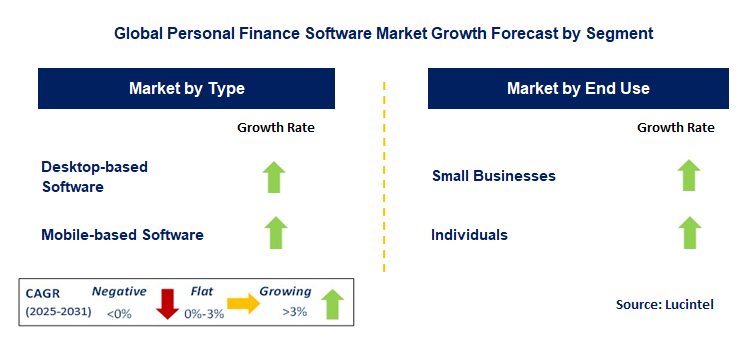
• Lucintel forecasts that, within the type category, mobile-based software is expected to witness higher growth over the forecast period.
• Within the end use category, individual is expected to witness higher growth.
• In terms of region, APAC is expected to witness the highest growth over the forecast period. Gain valuable insights for your business decisions with our comprehensive 150+ page report. Sample figures with some insights are shown below.
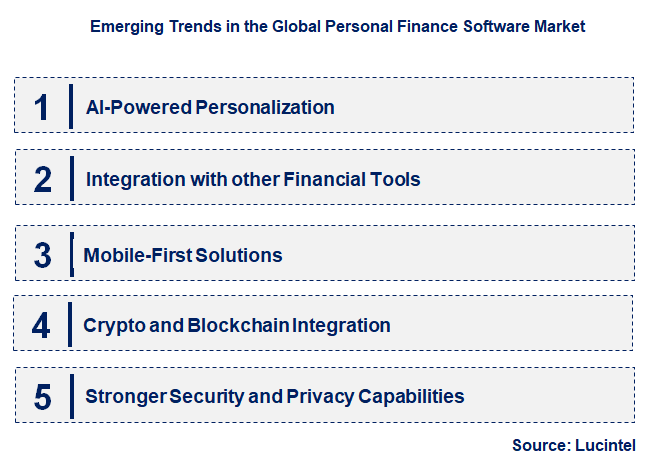
• AI-Powered Personalization: AI-powered personalization in personal finance software is on the rise, providing consumers with personalized financial guidance and budgeting tips. Through analysis of spending behavior, income cycles, and financial objectives, AI components assist users in maximizing their finances in real-time. This development is rendering personal finance software more user-friendly, providing users with actionable information to enhance their finances.
• Integration with other Financial Tools: Personal finance software is being increasingly integrated with other financial tools, including investment sites, tax preparation systems, and electronic wallets. Integration provides users with a single-stop solution to organize all financial functions of their life. With the synchronization of many accounts, assets, and liabilities, users can better monitor their net worth, keep track of investments, and plan for future financial objectives.
• Mobile-First Solutions: With the growth in mobile usage, personal finance software is moving towards mobile-first solutions, giving users the convenience of managing their finances on the move. Mobile applications are becoming more feature-rich, with budgeting capabilities, bill reminders, and investment tracking that make life easier. Mobile-first platforms are attractive to younger, technologically savvy consumers who like to manage their finances on their smartphones.
• Crypto and Blockchain Integration: As cryptocurrency becomes more mainstream, personal finance software is now starting to add cryptocurrency wallets and blockchain technology. This development enables users to monitor their crypto holdings along with traditional investments, giving them a complete picture of their portfolio. With the increased use of digital currencies, this aspect is becoming a necessity for individuals who need to handle both fiat and crypto holdings through one platform.
• Stronger Security and Privacy Capabilities: With growing cybersecurity risks, providers of personal finance software are placing emphasis on improving their security and privacy capabilities. Multi-factor authentication, end-to-end encryption, and biometric protection are being added to safeguard financial information. Security-minded users are becoming more demanding and want to find software products that give importance to data protection and adhere to data protection standards, like GDPR. These new trends are transforming the personal finance software industry by making it more inclusive, secure, and accessible. The use of AI, mobile-first products, and cryptocurrency capabilities is enabling users to manage their finances in more innovative manners, while increased security features are establishing confidence in these tools.
• Growth of Subscription-Based Models: Subscription-based models are gaining popularity among personal finance software providers. With these models, users gain access to enhanced features like advanced budgeting, monitoring of credit scores, and investing tracking. Providers can use the subscription model to provide frequent updates and enhance customer service, ensuring it is a viable revenue stream for software vendors.
• Cross-Platform Capability: Development of cross-platform capabilities in personal financial software has helped users to see their financial information on more than one device. Whether a user does this from a smartphone program, an Internet portal, or a PC software program, today‘s user is able to access their finances as easily from wherever they may be. This makes it convenient for anyone to stay on top of their money issues regardless of the location.
• Cloud Integration: Cloud personal finance software is becoming increasingly popular because it is convenient and easily accessible. By saving financial information in the cloud, users are able to view their data from any location, and physical storage is not necessary. Cloud integration enables automatic synchronization between devices and real-time updates, which streamlines financial management.
• User Experience Improvements: Firms are investing in improving the user experience (UX) by making interfaces more intuitive. Personal finance apps are becoming more intuitive with simple navigation, nice-looking dashboards, and streamlined workflows. The emphasis on UX is drawing a larger audience, particularly individuals who aren‘t necessarily tech inclined but still wish to better control their finances.
• Enhanced Compliance with Regulations: With data privacy of financial information emerging as a core concern, personal finance software companies are making efforts to adhere to strict regulations like GDPR and CCPA. This has given rise to enhanced security features and an elevated level of data protection. Organizations are also implementing open data usage policies to establish trust with their customers. These innovations are revolutionizing the personal finance software industry by improving accessibility, security, and user experience. The transition towards subscription models, cloud-based applications, and compliance with regulations is putting the industry on the path to long-term growth.
• Gen Z and Millennial Adoption: Gen Z and millennials are increasingly a core target segment for personal finance software. Gen Z and millennials are more familiar with technology and need tools that allow them to handle their finances by themselves. Personal finance apps with simple interfaces, automation, and real-time monitoring are the most attractive among these generations. With these populations putting more importance on being independent in finance, the personal finance software market is projected to grow.
• Small Business Financial Management: Personal finance software companies can target the small business market, providing products that assist entrepreneurs with their business expenditure, taxes, and cash flow. These products can automate financial processes and offer insightful information regarding the financial status of small businesses. This is a highly desirable market because increasing numbers of people are opening their own businesses and need simple to use financial management products.
• Retirement Planning Tools: With the aging world population, the demand for retirement planning solutions continues to rise. Personal finance tools that assist people in planning retirement by estimating savings in the future, handling pension money, and suggesting investments is witnessing increasing traction. With the emphasis on long-term financial planning, this app category offers massive growth opportunities.
• Financial Literacy and Education: As financial literacy gains prominence, personal finance software with educational materials, advice, and budgeting tools is increasingly sought after. By addressing consumers interested in enhancing their knowledge of finances, software firms can bridge the financial literacy gap while increasing their customer base.
• Financial Advisors and Robo-Advisors: Personal finance software companies can capitalize on the increasing adoption of robot-advisors in personal finance software. Robo-advisors offer automated investment recommendations using algorithms, which is attractive to individuals looking for low-cost and effective financial advice. Personal finance software companies can tap into this opportunity by integrating robot-advisory services into their software. The market for personal finance software is full of opportunities for expansion, particularly in the realms of financial education, small business management, and retirement planning. As consumers‘ needs change, businesses are discovering new ways to increase their offerings and reach a wider audience.
• Quicken
• The Infinite Kind
• Intuit
• You Need A Budget
• Buxfer
• Doxo Inc.
• Money Dashboards
• Moneyspire
• Personal Capital
• Pocket Smith
• Desktop-based Software
• Mobile-based Software
• Budget Planner
• Retirement Planner
• Investment Tracker
• Others
• North America
• Europe
• Asia Pacific
• The Rest of the World
• United States: The United States market for personal finance software has witnessed tremendous growth, particularly with an increasing number of consumers seeking software that provides a smooth experience across budgeting, investment tracking, and debt management. Leading players such as Mint and YNAB (You Need A Budget) are continually enhancing their services by adding features like AI-powered budgeting capabilities and built-in tax filing. The mass popularity of mobile phones and the need for financial awareness have also spurred the development of personal finance software. The proliferation of subscription-based models and paid features continues to propel the industry forward.
• China: Personal finance software is rapidly growing in China as more and more young shoppers turn to technology to manage finances. Chinese giants Alibaba and Tencent are integrating finance management tools within their platforms to enable users to monitor spending, investments, and savings in a single location. With the growing pressure for personal finance and the government‘s attention to encouraging digital finance, there is an emerging need for personal finance software. Incorporating fintech solutions into day-to-day mobile applications is making financial planning accessible to a broader population.
• Germany: Germany boasts a strong market for personal finance software due to a culture of planning and long-term saving. Well-known programs like Finable and Outback provide customers with easy-to-use functions to manage budgets, investments, and retirement savings. Germans are increasingly using software that links to their bank accounts and payment systems, allowing real-time tracking of transactions. With a rigorous focus on data protection and privacy, German customers are more inclined towards software that complies with strict regulations. The market continues to expand as individuals increasingly look for tools for optimizing their financial well-being in an increasingly regulated marketplace.
• India: In India, the personal finance software marketplace is changing as consumers become more computer literate and financial acumen increases. Increased demand for products that monitor expenditures, keep tabs on investments, and calculate taxes has come as a result of a rising middle class and rising income levels. These applications, such as Money Control and Walnut, are picking up popularity by providing features for budgeting, investment monitoring, and cost management. Increasing demand for cashless payments and financial inclusion is promoting more Indians to use personal finance software, particularly among the young working class and urban Indians who are more and more interested in managing their finances effectively.
• Japan: Japan‘s market for personal finance software is experiencing stable growth, driven by a technology-aware citizenry and aging population that desires tools for retirement planning and wealth management. Personal finance apps such as Zaim and Moneytree are favored for their simplicity, combining spending monitoring, savings targets, and investment management. The Japanese market is distinguished by its high focus on long-term financial planning, saving for retirement being one of the most important goals. The rising accessibility of English-language software packages is also drawing in expatriates and international citizens residing in Japan, widening the market even further.


• Quicken
• The Infinite Kind
• Intuit
• You Need A Budget
• Buxfer
• Doxo Inc.
• Money Dashboards
• Moneyspire
• Personal Capital
• Pocket Smith Q5. Which personal finance software market segment will be the largest in future? Answer: Lucintel forecasts that, within the type category, mobile-based software is expected to witness higher growth over the forecast period. Q6. In personal finance software market, which region is expected to be the largest in next 5 years? Answer: In terms of region, APAC is expected to witness the highest growth over the forecast period. Q7. Do we receive customization in this report? Answer: Yes, Lucintel provides 10% customization without any additional cost.


Choose a license that fits your team. Instant PDF delivery.
Prices exclude taxes. Instant delivery. Custom licensing available on request.
Market Report · July 15, 2026
Market Report · June 26, 2026
Market Report · June 24, 2026
Trusted partner for strategic intelligence and business growth


Receive a complimentary market analysis tailored to your industry. Our analysts will identify key growth opportunities and competitive dynamics specific to your business.

Market size, growth rate, and key trend analysis for your specific sector.

Top competitor positioning and market share analysis.

Strategic recommendations backed by data-driven insights.
Get curated market intelligence and competitive moves straight to your inbox.
By subscribing, you agree to receive our monthly insights. Unsubscribe anytime.
Receive a complimentary market analysis tailored to your industry. Our analysts will identify key growth opportunities and competitive dynamics specific to your business.
Market size, growth rate, and key trend analysis for your specific sector.
Top competitor positioning and market share analysis.
Strategic recommendations backed by data-driven insights.
Get curated market intelligence, emerging trends, and competitive moves straight to your inbox each month.
By subscribing, you agree to receive our monthly insights. Unsubscribe anytime.
We'll send your sample report shortly.