
Market Report · July 24, 2026

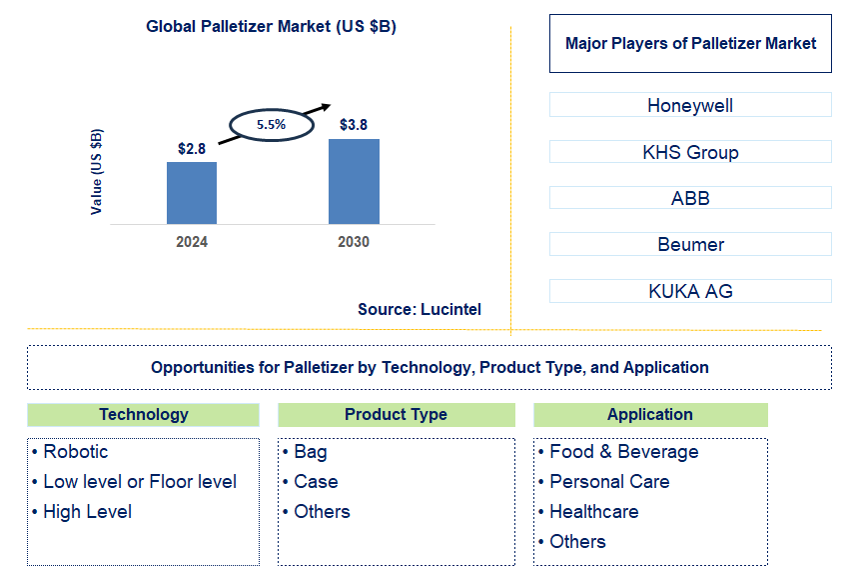
Key data points: The market size in 2030 = $3.81 billion, growth forecast = 5.5% annually for the next 6 years. Scroll below to get more insights. This market report covers trends, opportunities, and forecasts in the global palletizer market to 2030 by technology (robotic, low level or floor level, and high level), product type (bag, case, and others), application (food & beverage, personal care, healthcare, and others), and region (North America, Europe, Asia Pacific, and the Rest of the World)
We'll send your sample report shortly.
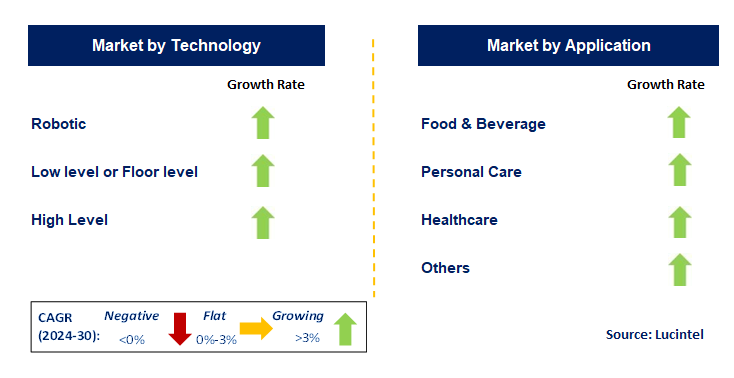
• Lucintel forecasts that, within the technology category, robotics is expected to witness the highest growth over the forecast period owing to its capability to modify product dimensions as well as complex layer patterns.
• Within the application category, food & beverage will remain the largest segment because it helps in reducing product damage and improving manufacturing efficiency.
• In terms of regions, APAC is expected to witness the highest growth over the forecast period due to the rapidly growing e-commerce sector and the presence of a large number of manufacturing units in countries like China and India.
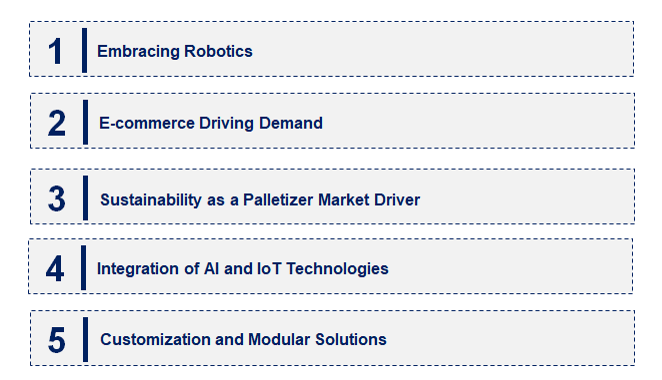
• Embracing Robotics: One major trend today is adopting robotic equipment over traditional systems because of their versatility and effectiveness. Robotic palletizers can be used with different types of products and packaging systems; an important factor within industries covering various product lines. By being flexible this reduces downtime hence improving throughput which makes them preferable for manufacturers inclined to optimize their undertakings shall be found in subsequent discussions on competition among players within the palletizing business.
• E-commerce Driving Demand: The growth of the e-commerce industry has had significant effects on the development of the palletizer market. The rise in online shopping has led to investments by businesses on automated solutions for loading more orders with increased speed thus making them want packing machines which use robots. This therefore implies that automated palletizers enable faster delivery processes; thus reducing labor costs along the supply chain network. In this context, it becomes evident that dynamic retail environments require scalable efficient systems.
• Sustainability as a Palletizer Market Driver: Most manufacturers are becoming interested in eco-friendly solutions when it comes to choosing alternative energy sources or materials used during the packaging process like plastic bags that can be reused and should not be disposed recklessly into water bodies causing pollution while others go for machinery that consumes less power when running production activities as it will be seen later. For companies to be compliant with environmental regulations and satisfy consumer needs, they are progressively adopting sustainable ways of doing business. Environmental friendliness can minimize costs while improving the image of a company in a competitive market like this.
• Integration of AI and IoT Technologies: The utilization of Artificial intelligence (AI) and Internet of Things (IoT) technologies is helping to increase efficiency levels within palletizing systems. It enables businesses to have real-time monitoring as well as carry out predictive maintenance, reducing downtime and optimizing performance. The integration with other automated systems for decision-making purposes improves through the use of AI-driven analytics whereas IoT connection aids ensure smooth operation together with other processes that are computerized. This change has been observed in most industries including the shipping sector which has witnessed an increased level of automation across all its activities.
• Customization and Modular Solutions: There is a growing demand for tailored and modular palletizer solutions that align with specific operational requirements. Manufacturers are now offering more adaptable systems that can easily be changed or expanded during the growth phases of any business enterprise. To achieve this, organizations should focus on getting one that meets their unique production processes thus enhancing effectiveness overall; this also makes customization a crucial element considered by enterprises aiming at sustaining competitiveness within the market.
• Advancement in Robots: The inclusion of robots into palletizing systems has resulted in more agility, accuracy, and speed. Robot-based palletizers can handle different kinds of products and sizes thus reducing human intervention needs as well as minimizing mistakes.
• Adoption of IoT in Palletization: The Internet of Things (IoT) is transforming how palletizers perform through real-time data capturing and analysis. IoT-enabled palletizers monitor performance metrics, identify exceptions, as well as optimize production processes.
• Modular Customized Designs: For several applications and industries, Palletizers are becoming modular and customizable. Such manufacturers can design their systems according to their specifications resulting in better production efficiency and investment returns.
• Energy saving emphasis: With so much focus on sustainability, energy-efficient designs for palletizers have been developed by producers. To reduce power consumption and limit environmental impact, companies are incorporating technologies such as regenerative braking or variable speed drives.
• Demand for collaborative robots (Cobots): Because they work safely alongside humans cobots are increasingly being used in applications requiring high levels of throughput such as those found within a warehouse handling system or packaging line where there may be many different product variants running simultaneously. Cobots save time through performing repetitive tasks hence enabling human workers to handle complex ones therefore increasing overall productivity.
• Food & Beverage Industry: Automated palletizers are finding increased use in the food and beverage industry where they enhance efficiency in operations and meet high volume demands. Automation is being adopted within this sector due to its need for consistency, hygiene, and faster processes. This opportunity significantly impacts the palletizer market by boosting demand for flexible and high-speed solutions that can handle a variety of packaging formats and sizes thereby enhancing throughput as well as lowering labor costs.
• Pharmaceutical Sector: Increased importance placed on contamination-free packaging solutions that are precise has led to advanced palletizers being used more often in pharmaceuticals. These systems enable careful handling of products which are highly sensitive thus conforming to strict regulations standards. This growth opportunity is critical for the palletizer market as it drives the need for highly specialized equipment capable of managing diverse product lines with precision, thus enhancing reliability and compliance in pharmaceutical operations.
• E-commerce & Retail: Efficient, scalable palletizing solutions that cater to multiple types of packaging along with their varying sizes are required for e-commerce and retail sectors expanding fast. Automated palletizers have the freedom and speed needed to match these sectors’ ever-rising tempos. This opportunity increases demand for customizable high-throughput systems capable of adapting to dynamic requirements posed by e-commerce fulfillment centers or retail distribution on the other hand.
• Chemical & Petrochemical Industries: In chemical industries, tough materials that are dangerous require reliable palletizing systems. These industries prefer automated palletizers because safety matters most beside accurateness. In this case, development of rugged durable systems that can operate under harsh conditions is propelled in order to enhance industrial safety and productivity thereby presenting a big market opportunity for growth.
• Automotive Industry: Palletizers are used in the automotive industry for efficient handling of bulky and heavy components. Most importantly, the ever-increasing complexity of automobile manufacturing processes necessitates the use of reliable and accurate palletizing solutions. This opportunity drives innovation in systems capable of handling different parts with varying weights and sizes, therefore it helps to improve workflow efficiency by mitigating mistakes made by humans.
• Honeywell
• KHS Group
• ABB
• Beumer
• KUKA AG
• ABC Packaging Machine
• Krones AG
• Kawasaki Heavy Industries
• BW Packaging
• Fuji Yuoski Kogyo
• Robotic
• Low level or Floor level
• High Level
• Bag
• Case
• Others
• Food & Beverage
• Personal Care
• Healthcare
• Others
• North America
• Europe
• Asia Pacific
• The Rest of the World
• United States: In the US market of palletizers there has been a high influence due to adoption of robotics as well as artificial intelligence at a faster pace. With an aim to increase productivity while minimizing their labor costs, firms have lately focused on investing more in automated palletizing systems. Moreover, e-commerce boom has resulted into growth in demand for flexible palletizer that can handle diverse package sizes.
• China: The country’s manufacturing sector expansion and increasing export activities contribute positively to a fast-growing market for palletizers in China. Furthermore, advanced palletizing technology has significantly gained popularity due to the government’s “Made in China 2025” initiative focusing on industrial automation. Some domestic suppliers are providing affordable alternatives targeting small and medium-sized enterprises.
• Germany: Highly developed Industry 4.0 initiatives make it beneficial for German companies operating within the country’s palette market space today. They act as pacemakers when it comes to intelligent technological integration such as IoT or machine learning into their product lines. This has brought about exceptionally effective and adaptable arraying devices that many sectors including automotive or logistics require.
• India: As manufacturers and logistics firms automate their operations steadily; it is becoming important to implement automation through the use of robotics across different applications including those that involve manual material handling tasks like packing boxes on a shipping dock before they can be transported elsewhere within an enterprise or distributed externally via supply chains thereby seeing much potential, especially with emerging trends from internet-based retailers who want more efficient methods applied toward moving goods from warehouses into delivery trucks straight to consumers doors. Several Indian manufacturers are moving towards semi-automated and fully automated palletizers as a means to enhance operational efficiencies and reduce the labor required during the process.
• Japan: The Japanese market for palletizers is characterized by highly developed robotics as well as precision engineering. In response to the aging population in Japan and the need for automation in production, many companies have adopted robotic palletizers on a large scale. Compact, high-speed systems that can fit into small working areas are what Japanese producers have been developing so far to meet unique demands from the local scene.


• Honeywell
• KHS Group
• ABB
• Beumer
• KUKA AG
• ABC Packaging Machine
• Krones AG
• Kawasaki Heavy Industries
• BW Packaging
• Fuji Yuoski Kogyo
Q6. Which palletizer market segment will be the largest in future?

Choose a license that fits your team. Instant PDF delivery.
Prices exclude taxes. Instant delivery. Custom licensing available on request.
Market Report · July 24, 2026
Market Report · July 20, 2026
Market Report · July 20, 2026
Trusted partner for strategic intelligence and business growth


Receive a complimentary market analysis tailored to your industry. Our analysts will identify key growth opportunities and competitive dynamics specific to your business.

Market size, growth rate, and key trend analysis for your specific sector.

Top competitor positioning and market share analysis.

Strategic recommendations backed by data-driven insights.
Get curated market intelligence and competitive moves straight to your inbox.
By subscribing, you agree to receive our monthly insights. Unsubscribe anytime.
Receive a complimentary market analysis tailored to your industry. Our analysts will identify key growth opportunities and competitive dynamics specific to your business.
Market size, growth rate, and key trend analysis for your specific sector.
Top competitor positioning and market share analysis.
Strategic recommendations backed by data-driven insights.
Get curated market intelligence, emerging trends, and competitive moves straight to your inbox each month.
By subscribing, you agree to receive our monthly insights. Unsubscribe anytime.
We'll send your sample report shortly.