
Market Report · July 13, 2026

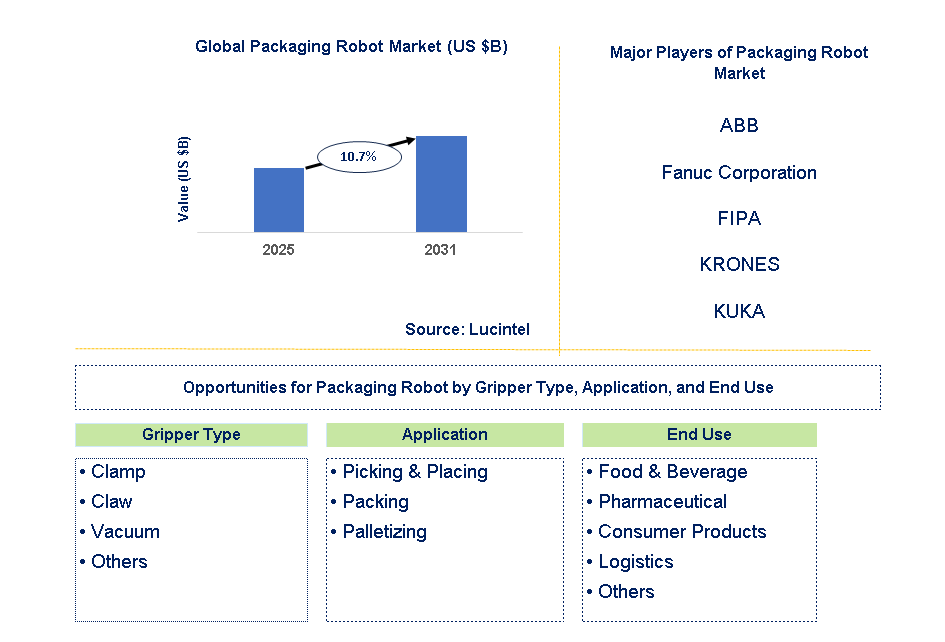
Key data points: The growth forecast = 10.7% annually for the next 7 years. Scroll below to get more insights. This market report covers trends, opportunities and forecasts in packaging robot market to 2031 by gripper type (clamp, claw, vacuum, and others), application (picking & placing, packing, and palletizing), end use (food & beverage, pharmaceutical, consumer products, logistics, and others), and region (North America, Europe, Asia Pacific, and the Rest of the World)
We'll send your sample report shortly.
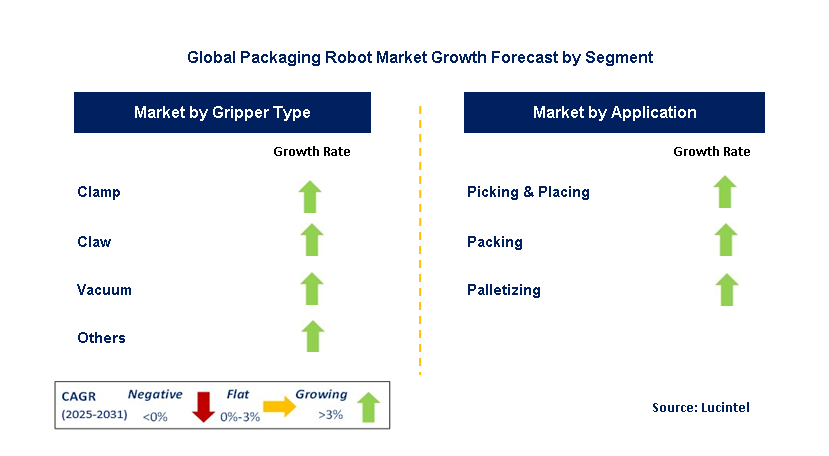
• Lucintel forecasts that, within the gripper type category, vacuum is expected to witness the highest growth over the forecast period.
• Within the application category, palletizing is expected to witness the highest growth.
• In terms of region, North America is expected to witness the highest growth over the forecast period. Gain valuable insights for your business decisions with our comprehensive 150+ page report. Sample figures with some insights are shown below.
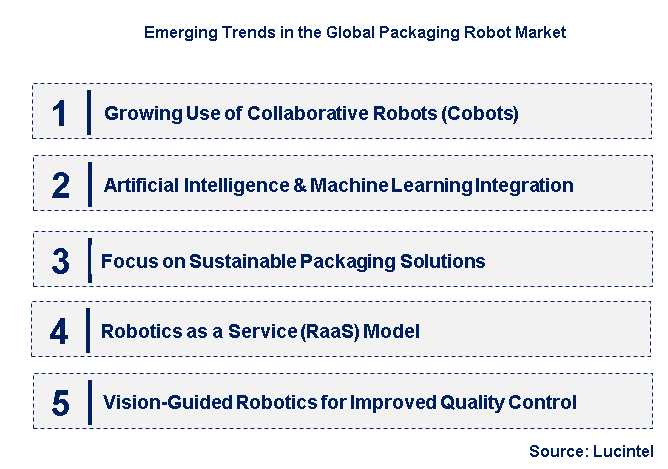
• Growing Use of Collaborative Robots (Cobots): Cobots are intended to coexist with human workers in a safe environment without requiring conventional safety guarding. Their growing use in packaging is spurred by their versatility, ease of programming, and reduced costs relative to conventional industrial robots. Cobots can perform a variety of tasks, ranging from pick and place to palletizing, to enhance productivity and safety in shared workspaces. Their collaborative nature enables a more integrated and effective human-robot workflow, especially in operations needing precision and human dexterity.
• Artificial Intelligence & Machine Learning Integration: AI and ML are being more and more integrated into packaging robots to increase their functionality and flexibility. AI algorithms can optimize robot performance for quicker and more accurate packaging processes, minimize cycle times, and enhance throughput. ML allows robots to learn from experience, making it possible to monitor packaging quality in real time, detect defects, and adjust to evolving packaging needs. This results in increased agility, increased productivity, and enhanced product quality in packaging processes.
• Focus on Sustainable Packaging Solutions: Increasing environmental issues and consumer pressure for sustainable practices are pushing the use of robots in sustainable packaging. Robots can be used to deal with new, usually more fragile, sustainable materials with care, reducing waste and damage. Robots can also streamline packaging processes to save on material and enable recyclable or biodegradable packaging handling. This follows the overall trend towards a circular economy and green manufacturing.
• Robotics as a Service (RaaS) Model: The RaaS model is becoming increasingly popular in the packaging robot market, allowing businesses the flexibility and affordability of embracing automation without heavy initial capital expenditure. RaaS entails renting or leasing robots and associated services, which sometimes comprise maintenance, software updates, and customer support. This model reduces the entry barrier for small and medium-sized businesses (SMEs) and enables businesses to scale their automation capabilities according to demand, giving them more flexibility and minimizing monetary risks.
• Vision-Guided Robotics for Improved Quality Control: Vision systems are growing more advanced and combined with packaging robots for improved quality control. These systems allow robots to "see" and examine products and packaging in real-time, detect defects, verify correct labeling, and check package integrity. This automated quality control minimizes the risk of mistakes, enhances product safety, and guarantees compliance with high-quality standards, resulting in increased customer satisfaction and less waste due to defective packaging. These new trends are all together redefining the packaging robot market by opening up automation as more accessible, flexible, efficient, and sustainable. The fusion of cobots and AI is allowing new heights of human-robot collaboration and smart automation. The emphasis on sustainability is inducing innovation in waste reduction and material handling. The RaaS business model is bringing robotic technology to everyone, and vision-guided systems are allowing greater levels of quality and accuracy. As these trends keep developing, they will further propel the use of packaging robots in broader industries and applications.
• Gripping Technology Advances: New robotic gripper technologies are greatly increasing the variety of products and materials packaging robots can package. Advances include more advanced vacuum grippers for fragile or flexible products, shape- and size-adjustable finger grippers, and soft robotics grippers for breakable goods. These developments allow robots to manage more types of packaging forms and products with higher accuracy and less damage, making them more versatile in various applications.
• Design of More Flexible and Modular Robotic Systems: There is increasing emphasis on designing packaging robot systems that are more flexible and modular. These systems can be readily reconfigured and adapted to perform various packaging tasks and formats, enabling manufacturers to quickly respond to shifting production requirements and product variations. Modular designs also make maintenance and upgrades easier, minimizing downtime and maximizing the overall efficiency of packaging lines.
• Integration of Advanced Sensor Technology: Integration of more advanced sensor technologies, such as 3D vision sensors and force sensors, is improving the capabilities of packaging robots. 3D vision enables robots to see and handle objects in three dimensions with better accuracy, enhancing pick and place performance and opening the door to more complicated tasks. Force sensors give robots a sense of touch, enabling them to manipulate delicate objects without destruction and to conduct tasks involving precise force control, like assembly within packaging.
• Increased Focus on Human-Robot Collaboration: The development and adoption of collaborative robots (cobots) are a key move towards more human-robot collaboration in packaging facilities. Cobots have safety features that enable them to collaborate with human workers without separation by a physical barrier. The human-robot collaboration leverages the strengths of both robots (speed, consistency) and humans (problem-solving, flexibility), making packaging processes more efficient and flexible. These critical advances in the packaging robot industry are promoting major increases in efficiency, flexibility, and sustainability in the packaging sector. Progress in cobot technology, vision systems, specialist robots, modular design, and sustainability features is allowing manufacturers to reach greater automation levels, enhance product quality, lower costs, and reduce their environmental impact. These trends show that there is ongoing development of packaging robots as a fundamental instrument for today's supply chains.
• Pick and Place Applications: The pick and place segment holds a high growth potential because it is highly adaptable and has wide usage across various industries like food and beverage, pharmaceuticals, and consumer packaged goods. The fast growth in e-commerce is also accelerating the need for pick and place robots to handle order fulfillment and different types of products efficiently. Development in vision systems and gripper technology is increasing the speed and precision of the robots, thus making them even more crucial in high-volume packaging applications and decreasing labor costs linked to repetitive actions.
• Palletizing and Depalletizing Applications: Automatic palletizing and depalletizing provide significant opportunities for growth, especially in businesses that handle high volumes of packaged products, including logistics, food and beverage, and manufacturing. Robotic palletizers and depalletizes have the capability to manage heavy loads with precision and accuracy, enhancing efficiency, minimizing workplace injuries, and streamlining warehouse operations. The expanding need for increased speed and greater reliability in material handling systems for warehouses and distribution centers is driving the use of these robotic systems.
• Case Packing Applications: Another major growth area is the use of robots in case packing. Case packing robots robotize the act of filling one item at a time into a case or carton, bringing with them benefits including speed increase, precision, and versatility when it comes to packaging varying sizes and configurations. This is specifically useful for highly productive industries, for example, food and beverages and consumer goods. The capacity of robots to execute intricate packing patterns and deal with diverse case sizes effectively promotes their usage in streamlining secondary packaging procedures.
• Filling Applications: Robotic filling systems offer huge growth prospects in applications involving precise and hygienic filling of containers in industries like pharmaceuticals, food and beverages, and cosmetics. Robots can fill liquids, powders, and granular materials with great precision, providing consistent filling volumes and reducing waste in the product. The need for automation in meeting hygiene standards and minimizing the risk of contamination, particularly in the pharmaceutical and food sectors, is prompting the use of robotic filling solutions.
• Specialized Packaging Applications: In addition to the primary uses, increasing opportunities exist for specialized packaging robots with specific industry requirements. These involve robots that handle or delicate products, executing sophisticated packaging operations in the electronics production sector, or doing their work in controlled environments in the pharmaceutical sector. The uptrend in requests for customized automation solutions that can handle unique problems and requirements in different industries is expanding the market for these specialized robotic systems. Strategic growth prospects in the packaging robot market are widespread across different key applications. The growing demand for efficiency, accuracy, and flexibility in packaging operations in industries such as e-commerce, food and beverage, pharmaceuticals, and logistics is driving the uptake of robotic solutions for pick and place, palletizing, case packing, filling, and niche applications. By targeting these high-growth application segments and building on innovations in robotics technology, the stakeholders can take advantage of the large growth potential for the packaging robot market.
• ABB
• Fanuc Corporation
• FIPA
• KRONES
• KUKA
• MIP Robotics
• Mitsubishi Electric Corporation
• ProMach
• Remtec Automation
• Schneider Electric SE
• Clamp
• Claw
• Vacuum
• Others
• Picking & Placing
• Packing
• Palletizing
• North America
• Europe
• Asia Pacific
• The Rest of the World
• United States: The US market for packaging robots is growing strongly, fueled by an established automation infrastructure and high labor costs. Recent developments include the release of new, versatile robots, which are meant to execute operations such as box packing and improvements in automation systems that incorporate robotics to boost productivity in packaging and logistics. The market is registering growing use of cobots due to their safety and ability to work with human operators, especially in consumer goods and pharmaceutical industries. In addition, the emphasis is being placed on intelligent packaging solutions and AI integration in order to better increase efficiency as well as enhance quality control across packaging operations.
• China: China is a huge and fast-growing market for packaging robots driven by escalating labor expenses as well as robust efforts to develop industrial automation. Recent advances include increased numbers of local robot makers and the implementation of robotic systems to enhance product quality and cycle times in numerous industries. The industry is dominated by a high level of transactions and an increasing influx of Chinese makers raising competition levels. There is also an observed interest in the flexibility of robots for different packaging and supply chain applications, boosting accuracy and eliminating operational irregularities.
• Germany: Germany's packaging robot market is characterized by technological innovation and a high focus on precision and quality in supply chain operations. Recent innovations involve the integration of sophisticated sensors, vision technology, and laser detection features in packaging robots, improving their capability to identify the location of objects and accurately label and code them. The market is also experiencing collaborations and acquisitions to create advanced automation technologies. In addition, the growing uptake of Industry 4.0 principles is powering the use of robots in smart manufacturing facilities to achieve more efficient and networked packaging processes.
• India: India's packaging robot industry is growing significantly, spurred by growing demand for automation in packaging processes and improvements in robotics technologies, such as AI and machine learning. Current trends are pointing towards greater automation using robots for a wide range of packaging operations, such as complicated and sensitive ones. The industry is also witnessing more focus on the quality and safety of products, with robots maintaining accurate and delicate handling of products. The food and beverage industry is a prime user, driven by the increasing consumption of packaged food and the need for rapid and clean packaging methods.
• Japan: The Japanese packaging robotics market is noted for its intensive emphasis on reducing labor shortages occasioned by demographic aging and aggressive labor laws. New trends involved the expanding presence of collaborative robots to work jointly with humans as well as the use of artificial intelligence-powered automation for enhanced precision and efficiency when it comes to logistics and warehouse operations. Rising Robot-as-a-Service (RaaS) is also notable in reducing the capital expenses required and making it easier to adopt automation. Also, Japan's focus on innovation is driving the union of robotics and IoT as well as smart factory systems in working with perishable products and minimizing space usage in city warehouses.


• ABB
• Fanuc Corporation
• FIPA
• KRONES
• KUKA
• MIP Robotics
• Mitsubishi Electric Corporation
• ProMach
• Remtec Automation
• Schneider Electric SE Q5. Which packaging robot market segment will be the largest in future? Answer: Lucintel forecasts that, within the gripper type category, vacuum is expected to witness the highest growth over the forecast period. Q6. In packaging robot market, which region is expected to be the largest in next 5 years? Answer: In terms of region, North America is expected to witness the highest growth over the forecast period. Q7. Do we receive customization in this report? Answer: Yes, Lucintel provides 10% customization without any additional cost.


Choose a license that fits your team. Instant PDF delivery.
Prices exclude taxes. Instant delivery. Custom licensing available on request.
Market Report · July 13, 2026
Market Report · July 13, 2026
Market Report · July 2, 2026
Trusted partner for strategic intelligence and business growth


Receive a complimentary market analysis tailored to your industry. Our analysts will identify key growth opportunities and competitive dynamics specific to your business.

Market size, growth rate, and key trend analysis for your specific sector.

Top competitor positioning and market share analysis.

Strategic recommendations backed by data-driven insights.
Get curated market intelligence and competitive moves straight to your inbox.
By subscribing, you agree to receive our monthly insights. Unsubscribe anytime.
Receive a complimentary market analysis tailored to your industry. Our analysts will identify key growth opportunities and competitive dynamics specific to your business.
Market size, growth rate, and key trend analysis for your specific sector.
Top competitor positioning and market share analysis.
Strategic recommendations backed by data-driven insights.
Get curated market intelligence, emerging trends, and competitive moves straight to your inbox each month.
By subscribing, you agree to receive our monthly insights. Unsubscribe anytime.
We'll send your sample report shortly.