
Market Report · July 15, 2026

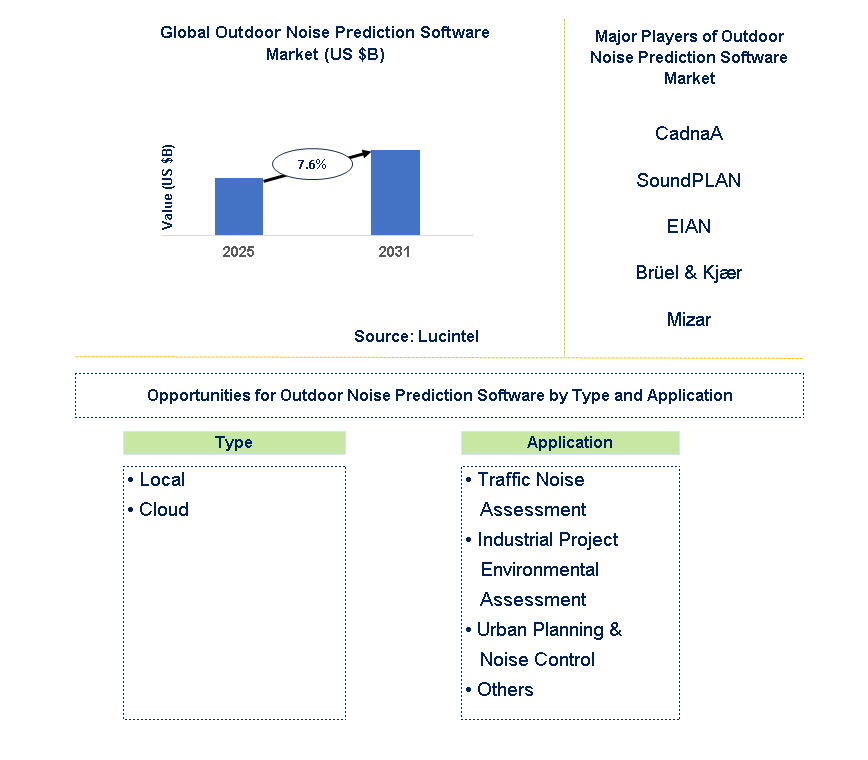
Key data points: The growth forecast = 7.6% annually for the next 7 years. Scroll below to get more insights. This market report covers trends, opportunities and forecasts in outdoor noise prediction software market to 2031 by type (local and cloud), application (traffic noise assessment, industrial project environmental assessment, urban planning & noise control, and others), and region (North America, Europe, Asia Pacific, and the Rest of the World)
We'll send your sample report shortly.
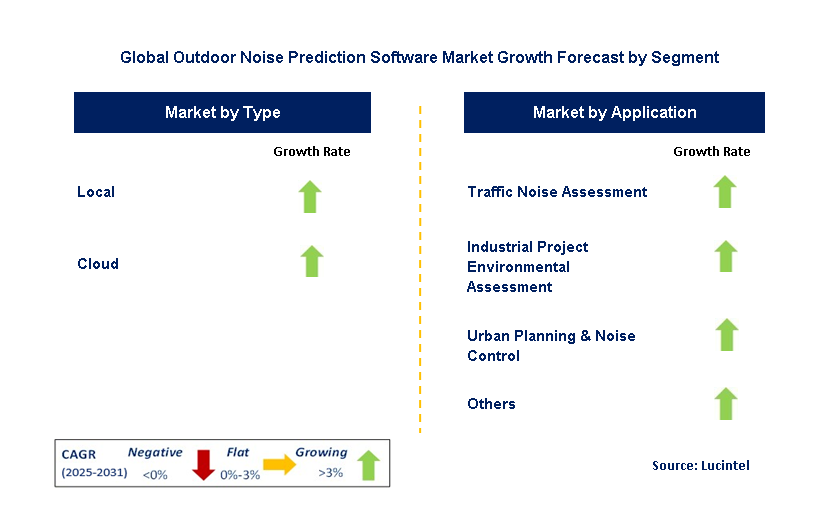
• Lucintel forecasts that, within the type category, cloud is expected to witness higher growth over the forecast period.
• Within the application category, traffic noise assessment is expected to witness the highest growth.
• In terms of region, Europe is expected to witness the highest growth over the forecast period. Gain valuable insights for your business decisions with our comprehensive 150+ page report. Sample figures with some insights are shown below.
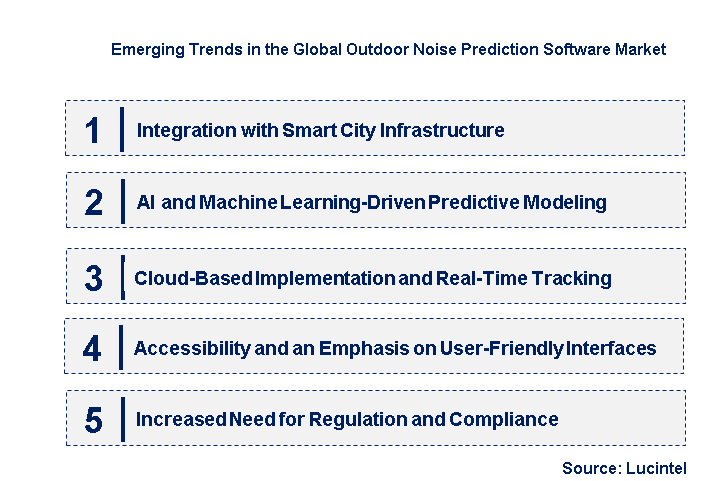
• Integration with Smart City Infrastructure: Software for predicting outdoor noise is now being incorporated into smart city systems. These platforms collect information from traffic and public transportation systems and environmental sensors to create dynamic noise maps. They help cities manage traffic, plan construction, and enforce noise regulation better. Incorporating systems also helps achieve streamlined holistic environment supervisory tools that can elevate decision pathways. This development is in sync with the increasing international focus on urban centers that are truly sustainable, accessible, and healthy for residents where residents noise pollution is considered a vital public health indicator. Citizens' feedback and visualization provide augmented feedback as noise control can be more proactive and responsive.
• AI and Machine Learning-Driven Predictive Modeling: Predictive noise software will undergo significant changes with real-time and precise forecasting thanks to the noise prediction software's integration with artificial intelligence. Noise levels are predicted better by machine learning algorithms that analyze historical noise data alongside weather data and urban layouts. This makes policy enforcement and infrastructure planning proactive. Models also adjust IoT devices provide real-time data, improving precision over time, demonstrating AI capabilities. This development is advantageous in complex settings or dynamic environments where traditional modeling methods fail. The use of AI to perform batch simulations and analyses is setting a new pace in the scalability, accuracy, and reliability of noise prediction applications.
• Cloud-Based Implementation and Real-Time Tracking: The cloud enables noise prediction processing, result visualization, sharing, and information data in real-time. Through cloud computing, regions and businesses with multiple locations are able to access and manage their information systems remotely using noise cloud platforms that are scalable. The systems usually have APIs that integrate effortlessly with environmental dashboards and city tools for integrating planning systems. By monitoring noise issues such as traffic congestion and construction disruptions, continuous updates and quick reactions in real-time ensure rapid resolution. This trend improves operational efficiency and expands market reach to smaller cities or organizations that previously had limited access to detailed noise modeling resources.
• Accessibility and an Emphasis on User-Friendly Interfaces: The shift toward engaging non-specialists with environmental programs increases the demand for graphical interfaces and data representation. Advanced outdoor noise prediction tools allow multi-lingual usage, mobile access, drag-and-drop modeling as well as mobile access. Because of these features, most city officials, planners, and at times even ordinary citizens can understand, interpret and take action based on the noise data provided. Improved user experience encourages the public to participate in urban development activities. The ability to visualize complex information through noise maps and interactive dashboards prompts stakeholders to engage in noise mitigation efforts and fosters community-led planning initiatives.
• Increased Need for Regulation and Compliance: In all parts of the world, governments are enforcing more precise control of noise, and thus predictive software is becoming vital in making compliance easier. For new construction projects, industrial complexes, transportation facilities, and similar infrastructure, sponsors have to undergo prior detailed noise studies. This is creating demand for software that can produce legally certifiable documents as well as assist in active noise control management for the future. Vendors are incorporating complete audit compliance, automatic report generation, and compliance with international standards such as the EU Environmental Noise Directive or US NEPA harmonization. With evolving regulations, there is mounting enforcement from document verifiable compliance and modular adaptation that helps users mitigate litigation and achieve regulated climate goals. Similar to the global focus on urban well-being, smart systems, and ecological compliance, the outdoor noise prediction software market is progressing in tandem. The field is witnessing a wave of technological advancement, ranging from AI-driven modeling to integration with smart city frameworks. The United States, China, Germany, India, and Japan have adopted relatively tailored unique policies for the software industry, demonstrating how diverse needs and regulatory frameworks guide technological assimilation. Newer developments have enhanced the precision, usability, and effectiveness of these tools for governments and other entities that manage organizational soundscapes. Altogether, these innovations are propelling the application of noise modeling in urban planning as a fundamental element.
• Incorporation of AI for Predictive Accuracy: AI has become one of the most important features of modern outdoor noise prediction software to improve the accuracy of simulations and forecasts. The application of machine learning algorithms to analyze historical noise data for predicting the future allows the software to adapt to complex urban settings with dynamically changing noise determinates such as traffic, construction, and industrial activity. This along with other improvements allows for mitigation strategies to be enacted prior to noise issues arising along much more accurate assessments of the impact of noise environmentally. The adoption of AI alongside other factors enables greater efficiency for engineers and planners in adhering to regulatory compliance which is now being accepted widely which increases its value and aids in shifting many buyers’ decisions greatly.
• Cloud Deployment and the SaaS Model: The delivery of the outdoor noise prediction software is now easier and more sophisticated due to the adoption of cloud-systems and Software-as-a-Service (SaaS) models. These methods permit flexible accessibility, remote real-time collaboration, and cost-efficient expansion. Users can conduct noise assessments on the cloud without high-end local infrastructure. In addition, cloud deployment simplifies data sharing between stakeholders, improves security, and enables faster software updates. This shift also supports students and small and medium sized enterprises, mobile SMEs, as well as government institutions with scant IT support. Thus, widening the customer base and accelerating adoption in the global market.
• Improved GIS Integration for Spatial Analysis: The integration of Geographic Information Systems (GIS) has Outdoor Noise prediction instruments implications in urban planning by enabling the mapping of cities at a higher resolution, including massive metropolitan areas, with significantly enhanced precision in noise propagation mapping. Through superimposition of Noise over Geospatial maps, users can identify with pinpoint accuracy, future potential hot spots, perform development impact simulations, and craft precise mitigation measures. For city planners, infrastructure developers, and environmental consultants, enhanced spatial precision helps make operations and regulatory decision clearer and easier. Enhanced GIS capability also aids regulatory reporting and public accountability which drives cross sector usage growth.
• Compliance Features for Regulatory Adaptation: Newer versions of outdoor noise prediction software now include features meant for compliance, such as emissions control capability within the European Union Environmental Noise Directive or the United States Environmental Protection Agency. These compliance modules automatically format output data, create mitigation proposals, and compile reports within regulatory standards. Such features increase compliance while reducing administrative work, which adds to the desirability of the software among noise regulation consultants and urban planners.
• Integration of Real-Time Monitoring with IoT Sensor: Real-time feedback along with noise emission monitoring has now been made possible by the use of the Internet of Things (IoT) sensors. These devices gather static acoustic data which the software models cyclically adjusts to achieving more sophisticated noise forecasting techniques. This makes the prediction software more effective in dynamic situations such as traffic control, airport traffic planning, and smart city systems. In quickly changing noise environments, real-time monitoring features are crucial, giving competitive advantage to those software firms who offer such features. The recent changes in AI functionality and surge in GIS capabilities in construction monitoring make outdoor predictive noise soft ware more reliable, powerful, and ready for the market. These factors are increasing the attractiveness of the software in the businesses’ eyes. As industries and governments place more importance on urban sustainability, the broad capabilities of the software will allow solution provides to further penetrate the e market. In addition to this, the software will also diversify its application scope which will increase the competition among the providers.
• Urban Planning Smart City Development: Urban planning agencies are employing outdoor noise prediction technology to design sound-sensitive cities. Smart cities, as more focused on sustainability, rely on such tools for planners who need to simulate scenarios where noise levels change due to variations in zoning, traffic patterns, and infrastructure additions. These software applications aid in green space reservations as well as in the construction of residential areas that do not impede quiet space standards. Increased focus towards urban livability alongside the environmental health creates a constant demand for forecasting tools, which generates collaboration between technology companies and city administrations, driving sustainable growth within the urban planning market.
• Transportation Infrastructure Projects: Major roads as well as railroads and airports are designed with the aid of noise prediction tools to assist in the planning and operational phases. The software models the impact of traffic volume, speed, and types of vehicles on the surrounding environment. Through the use of the findings, governments and contractors are able to implement noise control measures such as barriers and route alterations. With a notable increase in spending on transportation projects on a global scale, especially within developing economies, this area of application continues to generate substantial need for reliable prediction tools.
• Environmental Impact Assessments: Environmental consultants performing Impact studies for potential new developments which could be an industrial plant, a commercial facility or a renewable energy facility, make use of outdoor noise prediction models to assess possible acoustic impacts. The capability to simulate future scenarios and devise mitigation approaches is a legislative prerequisite in numerous jurisdictions. This tendency is expanding alongside the escalating stringency of environmental regulations and policies as there is a great need for forecasting methods that facilitate easy compliance while providing reliable, substantiable, verifiable information.
• Industrial Site Management and Compliance: The manufacturing plants, the mines, and the logistics almshouses are required to limit the environmental intrusive noise for occupational and public health regulations. Noise mapping software assists these locations in erecting acoustic fences, machine positioning, and monitoring community incursion. As the industry strives to meet the ESG (Environmental Social Governance) requirements, utilizing predictive software in compliance frameworks is becoming a competitive advantage. Also, this is good for software marketing as well as competition to develop industry-specific functionalities.
• Entertainment and Event Management: Minimizing disturbance in densely populated neighborhoods is a challenge at concerts, sports events, and festivals. Certain event organizers make use of outdoor noise prediction tools to forecast sound dispersion for speaker placement and compliance with local regulations. This niche, albeit small, has grown in its relevance due to the increase of open-air and outdoor entertainment venues in a post-pandemic world. Enhanced public relations as a socially responsible organization which captures event approvals enables new revenue opportunities for software vendors. The competitive landscape for outdoor noise prediction software is evolving due to the increasing demand from various industries and providing expansive growth opportunities. The software’s capabilities to assist with planning, compliance, and stakeholder engagement as organizations become more environmentally sustainable and data-driven adopts a proactive position. These developments present the market with unique prospects for sustained industry expansion and diversification for multiple sectors and purposes.
• CadnaA
• SoundPLAN
• EIAN
• Brüel & Kjær
• Mizar
• DataKustik
• SoundPLAN International
• Transport Research Laboratory
• Shenzhen Aosin Purification Technology
• Beijing Acoustic Technology
• Local
• Cloud
• Traffic Noise Assessment
• Industrial Project Environmental Assessment
• Urban Planning & Noise Control
• Others
• North America
• Europe
• Asia Pacific
• The Rest of the World
• United States: Across the realms of transportation, construction, and even aviation, the adoption of predictive outdoor noise software is on the rise in America. Agencies like the Federal Highway Administration FHWA and Federal Aviation Administration FAA are developing tools to assess the environmental impacts of their operations. Recent work has been focusing on fusing artificial intelligence with geographic information systems or GIS to enhance the accuracy of noise modeling for bulky infrastructure systems. As litigation over noise issues increases, municipalities are actively applying contemporary noise mapping techniques to enforce compliance with local noise regulations. At the same time, the acquisition of smart city projects is stimulating partnerships between public authorities and software developers to provide efficient solutions for real-time scalable data analysis in noise prediction.
• China: With socio-economic advancements, comes the reality of increasing noise pollution. This is particularly true in modern cities and urban areas like China. Noise mapping for large scale construction and developmental projects has been made a necessity by some governmental policies as they seek to minimize noise and control its effects. Chinese software companies are implementing modern technology that integrates AI with satellite imaging and noise sensors, allowing for automated noise monitoring within metropolitan areas. This technology helps to maintain sustainable development, as well as aiding in the traffic systems of Siri like cities, including Beijing and Shenzhen. Educational trusts along with environment based NGO’s are also developing analytical platforms for contemporary real-time noise surveillance in a bid to protect the public’s health and help environmental policies.
• Germany: Famous for its advancement in environmental policies, Germany has adopted the use of noise mapping technology in recent civil development projects. Under the construction of urban areas focus is placed on transportation systems like roads, railroads, and renewable sources of energy such as sleeping wind turbines. Urban areas are now overly populated; hence countries are focusing on more renovated approaches to aid efficient infrastructure mapping. For construction planning, German firms are focusing on systems that deal with terrain features, whether they be weather conditions or surroundings. Public leasing of noise maps aided civic involvements with the structures blueprints when integrating rigorous methodologies in forming the environmentally friendly city. These modern options foster enhanced public trust and allow users to actively partake in urban community frameworks.
• India: The CPCB, as well as other emerging regulatory agencies, are taking steps towards actively participating in the noise mapping of metropolitan areas. As a result of urbanization, increased traffic, and industrial growth, the demand for such solutions in the region is escalating. Enhanced information technological infrastructures, which the Indian government is attempting to deploy, encourage the integration of the IoT with mobile and GIS solutions, as well as cloud computing. In addition, there is currently a surge in start ups and soft ware providers that offer region specific solutions. These start ups are being funded by the Indian government as a part of the smart city initiative. The primary obstacle, however, is lack of awareness. There seems to hope ,however, in the collaboration with academic institutes and city level pilot projects.
• Japan: In Japan, outdoor noise mapping software is further improved by the widespread use of machine learning systems to increase the accuracy of noise detection in complicated urban terrains. Moreover, it continues to lead in precision-driven technologies. The softness of the Ministry of the Environment towards boundless noise mapping and control, especially on airports, highways and railways, adds fuel to the fire. Anticipatory systems to control noise in case of disasters are also integrated with emergency situation preparedness systems. Users can avail noise information for urban planning and infrastructural development through government and private sectors due to the rising transparency in multifunctional multilingual mobile systems.


• CadnaA
• SoundPLAN
• EIAN
• Brüel & Kjær
• Mizar
• DataKustik
• SoundPLAN International
• Transport Research Laboratory
• Shenzhen Aosin Purification Technology
• Beijing Acoustic Technology Q5. Which outdoor noise prediction software market segment will be the largest in future? Answer: Lucintel forecasts that, within the type category, cloud is expected to witness higher growth over the forecast period. Q6. In outdoor noise prediction software market, which region is expected to be the largest in next 5 years? Answer: In terms of region, Europe is expected to witness the highest growth over the forecast period. Q7. Do we receive customization in this report? Answer: Yes, Lucintel provides 10% customization without any additional cost.


Choose a license that fits your team. Instant PDF delivery.
Prices exclude taxes. Instant delivery. Custom licensing available on request.
Market Report · July 15, 2026
Market Report · June 26, 2026
Market Report · June 24, 2026
Trusted partner for strategic intelligence and business growth


Receive a complimentary market analysis tailored to your industry. Our analysts will identify key growth opportunities and competitive dynamics specific to your business.

Market size, growth rate, and key trend analysis for your specific sector.

Top competitor positioning and market share analysis.

Strategic recommendations backed by data-driven insights.
Get curated market intelligence and competitive moves straight to your inbox.
By subscribing, you agree to receive our monthly insights. Unsubscribe anytime.
Receive a complimentary market analysis tailored to your industry. Our analysts will identify key growth opportunities and competitive dynamics specific to your business.
Market size, growth rate, and key trend analysis for your specific sector.
Top competitor positioning and market share analysis.
Strategic recommendations backed by data-driven insights.
Get curated market intelligence, emerging trends, and competitive moves straight to your inbox each month.
By subscribing, you agree to receive our monthly insights. Unsubscribe anytime.
We'll send your sample report shortly.