
Market Report · July 29, 2026

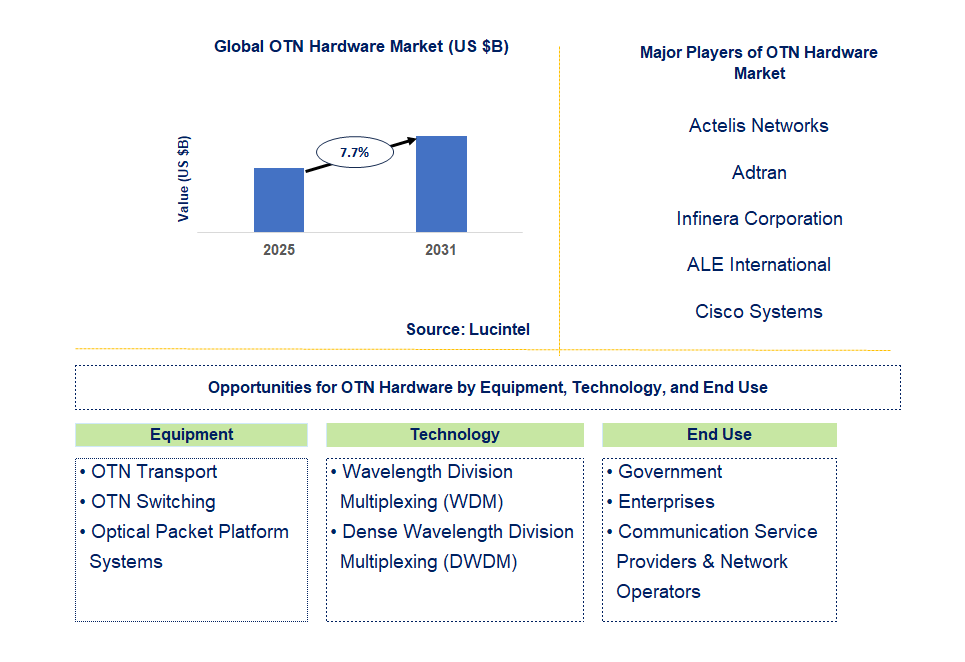
Key data points: The growth forecast = 7.7% annually for the next 7 years. Scroll below to get more insights. This market report covers Trends, opportunity and forecast in OTN hardware market to 2031 by equipment (OTN transport, OTN switching, and optical packet platform systems), technology (wavelength division multiplexing (WDM) and dense wavelength division multiplexing (DWDM)), end use (government, enterprises, and communication service providers & network operators), and region (North America, Europe, Asia Pacific, and the Rest of the World)
We'll send your sample report shortly.
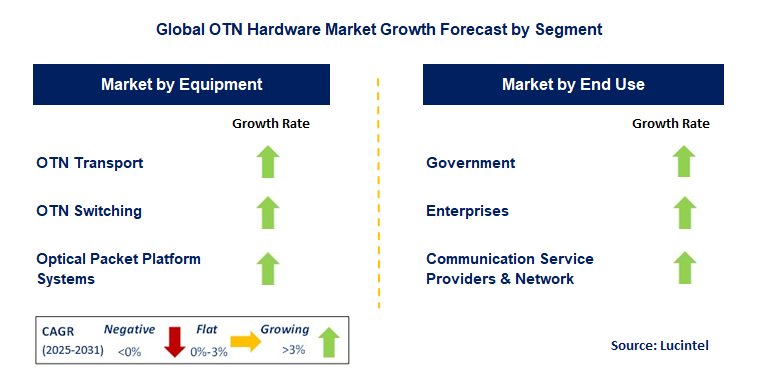
• Lucintel forecasts that, within the equipment category, the optical packet platform system will remain the largest segment over the forecast period.
• Within the end use category, communication service provider & network operator will remain the largest segment.
• In terms of region, North America will remain the largest region over the forecast period. Gain valuable insights for your business decisions with our comprehensive 150+ page report. Sample figures with some insights are shown below.
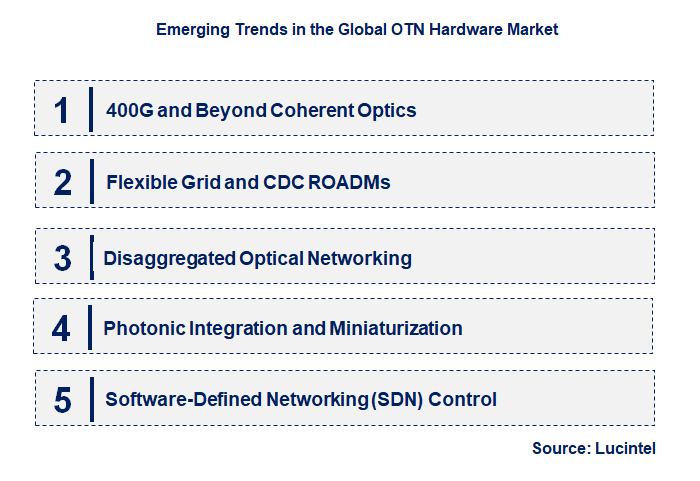
• 400G and Beyond Coherent Optics: The adoption of 400G and higher coherent optical technologies is accelerating to meet the ever-increasing bandwidth demands of data centers, cloud services, and 5G networks. These technologies enable higher data rates over long distances, improving network capacity and reducing the cost per bit. This trend is driving the development of more powerful and efficient optical transceivers and line systems.
• Flexible Grid and CDC ROADMs: Flexible grid and Colorless, Directionless, Contentionless (CDC) ROADMs are becoming increasingly important for enabling dynamic and programmable optical networks. These technologies allow network operators to reconfigure their optical paths remotely and efficiently, optimizing network utilization and reducing operational expenses. This flexibility is crucial for supporting the dynamic nature of cloud computing and other bandwidth-intensive applications.
• Disaggregated Optical Networking: Disaggregated optical networking architectures, separating the control plane from the data plane, are gaining traction. This approach allows network operators to choose best-of-breed components from different vendors, improving network flexibility and reducing vendor lock-in. Disaggregation also enables faster innovation cycles and simplifies network management through software-defined networking (SDN) control.
• Photonic Integration and Miniaturization: Photonic integration and miniaturization are key trends for reducing the size, power consumption, and cost of OTN hardware. Integrating multiple optical functions onto a single chip improves energy efficiency and reduces the footprint of optical equipment. This trend is crucial for deploying high-capacity optical networks in space-constrained environments and reducing operational costs.
• Software-Defined Networking (SDN) Control: SDN is playing an increasingly important role in managing and controlling OTN networks. SDN enables automated provisioning, dynamic resource allocation, and simplified network management through centralized software control. This enhances network agility, reduces operational expenses, and allows network operators to respond quickly to changing traffic demands. These trends are fundamentally reshaping the OTN hardware market. The move towards higher data rates, flexible and programmable networks, disaggregated architectures, photonic integration, and SDN control is creating a more dynamic and efficient optical transport landscape, enabling the deployment of next-generation communication services and supporting the growth of bandwidth-intensive applications.
• Terabit-Scale Transmission: The industry is pushing the limits of optical transmission, with the development and deployment of terabit-per-second and even multi-terabit-per-second optical technologies. These advancements are crucial for supporting the massive bandwidth demands of data centers, cloud services, and future applications. This requires innovation in optical transceivers, amplifiers, and other network components.
• Advanced Modulation Formats and Coherent Detection: Advanced modulation formats and coherent detection techniques are being employed to achieve these higher data rates. These technologies enable more efficient use of the optical spectrum, allowing network operators to transmit more data over existing fiber infrastructure. This drives innovation in digital signal processing and optical component design.
• Programmable and Flexible ROADMs: Reconfigurable Optical Add-Drop Multiplexers (ROADMs) are becoming more sophisticated, with features like flexible grid, colorless, directionless, and contentionless (CDC) capabilities. These enhancements enable dynamic and automated provisioning of optical connections, improving network agility and reducing operational expenses. This allows network operators to quickly respond to changing traffic demands and optimize network utilization.
• Open and Disaggregated Architectures: The trend towards open and disaggregated optical networking architectures is gaining momentum. This approach separates the control plane from the data plane, allowing network operators to choose best-of-breed components from different vendors and avoid vendor lock-in. Disaggregation also simplifies network management through software-defined networking (SDN) control.
• AI and Machine Learning Integration: Artificial intelligence (AI) and machine learning (ML) are being integrated into OTN hardware and software to improve network performance, optimize resource allocation, and automate network management tasks. AI/ML algorithms can analyze network traffic patterns, predict failures, and optimize routing decisions, leading to more efficient and reliable optical networks. These developments are significantly impacting the OTN hardware market, creating a more dynamic and competitive landscape. The focus on higher data rates, flexible and programmable networks, open architectures, AI/ML integration, and advanced modulation techniques is shaping the future of optical transport and enabling the next generation of communication services.
• Data Center Interconnect (DCI): The explosion of cloud computing and the increasing reliance on data centers are driving the demand for high-capacity DCI solutions. OTN technology is crucial for connecting geographically dispersed data centers, enabling seamless data transfer and disaster recovery. This presents a significant opportunity for vendors offering high-bandwidth, low-latency OTN solutions optimized for DCI applications.
• 5G Network Deployment: The global rollout of 5G networks is creating a surge in demand for high-capacity and flexible optical transport solutions. OTN technology is essential for transporting the massive amounts of data generated by 5G base stations and connecting them to the core network. This presents a major growth opportunity for vendors providing OTN equipment that can meet the stringent requirements of 5G networks, including low latency and high reliability.
• Metro and Access Networks: The increasing demand for broadband access and the proliferation of connected devices drive the need for high-capacity metro and access networks. OTN technology is being deployed in these networks to provide efficient and scalable data traffic transport. This creates opportunities for vendors offering cost-effective and compact OTN solutions tailored for metro and access network applications.
• Enterprise Networks: Large enterprises are increasingly relying on high-bandwidth connectivity to support their operations and connect their various branches and data centers. OTN technology offers a reliable and secure way to transport data across enterprise networks. This presents a growth opportunity for vendors offering OTN solutions that can meet the specific needs of enterprise customers, including security features and integration with existing IT infrastructure.
• Content Delivery Networks (CDNs): CDNs rely on high-capacity and low-latency connectivity to deliver content to users efficiently. OTN technology plays a critical role in connecting CDN nodes and ensuring seamless content delivery. This presents an opportunity for vendors offering OTN solutions optimized for CDN applications, including high bandwidth, low latency, and support for dynamic traffic management. These growth opportunities significantly impact the OTN hardware market, driving innovation and specialization. Vendors who can develop solutions that address the specific needs of these key applications, offering high performance, cost-effectiveness, and flexibility, will be well-positioned for success in this rapidly expanding market.
• Actelis Networks
• Adtran
• Infinera Corporation
• ALE International
• Cisco Systems
• Ribbon Communications Operating
• Telefonaktiebolaget LM Ericsson
• Extreme Networks
• Dell
• Huawei Technologies
• OTN Transport
• OTN Switching
• Optical Packet Platform Systems
• Wavelength Division Multiplexing (WDM)
• Dense Wavelength Division Multiplexing (DWDM)
• North America
• Europe
• Asia Pacific
• The Rest of the World
• United States: The US OTN market is characterized by a strong focus on high-capacity and long-reach optical transport solutions. Key developments include the adoption of 400G and 800G coherent optical technologies, advancements in ROADM (Reconfigurable Optical Add-Drop Multiplexer) technology for flexible network configuration, and the growing adoption of disaggregated optical networking architectures. There's also a strong emphasis on software-defined networking (SDN) control for automated network provisioning and management.
• China: The Chinese OTN market is experiencing rapid growth, driven by massive investments in 5G infrastructure and data center construction. Key developments include the deployment of high-capacity OTN networks based on 400G and beyond technologies, the development of domestic optical chipsets and components, and the increasing adoption of flexible grid and colorless, directionless, contentionless (CDC) ROADMs. China is also actively promoting the development of its own optical transport standards and technologies.
• Germany: The German OTN market is characterized by a focus on reliability, security, and energy efficiency. Key developments include the deployment of high-capacity OTN networks for both telecom and enterprise applications, the increasing adoption of energy-efficient optical technologies, and a strong emphasis on network security and data privacy. Germany is also actively participating in international standardization efforts for OTN technology.
• India: The Indian OTN market is experiencing rapid expansion, driven by increasing broadband penetration and the rollout of 5G networks. Key developments include the deployment of cost-effective OTN solutions for both metro and long-haul applications, the increasing adoption of flexible and programmable optical transport equipment, and a growing focus on network optimization and automation. India is also promoting the development of domestic optical component manufacturing capabilities.
• Japan: The Japanese OTN market is characterized by a strong focus on innovation and high-quality optical transport solutions. Key developments include the development of ultra-high-capacity optical transmission technologies, advancements in photonic integration and miniaturization, and a strong emphasis on network reliability and resilience. Japan is also actively involved in international collaboration on OTN technology development and standardization.


• Actelis Networks
• Adtran
• Infinera Corporation
• ALE International
• Cisco Systems
• Ribbon Communications Operating
• Telefonaktiebolaget LM Ericsson
• Extreme Networks
• Dell
• Huawei Technologies Q5. Which OTN hardware market segment will be the largest in future? Answer: Lucintel forecasts that the optical packet platform system will remain the largest segment over the forecast period. Q6. In OTN hardware market, which region is expected to be the largest in next 5 years? Answer: North America will remain the largest region over the forecast period. Q7. Do we receive customization in this report? Answer: Yes, Lucintel provides 10% customization without any additional cost.


Choose a license that fits your team. Instant PDF delivery.
Prices exclude taxes. Instant delivery. Custom licensing available on request.
Market Report · July 29, 2026
Market Report · July 20, 2026
Market Report · July 20, 2026
Trusted partner for strategic intelligence and business growth


Receive a complimentary market analysis tailored to your industry. Our analysts will identify key growth opportunities and competitive dynamics specific to your business.

Market size, growth rate, and key trend analysis for your specific sector.

Top competitor positioning and market share analysis.

Strategic recommendations backed by data-driven insights.
Get curated market intelligence and competitive moves straight to your inbox.
By subscribing, you agree to receive our monthly insights. Unsubscribe anytime.
Receive a complimentary market analysis tailored to your industry. Our analysts will identify key growth opportunities and competitive dynamics specific to your business.
Market size, growth rate, and key trend analysis for your specific sector.
Top competitor positioning and market share analysis.
Strategic recommendations backed by data-driven insights.
Get curated market intelligence, emerging trends, and competitive moves straight to your inbox each month.
By subscribing, you agree to receive our monthly insights. Unsubscribe anytime.
We'll send your sample report shortly.