
Market Report · July 15, 2026

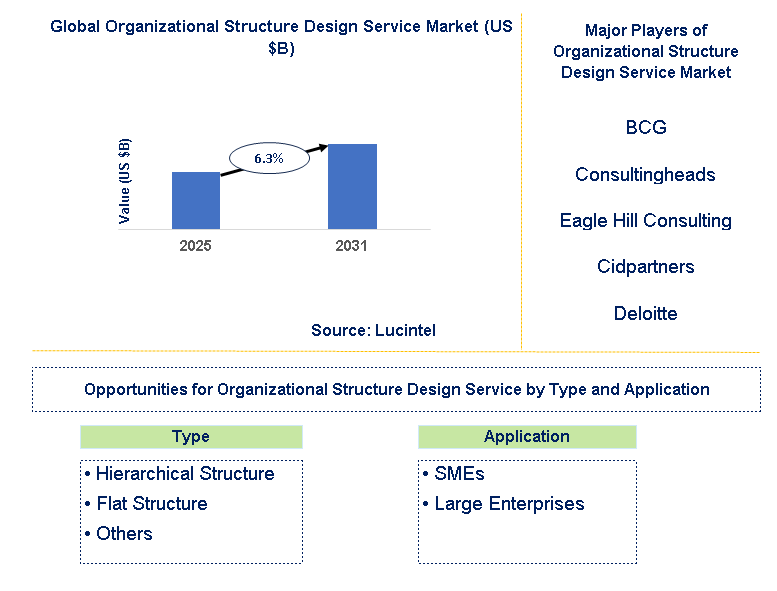
Key data points: The growth forecast = 6.3% annually for the next 7 years. Scroll below to get more insights. This market report covers Trends, opportunities and forecasts in organizational structure design service market to 2031 by type (hierarchical structure, flat structure, and others), application (SMEs and large enterprises), and region (North America, Europe, Asia Pacific, and the Rest of the World)
We'll send your sample report shortly.
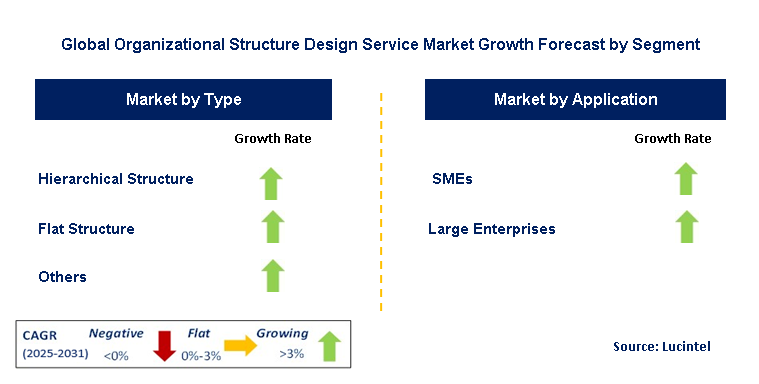
• Lucintel forecasts that, within the type category, hierarchical structure is expected to witness higher growth over the forecast period.
• Within the application category, large enterprise is expected to witness higher growth.
• In terms of region, North America is expected to witness the highest growth over the forecast period.
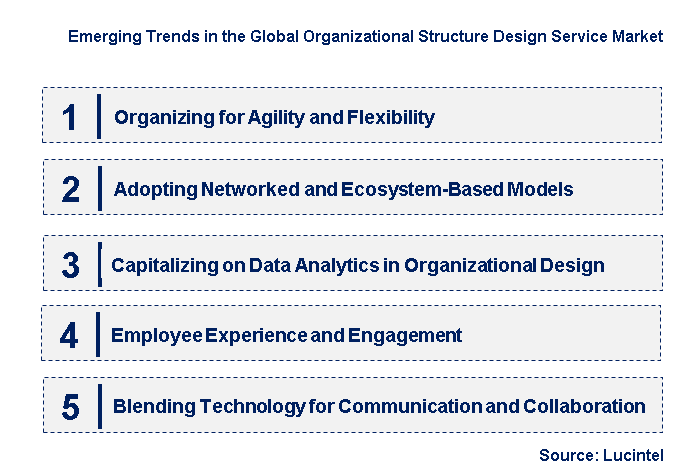
• Organizing for Agility and Flexibility: A prominent trend is shifting towards organizational designs that can be rapidly adjusted to respond to altering market situations and customer needs. This entails creating leaner hierarchies, empowered teams, and dynamic project-based structures to facilitate rapid mobilization of resources and decision-making. The result is heightened responsiveness, accelerated cycles of innovation, and the capability to seize upcoming opportunities in an ever-changing business environment.
• Adopting Networked and Ecosystem-Based Models: Organizations are increasingly accepting the value of external collaborations and partnerships. This is driving the creation of networked organizational frameworks that enable free flow with suppliers, customers, and other stakeholders in larger business ecosystems. The effect is amplified innovation through external information sharing, broadened market reach, and amplified resilience through diversified relations.
• Capitalizing on Data Analytics in Organizational Design: The presence of large volumes of organizational data is facilitating a more analytical approach to structure design. Service providers are using analytics to determine inefficiencies, comprehend patterns of communication, and forecast the effect of structural adjustments. The result is more informed decision-making, better resource allocation, and the development of structures empirically proven to be effective.
• Employee Experience and Engagement: Having identified the correlation between organizational structure and employee happiness, there is an increasing move towards structuring to foster autonomy, collaboration, and purpose. This involves thinking about aspects such as team autonomy, cross-functional collaboration, and transparent career progression. The outcome is enhanced morale among employees, increased levels of engagement, and better retention of talent in a competitive labor market.
• Blending Technology for Communication and Collaboration: Collaborative tools and digital platforms are increasingly becoming a vital part of how organizations are organized and work is accomplished. Service providers are assisting businesses in creating structures that take advantage of these technologies to enable smooth communication, knowledge exchange, and collaboration among geographically distributed teams and functional silos. The result is increased efficiency, better flow of communication, and the capability to work efficiently in a remote or hybrid work setup. These nascent trends are essentially transforming the organizational structure design service market away from classic, inflexible hierarchies towards more adaptive, networked, data-oriented, employee-focused, and tech-enabled organizational structures. Service firms are evolving their skills and solutions to assist companies in this new environment and to design structures that enable their strategic objectives in a fast-changing world.
• Use of Digital Diagnostic Tools and Platforms: Recent advances have seen the rising application of digital platforms and diagnostic tools to determine current organizational architectures. These utilize surveys, network analysis, and data visualization to determine bottlenecks, communication inefficiencies, and areas to improve, presenting a more objective and data-based basis for redesigning.
• Incorporating Change Management Knowledge: Aware that structural changes invariably involve cultural and process changes, there is increasing incorporation of change management knowledge into organizational structure design services. Consultants are offering holistic support to enable organizations to better manage the people side of change, making transitions less bumpy and more employee-friendly.
• Tailoring and Customization of Solutions: There is a shift from the one-size-fits-all approach towards a more tailored and customized organizational structure design solution. Service providers are now paying greater attention to the particular strategic objectives, industry setting, and cultural context of each client in order to create structures that are fit for purpose.
• Focus on Scalability and Future-Proofing: Organizations are looking for structural designs that not only meet existing needs but also have the flexibility to scale and evolve to meet future challenges and opportunities. Service providers are integrating scenario planning and forward-looking design principles to develop organizational structures that can change over time.
• Greater Emphasis on Project-Oriented and Team-Based Organizational Structures: Spurred by requirements for agility and innovation, there is greater pressure to create team-based and project-oriented organizational architectures. There is more provision of services on designing efficient team structures, cross-functional collaboration mechanisms, and project management systems that can improve responsiveness and propel results. These critical advancements are influencing the organizational structure design service market by making the process more data-intensive, change-conscious, tailored, forward-looking, and agile team-based model-centered, ultimately making organizational changes more effective and enduring.
• Enabling Digital Transformation Programs: With organizations from all industries in the process of digital transformation, there is a heightened demand for organizational structures capable of enabling agility, cross-functional collaboration, and new technology integration. Service providers can provide advice on designing digital-first organizational architecture and retrofitting current structures to the digital environment.
• Enabling Mergers and Acquisitions Integration: Mergers and acquisitions usually necessitate large-scale organizational restructuring in order to deliver synergies and blend disparate cultures and processes. Offering expert organizational design services to enable M&A integration, structural alignment, and cultural integration planning offers a sizeable growth potential.
• Facilitating Global Growth and Internationalization: Global companies need to create sophisticated international organizational designs that will be able to manage operations in different geographies and cultures effectively. Global organizational design and cross-cultural management expert service providers can meet this emerging demand.
• Remote and Hybrid Work Models Designing: The growth in remote and hybrid work models makes it necessary to rethink conventional organizational design to accommodate effective communication, collaboration, and performance management of distributed teams. Providing services for designing structures designed for remote and hybrid work creates a timely growth opportunity.
• Restructuring for Sustainability and Social Impact: As more emphasis is being placed on environmental, social, and governance (ESG) considerations, organizations are looking for structural reform to incorporate sustainability and social impact into their very fabric. Service providers can provide advice on structuring organizations to enable these goals and the incorporation of ESG considerations into decision-making. These strategic growth prospects underscore the potential for the organizational structure design service market to grow by addressing the particular structural issues and strategic imperatives of digital transformation, M&A integration, global expansion, remote/hybrid work models, and sustainability initiatives. By adapting their capabilities to these critical applications, service providers can capture new market demand and create substantial value for their customers.
• BCG
• Consultingheads
• Eagle Hill Consulting
• Cidpartners
• Deloitte
• Bain
• Mercer
• Korn Ferry
• Navalent
• McKinsey
• Hierarchical Structure
• Flat Structure
• Others
• SMEs
• Large Enterprises
• North America
• Europe
• Asia Pacific
• The Rest of the World
• United States: The US market is experiencing a high demand for organizational structure design services that enable agility, innovation, and digital transformation. Recent trends involve more emphasis on team-based structures, matrix organizations, and lotacracy to promote collaboration and responsiveness. Consulting firms are making greater use of data analytics to diagnose organizational inefficiencies and design data-driven structural solutions. There is also an increasing focus on change management services to facilitate successful implementation of new organizational designs.
• China: China's fast-developing economy and its pursuit of global competitiveness are driving the need for contemporary organizational forms. Developments in recent times have involved a move from conventional hierarchical models to more agile and market-responsive designs. Structures that facilitate innovation and internationalization are increasingly of interest. Technology is a major factor, with firms using digital platforms for communication and collaboration through complex organizational networks. Government policies encouraging efficiency and innovation also drive structural change.
• Germany: Stability and clear-cut organizational frameworks dominate the German market, influenced as they tend to be by co-determination tradition. Trends currently are geared toward optimizing what is already there in terms of achieving more efficiency and making these compatible with digitalization and globalization challenges. Interest is growing in cross-functional teams and project-oriented structures to provide an environment that stimulates innovation and has a formal structure. Worker involvement and consideration of works councils form part of organizational design initiatives.
• India: India's pluralistic and expanding economy provides a challenging context for organizational structure design. Current trends include the shift towards professionalized and formalized structures in historically family businesses. There is also increased usage of global best practices in organizational design, especially among multinational corporations in India. Balancing local context with international standards is an important consideration, as well as coping with big and diverse workforces.
• Japan: The Japanese market is marked by a strong focus on consensus-based decision-making and hierarchical organizations, although these are slowly changing. Developments over recent years have been an increased interest in flatter organizational structures and giving teams more autonomy to encourage innovation and respond to global competition. It is also an emphasis on making technology work to enhance communication and collaboration within organizations while still honoring traditional culture. Change management is typically approached with careful consideration for employee buy-in and long-term stability.


• BCG
• Consultingheads
• Eagle Hill Consulting
• Cidpartners
• Deloitte
• Bain
• Mercer
• Korn Ferry
• Navalent
• McKinsey Q5. Which organizational structure design service market segment will be the largest in future? Answer: Lucintel forecasts that, within the type category, hierarchical structure is expected to witness higher growth over the forecast period. Q6. In organizational structure design service market, which region is expected to be the largest in next 5 years? Answer: In terms of region, North America is expected to witness the highest growth over the forecast period. Q7. Do we receive customization in this report? Answer: Yes, Lucintel provides 10% customization without any additional cost.


Choose a license that fits your team. Instant PDF delivery.
Prices exclude taxes. Instant delivery. Custom licensing available on request.
Market Report · July 15, 2026
Market Report · June 26, 2026
Market Report · June 24, 2026
Trusted partner for strategic intelligence and business growth


Receive a complimentary market analysis tailored to your industry. Our analysts will identify key growth opportunities and competitive dynamics specific to your business.

Market size, growth rate, and key trend analysis for your specific sector.

Top competitor positioning and market share analysis.

Strategic recommendations backed by data-driven insights.
Get curated market intelligence and competitive moves straight to your inbox.
By subscribing, you agree to receive our monthly insights. Unsubscribe anytime.
Receive a complimentary market analysis tailored to your industry. Our analysts will identify key growth opportunities and competitive dynamics specific to your business.
Market size, growth rate, and key trend analysis for your specific sector.
Top competitor positioning and market share analysis.
Strategic recommendations backed by data-driven insights.
Get curated market intelligence, emerging trends, and competitive moves straight to your inbox each month.
By subscribing, you agree to receive our monthly insights. Unsubscribe anytime.
We'll send your sample report shortly.