
Market Report · July 15, 2026

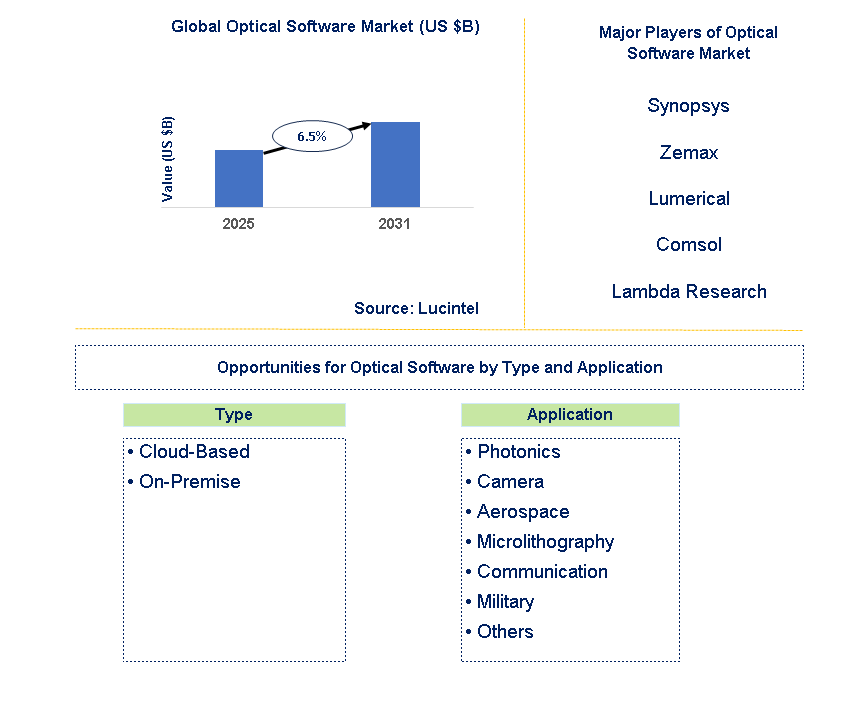
Key data points: The growth forecast = 6.5% annually for the next 7 years. Scroll below to get more insights. This market report covers Trends, opportunity and forecast in optical software market to 2031 by type (cloud-based and on-premise), application (photonics, camera, aerospace, microlithography, communication, military, and others), and region (North America, Europe, Asia Pacific, and the Rest of the World)
We'll send your sample report shortly.
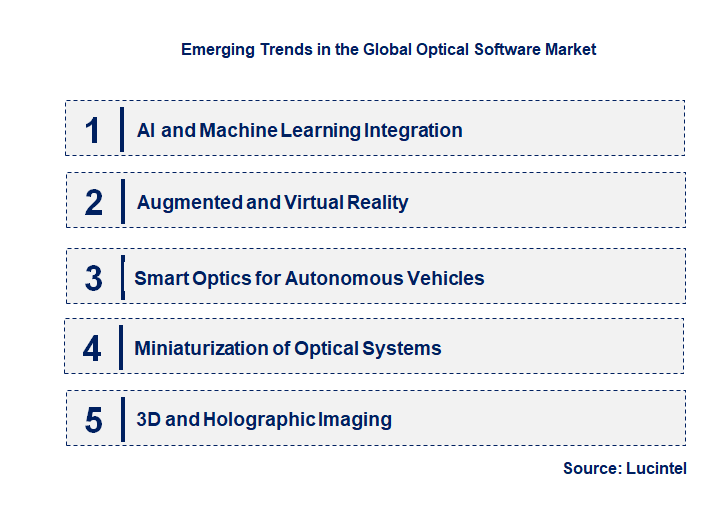
• AI and Machine Learning Integration: AI and machine learning are revolutionizing the optical software market by enabling faster, more accurate simulations of optical systems. These technologies automate design processes, optimize lens configurations, and predict system performance under various conditions. AI algorithms are making it easier to design complex optical systems with minimal human intervention, ultimately increasing the efficiency and precision of optical designs.
• Augmented and Virtual Reality: The rise of augmented reality (AR) and virtual reality (VR) technologies has spurred demand for advanced optical software. AR/VR applications rely on precise optics to deliver high-quality visuals and immersive experiences. Optical software tools are now being developed to design and simulate optical systems for AR/VR headsets, displays, and cameras, enabling the creation of more realistic, high-performing AR/VR solutions.
• Smart Optics for Autonomous Vehicles: The optical software market is benefiting from the growing demand for smart optics in autonomous vehicles. Lidar, radar, and camera systems used in self-driving cars rely heavily on optical software for design and optimization. This trend is driving the need for more accurate simulations of optical sensors and more efficient development processes, helping to improve vehicle safety and navigation systems.
• Miniaturization of Optical Systems: The miniaturization of optical systems is another significant trend in the market. As consumer electronics, medical devices, and IoT applications demand smaller, lighter, and more efficient optics, optical software solutions are being developed to accommodate these needs. Designers are focusing on optimizing small-scale optical systems for use in portable devices while maintaining high performance, paving the way for new innovations in compact electronics.
• 3D and Holographic Imaging: The demand for 3D and holographic imaging technologies is driving advancements in optical software. These technologies require complex optical systems to produce high-definition, multi-dimensional images. Optical software is being used to simulate and optimize these systems, enabling the creation of advanced 3D and holographic imaging solutions for industries such as medical diagnostics, entertainment, and product design. Emerging trends such as AI integration, the growth of AR/VR, autonomous vehicles, miniaturization, and 3D imaging are transforming the optical software market. These trends are leading to more intelligent, efficient, and innovative optical systems, driving advancements across industries and reshaping the market to address new challenges and opportunities.
• AI-Powered Optical Design Tools: One of the key developments in the optical software market is the integration of AI-powered optical design tools. These tools use machine learning algorithms to automate the optical design process, enabling faster, more accurate designs. AI can optimize lens configurations, predict system performance, and reduce errors, significantly improving the design cycle for optical systems.
• Cloud-Based Optical Software: Cloud-based optical software solutions are gaining popularity due to their ability to provide scalability, accessibility, and collaboration. These platforms allow teams to work on optical design projects remotely, providing real-time collaboration and access to powerful computing resources. Cloud-based solutions offer cost-effectiveness and flexibility, especially for smaller companies with limited access to high-end hardware.
• Integration with IoT and Smart Devices: Optical software is being increasingly integrated with the Internet of Things (IoT) and smart devices. As more devices, such as wearables, smart cameras, and sensors, rely on optical systems for functionality, the need for optimized optical software has grown. This integration allows for real-time processing and data sharing between devices, creating new opportunities for smart devices and industrial automation.
• Advancements in 3D Imaging Software: 3D imaging software has seen major advancements, particularly in medical imaging and manufacturing applications. Optical software is being used to design and optimize 3D imaging systems, offering clearer, more accurate visuals for medical diagnostics, industrial inspections, and entertainment. These advancements are pushing the boundaries of optical design, enabling new applications, and improving user experiences.
• Enhanced Medical Imaging Software: In the healthcare sector, optical software is playing a critical role in advancing medical imaging technologies. Recent developments in software have improved the accuracy, resolution, and speed of imaging systems, allowing for better diagnostics and treatment planning. Optical software is helping to simulate light interactions within tissues and organs, improving the precision of imaging techniques such as optical coherence tomography (OCT) and endoscopy. Recent developments in optical software, driven by AI, cloud computing, IoT integration, 3D imaging, and advancements in medical technologies, are making optical design faster, more precise, and more accessible. These developments are improving the functionality of optical systems across various industries and accelerating innovation in the field.
• Mobile and Consumer Electronics: The rise of advanced optics in mobile devices and consumer electronics presents a major growth opportunity for optical software developers. As smartphones, smart glasses, and other consumer electronics integrate sophisticated optical systems, the demand for software that can optimize camera functionality, display quality, and sensor performance is increasing. Optical software solutions will play a crucial role in improving design accuracy and efficiency in these devices.
• Automotive and Autonomous Vehicles: The automotive industry, particularly in the realm of autonomous vehicles, offers substantial growth opportunities for optical software. Optical systems used in sensors, cameras, and lidar technology are critical for vehicle navigation and safety. As self-driving cars become more prevalent, the need for software that can optimize sensor performance and reduce design costs will continue to rise, creating significant growth opportunities in this sector.
• Healthcare and Medical Imaging: The healthcare industry, especially in the field of medical imaging, represents a key growth area for optical software. Advancements in optical imaging systems, such as optical coherence tomography (OCT) and 3D imaging, require sophisticated software tools to optimize system design and improve diagnostic accuracy. As healthcare providers continue to adopt these technologies, optical software solutions will play a pivotal role in enhancing medical imaging capabilities.
• Industrial Automation and Manufacturing: In industrial automation and manufacturing, optical software is becoming increasingly important for quality control, precision measurement, and machine vision. Optical software solutions that enhance the accuracy of visual inspections, reduce defects, and optimize production efficiency are in high demand. As industries move towards more automated processes, the need for reliable optical software to improve manufacturing systems will continue to grow.
• Research and Development in Photonics: The growth of photonics research presents another key opportunity for optical software providers. As photonic technologies advance, the need for optical software to model and simulate light behavior at microscopic levels is increasing. This growth opportunity is particularly significant in fields such as quantum computing, telecommunications, and advanced material science, where precision optical design is critical. Strategic growth opportunities in the optical software market are abundant in mobile electronics, autonomous vehicles, healthcare, industrial automation, and photonics research. As these sectors continue to grow, optical software developers have the opportunity to innovate and create solutions that address the evolving needs of these industries, driving the expansion of the market.
• Synopsys
• Zemax
• Lumerical
• Comsol
• Lambda Research Corporation
• Ansys
• Lightmachinery
• LTI Optics
• Optica Software
• Breault Research Organization
• Cloud-Based
• On-Premise
• Photonics
• Camera
• Aerospace
• Microlithography
• Communication
• Military
• Others
• North America
• Europe
• Asia Pacific
• The Rest of the World
• United States: In the United States, the optical software market has seen rapid innovation driven by the integration of AI and machine learning algorithms into optical design. The need for high-performance optical systems in sectors such as autonomous vehicles, medical imaging, and augmented reality has spurred the development of advanced optical software solutions. Furthermore, significant investments in R&D by leading tech companies are leading to faster design processes, enhanced precision, and more efficient optical system simulations, paving the way for cutting-edge optical applications across various industries.
• China: The Chinese optical software market has experienced significant growth, mainly due to the country's emphasis on technological innovation and advancement. With the rapid development of the semiconductor industry, smart devices, and AI-based technologies, there is an increasing demand for advanced optical systems in consumer electronics, manufacturing, and telecommunications. China’s robust support for research and development, along with its expanding optical design capabilities, is pushing the market toward more sophisticated, high-precision optical software solutions to meet industry demands for innovation.
• Germany: In Germany, optical software is gaining traction due to the country's emphasis on precision engineering and industrial automation. The automotive and manufacturing industries are adopting optical software for lens design, imaging systems, and sensor optimization, particularly for autonomous vehicles and smart manufacturing. Germany’s leadership in high-quality engineering, combined with its strong commitment to Industry 4.0 initiatives, is driving the integration of optical software with AI, IoT, and automation, leading to the development of more efficient, precision-driven optical systems.
• India: In India, optical software has gained traction, especially in sectors like defense, healthcare, and telecommunications. The country is focusing on developing cost-effective optical solutions tailored to local needs, with growing demand for imaging technologies in medical diagnostics and industrial automation. India’s burgeoning tech startup ecosystem and government-driven initiatives such as "Make in India" are contributing to the growth of optical software, with an increasing emphasis on affordability and accessibility in optical design and simulation software.
• Japan: Japan remains a global leader in the optical software market, particularly in sectors like consumer electronics, robotics, and medical imaging. Japanese companies are focusing on high-precision optical software for applications in semiconductors, imaging, and robotics. With significant investments in R&D, Japan’s optical software solutions are advancing rapidly, enabling improvements in optics for imaging systems, light-based sensors, and machine vision technology, thus reinforcing the country’s position in the global optical software market.


• Synopsys
• Zemax
• Lumerical
• Comsol
• Lambda Research Corporation
• Ansys
• Lightmachinery
• LTI Optics
• Optica Software
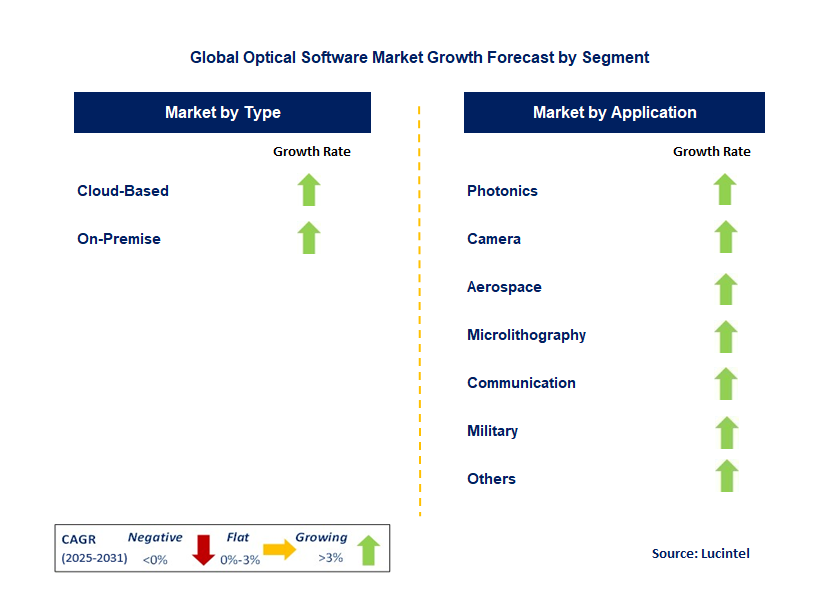
• Breault Research Organization Q5. Which optical software market segment will be the largest in future? Answer: Lucintel forecasts that cloud-based is expected to witness higher growth over the forecast period. Q6. In optical software market, which region is expected to be the largest in next 5 years? Answer: APAC is expected to witness the highest growth over the forecast period. Q7. Do we receive customization in this report? Answer: Yes, Lucintel provides 10% customization without any additional cost.


Choose a license that fits your team. Instant PDF delivery.
Prices exclude taxes. Instant delivery. Custom licensing available on request.
Market Report · July 15, 2026
Market Report · June 26, 2026
Market Report · June 24, 2026
Trusted partner for strategic intelligence and business growth


Receive a complimentary market analysis tailored to your industry. Our analysts will identify key growth opportunities and competitive dynamics specific to your business.

Market size, growth rate, and key trend analysis for your specific sector.

Top competitor positioning and market share analysis.

Strategic recommendations backed by data-driven insights.
Get curated market intelligence and competitive moves straight to your inbox.
By subscribing, you agree to receive our monthly insights. Unsubscribe anytime.
Receive a complimentary market analysis tailored to your industry. Our analysts will identify key growth opportunities and competitive dynamics specific to your business.
Market size, growth rate, and key trend analysis for your specific sector.
Top competitor positioning and market share analysis.
Strategic recommendations backed by data-driven insights.
Get curated market intelligence, emerging trends, and competitive moves straight to your inbox each month.
By subscribing, you agree to receive our monthly insights. Unsubscribe anytime.
We'll send your sample report shortly.