
Market Report · May 18, 2026

This market report covers trends, opportunities, and forecasts in the global optical coatings market to 2031 by technology (sputtering process, e-beam evaporation, ion-assisted deposition, vacuum deposition, and others), application (electronics & semiconductor, aerospace & defense, and others), and region (North America, Europe, Asia Pacific, and the Rest of the World)
We'll send your sample report shortly.
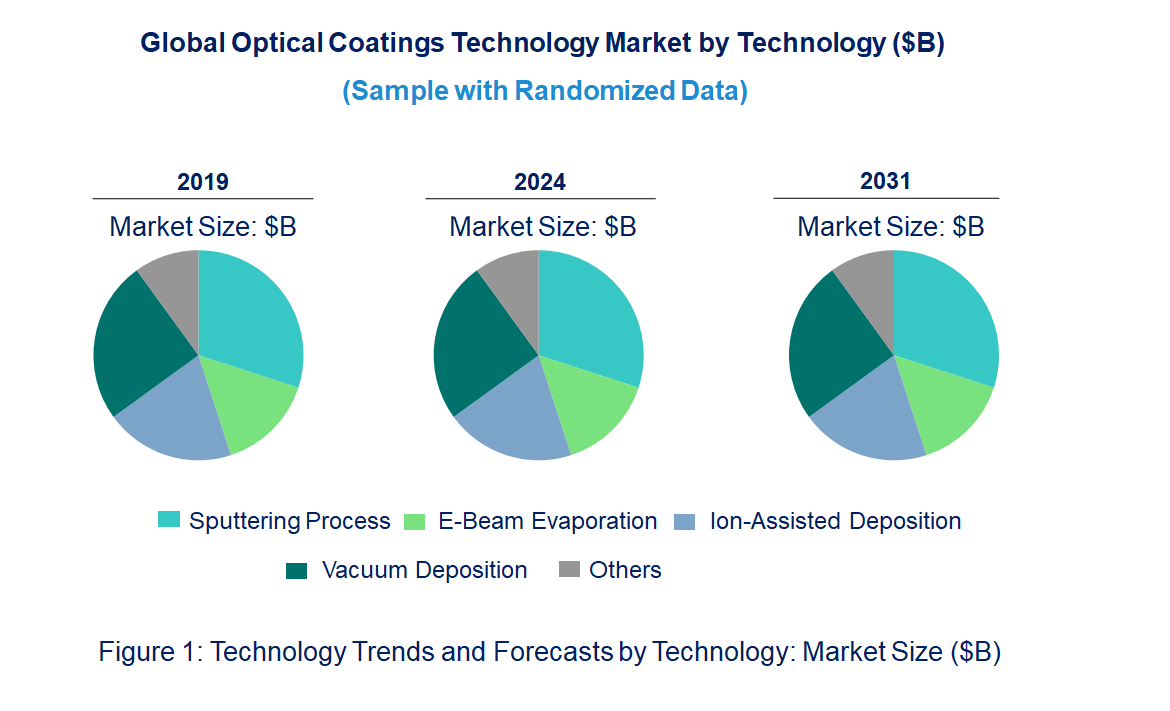
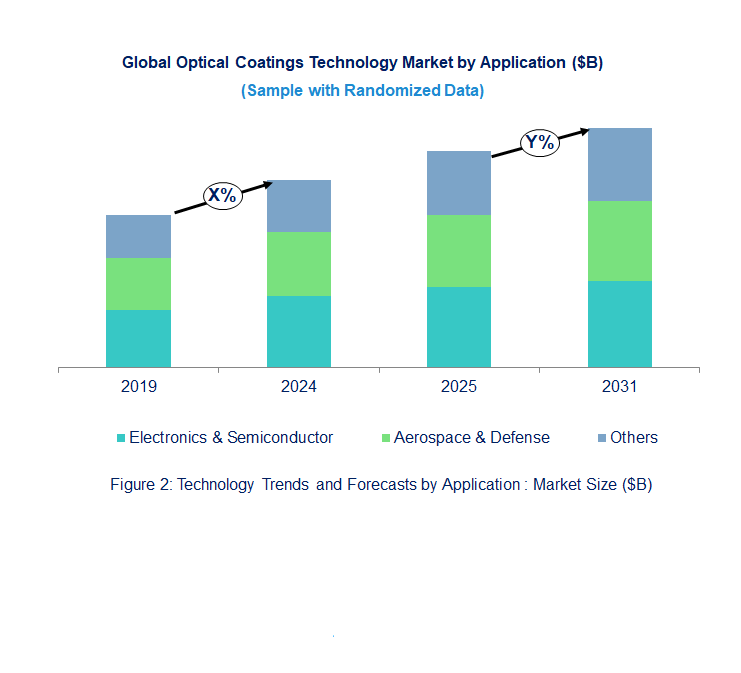
• Thin-film coatings demand in electronics and semiconductors grows: As electronics become more compact and integrated, advanced thin-film coatings are gaining increasing demand. Such coatings provide critical functionalities like anti-reflective properties, high optical performance, and protection against environmental factors, thus enabling continued miniaturization and efficiency of electronic devices.
• Anti-reflective coatings for aerospace and defense: Growth is expected in the aerospace and defense industries for high-performance anti-reflective coatings in high-clarity optical conditions to prevent glare in extreme conditions. They play a crucial role in avionics, optical lenses, and sensors, where precision and reliability are essential.
• Growth of multi-layer coatings for improved performance: Multi-layer coatings are gaining importance due to their better performance for applications requiring high durability and superior optical characteristics. These coatings are widely used in industries such as aerospace, automotive, and telecom, where multiple functions like reflection control, durability, and resistance in harsh environments are required.
• Coatings with smart technology integration: The use of optical coatings in combination with smart technologies is on the rise. For instance, coatings are currently being applied to sensors, touch screens, and smart windows to enhance performance, save energy, and improve the user experience. This integration is increasingly relevant in the consumer electronics and automotive sectors.
• Eco-friendly and sustainable coatings: With growing concerns about the environment, the focus is on developing eco-friendly optical coatings. Such coatings are made from non-toxic and recyclable materials, thus addressing sustainability issues while still offering high optical performance in various applications. These trends are reshaping the optical coatings market by driving demand for more specialized coatings, fostering innovation in new materials and technologies, and enhancing the performance and sustainability of optical systems across industries.
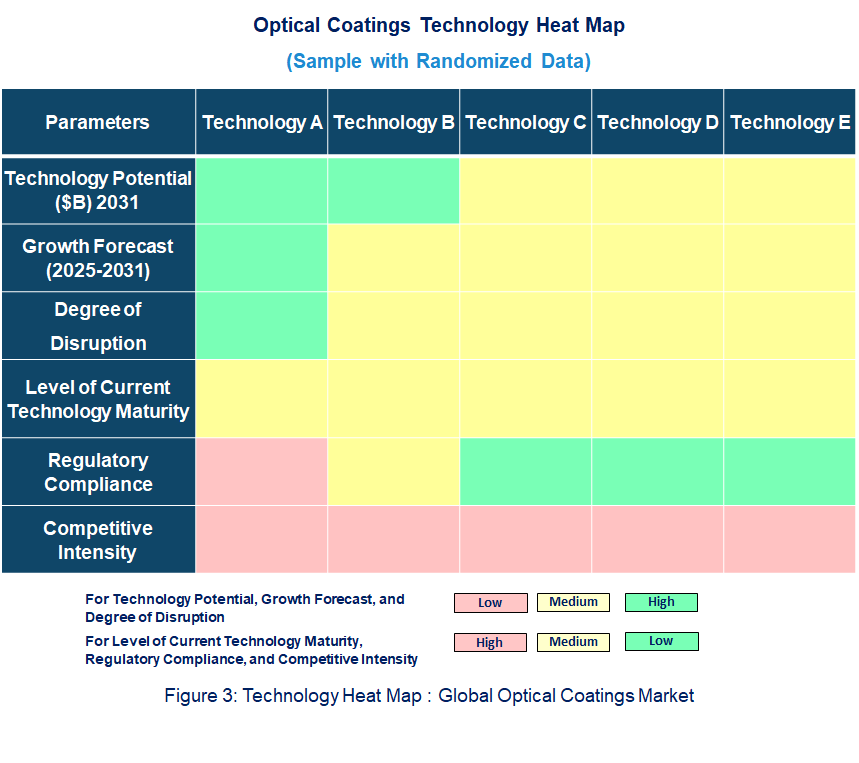
• Technology Potential: The technology potential of optical coatings is high, driven by the growing demand for high-performance optical components in sectors like AR/VR, advanced displays, and renewable energy. Innovations in multilayer coatings, anti-reflection films, and thin-film technologies are making it possible to develop more efficient and cost-effective solutions. In addition, the integration of coatings with new materials like graphene and quantum dots has further expanded application possibilities in high-performance optical systems.
• Degree of Disruption: The degree of disruption in the optical coatings market is moderate. Traditional coating technologies such as anti-reflection coatings and mirror coatings are well-established. However, emerging techniques like nanocoatings and adaptive coatings are starting to disrupt the market by offering enhanced functionality, such as dynamic light control and improved durability.
• Current Technology Maturity: The technology for optical coatings is relatively mature, with well-established methods like vacuum deposition and sputtering. However, innovations in nanotechnology and functional coatings are still in the developmental or early adoption phase.
• Regulatory Compliance: Optical coatings must comply with various industry standards, including ISO certifications and environmental regulations, particularly regarding material safety and performance. Compliance ensures the reliability and safety of optical components used in critical applications, such as aerospace and medical devices.
• Gelest: Gelest has introduced specialty coatings and materials for the semiconductor and optics industries. Their emphasis on novel materials has led to coatings with improved properties such as increased durability, enhanced reflectivity, and better resistance to environmental factors, making them appealing to the electronics and aerospace markets.
• Alluxa: Alluxa specializes in high-performance optical coatings, particularly for the telecommunications, aerospace, and defense industries. Their recent developments in custom thin-film coatings have expanded their market reach, providing solutions for optical systems that require precise spectral performance and high durability under extreme conditions.
• Cascade Optical: Cascade Optical has focused on expanding its capabilities in producing anti-reflective coatings for optical components. Their recent innovations in multi-layer coatings for laser optics and sensor applications have enhanced their reputation in precision optics, particularly for aerospace and defense markets.
• Chroma Technology: Chroma Technology has developed the use of optical coatings in scientific instruments, especially optical filters. Their coatings provide greater precision and efficiency, particularly in applications related to medical diagnostics and research, where performance is crucial.
• Inrad Optics: Inrad Optics has been broadening its portfolio of custom coatings for high-tech industries, particularly in laser optics and precision optical systems. Recent efforts include developing coatings with enhanced durability and optical performance for use in aerospace, defense, and medical devices.
• PPG Industries: PPG Industries continues to improve its line of coatings for both the automotive and electronics markets. The company has developed new optical coatings that address the need to further functionalize glass and optical parts used in automobile displays, smart windows, and consumer electronics for aesthetics and performance.
• Viavi Solutions: Viavi Solutions is at the forefront of innovation in optical coatings for fiber optics and telecommunications applications. Their emphasis on precision coatings for optical fibers and related components has improved performance in network communications, supporting the increasing demand for high-speed data transmission technologies. These advancements signify a continuous push for innovation and expansion into new markets for optical coatings. Such developments are based on scientific advancements in material science and coating processes, along with increasing demand for high-performance coatings in critical industries.
• Increasing demand for sophisticated optical components: The use of optical components in electronics, automotive, aerospace, and healthcare is driving the demand for high-quality coatings. As demand for performance in optics increases, there is a need for specialized coatings, such as anti-reflective, high-durability, and multi-layer coatings.
• Technological advancements in coating processes: Advancements in coating technologies, such as sputtering and ion-assisted deposition, have enhanced the precision, efficiency, and scalability of optical coatings. These innovations are expanding the range of applications and improving the performance of optical systems.
• Electronics and semiconductor sector growth: The miniaturization of electronic devices and semiconductors continues to drive the growth of optical coatings. Coatings improve performance, protect the product, and increase energy efficiency as electronics continue to miniaturize.
• Aerospace and defense applications: The demand for high-performance coatings in aerospace and defense, particularly for anti-reflective coatings and coatings that withstand extreme conditions, is driving market growth. Optical coatings are critical for avionics, sensors, and optical lenses used in these industries. Challenges in the optical coatings include:
• Cost and complexity of advanced coating technologies: Ion-assisted deposition and sputtering are advanced coating technologies that can be expensive in terms of production and equipment. This can limit their adoption, especially for smaller manufacturers or in cost-sensitive markets.
• Environmental and regulatory concerns: The optical coatings industry faces pressure to develop more environmentally friendly options. Concerns revolve around regulatory compliance regarding environmental standards and the use of hazardous materials in coatings. These drivers and challenges illustrate how the optical coatings market is dynamic, where technological advancements and industry growth are tempered by cost, regulatory, and material-related challenges.
• Gelest
• Alluxa
• Cascade Optical
• Chroma Technology
• Inrad Optics
• PPG Industries
• Technology Readiness by Type in the optical coatings market: Sputtering and e-beam evaporation are mature, widely used technologies for high-quality coatings. Sputtering is preferred for photonics and solar applications, while e-beam evaporation excels in material purity but requires complex equipment. IAD provides strong, durable films for aerospace and automotive optics. Vacuum deposition remains popular for less demanding applications but faces competition from advanced methods like ALD and IAD. Competitive intensity is high, and newer techniques offer better performance and efficiency. Regulatory compliance is essential, especially in high-risk sectors like aerospace, healthcare, and defense. Key applications include telecommunications, lens coatings, and aerospace optics.
• Competitive Intensity and Regulatory Compliance in the optical coatings market: The optical coatings market is highly competitive with technologies like sputtering, e-beam evaporation, IAD, and vacuum deposition, each suited for different applications. Sputtering and e-beam evaporation are commonly used for high-performance coatings in industries like telecommunications and optics, while IAD and ALD offer superior coating strength and performance, especially in aerospace and defense. Regulatory compliance is crucial, especially for industries like aerospace and healthcare, which have stringent safety and performance standards. Technologies like e-beam evaporation need to meet environmental requirements, while IAD and sputtering face energy efficiency challenges. As sustainability becomes more important, compliance with environmental regulations, such as RoHS, will be critical for all technologies.
• Disruption Potential of Technologies in optical coatings: Technologies like sputtering, e-beam evaporation, ion-assisted deposition, and vacuum deposition have significant disruption potential in the optical coatings market. Sputtering offers precision and superior adhesion, while e-beam evaporation ensures material purity, though it requires complex systems. Ion-assisted deposition (IAD) enhances film density and adhesion, making it ideal for durable applications. Vacuum deposition remains cost-effective but is challenged by more advanced methods. Emerging technologies like atomic layer deposition (ALD), capable of ultra-thin films with atomic precision, will disrupt niche applications requiring extreme precision. These technologies will evolve to meet the demand for thinner, more efficient coatings.
• Sputtering Process
• E-Beam Evaporation
• Ion-Assisted Deposition
• Vacuum Deposition
• Others
• Electronics & Semiconductor
• Aerospace & Defense
• Others
• North America
• Europe
• Asia Pacific
• The Rest of the World
• Latest Developments and Innovations in the Optical Coatings Technologies
• Companies / Ecosystems
• Strategic Opportunities by Technology Type


Choose a license that fits your team. Instant PDF delivery.
Prices exclude taxes. Instant delivery. Custom licensing available on request.
Market Report · May 18, 2026
Market Report · May 18, 2026
Market Report · May 18, 2026
Trusted partner for strategic intelligence and business growth


Receive a complimentary market analysis tailored to your industry. Our analysts will identify key growth opportunities and competitive dynamics specific to your business.

Market size, growth rate, and key trend analysis for your specific sector.

Top competitor positioning and market share analysis.

Strategic recommendations backed by data-driven insights.
Get curated market intelligence and competitive moves straight to your inbox.
By subscribing, you agree to receive our monthly insights. Unsubscribe anytime.
Receive a complimentary market analysis tailored to your industry. Our analysts will identify key growth opportunities and competitive dynamics specific to your business.
Market size, growth rate, and key trend analysis for your specific sector.
Top competitor positioning and market share analysis.
Strategic recommendations backed by data-driven insights.
Get curated market intelligence, emerging trends, and competitive moves straight to your inbox each month.
By subscribing, you agree to receive our monthly insights. Unsubscribe anytime.
We'll send your sample report shortly.