
Market Report · July 22, 2026

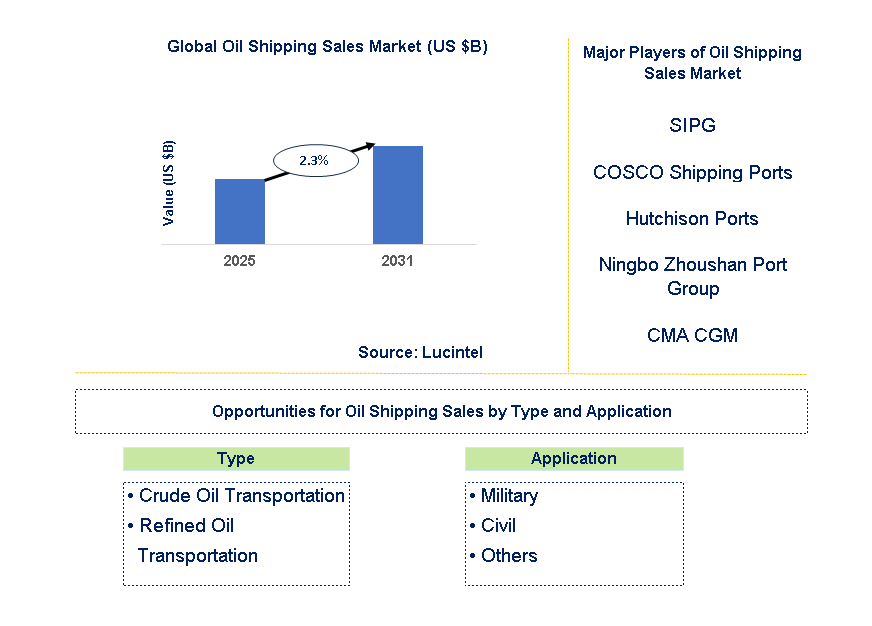
Key data points: The growth forecast = 2.3% annually for the next 7 years. Scroll below to get more insights. This market report covers Trends, opportunities and forecasts in oil shipping sales market to 2031 by type (crude oil transportation and refined oil transportation), application (military, civil, and others), and region (North America, Europe, Asia Pacific, and the Rest of the World)
We'll send your sample report shortly.
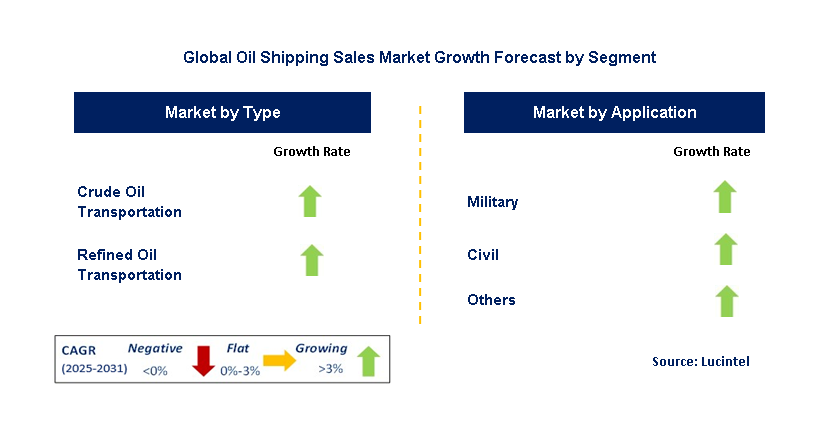
• Lucintel forecasts that, within the type category, crude oil transportation is expected to witness higher growth over the forecast period.
• Within the application category, civil is expected to witness higher growth due to expansion in global trade.
• In terms of region, APAC is expected to witness the highest growth over the forecast period due to increasing trade volumes in this region.
• Adoption of LNG-Powered Tankers: Shipping firms are increasingly investing in LNG-powered tankers to minimize carbon emissions and meet international regulations, increasing sustainability in oil transport.
• Growth in Digital Shipping Solutions: AI and IoT-based tracking systems are enhancing efficiency, allowing real-time monitoring of oil shipments and optimizing logistics to ensure speedy deliveries.
• Expansion of Green Shipping Corridors: Governments and shipping firms are jointly setting up green corridors that focus on environmentally friendly routes with low emissions to ensure the safe transportation of oil.
• Escalated Emphasis on Tanker Fleet Modernization: Older oil tankers are being phased out in favor of new, efficient ships that are compliant with the latest emissions laws and increase the fuel efficiency.
• Increased Investment in Port Infrastructure: Nations are overhauling seaport complexes to increase shipping capacity for crude oil, limit bottlenecks, and achieve overall efficiency within global oil exports.
These new trends are remodeling the oil shipping sales market by encouraging sustainability, boosting efficiency, and updating logistics. Market participants are embracing new tactics to adapt to changing regulatory and market environment.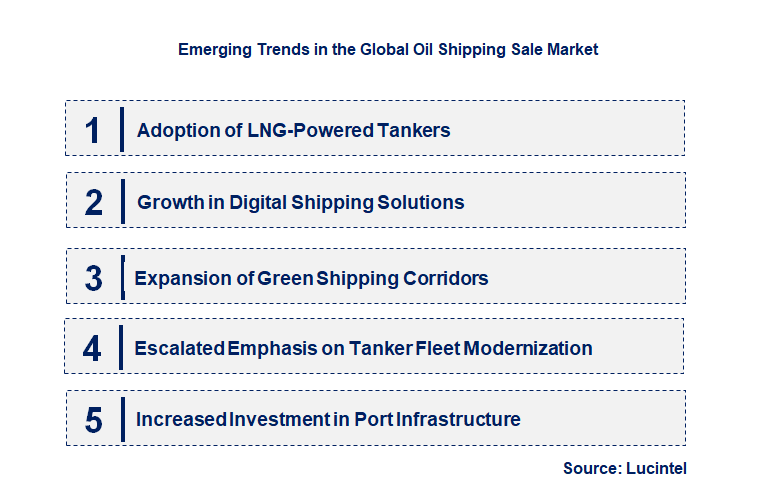
• Scaling of Carbon-Neutral Shipping Ventures: Firms are embracing carbon offset initiatives and green technologies to lower carbon emissions, as per global sustainability objectives.
• Deployment of AI-Based Route Optimization: Big data analytics and AI-enabled navigation systems are enhancing shipping efficiency through route optimization and reduced fuel usage.
• Growth in Dual-Fuel Tanker Adoption: The sector is moving toward dual-fuel ships that can operate on both traditional fuels and alternatives such as LNG, increasing flexibility in fuel utilization.
• Development of Automated Oil Tanker Systems: The adoption of automation and remote-control systems is improving tanker safety, eliminating human errors, and increasing operating efficiency.
• Growth in Strategic Oil Shipping Partnerships: Shipping companies for oil are entering partnerships to maximize fleet usage, share logistics infrastructure, and minimize total transportation costs.
These developments are promoting the oil shipping sales market by improving sustainability, increasing efficiency, and updating vessel fleets. The industry is changing to address new challenges while ensuring long-term profitability.• Adoption of Alternative Fuels: The shift towards LNG, biofuels, and hydrogen-based fuels is creating opportunities for shipbuilders and operators to develop cleaner, more efficient oil transport solutions.
• Increased Offshore Oil Production: Growing offshore oil production is propelling demand for specialized tankers and enhanced logistics for oil transport from distant extraction sites.
• Digital Supply Chain Solutions Growth: Blockchain, AI, and IoT technology integration is automating tracking of oil shipments, eliminating inefficiencies, and enhancing supply chain security.
• Investments in Smart Ports and Logistics: Nations are modernizing port facilities with automation, AI-based monitoring, and quicker handling systems to increase oil transport capacity.
• Development of Energy-Efficient Tankers: Improvements in ship design are opening up new market opportunities for energy-efficient tankers that meet more stringent environmental regulations.
These growth opportunities of a strategic nature are transforming the oil shipping sales market by fueling innovation, promoting efficiency, and enhancing sustainability. The sector is evolving in response to new demands while sustaining long-term market sustainability.• SIPG
• COSCO Shipping Ports
• Hutchison Ports
• Ningbo Zhoushan Port Group
• CMA CGM
• Hapag-Lloyd
• Ocean Network Express
• Crude Oil Transportation
• Refined Oil Transportation
• Military
• Civil
• Others
• North America
• Europe
• Asia Pacific
• The Rest of the World
• United States: The United States is growing its crude oil exports, selling more oil tankers to keep up with rising international demand. The nation is making investments in newer, more efficient vessels to meet international emission standards and make shipping more efficient. Moreover, developments in port facilities are allowing for quicker processes of shipping oil, making global trade more competitive.
• China: China is solidifying its position in the oil shipping industry by purchasing new tankers and constructing strategic port facilities. The nation is investing in green shipping technologies to lower carbon emissions while increasing its fleet to satisfy growing domestic and international demand for oil. Government policies are also aiding the modernization of oil transport logistics.
• Germany: Germany is prioritizing green oil shipping solutions through the promotion of low-emission ships and alternative fuels. Germany is investing in LNG-fueled oil tankers to meet European Union environmental standards. Furthermore, innovations in digital shipping technology are enhancing operational efficiency and traceability, increasing Germany's position in global oil shipping.
• India: India is augmenting its shipping capacity for oil by investing in bigger tanker fleets and developing its maritime infrastructure. India is bolstering its shipping deals with major oil-exporting countries to have a secure supply chain. India is also implementing cutting-edge maritime logistics technology to make oil transportation more efficient and cost-effective in the industry.
• Japan: Japan is also modernizing its oil shipping business by embracing energy-efficient ship designs and automation technologies. The nation is concentrating on minimizing its reliance on older tankers by ordering new environmentally friendly ships. Initiatives by the government are encouraging sustainable shipping to keep Japan an important player in international oil trade while adhering to emissions norms.


• SIPG
• COSCO Shipping Ports
• Hutchison Ports
• Ningbo Zhoushan Port Group
• CMA CGM
• Hapag-Lloyd
• Ocean Network Express
Q5. Which oil shipping sales market segment will be the largest in future?

Choose a license that fits your team. Instant PDF delivery.
Prices exclude taxes. Instant delivery. Custom licensing available on request.
Market Report · July 22, 2026
Market Report · June 26, 2026
Market Report · May 18, 2026
Trusted partner for strategic intelligence and business growth


Receive a complimentary market analysis tailored to your industry. Our analysts will identify key growth opportunities and competitive dynamics specific to your business.

Market size, growth rate, and key trend analysis for your specific sector.

Top competitor positioning and market share analysis.

Strategic recommendations backed by data-driven insights.
Get curated market intelligence and competitive moves straight to your inbox.
By subscribing, you agree to receive our monthly insights. Unsubscribe anytime.
Receive a complimentary market analysis tailored to your industry. Our analysts will identify key growth opportunities and competitive dynamics specific to your business.
Market size, growth rate, and key trend analysis for your specific sector.
Top competitor positioning and market share analysis.
Strategic recommendations backed by data-driven insights.
Get curated market intelligence, emerging trends, and competitive moves straight to your inbox each month.
By subscribing, you agree to receive our monthly insights. Unsubscribe anytime.
We'll send your sample report shortly.