
Market Report · July 24, 2026

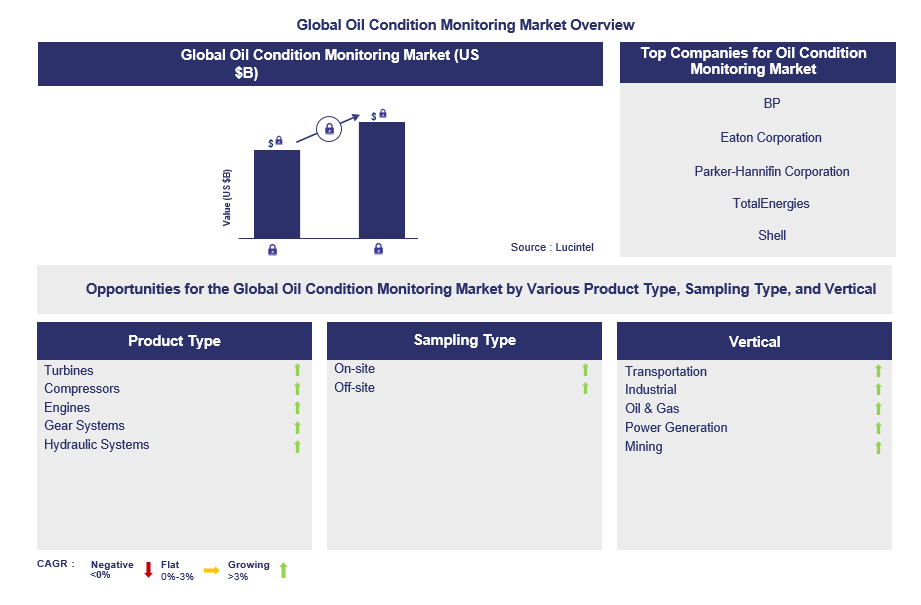
Key data points: The market size in 2030 = $1.9 billion, growth forecast = 7.1% annually for the next 6 years. Scroll below to get more insights. This market report covers trends, opportunities, and forecasts in the global oil condition monitoring market to 2030 by product type (turbines, compressors, engines, gear systems, and hydraulic systems), sampling type (on-site and off-site), vertical (transportation, industrial, oil & gas, power generation, and mining), and region (North America, Europe, Asia Pacific, and the Rest of the World)
We'll send your sample report shortly.
• Lucintel forecasts that, within the product type category, the engine segment is expected to witness the highest growth over the forecast period.
• Within the vertical category, the power generation segment will remain the largest segment.
• In terms of region, APAC is expected to witness the highest growth over the forecast period.
• Artificial Intelligence and Machine Learning Integration: Oil condition monitoring is being transformed by the adoption of artificial intelligence (AI) and machine learning (ML). These technologies allow for real-time processing of information, enabling more accurate oil quality assessments and machinery health evaluations. By incorporating AI and ML, companies can better anticipate maintenance needs, reduce sudden failures, and optimize maintenance schedules, ultimately improving performance while lowering costs.
• Embrace of Industrial Internet of Things (IIoT): The Industrial Internet of Things (IIoT) has revolutionized oil condition monitoring by enabling sensors and monitoring devices to integrate with cloud-based analytics platforms. This allows organizations to continuously monitor equipment performance and oil conditions, providing actionable insights. The IIoT improves data collection and analysis, leading to better decision-making and timely interventions that can significantly extend equipment life at much lower maintenance costs.
• Increased Demand for Predictive Maintenance: Predictive maintenance solutions are increasingly in demand across various sectors due to the need to reduce downtime and lower maintenance costs. Data analytics enable predictive maintenance systems to anticipate equipment failures before they occur, minimizing potential damage from unforeseen breakdowns or accidents. This leads to higher uptime, improved safety, and, most importantly, increased productivity, particularly in the manufacturing, automotive, and energy industries, where reliability is paramount.
• Sustainability and Environmental Compliance Drive: The oil condition monitoring market is seeing a rise in focus on sustainability and environmental compliance. Waste management and emissions must be strictly regulated by organizations. Monitoring systems help reduce waste, maximize oil usage, and support sustainable operations. By investing in such monitoring systems, companies can create a healthier environment while improving their compliance with stringent regulations and enhancing their reputation.
• Sensor Technology Advancements: Oil condition monitoring is heavily influenced by advances in sensor technology. New developments in sensor design facilitate more accurate measurements of oil parameters such as viscosity, acidity, and contamination levels. These improvements result in better data quality, leading to more informed decision-making and better maintenance planning practices. As these technologies evolve, they will play a significant role in improving the effectiveness of oil condition monitoring systems (OCMS) across industries.

• Oil Sensor Technology Advancements: The introduction of novel sensors, such as wireless sensor networks and fiber optic sensors, has made real-time tracking of oil parameters like temperature, pressure, and viscosity possible. This allows for early identification of potential failures and provides valuable insights into equipment health.
• Integration with AI and Machine Learning: Large volumes of sensor data can now be analyzed using AI and ML algorithms to identify patterns indicative of abnormal oil conditions. This enables predictive maintenance, which reduces downtime by predicting equipment failure before it occurs, thereby lowering both downtime costs and maintenance expenses.
• Cloud-Based Platforms Development: Cloud-based platforms offer a cost-effective, scalable solution for storing, analyzing, and visualizing data related to the condition of oil. These platforms support remote monitoring, collaboration, and advanced analytics capabilities.
• Increased Focus on Integration with IoT: Real-time data collection and remote diagnostics through IoT technologies are now integral to oil condition monitoring systems. This integration helps achieve predictive maintenance capabilities, improving operational efficiencies and enhancing asset management.
• Growing Adoption of Digital Twins: Digital twins simulate scenarios for oil condition monitoring while optimizing maintenance strategies for physical assets represented virtually. New technologies can be tested, potential risks identified, and overall asset performance improved.
• Automotive Industry: Oil condition monitoring in vehicles has been revolutionized by advanced sensors and real-time monitoring systems, which enable predictive maintenance that reduces engine wear. This extends vehicle life, reduces maintenance costs, and improves reliability.
• Industrial Machinery: The integration of IoT (Internet of Things) and AI (Artificial Intelligence) into oil condition monitoring systems has made data analysis more precise and automated. This progress minimizes unplanned downtime by detecting potential failures early and optimizing the performance of manufacturing plant machinery.
• Aviation Sector: Enhanced oil condition monitoring is essential for ensuring engine safety and efficiency in aviation. Real-time monitoring and analysis of oil quality help predict when servicing is needed, preventing costly in-flight failures and ensuring compliance with strict safety regulations.
• Marine Industry: Monitoring the condition of oils is crucial in marine applications to prevent engine breakdowns and failures caused by harsh environmental conditions. Adoption of sophisticated monitoring solutions can increase operational reliability, reduce risks associated with costly repairs, and enhance vessel performance.
• Power Generation: Turbines and generators in power plants rely on oil condition monitoring to maintain efficiency and reliability. These systems help prevent unexpected breakdowns by detecting early signs of oil degradation, optimizing maintenance planning, and improving operational efficiency within power plants.
• Technological advancements: Sensor technology, data analytics, and machine learning have evolved rapidly, making oil condition monitoring systems more effective than ever before. These advancements allow for more accurate detection of flaws and timely responses, leading to improved equipment reliability and reduced maintenance costs.
• More emphasis on predictive maintenance: Industries worldwide are increasingly focused on optimizing their operational efficiency while minimizing downtime. To enable predictive maintenance and highlight potential equipment failures before they happen, oil condition monitoring plays a significant role.
• Increasing energy demands: The global rise in energy demand, driven by population growth and economic development, has led to increased production and consumption of oil and gas. This calls for efficient monitoring of oil-related machinery to ensure maximum performance and durability.
• Environmental regulations and regulatory mandates: Governments globally have implemented stringent regulations to address environmental concerns and ensure the safe operation of industrial entities. Information about the condition of oil-based systems is critical for compliance with these regulations, such as health records and emissions data.
• Inexpensive solutions: Technological advancements and economies of scale have made oil condition monitoring solutions more affordable, allowing many industries to adopt these systems. As a result, the market has expanded, creating more growth opportunities.
• Data integration and analysis: Oil condition monitoring systems generate large amounts of data, which must be integrated and analyzed effectively. Strong data management and analysis capabilities are required to extract valuable insights that promote informed decision-making.
• Sensor reliability and accuracy: Poor calibration can negatively affect sensor accuracy. Since the reliability of sensors is crucial for generating accurate findings from oil condition monitoring systems, questionable sensor quality can undermine the credibility of the data.
• Security risks: As oil condition monitoring systems become more connected, they face increased risks of cyberattacks. Unauthorized access and potential data loss are serious concerns that need to be addressed to ensure the security and integrity of the system.
• BP
• Eaton Corporation
• Parker-Hannifin Corporation
• Totalenergies
• Shell
• General Electric
• Bureau Veritas
• SGS
• Chevron Corporation
• Intertek Group
• Turbines
• Compressors
• Engines
• Gear Systems
• Hydraulic Systems
• On-Site
• Off-Site
• Transportation
• Industrial
• Oil & Gas
• Power Generation
• Mining
• North America
• Europe
• Asia Pacific
• The Rest of the World
• United States: AI and IoT technologies have been integrated into oil condition monitoring systems to boost performance in the United States. Many companies now prefer predictive analytics for real-time monitoring, which makes scheduling maintenance easier and helps reduce downtime. These advanced sensors are more data-analytical, leading to highly accurate diagnostics and better management of oil health.
• China: The Chinese market has expanded due to rapid industrial growth and infrastructure development. There has been a significant transition to automated systems for determining lubricant quality, responding to the growing demand for operational efficiency and lower service costs. The adoption of advanced sensors and data collection techniques has made oil analysis more reliable and accurate across various industrial applications.
• Germany: The German market is focused on technological innovation, particularly precision engineering applied to oil condition monitoring. Advanced spectroscopy techniques, along with machine learning algorithms, have been adopted to make oil analysis more precise. The goal is to integrate these systems with existing industrial infrastructure to make them predictive rather than reactive, promoting the extended lifespan of equipment.
• India: Growth in manufacturing processes and modernization efforts have driven India's oil condition monitoring market. Key developments include the introduction of locally designed, low-cost yet high-performance monitoring solutions. Various industries are emphasizing digitization and automation to improve maintenance procedures while reducing operational costs.
• Japan: Advanced monitoring technologies are being integrated with traditional industries in Japan. Innovations include the use of highly sensitive sensors and automated analysis tools, which enhance the accuracy of oil condition assessments. These technologies are used to maintain high operational standards and extend the lifespan of machinery in this market.


• BP
• Eaton Corporation
• Parker-Hannifin Corporation
• TotalEnergies
• Shell
• General Electric
• Bureau Veritas
• SGS
• Chevron Corporation
• Intertek Group
Q6. Which oil condition monitoring market segment will be the largest in the future?

Choose a license that fits your team. Instant PDF delivery.
Prices exclude taxes. Instant delivery. Custom licensing available on request.
Market Report · July 24, 2026
Market Report · July 20, 2026
Market Report · July 20, 2026
Trusted partner for strategic intelligence and business growth


Receive a complimentary market analysis tailored to your industry. Our analysts will identify key growth opportunities and competitive dynamics specific to your business.

Market size, growth rate, and key trend analysis for your specific sector.

Top competitor positioning and market share analysis.

Strategic recommendations backed by data-driven insights.
Get curated market intelligence and competitive moves straight to your inbox.
By subscribing, you agree to receive our monthly insights. Unsubscribe anytime.
Receive a complimentary market analysis tailored to your industry. Our analysts will identify key growth opportunities and competitive dynamics specific to your business.
Market size, growth rate, and key trend analysis for your specific sector.
Top competitor positioning and market share analysis.
Strategic recommendations backed by data-driven insights.
Get curated market intelligence, emerging trends, and competitive moves straight to your inbox each month.
By subscribing, you agree to receive our monthly insights. Unsubscribe anytime.
We'll send your sample report shortly.