
Market Report · May 18, 2026

This market report covers trends, opportunities, and forecasts in the global nut processing machine market to 2031 by technology (dry roasting technology, peeling technology, shelling technology, sorting and grading technology, and others), end use industry (food and beverage industry, agriculture industry, retail and packaging industry, pharmaceuticals industry, and others), and region (North America, Europe, Asia Pacific, and the Rest of the World)
We'll send your sample report shortly.
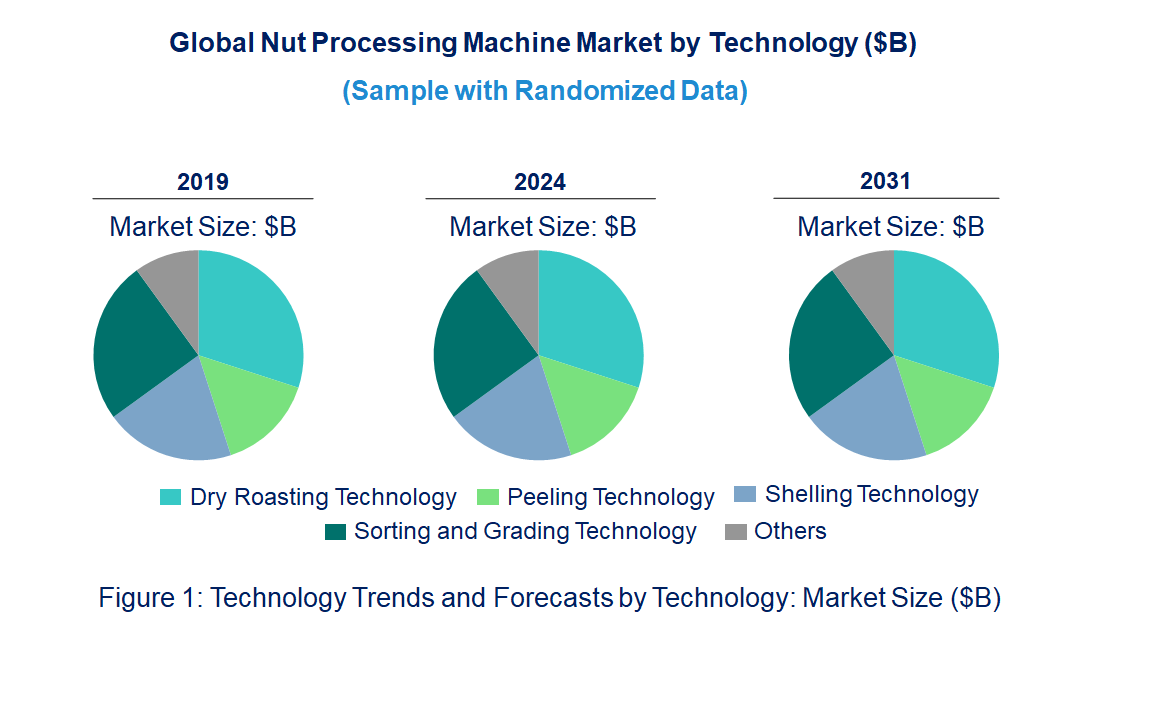
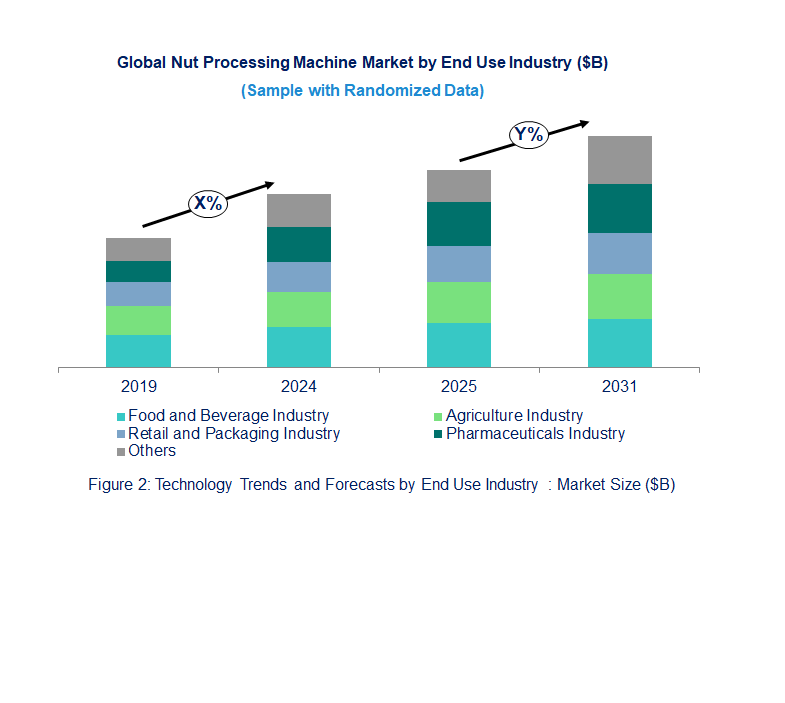
• Adoption of AI and Optical Sorting Systems: Advanced AI-driven optical sorters are replacing manual and semi-automatic grading systems. These systems offer improved accuracy, higher throughput, and reduced product waste.
• Energy-Efficient Infrared Roasting: Infrared roasting technology is emerging as a cleaner, faster, and more energy-efficient alternative to traditional convection roasting. It significantly reduces processing time and energy usage.
• Integration of IoT and Predictive Maintenance: Machines equipped with IoT sensors provide real-time data on performance. This enables predictive maintenance and reduces unexpected downtimes.
• Multi-Function Processing Units: Manufacturers are shifting toward machines that integrate peeling, shelling, and grading into a single unit. This optimizes floor space and improves operational efficiency.
• Customization and Smart Control Interfaces: Smart touch panels and customizable machine settings allow operators to fine-tune processing conditions based on different nut types. This leads to better consistency and reduces operator error. These technology trends are reshaping the nut processing machine market by making operations more precise, reliable, and cost-efficient. As automation, smart technologies, and energy-saving methods become standard, the market is expected to become increasingly competitive and innovation-driven. This shift aligns with evolving industry demands and consumer expectations.
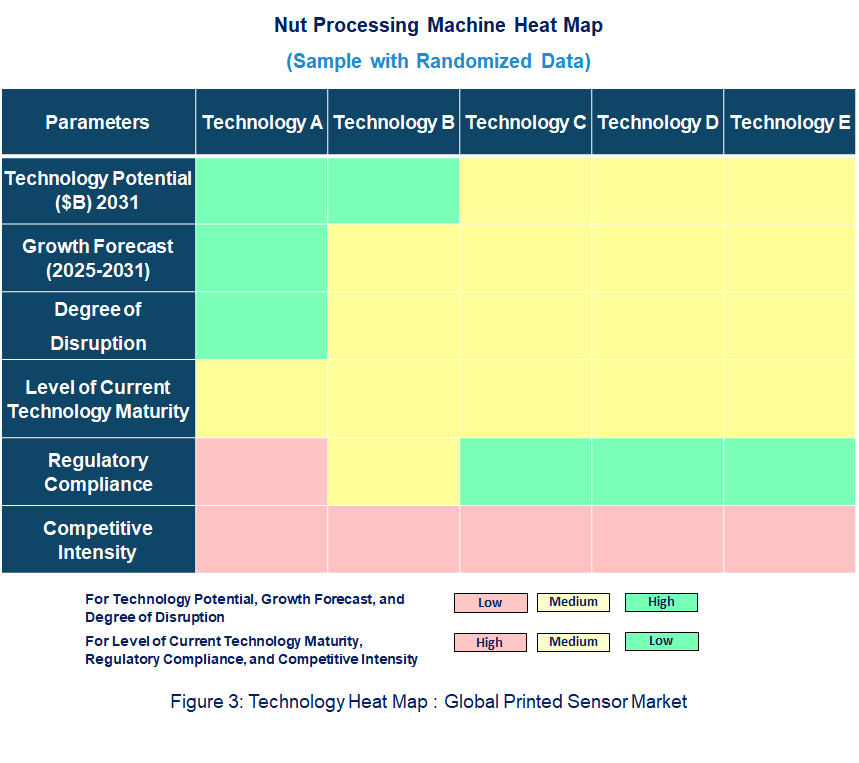
• Technology Potential: The nut processing machine market technology holds significant potential due to increasing demand for high-efficiency automated solutions that enhance productivity, reduce labor costs, and maintain product quality. Innovations such as AI-based quality inspection, IoT-enabled monitoring, and precision sorting are reshaping the industry.
• Degree of Disruption: In terms of the degree of disruption, these technologies are moderately to highly disruptive. Traditional nut processing methods are labor-intensive and less consistent. Automation and smart technologies drastically change operations by increasing throughput and reducing waste, creating a competitive edge for early adopters.
• Level of Current Technology Maturity: The level of current technology maturity varies across segments. Basic processing equipment, such as shellers and roasters, is well established. However, advanced technologies, including optical sorters, robotic handling, and AI-driven grading systems, are in the growth stage, with increasing adoption and room for optimization and wider deployment.
• Regulatory Compliance: Regulatory compliance is a critical aspect, especially for food-grade machinery. Technologies must comply with international food safety standards such as FDA, ISO 22000, and CE marking. There is also growing pressure to meet environmental regulations regarding energy use and waste management. Manufacturers are investing in technologies that support traceability, hygiene, and sustainable processing to align with global regulations and meet consumer expectations. As technology continues to advance, the nut processing machine market is poised for substantial growth. Automation and smart technologies are transforming traditional methods, offering significant improvements in productivity, consistency, and sustainability. However, manufacturers must balance innovation with compliance with regulatory standards to ensure food safety and environmental responsibility. With ongoing developments, the market is likely to see wider adoption of these advanced systems, providing competitive advantages to those who invest early in these technologies.
• Dry Roasting Technology: It has the potential to revolutionize nut roasting by offering more uniform heating and energy efficiency, reducing production time.
• Peeling Technology: This enhances the quality of peeled nuts with greater precision and minimizes damage, driving automation in processing.
• Shelling Technology: Innovations such as robotic and pneumatic shelling systems drastically reduce waste and increase throughput.
• Sorting and Grading Technology: Powered by AI and machine vision, this technology is transforming nut selection, ensuring consistent quality and minimizing human intervention. Other emerging technologies, such as vacuum frying or sustainable packaging systems, provide eco-friendly alternatives that cater to consumer preferences for healthier, more sustainable products. These technologies collectively disrupt traditional nut processing by reducing costs, waste, and labor while enhancing productivity and product quality.
• Technological Advancements: Automation and innovations in machine design have improved efficiency and precision, reducing manual labor and enhancing processing speeds. The shift toward digital solutions is also making machines more adaptable and user-friendly, accelerating market growth.
• Demand for Processed and Packaged Nuts: The rising popularity of processed nuts as snacks and ingredients in healthy foods is fueling the need for efficient nut processing equipment. Health-conscious consumers are propelling this demand, leading to an increase in machine installations worldwide.
• Automation and Labor Cost Reduction: With automation becoming a priority in various industries, the nut processing sector is increasingly adopting machines that minimize human intervention, reduce labor costs, and improve overall operational efficiency.
• Growth in Health Consciousness: With an increasing number of consumers prioritizing health, the demand for plant-based, nutritious products like nuts has surged. This has spurred the need for efficient, high-quality nut processing machines to cater to the global market.
• Expansion of Nut Processing Plants: The global expansion of nut processing plants, particularly in emerging markets, is increasing the demand for advanced processing machines to meet production targets, thus driving market growth. Challenges in the nut processing market are:
• High Capital Investment: The high initial cost of purchasing and maintaining nut processing machines can deter small-scale producers from entering the market. The financial barrier to entry remains a significant challenge for many businesses, especially in developing regions.
• Skilled Labor Shortage: Despite technological advancements, operating and maintaining nut processing machines require specialized skills. The shortage of skilled labor and technical expertise to handle complex machinery is hampering the market's growth in certain regions.
• Fluctuating Raw Material Prices: The volatility in nut prices due to climate conditions, supply chain disruptions, and agricultural challenges creates an unstable market environment. This unpredictability affects the overall demand for processing machines and their utilization rates. The nut processing machine market is experiencing robust growth driven by technological advancements, increasing demand for processed nuts, and a shift toward automation. However, challenges such as high capital investment, labor shortages, and fluctuating raw material prices continue to pose hurdles
• Bt Corporation
• Key Technology
• The Middleby Corporation
• Feucht-Obsttechnik.De
• Lewis M. Carter Manufacturing, Llc,
• Buhler Ag
• Disruption Potential of Technologies for Nut Processing Machine Technology: Dry roasting technology has high disruption potential due to growing demand for oil-free, healthier snack alternatives, with energy-efficient and automated systems enhancing productivity. Peeling technology offers medium disruption by improving yield and minimizing damage to nut kernels, especially with laser or pneumatic systems. Shelling technology remains essential and increasingly disruptive through precision mechanics and AI-based shell recognition, reducing waste and enhancing throughput. Sorting and grading technology is highly disruptive as it leverages computer vision and machine learning for real-time quality assessment, enabling premium product segmentation. Other emerging technologies, such as vacuum drying or microwave-based treatments, hold niche disruption potential in quality retention and energy optimization. Overall, technologies that enhance automation, reduce waste, and ensure consistent quality are driving disruption in nut processing. AI integration and sensor-driven precision are increasingly central to this disruption across multiple stages.
• Competitive Intensity and Regulatory Compliance of Technologies for Nut Processing Machine Technology: Dry roasting and shelling Technologies face high competitive intensity due to strong demand from large-scale processors and innovation in heat management and mechanical precision. Peeling Technology is moderately competitive, especially in regions focusing on kernel preservation. Sorting and grading technologies are fiercely competitive, with vision-based systems and AI integration creating a fast-evolving landscape. Other technologies, such as microwave processing or automated packaging, are seeing emerging competition. Regulatory compliance is moderate to high across the board: Dry roasting must meet food safety and thermal processing regulations. Shelling and Peeling must comply with machinery safety and food contact material standards. Sorting systems must ensure hygiene and non-contamination, especially with optical equipment. Other technologies face varying compliance depending on the novelty and energy use. Overall, competition is tied to efficiency gains, yield improvement, and ease of regulatory approval.
• Technology Readiness, Competitive Level, Regulatory Compliance, and Key Applications by Technology Type: Dry roasting technology, with high competitiveness and moderate regulatory scrutiny; widely used in commercial nut roasting lines. Peeling technology stands at, moderately competitive level, with safety and contamination standards applied in almond, peanut, and cashew processing. Shelling technology is highly competitive due to mechanical innovations and kernel integrity requirements, used in cracking hard-shelled nuts like walnuts and pistachios. Sorting and grading technology is facing intense competition, crucial for premium nut classification based on size, color, and defects. Other technologies (e.g., microwave drying, UV sterilization) vary from with emerging competitiveness and evolving compliance needs; applicable in specialty processing and preservation. Each technology serves a specific step in the nut processing chain, with readiness and competition dictated by efficiency, food safety, and automation capabilities.
• Dry Roasting Technology
• Peeling Technology
• Shelling Technology
• Sorting and Grading Technology
• Others
• Food and Beverage Industry
• Agriculture Industry
• Retail and Packaging Industry
• Pharmaceuticals Industry
• Others
• North America
• Europe
• Asia Pacific
• The Rest of the World
• Latest Developments and Innovations in the Nut Processing Machine Technologies
• Companies / Ecosystems
• Strategic Opportunities by Technology Type


Choose a license that fits your team. Instant PDF delivery.
Prices exclude taxes. Instant delivery. Custom licensing available on request.
Market Report · May 18, 2026
Market Report · May 18, 2026
Market Report · May 18, 2026
Trusted partner for strategic intelligence and business growth


Receive a complimentary market analysis tailored to your industry. Our analysts will identify key growth opportunities and competitive dynamics specific to your business.

Market size, growth rate, and key trend analysis for your specific sector.

Top competitor positioning and market share analysis.

Strategic recommendations backed by data-driven insights.
Get curated market intelligence and competitive moves straight to your inbox.
By subscribing, you agree to receive our monthly insights. Unsubscribe anytime.
Receive a complimentary market analysis tailored to your industry. Our analysts will identify key growth opportunities and competitive dynamics specific to your business.
Market size, growth rate, and key trend analysis for your specific sector.
Top competitor positioning and market share analysis.
Strategic recommendations backed by data-driven insights.
Get curated market intelligence, emerging trends, and competitive moves straight to your inbox each month.
By subscribing, you agree to receive our monthly insights. Unsubscribe anytime.
We'll send your sample report shortly.