
Market Report · July 15, 2026

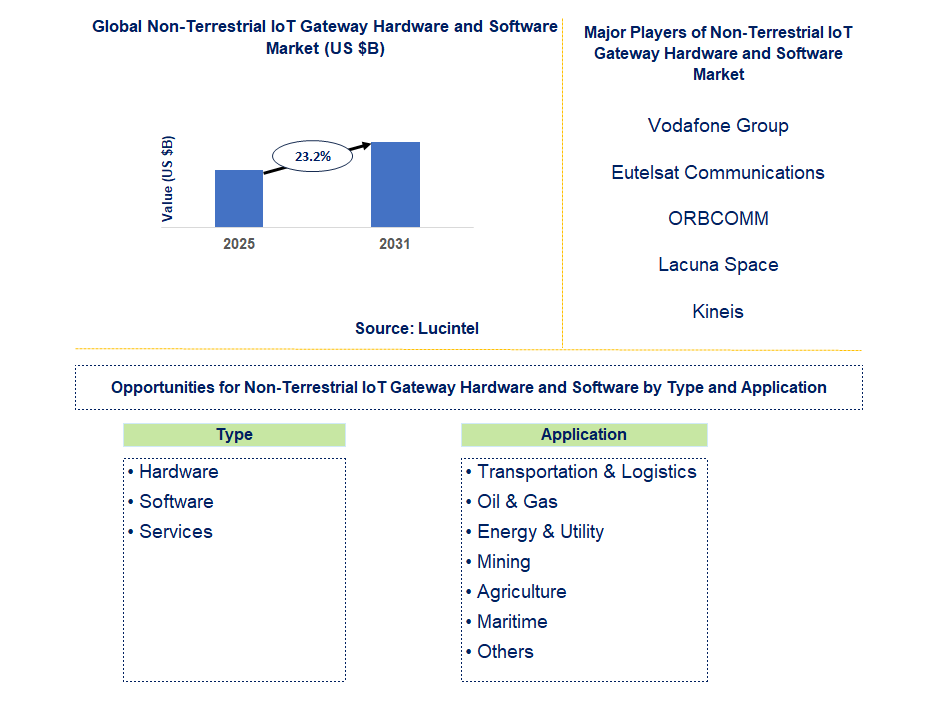
Key data points: The growth forecast = 23.2% annually for the next 7 years. Scroll below to get more insights. This market report covers Trends, opportunity and forecast in non-terrestrial IoT gateway hardware and software market to 2031 by type (hardware, software, and services), application (transportation & logistics, oil & gas, energy & utility, mining, agriculture, maritime, and others), and region (North America, Europe, Asia Pacific, and the Rest of the World)
We'll send your sample report shortly.
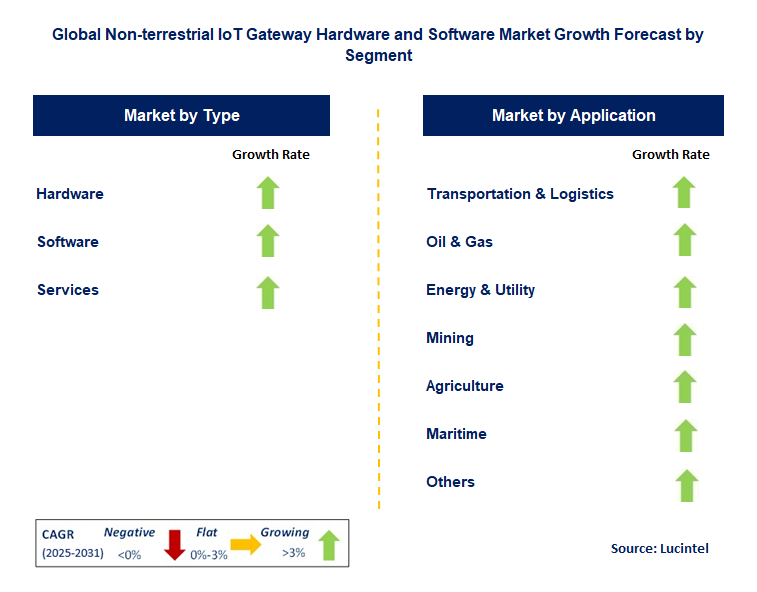
• Lucintel forecasts that, within the type category, hardware is expected to witness the highest growth over the forecast period.
• Within the application category, transportation & logistic is expected to witness the highest growth.
• In terms of region, APAC is expected to witness the highest growth over the forecast period. Gain valuable insights for your business decisions with our comprehensive 150+ page report. Sample figures with some insights are shown below.
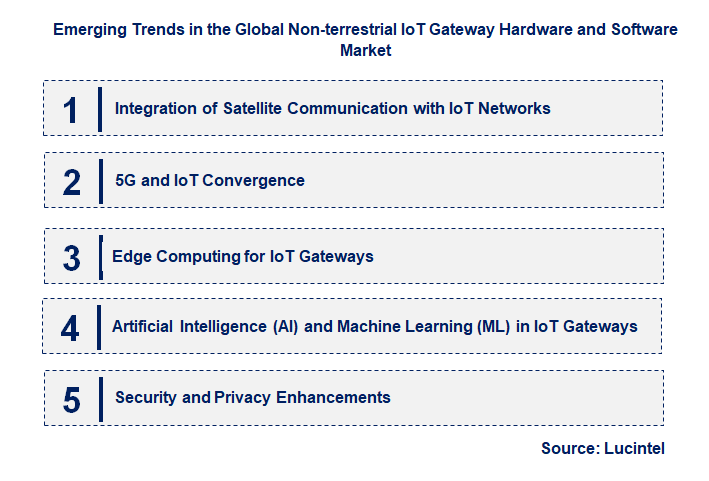
• Integration of Satellite Communication with IoT Networks: The integration of satellite communication with traditional IoT networks is a key trend that is reshaping the market. Satellite-based IoT gateways are bridging the connectivity gap in remote and rural areas where terrestrial networks are unavailable. By leveraging low Earth orbit (LEO) satellites, IoT devices can maintain global communication with minimal latency and increased reliability. This integration enables real-time monitoring and data collection in applications such as environmental monitoring, agriculture, and logistics. As satellite communication technology continues to improve, its integration with IoT networks will expand, offering a robust solution for global IoT connectivity, especially in underserved regions.
• 5G and IoT Convergence: The convergence of 5G and IoT is another emerging trend driving the Non-terrestrial IoT Gateway market. 5G technology offers ultra-low latency, high bandwidth, and massive connectivity, making it ideal for IoT applications that require real-time data transfer. The combination of 5G networks with non-terrestrial gateways, such as satellite IoT systems, enables seamless communication across vast geographies. This trend is particularly beneficial for sectors like autonomous vehicles, smart cities, and remote healthcare. With 5G facilitating higher-speed IoT data exchange and non-terrestrial gateways ensuring global coverage, the convergence of these technologies will unlock new opportunities for IoT innovations.
• Edge Computing for IoT Gateways: Edge computing is increasingly being integrated into non-terrestrial IoT gateways to enable faster data processing and reduce reliance on centralized cloud servers. By processing data at the edge, closer to the source of the data, this technology improves response times and reduces latency, crucial for time-sensitive IoT applications. In non-terrestrial environments, such as remote areas or maritime regions, this trend is particularly beneficial as it minimizes the need for continuous satellite communication, saving bandwidth and improving operational efficiency. The implementation of edge computing at IoT gateways enhances the overall performance of satellite-based IoT systems, making them more efficient and scalable.
• Artificial Intelligence (AI) and Machine Learning (ML) in IoT Gateways: Artificial intelligence (AI) and machine learning (ML) are being integrated into non-terrestrial IoT gateway systems to enhance their data analytics capabilities. By incorporating AI and ML algorithms, IoT gateways can process large volumes of data in real-time and make intelligent decisions based on the insights generated. This trend is particularly relevant in applications such as predictive maintenance, where AI algorithms analyze sensor data to predict failures before they occur. The ability to perform AI-driven analysis on IoT data collected via satellite or other non-terrestrial means will drive greater automation, efficiency, and scalability in industries such as transportation, energy, and agriculture.
• Security and Privacy Enhancements: As the number of connected IoT devices increases, ensuring data security and privacy has become a critical trend in the Non-terrestrial IoT Gateway market. The use of non-terrestrial networks adds an extra layer of complexity, as satellite communications can be vulnerable to interception, jamming, and other cybersecurity threats. There is a growing focus on integrating robust encryption, blockchain technology, and secure authentication mechanisms into IoT gateways to address these concerns. This trend is essential for safeguarding sensitive data and ensuring the integrity of communication in industries such as defense, healthcare, and finance, where security is paramount. These emerging trends—satellite integration, 5G convergence, edge computing, AI/ML adoption, and enhanced security—are reshaping the non-terrestrial IoT gateway hardware and software market. Together, they are expanding the reach and capabilities of IoT systems, enabling real-time, low-latency communication and fostering innovation across various industries. With satellite and 5G technologies pushing the boundaries of connectivity, IoT gateways are becoming increasingly sophisticated, providing seamless global communication and advanced data processing. As these trends evolve, the market will witness significant advancements in the efficiency, scalability, and security of IoT solutions in non-terrestrial environments.
• Integration of Low Earth Orbit (LEO) Satellites: The deployment of Low Earth Orbit (LEO) satellite constellations is a major development in the Non-terrestrial IoT Gateway market. Companies like SpaceX's Starlink and OneWeb are launching large fleets of LEO satellites to provide low-latency, high-speed IoT connectivity. This is particularly beneficial for remote monitoring and data collection in areas where traditional terrestrial networks are unavailable or unreliable. LEO satellites ensure global coverage, making them essential for industries like agriculture, logistics, and maritime, where IoT devices require reliable, uninterrupted communication.
• 5G and Satellite Network Integration: The integration of 5G technology with satellite networks is transforming the Non-terrestrial IoT Gateway market by enhancing the speed, capacity, and reliability of IoT communications. This integration enables hybrid communication systems that combine the strengths of 5G's high bandwidth and low latency with the global coverage of satellite networks. This development is crucial for industries requiring real-time data transmission, such as autonomous vehicles, smart cities, and industrial automation. It is also expected to improve network efficiency, providing more reliable connectivity for IoT devices in remote or underserved locations.
• Miniaturization of IoT Gateways: Advances in miniaturization and the development of compact, low-power IoT gateways are allowing for broader applications in the Non-terrestrial IoT space. Smaller, more energy-efficient hardware enables the deployment of IoT systems in remote areas, even in harsh environments like deserts or polar regions, where power sources are limited. These compact gateways also reduce costs and allow for more affordable, scalable solutions in industries such as agriculture, wildlife monitoring, and environmental sensing. The trend toward miniaturization is making Non-terrestrial IoT solutions more accessible and feasible for small and medium-scale applications.
• Software-Defined Networking (SDN) for IoT Gateways: Software-Defined Networking (SDN) is being increasingly adopted to improve the flexibility, scalability, and manageability of IoT gateways. SDN allows for dynamic reconfiguration of network protocols, enabling IoT devices to adapt quickly to changing conditions. This is especially important for non-terrestrial communication, where varying satellite conditions can impact network performance. With SDN, IoT gateways can automatically optimize their routing and network parameters, ensuring consistent and efficient data transmission. This development is making IoT systems more resilient, with the ability to maintain performance even in challenging network environments.
• Collaboration Between Satellite and Telecom Providers: Growing collaborations between satellite providers and telecom companies are accelerating the development of integrated non-terrestrial IoT solutions. Telecom providers are increasingly partnering with satellite operators to offer hybrid communication services, which combine terrestrial and satellite networks for seamless connectivity. This partnership is enabling more comprehensive and robust IoT systems that can provide continuous coverage, even in remote or rural areas. The collaboration between these sectors is lowering the barriers to entry for IoT applications, particularly in sectors like agriculture, logistics, and environmental monitoring. Recent developments in the non-terrestrial IoT gateway hardware and software market are significantly enhancing the capabilities of global IoT networks. The integration of LEO satellites, 5G networks, miniaturized gateways, SDN, and telecom-satellite collaborations are driving the market forward, providing seamless and reliable connectivity across diverse industries. These innovations are ensuring that IoT devices in remote or challenging locations can transmit data effectively, thus expanding the range of applications and fostering growth in industries like agriculture, logistics, and environmental monitoring. As these developments continue, the market will experience greater scalability, flexibility, and reliability, opening new opportunities for IoT-driven innovations.
• Remote Monitoring and Environmental Management: Integrating non-terrestrial IoT gateways for remote monitoring in environmental management is a significant growth opportunity. IoT-enabled sensors and devices can be deployed in remote locations such as forests, oceans, and rural areas to monitor environmental conditions, pollution levels, and wildlife. Satellite-based IoT gateways ensure real-time data can be transmitted without terrestrial infrastructure, providing consistent monitoring capabilities in hard-to-reach regions. This opportunity is particularly valuable for governments, research institutions, and environmental organizations focused on sustainability and climate change mitigation efforts.
• Agricultural IoT and Precision Farming: Non-terrestrial IoT gateways are transforming agriculture, offering opportunities for precision farming through advanced satellite communications. With IoT sensors embedded in farms and fields, farmers can collect valuable data on soil moisture, crop health, and weather patterns. Non-terrestrial gateways allow this data to be transmitted from remote rural areas to central systems for analysis, even when traditional networks are unavailable. This growth opportunity enhances productivity, reduces waste, and supports smarter decision-making in agriculture, increasing yields and sustainability. As the agricultural sector becomes more data-driven, non-terrestrial IoT gateways will play a key role in optimizing farming practices.
• Logistics and Supply Chain Optimization: The use of non-terrestrial IoT gateways in logistics and supply chain management presents a growth opportunity to enhance operational efficiency and track assets globally. Non-terrestrial IoT networks enable real-time tracking of shipments, cargo conditions, and vehicle fleets, even in remote or oceanic regions where terrestrial connectivity is limited. With satellite-based IoT gateways, logistics companies can monitor assets across the globe, improving route planning, reducing downtime, and ensuring security. This opportunity contributes to increased transparency, lower operational costs, and more efficient global supply chains, driving growth in industries such as retail, manufacturing, and transportation.
• Smart Cities and Infrastructure Monitoring: Smart city applications, particularly in infrastructure management and urban monitoring, present a significant growth opportunity for non-terrestrial IoT gateways. With the growing adoption of IoT for traffic management, waste disposal, energy management, and public safety, non-terrestrial IoT gateways offer the ability to connect IoT devices even in areas where conventional terrestrial networks may struggle. Satellite communication can provide a reliable, global infrastructure backbone for smart cities, enabling real-time data collection and monitoring to optimize city services, reduce energy consumption, and enhance the quality of life for urban residents.
• Disaster Management and Emergency Response: Non-terrestrial IoT gateways also provide a critical growth opportunity in disaster management and emergency response. During natural disasters such as hurricanes, earthquakes, or wildfires, terrestrial communication networks often become damaged or overloaded. IoT devices equipped with non-terrestrial gateways can deliver vital information from affected areas, such as flood levels, fire spread, or infrastructure damage, to response teams. Satellite-based communication ensures that critical data reaches authorities in real time, helping to coordinate relief efforts and improve emergency response capabilities. This growth opportunity contributes to more effective disaster management and reduces response times in crises. The growth opportunities in the non-terrestrial IoT gateway hardware and software market, spanning applications in remote monitoring, agriculture, logistics, smart cities, and disaster management, are significantly reshaping the industry. These opportunities leverage satellite and non-terrestrial communication technologies to provide reliable, global connectivity where terrestrial infrastructure is insufficient. As industries increasingly rely on real-time data and automation, the market for non-terrestrial IoT gateways is expanding, driving innovation in sectors ranging from environmental management to urban infrastructure. These advancements will enhance operational efficiency, security, and sustainability, positioning non-terrestrial IoT gateways as pivotal enablers of future technological ecosystems.
• Vodafone Group
• Eutelsat Communications
• ORBCOMM
• Lacuna Space
• Kineis
• Wyld Networks
• Satel Benelux
• WTE Limited
• GateHouse
• FreeWave Technologies
• Hardware
• Software
• Services
• Transportation & Logistics
• Oil & Gas
• Energy & Utility
• Mining
• Agriculture
• Maritime
• Others
• North America
• Europe
• Asia Pacific
• The Rest of the World
• United States: In the United States, the Non-terrestrial IoT Gateway market is seeing significant progress, particularly in the commercial space sector. Companies like SpaceX and OneWeb are developing low Earth orbit (LEO) satellite constellations to provide global IoT connectivity. These advancements are enabling real-time monitoring of remote assets, such as vehicles, agricultural equipment, and infrastructure in isolated areas. Moreover, the U.S. government’s investment in space-based IoT networks, supported by regulatory frameworks like the Federal Communications Commission’s (FCC) satellite communication policies, is accelerating market adoption. This environment is driving innovation in both hardware and software solutions for seamless IoT communication across remote locations.
• China: China is advancing rapidly in the Non-terrestrial IoT Gateway market, driven by both governmental and private sector initiatives. The country’s space ambitions are focused on deploying a robust constellation of satellites that will enable widespread IoT connectivity. Chinese companies, such as China Satcom and other space-tech giants, are collaborating with IoT platform providers to integrate satellite-based communication systems into their IoT networks. This development is particularly important for industries like agriculture and environmental monitoring, where real-time data from remote regions is critical. Furthermore, China’s commitment to expanding its space infrastructure is enhancing the overall reach and effectiveness of non-terrestrial IoT solutions.
• Germany: Germany is leading in the European market for Non-terrestrial IoT Gateways, with a focus on integrating satellite IoT connectivity for industrial and automotive applications. As part of its Industry 4.0 strategy, Germany is incorporating IoT-based solutions across manufacturing processes, enabling the monitoring and management of machinery in remote or challenging environments. German companies are working closely with satellite providers, such as the European Space Agency (ESA), to develop high-performance IoT gateways tailored for industrial IoT applications. The integration of these systems with 5G and satellite communications is enhancing their reliability and speed, making them essential for smart factories and autonomous systems.
• India: India is making strides in the Non-terrestrial IoT Gateway market through government-backed initiatives aimed at expanding connectivity to underserved areas. The Indian Space Research Organisation (ISRO) is playing a key role in the development of IoT gateways that utilize satellite communication for rural and agricultural applications. This is particularly beneficial for monitoring crops, weather conditions, and infrastructure in remote regions. Moreover, India’s push towards Smart Cities and digital transformation is driving demand for robust and scalable IoT systems, with satellite communication acting as a reliable solution in places where terrestrial networks are inadequate or unavailable.
• Japan: Japan is witnessing growing adoption of Non-terrestrial IoT Gateway solutions, with a focus on providing connectivity for maritime, defense, and logistics industries. Japan’s space-based IoT solutions are well-integrated with its existing advanced technological infrastructure, providing seamless communication across both urban and remote areas. Japanese companies are leveraging satellite technology to monitor logistics and track assets in real time, improving supply chain efficiency. Furthermore, Japan’s emphasis on smart city development and advanced manufacturing is fostering the need for reliable, large-scale IoT networks that can be supported by non-terrestrial gateways.


• Vodafone Group
• Eutelsat Communications
• ORBCOMM
• Lacuna Space
• Kineis
• Wyld Networks
• Satel Benelux
• WTE Limited
• GateHouse
• FreeWave Technologies Q5. Which non-terrestrial IoT gateway hardware and software market segment will be the largest in future? Answer: Lucintel forecasts that hardware is expected to witness the highest growth over the forecast period. Q6. In non-terrestrial IoT gateway hardware and software market, which region is expected to be the largest in next 5 years? Answer: APAC is expected to witness the highest growth over the forecast period. Q7. Do we receive customization in this report? Answer: Yes, Lucintel provides 10% customization without any additional cost.


Choose a license that fits your team. Instant PDF delivery.
Prices exclude taxes. Instant delivery. Custom licensing available on request.
Market Report · July 15, 2026
Market Report · June 26, 2026
Market Report · June 24, 2026
Trusted partner for strategic intelligence and business growth


Receive a complimentary market analysis tailored to your industry. Our analysts will identify key growth opportunities and competitive dynamics specific to your business.

Market size, growth rate, and key trend analysis for your specific sector.

Top competitor positioning and market share analysis.

Strategic recommendations backed by data-driven insights.
Get curated market intelligence and competitive moves straight to your inbox.
By subscribing, you agree to receive our monthly insights. Unsubscribe anytime.
Receive a complimentary market analysis tailored to your industry. Our analysts will identify key growth opportunities and competitive dynamics specific to your business.
Market size, growth rate, and key trend analysis for your specific sector.
Top competitor positioning and market share analysis.
Strategic recommendations backed by data-driven insights.
Get curated market intelligence, emerging trends, and competitive moves straight to your inbox each month.
By subscribing, you agree to receive our monthly insights. Unsubscribe anytime.
We'll send your sample report shortly.