
Market Report · July 15, 2026

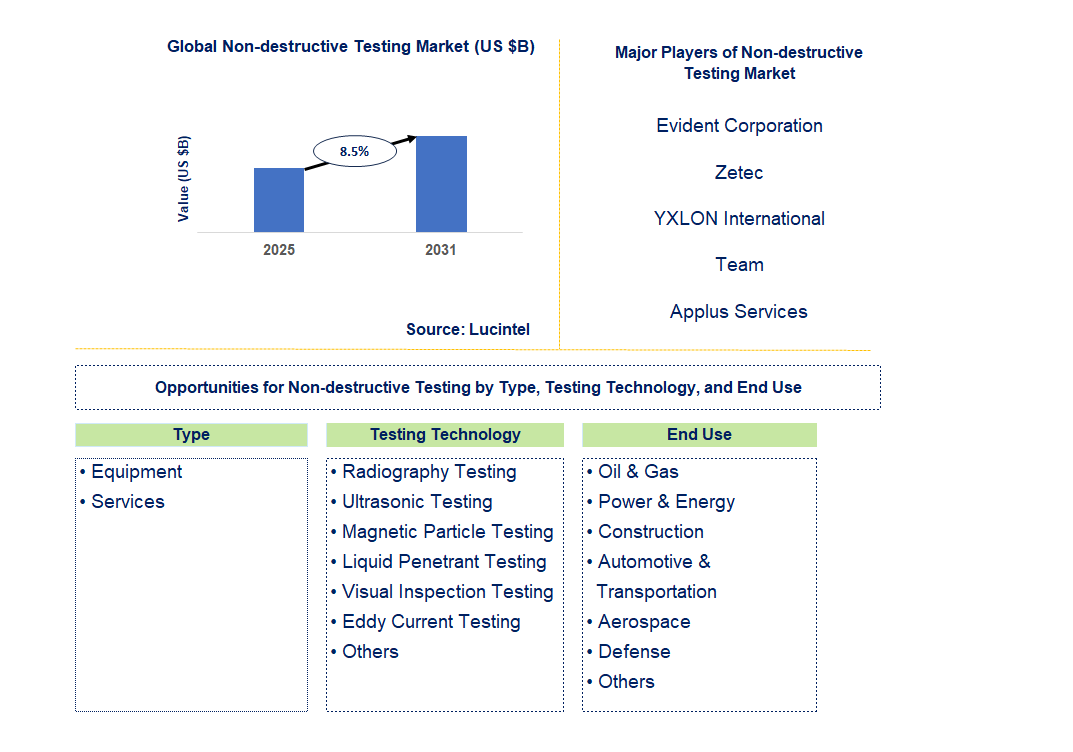
Key data points: The growth forecast = 8.5% annually for the next 7 years. Scroll below to get more insights. This market report covers trends, opportunities and forecasts in non-destructive testing market to 2031 by type (equipment and services), testing technology (radiography testing, ultrasonic testing, magnetic particle testing, liquid penetrant testing, visual inspection testing, eddy current testing, and others), end use (oil & gas, power & energy, construction, automotive & transportation, aerospace, defense, and others), and region (North America, Europe, Asia Pacific, and the Rest of the World)
We'll send your sample report shortly.
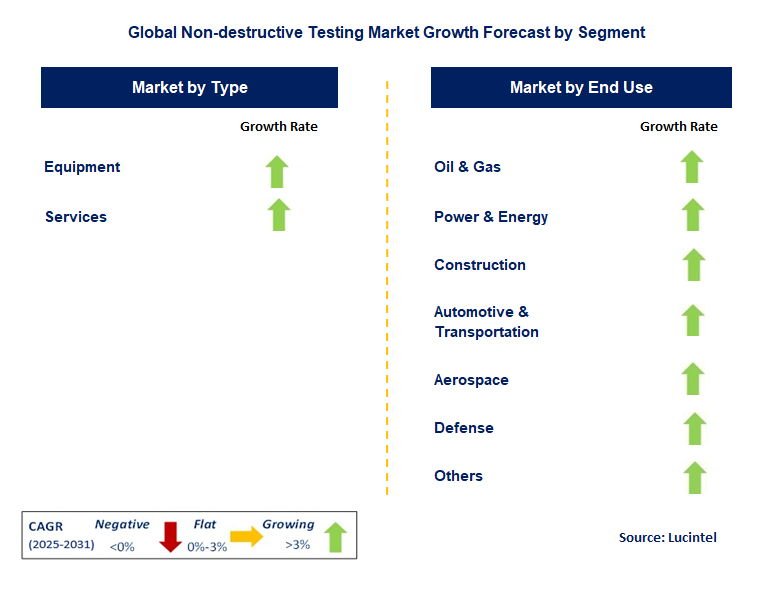
• Lucintel forecasts that, within the type category, service is expected to witness higher growth over the forecast period.
• Within the end use category, oil & gas is expected to witness the highest growth.
• In terms of region, North America is expected to witness the highest growth over the forecast period. Gain valuable insights for your business decisions with our comprehensive 150+ page report. Sample figures with some insights are shown below.
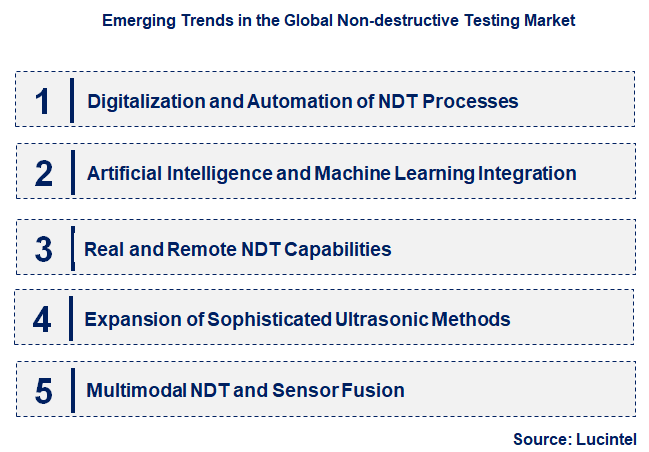
• Digitalization and Automation of NDT Processes: This movement encompasses the translation of conventional analog NDT information into digital representations and the automation of inspection processes through robotic systems, drones, and automated scanners. The effect is a considerable boost in inspection velocity, repeatability, and accuracy of data. Digitalization makes it convenient to store, retrieve, and analyze the data, while automation minimizes human error, improves safety in dangerous environments, and supports continuous monitoring. This translates into streamlined workflow and improved decision-making for asset management.
• Artificial Intelligence and Machine Learning Integration: AI and ML algorithms are being more and more integrated into NDT systems for augmenting defect detection, data interpretation, and predictive analytics. The result is a paradigm shift in the speed and accuracy of flaw detection. AI-based systems are able to process large datasets from NDT tests, learn from historical outcomes, and detect very subtle abnormalities that human inspectors may overlook. This results in fewer false negatives and positives, supporting more accurate evaluation and anticipatory maintenance plans.
• Real and Remote NDT Capabilities: This movement emphasizes inspection at a distance and the acquisition of instantaneous results, frequently through the use of drones, remotely operated vehicles (ROVs), and wireless sensor networks. The effect is enhanced safety for inspectors in difficult-to-reach or hazardous locations, coupled with a dramatic decrease in downtime. Real-time transmission of data provides instant analysis and decision-making, which facilitates rapid response to possible defects and enhances operating continuity. This is especially helpful for vital infrastructure and distant assets.
• Expansion of Sophisticated Ultrasonic Methods: Sophisticated ultrasonic techniques like Phased Array Ultrasonic Testing (PAUT), Time-of-Flight Diffraction (TOFD), and Guided Wave Ultrasonics (GWU) are becoming increasingly popular. The effect is increased ability to identify and define imperfections in complex geometries and heavier materials more accurately. These methods have better imaging and sizing characteristics than standard ultrasonics, with more detailed information on material integrity. They are essential for applications such as aerospace and energy, where complex components and high reliability are a priority.
• Multimodal NDT and Sensor Fusion: This trend is about putting two or more NDT methods together to obtain fuller and complementary information regarding a material or component, frequently with sensor fusion to merge different datasets. The result is a more complete and reliable evaluation of asset health. By capitalizing on the capabilities of various NDT techniques, like combining visual examination with infrared or ultrasonic information, technicians can obtain a better picture of defects and material behavior, resulting in better diagnoses and more informed choices. These new trends are essentially transforming the market for non-destructive testing by forcing it toward a future that is smarter, robotic, and all-encompassing. They are improving safety, increasing efficiency, and making material integrity more insightful. The transition allows industries to transition from reactive maintenance to predictive asset management, maximizing operational lifecycles and guaranteeing improved standards of quality and reliability. The NDT market is transforming into a critical Industry 4.0 and digital transformation enabler for many industries.
• Robotics and Drone Integration: One of the major developments is the large-scale integration of advanced robotics and drones for NDT inspection, particularly in dangerous or hard-to-reach locations. This affects the industry by greatly enhancing safety for human inspectors, lowering inspection time, and improving data gathering in hostile environments. Drone vehicles with NDT sensors are able to quickly and effectively inspect large structures such as bridges, pipelines, and wind turbines with high-resolution data that was otherwise difficult or even hazardous to acquire.
• Real-time Data Analysis and AI-based Interpretation: Building real-time data processing and interpretation capabilities, fueled by Artificial Intelligence (AI) and Machine Learning (ML), is revolutionizing NDT. This influences the market by allowing for real-time defect detection and characterization, minimizing the necessity for long post-inspection analysis. AI can process intricate NDT data patterns, detect anomalies, and even make predictions about likely failures, contributing to quicker decision-making, enhanced accuracy, and more efficient predictive maintenance techniques.
• More Portable and Handheld NDT Equipment with Advanced Capabilities: There has been an enormous innovation in developing smaller, more portable, and user-friendly NDT equipment with higher capabilities. This affects the market by making NDT more convenient and adaptable, and inspections can be more readily carried out in the field or in tight spaces. These tools frequently include sophisticated sensors, easy-to-use interfaces, and wireless connections, which equip technicians with advanced diagnostic tools for in-situ inspection and quick deployment.
• Additive Manufacturing Quality Control: As additive manufacturing permeates numerous sectors, an important advancement is the growing use of NDT for quality control of 3D-printed parts. This affects the market by resolving specific issues in testing complicated geometries and internal structures inherent to additive manufacturing. NDT methods such as X-ray computed tomography and sophisticated ultrasonics play a crucial role in finding internal defects, porosity, and inconsistencies, securing the structural integrity and performance of these new materials.
• Greater Emphasis on Digital Twin Integration: The creation of merging NDT information with digital twin technology is a major step forward. This has the effect of creating a living, virtual duplicate of an asset that is constantly refreshed with inspection information. This makes predictive maintenance, optimal operating strategies, and full lifecycle management possible. Digital twins support simulation and what-if analysis, allowing companies to predict asset degradation and plan for maintenance in advance, resulting in increased asset lifespan and fewer breakdowns. These innovations are deeply influencing the non-destructive testing industry by driving it toward a future of more integrated, intelligent, and efficient inspections. The focus is on automation, real-time insight, and holistic data management, going beyond basic defect detection to predictive asset management. This shift improves safety, lowers operational expense, and aligns with the wider industrial trend toward Industry 4.0, making NDT an essential capability for ensuring the integrity and reliability of critical assets and products.
• Aerospace and Defense Applications: The aerospace and defense industries offer good growth potential because of stringent safety regulations, the adoption of advanced composite materials, and constant requirements for inspection of aging aircraft and defense equipment. Applications of NDT in this case involve testing aircraft structures for fatigue cracks, delamination of composites, and the integrity of engine components. The driving force is the need for extremely precise, automated, and digital NDT solutions that are capable of scanning complex geometries as well as critical components to provide assurance of flight safety and operational readiness.
• Oil and Gas Infrastructure Inspection: The extensive and mature infrastructure in the oil and gas industry, such as pipelines, refineries, and offshore platforms, presents significant opportunities for NDT growth. Uses include corrosion detection, weld inspection, and structural integrity examination to avoid leaks, ruptures, and environmental disasters. The emphasis is on distant inspection technologies like drone-based thermography and robotic crawlers for pipeline inspection, allowing more efficient and safer monitoring of key assets and guaranteeing compliance with regulations.
• Automotive Manufacturing and Electric Vehicles (EVs): The automotive sector, especially with the fast pace of electric vehicle growth, offers a burgeoning NDT market. Applications include checking weld quality in car bodies to testing battery cell integrity and finding defects in light materials. The transition to EVs presents new NDT requirements for battery production and assembly, such as methods such as ultrasonic inspection and X-ray examination for quality control of battery packs. This maintains vehicle safety, performance, and prolongs battery longevity.
• Power Generation and Renewable Energy: The power generation industry, including nuclear, fossil fuel, and renewable energy (solar panels, wind turbines), presents a major NDT growth. Uses include testing turbine blades for cracking, examining boiler tube integrity, and tracking nuclear component structural health. Renewable energy facility growth requires NDT for in-service inspection and manufacturing quality control of wind turbine components and solar panel arrays to ensure sustainable energy generation long-term efficiency and safety.
• Public Construction and Infrastructure: Aging public infrastructure, such as bridges, roads, railways, and buildings, requires widespread NDT for structural health monitoring and maintenance. Applications include testing concrete integrity, rebar corrosion detection, and identifying concealed defects in key load-bearing structures. Growth is driven here by government programs for infrastructure renewal and the requirement for maintaining public safety. Sophisticated NDT techniques, including ground penetrating radar and acoustic emission testing, play a vital role in non-destructive examination of mega-scale civil structures. These growth prospects are significantly influencing the non-destructive testing market by making it more diversified in terms of application base and encouraging NDT technologies to innovate. The market is getting more niche-oriented, with NDT service providers creating customized solutions for particular industry requirements. This emphasis on major applications is stimulating the creation of more efficient, precise, and automated inspection techniques, which eventually lead to better safety, improved asset reliability, and optimal operational expenses in key global industries.
• Evident Corporation
• Zetec
• YXLON International
• Team
• Applus Services
• Mistras Group
• SGS
• Fujifilm Corporation
• Bureau Veritas
• Nikon Metrology
• Equipment
• Services
• Radiography Testing
• Ultrasonic Testing
• Magnetic Particle Testing
• Liquid Penetrant Testing
• Visual Inspection Testing
• Eddy Current Testing
• Others
• North America
• Europe
• Asia Pacific
• The Rest of the World
• United States: The US NDT market is dominated by aggressive adoption of advanced digital NDT methods, most notably in aerospace, oil and gas, and power generation. There is a strong focus on automation, robotics, and Artificial Intelligence (AI) for high accuracy and efficiency in inspection. The market enjoys heavy investments in research and development, as well as strict safety standards. The trend is towards combining data analytics and remote inspection ability to drive asset integrity management and minimize human intervention in critical environments.
• China: The NDT market of China is growing fast on the back of huge infrastructure developments, fast-growing manufacturing, and aggressive efforts towards industrial upgrading. Though conventional NDT techniques continue to dominate, there is a rapid transition towards enhanced methods such as phased array ultrasonic testing (PAUT) and digital radiography. Locally based manufacturers are becoming increasingly competitive, with emphasis on cost-saving, high-volume options. Government support for quality control and industrial automation also speeds up market growth, particularly in the automotive and construction industries.
• Germany: The NDT market in Germany is spurred by its high-technology manufacturing and automobile sectors, with a focus on high quality and precision engineering. There is demand for advanced NDT solutions such as computed tomography (CT) and sophisticated ultrasonic testing for maintaining product integrity and conformity. The market is focused on integration with Industry 4.0 ideas, where there is a focus on automation, data connectivity, and predictive maintenance. Research centers and industrial stakeholders work closely to drive innovative NDT technology.
• India: The Indian NDT market is experiencing significant growth with the fast pace of industrialization, stepped-up infrastructure development, and enhanced awareness towards safety and quality. Though cost is an important consideration, there is a growing acceptance of sophisticated NDT methods, especially by the oil and gas, power generation, and construction industries. Demand for NDT services from Small and Medium-sized Enterprises (SMEs) is also increasing in the market. Government policy and an emphasis on "Make in India" programs are also driving local NDT capacities and market growth.
• Japan: The Japanese NDT market is technologically advanced and mature, with a focus on high-precision and automated inspection solutions. The major drivers of demand are in the automotive, aerospace, and nuclear power sectors, where strict quality control is essential. Latest trends identify the use of AI and machine learning for defect detection and analysis, accelerating inspection speed and accuracy. Japanese firms are putting money into establishing highly advanced, user-friendly NDT equipment and systems that reduce the risk of human error and maximize productivity.


• Evident Corporation
• Zetec
• YXLON International
• Team
• Applus Services
• Mistras Group
• SGS
• Fujifilm Corporation
• Bureau Veritas
• Nikon Metrology Q5. Which non-destructive testing market segment will be the largest in future? Answer: Lucintel forecasts that, within the type category, service is expected to witness higher growth over the forecast period. Q6. In non-destructive testing market, which region is expected to be the largest in next 5 years? Answer: In terms of region, North America is expected to witness the highest growth over the forecast period. Q7. Do we receive customization in this report? Answer: Yes, Lucintel provides 10% customization without any additional cost.


Choose a license that fits your team. Instant PDF delivery.
Prices exclude taxes. Instant delivery. Custom licensing available on request.
Market Report · July 15, 2026
Market Report · June 26, 2026
Market Report · June 24, 2026
Trusted partner for strategic intelligence and business growth


Receive a complimentary market analysis tailored to your industry. Our analysts will identify key growth opportunities and competitive dynamics specific to your business.

Market size, growth rate, and key trend analysis for your specific sector.

Top competitor positioning and market share analysis.

Strategic recommendations backed by data-driven insights.
Get curated market intelligence and competitive moves straight to your inbox.
By subscribing, you agree to receive our monthly insights. Unsubscribe anytime.
Receive a complimentary market analysis tailored to your industry. Our analysts will identify key growth opportunities and competitive dynamics specific to your business.
Market size, growth rate, and key trend analysis for your specific sector.
Top competitor positioning and market share analysis.
Strategic recommendations backed by data-driven insights.
Get curated market intelligence, emerging trends, and competitive moves straight to your inbox each month.
By subscribing, you agree to receive our monthly insights. Unsubscribe anytime.
We'll send your sample report shortly.