
Market Report · July 16, 2026

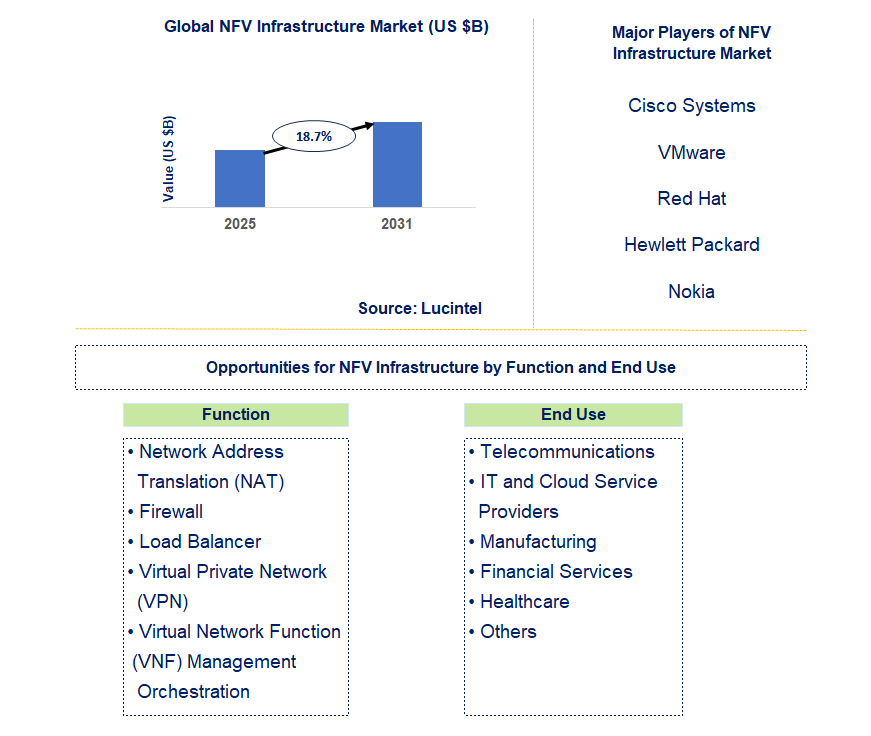
Key data points: The growth forecast = 18.7% annually for the next 7 years. Scroll below to get more insights. This market report covers Trends, opportunity and forecast in NFV infrastructure market to 2031 by function (network address translation (NAT), firewall, load balancer, virtual private network (VPN), and virtual network function (VNF) management & orchestration), end use (telecommunications, IT and cloud service providers, manufacturing, financial services, healthcare, and others), and region (North America, Europe, Asia Pacific, and the Rest of the World)
We'll send your sample report shortly.
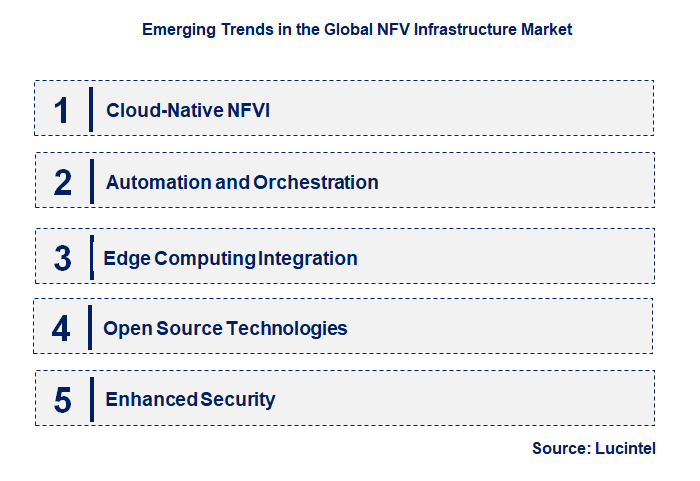
• Cloud-Native NFVI: The adoption of cloud-native principles and technologies is accelerating in the NFVI market. Cloud-native NFVI platforms leverage containerization, microservices, and DevOps practices to enable greater agility, scalability, and portability. This trend is allowing telecom operators to deploy and manage network functions more efficiently, similar to how cloud providers operate their infrastructure.
• Automation and Orchestration: Automation and orchestration are becoming increasingly critical for managing complex NFVI deployments. Automated tools and platforms are used to provision, configure, and manage virtual network functions (VNFs) across the NFVI. This reduces manual effort, improves operational efficiency, and enables faster service deployment.
• Edge Computing Integration: Edge computing is driving the evolution of NFVI by extending it to the network edge. Edge NFVI deployments enable the processing of data closer to the source, reducing latency and improving the performance of applications like IoT and AR/VR. This trend is crucial for supporting the growing demand for low-latency services.
• Open Source Technologies: Open-source technologies are playing a significant role in the NFVI market. Open-source platforms like OpenStack and Kubernetes are being widely adopted, fostering innovation and reducing vendor lock-in. This trend is driving the development of standardized and interoperable NFVI solutions.
• Enhanced Security: Security is a paramount concern in NFVI deployments. NFVI platforms are being enhanced with security features like network segmentation, intrusion detection, and access control to protect against cyber threats. This focus on security is crucial for ensuring the integrity and reliability of virtualized network functions. These emerging trends are reshaping the NFVI market by driving the development of more agile, scalable, and secure infrastructure solutions. Cloud-native architectures, automation and orchestration, edge computing integration, open-source technologies, and enhanced security are transforming how telecom networks are designed, deployed, and managed. These advancements are creating new opportunities for innovation and growth, enabling the deployment of next-generation network services and supporting the digital transformation of industries. The market is becoming more open, software-driven, and focused on efficiency and security.
• Cloud-Native NFVI Platforms: The adoption of cloud-native principles and technologies is accelerating in the NFVI market. Cloud-native NFVI platforms leverage containerization, microservices, and DevOps practices to enable greater agility, scalability, and portability. This allows telecom operators to deploy and manage network functions more efficiently, similar to how cloud providers operate, improving resource utilization and accelerating service delivery.
• Increased Automation and Orchestration: Automation and orchestration are becoming essential for managing complex NFVI deployments. Automated tools and platforms are used to provision, configure, and manage virtual network functions (VNFs) across the NFVI. This reduces manual effort, improves operational efficiency, and enables faster service deployment, reducing time-to-market for new services and minimizing operational expenses.
• Edge Computing Integration with NFVI: Edge computing is driving the evolution of NFVI by extending it to the network edge. Edge NFVI deployments enable data processing closer to the source, reducing latency and improving the performance of applications like IoT and AR/VR. This enables new use cases and improves the user experience for latency-sensitive applications.
• Growing Adoption of Open Source: Open-source technologies are playing a significant role in the NFVI market. Open-source platforms like OpenStack and Kubernetes are being widely adopted, fostering innovation and reducing vendor lock-in. This promotes interoperability and reduces costs associated with proprietary solutions.
• Enhanced Security within NFVI: Security is a paramount concern in NFVI deployments. NFVI platforms are being enhanced with security features like network segmentation, intrusion detection, and access control to protect against cyber threats. This focus on security is crucial for ensuring the integrity and reliability of virtualized network functions and protecting sensitive data. These recent developments are significantly impacting the NFVI market by driving the development of more agile, scalable, and secure infrastructure solutions. Cloud-native architectures, increased automation, edge computing integration, open-source adoption, and enhanced security are transforming how telecom networks are designed, deployed, and managed. These advancements are creating new opportunities for innovation and growth, enabling the deployment of next-generation network services and supporting the digital transformation of industries. The market is becoming more dynamic, open, and focused on efficiency and security.
• 5G Network Deployments: The rollout of 5G networks presents a major growth opportunity for the NFVI market. 5G requires a flexible and scalable infrastructure, and NFVI is well-suited to meet these demands. NFVI enables the dynamic deployment and management of 5G network functions, supporting the rapid rollout of 5G services. This includes network slicing capabilities, which allow operators to create virtualized networks tailored to specific use cases.
• Edge Computing Infrastructure: The growth of edge computing is creating new opportunities for NFVI. Edge computing deployments require a distributed and agile infrastructure, and NFVI can be extended to the network edge to support these deployments. This enables the processing of data closer to the source, reducing latency and improving the performance of applications like IoT and AR/VR.
• Network Slicing for Enterprise Services: Network slicing, enabled by NFVI, allows telecom operators to create virtualized networks tailored to the specific needs of enterprise customers. This opens up new revenue streams for operators by offering customized connectivity solutions for various industries, such as manufacturing, healthcare, and transportation. Enterprises can benefit from dedicated network resources and improved security.
• IoT Platform Enablement: The proliferation of IoT devices is driving the demand for scalable and flexible IoT platforms. NFVI can be used to deploy and manage these platforms, enabling the connectivity, management, and processing of data from millions of connected devices. This creates opportunities for operators to offer managed IoT services to businesses and consumers.
• Cloud-Native Network Functions: The transition to cloud-native network functions (CNFs) is creating new opportunities for NFVI. CNFs are designed to run on cloud infrastructure and leverage cloud-native principles like containerization and microservices. This enables greater agility, scalability, and portability for network functions, improving operational efficiency and reducing costs. These growth opportunities are significantly impacting the NFVI market by driving innovation, increasing competition, and expanding the range of services telecom operators offer. The focus on 5G, edge computing, network slicing, IoT, and cloud-native technologies transforms how telecom networks are designed, deployed, and managed. These trends are creating a more dynamic and user-centric market focusing on delivering agile, scalable, and cost-effective network solutions.
• Cisco Systems
• VMware
• Red Hat
• Hewlett Packard Enterprise (HPE)
• Nokia
• Ericsson
• Juniper Networks
• Dell Technologies
• NEC
• Huawei
• Network Address Translation (NAT)
• Firewall
• Load Balancer
• Virtual Private Network (VPN)
• Virtual Network Function (VNF) Management & Orchestration
• Telecommunications
• IT and Cloud Service Providers
• Manufacturing
• Financial Services
• Healthcare
• Others
• North America
• Europe
• Asia Pacific
• The Rest of the World
• United States: The US is a leading market for NFVI, with major telecom operators and cloud providers investing heavily in NFV deployments. US companies are at the forefront of developing cloud-native NFVI platforms and open-source technologies. There is a strong emphasis on automation and orchestration in US NFV deployments. The US market is characterized by a high level of innovation and a strong demand for agile and scalable NFVI solutions.
• China: China is rapidly expanding its NFVI market, driven by the country's large telecom market and the government's push for network modernization. Chinese telecom companies are deploying NFV to improve network efficiency and reduce costs. The Chinese government is also supporting the development of domestic NFVI technologies. The market is becoming increasingly competitive, with both domestic and international players vying for market share.
• Germany: Germany is a technologically advanced market with a strong focus on industrial automation and Industry 4.0. German telecom operators are investing in NFVI to support these applications. There is a growing emphasis on network security and data privacy in German NFV deployments. The German government is also supporting the development of broadband infrastructure and promoting the adoption of NFV.
• India: India is a rapidly growing market for NFVI, driven by increasing mobile penetration and the government's Digital India initiative. Indian telecom operators are deploying NFV to improve network capacity and reduce costs. There is a growing demand for affordable NFVI solutions in India. The Indian government is also promoting the development of domestic telecom equipment manufacturing.
• Japan: Japan has a mature telecom market with a high penetration rate of mobile and broadband services. Japanese telecom operators are investing in NFVI to support the rollout of 5G networks and develop new 5G applications. There is a strong emphasis on network reliability and quality of service in Japan. The Japanese government is also supporting the development of next-generation networks.


• Cisco Systems
• VMware
• Red Hat
• Hewlett Packard Enterprise (HPE)
• Nokia
• Ericsson
• Juniper Networks
• Dell Technologies
• NEC
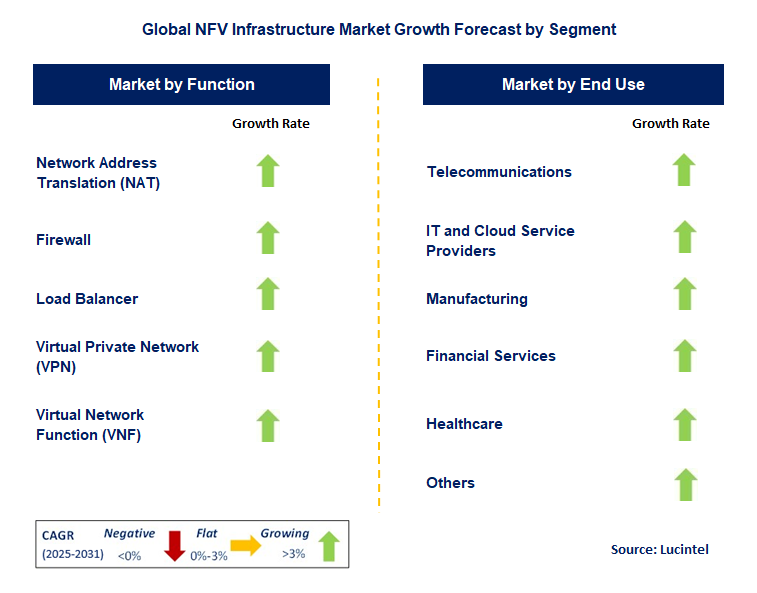
• Huawei Q5. Which NFV infrastructure market segment will be the largest in future? Answer: Lucintel forecasts that network address translation is expected to witness the highest growth over the forecast period. Q6. In NFV infrastructure market, which region is expected to be the largest in next 5 years? Answer: APAC is expected to witness the highest growth over the forecast period. Q7. Do we receive customization in this report? Answer: Yes, Lucintel provides 10% customization without any additional cost.


Choose a license that fits your team. Instant PDF delivery.
Prices exclude taxes. Instant delivery. Custom licensing available on request.
Market Report · July 16, 2026
Market Report · May 18, 2026
Market Report · May 18, 2026
Trusted partner for strategic intelligence and business growth


Receive a complimentary market analysis tailored to your industry. Our analysts will identify key growth opportunities and competitive dynamics specific to your business.

Market size, growth rate, and key trend analysis for your specific sector.

Top competitor positioning and market share analysis.

Strategic recommendations backed by data-driven insights.
Get curated market intelligence and competitive moves straight to your inbox.
By subscribing, you agree to receive our monthly insights. Unsubscribe anytime.
Receive a complimentary market analysis tailored to your industry. Our analysts will identify key growth opportunities and competitive dynamics specific to your business.
Market size, growth rate, and key trend analysis for your specific sector.
Top competitor positioning and market share analysis.
Strategic recommendations backed by data-driven insights.
Get curated market intelligence, emerging trends, and competitive moves straight to your inbox each month.
By subscribing, you agree to receive our monthly insights. Unsubscribe anytime.
We'll send your sample report shortly.